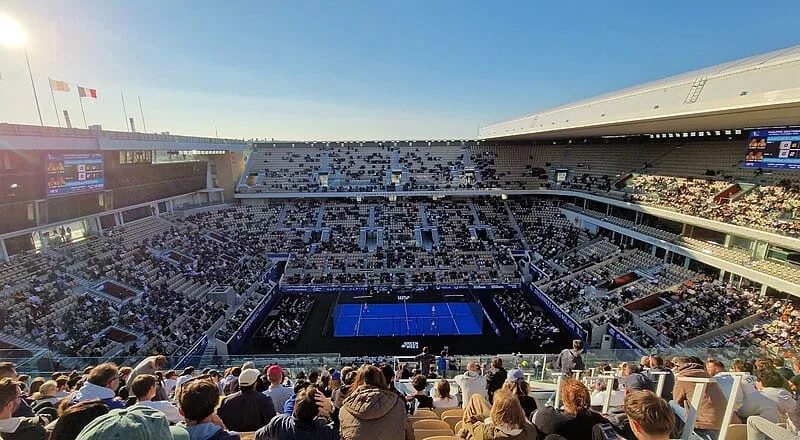
The most fitting farewell for Gael Monfils was never going to be a polite wave from the baseline. Paris has watched him fly, skid, grin, improvise, collapse into impossible splits and turn points into tiny pieces of theatre. A quiet goodbye would almost feel rude. So Roland Garros has chosen the obvious shape for his last French Open: lights, music, friends, Court Philippe-Chatrier, and a crowd invited to remember not just what he won, but what he made the place feel like.
On Thursday, May 21, 2026, the tournament is scheduled to stage Gael & Friends, a dedicated evening around Monfils before his final Roland Garros appearance. Roland Garros says the night will bring together current players, former companions, Richard Gasquet, Jo-Wilfried Tsonga, DJ Martin Solveig, rapper-dancer Franglish, singer Matt Pokora and comedian Paul de Saint-Sernin. That is not the architecture of a standard testimonial. It is closer to a Paris culture night with tennis as the emotional center.
That is why this story belongs in lifestyle, not just the tournament file. We already have a practical Roland Garros guide for the event itself. This is about what happens when a Slam recognizes that a player can matter as atmosphere, memory and public feeling. Monfils is retiring from the sport's main stage as one of tennis' great mood-makers, someone whose meaning was never contained by rankings, prize money or the clean arithmetic of trophies.
Why the Monfils farewell matters right now
The timing gives the event its charge. Roland Garros Opening Week began on Monday, May 18, with qualifying, expanded fan access and the main draw still waiting for Sunday, May 24. In that soft space before the tournament becomes all scores and survival, Monfils gets an evening on Chatrier at 7:30 p.m., framed by music and memory rather than by a bracket.
Roland Garros' own preview presents 2026 as an emotional final Paris chapter for Monfils, who is expected to retire later this year. The same official Opening Week program folds his celebration into a bigger fan-facing idea: practice sessions on Philippe-Chatrier, trophies on display, live music, player interviews, an RG Explorer map and hospitality around the Serres d'Auteuil gardens. Tennis is not only selling matches anymore. It is selling the full day: the walk through the grounds, the photo, the song from a court you will point to later.
That broader shift has been visible across the sport. Our recent piece on how SeatGeek is changing tennis fan access looked at the same movement from the ticketing side: tournaments trying to make the event feel smoother, richer and more legible to casual fans. Monfils' farewell is the more emotional version of that change. It asks what a tennis crowd is really buying when it buys one last night with a player it loves.
The showman label was always too small
Monfils has been called a showman for most of his career. The word is not wrong, but it can become a little lazy. It makes his tennis sound decorative, as if the leaps and slides were crowd service rather than a serious athletic language. His best points were not circus tricks. They were acts of timing, nerve and imagination performed by a body able to make strange decisions quickly.
There were limits. Monfils did not build the Grand Slam resume of the men who dominated his era. He played in the shadow of Federer, Nadal, Djokovic and Murray, then in the rising glare of the next generation. He did not become the champion France kept hoping for in Paris. Yet that is not the same as saying the career was incomplete. Tennis needs title collectors. It also needs players who change the temperature inside a stadium.
Monfils did that almost on command. A routine defensive point could turn into slapstick, then danger, then wonder in the space of six seconds. He made falling down look choreographed. He made retrieval feel like rebellion. He brought basketball rhythm, street-court looseness and a comic sense of suspense to a sport that often rewards control above all else.
That is why the farewell is culturally sharper than another draw preview. The sport can explain seeding and form forever, but readers remember the sound of a crowd rising before the point is actually over. Monfils gave people that sound.
Paris is staging a different kind of sports goodbye
Most tennis farewells follow a familiar script: last match, video montage, flowers, trembling microphone, maybe a few former players standing courtside. There is nothing wrong with that. Tennis is a sentimental sport, even when it pretends otherwise. But a standard ceremony would have flattened Monfils into respectability. Roland Garros is doing something more fitted to the person.
Gasquet and Tsonga give the night a generational French spine. Martin Solveig and Franglish make it explicitly musical. Matt Pokora and Paul de Saint-Sernin suggest rhythm, comedy and a little looseness. The shape matters because Monfils' career was never only about winning tennis points. It was about the human electricity around them.
That puts this farewell next to a wider tennis-culture trend. The sport is learning how to borrow from fashion, music, documentary, hospitality and celebrity without always losing itself. We saw the commercial side in why tennis is chasing fashion money in 2026. We saw the image economy in the Sinner-Gucci conversation. Monfils' night is less glossy and more affectionate, but it belongs to the same era: tennis understanding that the off-court frame can deepen the on-court memory.
What Roland Garros is really honoring
It is easy to say Roland Garros is honoring a French player. That is true, but incomplete. The tournament is also honoring a style of public athlete that has become harder to produce: expressive without seeming manufactured, funny without turning into a brand mascot, physically spectacular without feeling cold. Monfils was not relatable in the ordinary sense. Almost nobody can move like that. But he made elite tennis feel less sealed off.
There was always a little generosity in his performance. Even when the point was serious, he let the crowd in. He reacted. He laughed. He showed frustration in ways that looked human rather than managed. Sometimes that openness cost him. Sometimes it made him appear too loose beside the sport's colder greats. But it is also why the farewell has emotional weight. Fans do not feel they are losing a resume. They feel they are losing a particular room tone.
That is a different kind of legacy from the one tennis usually calculates. The sport loves numbers because numbers are clean. Titles, rankings, head-to-heads, weeks at No. 1. But a crowd's memory is messier. It remembers the night air, the weird point, the player who made strangers laugh in the same instant. Monfils' legacy lives there, in the gap between measurable greatness and felt importance.
What is confirmed, and what is not
Confirmed by Roland Garros: Opening Week began with qualifying on May 18; the main singles draws are scheduled for Thursday, May 21; and main-draw singles play begins Sunday, May 24. Confirmed by the tournament's event announcement: Gael & Friends is scheduled for May 21 at 7:30 p.m. on Court Philippe-Chatrier, with Gasquet, Tsonga, Martin Solveig, Franglish, Matt Pokora and Paul de Saint-Sernin listed among the participants.
Also confirmed by Roland Garros' tournament presentation: Monfils will bid farewell to Parisian clay in 2026 and will be celebrated after his final appearance. What is not confirmed yet is the emotional shape of that last match. Sport refuses to be scripted. The event can be planned. The goodbye still has to arrive through the score, the body and the crowd.
That distinction matters. A farewell show can create the frame, but it cannot manufacture the feeling. Monfils has to bring that himself, as he always has: with risk, timing, humor and the faint sense that the next ball might make the whole stadium sit up straighter.
Why this belongs beyond match coverage
A straight match preview would ask whether Monfils can win. A culture story asks why people care even if he does not. That is the more durable question. At 39, on home clay, in a tournament that has often demanded more from French players than it has given back, Monfils is carrying a kind of collective gratitude. The audience is not only hoping for a result. It is hoping for one more recognizable flash of him.
This is also why the story has mainstream reach. Casual readers may not know his career win-loss record. They can still understand the emotional grammar: a beloved performer, one last home stage, old friends, music, lights, a city saying goodbye in its own language. Tennis sometimes forgets that these are the stories that travel furthest beyond the sport.
The best comparison is not a trophy ceremony but a curtain call. Monfils spent two decades making tennis feel less rigid, more elastic, more alive to the crowd. Roland Garros is giving him a farewell that admits the obvious: some players do not merely pass through a tournament. They change its sound.
The bottom line
Gael Monfils' Roland Garros 2026 farewell works because it understands the player. It does not ask him to shrink into solemnity. It gives him friends, music, floodlights and Paris, then lets the night carry the meaning.
There will be better resumes in tennis history. There may not be many better exits. For a player who spent a career turning lost causes into theatre, the right goodbye is not silence. It is Chatrier after dark, waiting for one last burst of movement.
Sources
Roland Garros: Gael & Friends event announcement
Roland Garros: Opening Week details
Roland Garros: 2026 tournament presentation
Tennis.com: Roland Garros gives Monfils free rein for farewell event
El Pais: Monfils interview on expression and farewell
Last updated: August 2026
🎾 Gear from this story
WilsonWilson Clash 100Tommy Paul's racket of choiceView on Amazon →As an Amazon Associate, SUPER.TENNIS earns from qualifying purchases.