Roland Garros 2026 begins on May 18 at Stade Roland Garros in Paris, and for the first time in seven years the men's draw opens without Carlos Alcaraz. The 23-year-old Spaniard — the defending champion and arguably the most magnetic player on red clay since Rafael Nadal — withdrew on April 24 with a wrist injury that refused to heal in time for the European clay swing. His absence reshapes everything.
In his place stands Jannik Sinner, riding a streak no other player in tennis history has matched: five Masters 1000 titles in a row (Paris 2025, then Indian Wells, Miami, Monte Carlo and Madrid in 2026). The Italian world No. 1 has spent the season turning every clay tournament into a coronation — and yet Roland Garros remains the only Grand Slam he has never won.
It is the contradiction that defines the next three weeks. A heavy favourite who has technically never lifted the Coupe des Mousquetaires. A defending champion sitting at home. A fading king in Novak Djokovic still capable of authoring one last Slam. And a women's field where Iga Swiatek chases a fifth title against a generation that finally believes she can be beaten.
Sinner Roland Garros 2026 — the favourite without the trophy
Bookmakers have made Sinner a -260 favourite to win Roland Garros 2026. That price tells the story of his 2026 season more than any ranking. He has dropped only one set in three Masters 1000 finals on clay. He defeated Alexander Zverev in straight sets in Madrid. He survived a four-hour quarterfinal against rising 20-year-old Rafa Jodar without losing the deciding tiebreak. He arrives in Paris having played the most matches of any top-five player this clay season — and lost none of them.
The asterisk is everything Roland Garros has historically demanded: five-set endurance, the willingness to slide, the patience to construct a 25-shot rally instead of ending it with a forehand winner. Sinner has shown all three in 2026, but never on the slowest, most punishing courts in the sport. Last year's final — when he held three championship points against Alcaraz before losing in five sets — is the memory the entire Italian press will replay in his run-up.
His side of the draw will be friendlier than 2025. Without Alcaraz, his most plausible final opponent has shifted from Spain to Serbia and Germany.
The Alcaraz absence — what changes when the defending champion is out
Alcaraz's withdrawal is the single biggest news of the clay season. He skipped Madrid, then Rome, and his team confirmed the wrist needs at least six weeks of rest. The defending champion will not be in Paris. That hasn't happened at Roland Garros since 2018 (when Nadal won his 11th).
What does it mean tactically?
- Sinner's road opens up. The 2025 final and four prior meetings in 2024-25 sit overwhelmingly with Alcaraz on clay. Removing him from the bracket removes Sinner's only proven kryptonite on the surface.
- The 22-year-old generation gets daylight. Players like Joao Fonseca, Rafa Jodar, Arthur Fils, and Jakub Mensik no longer face the looming Alcaraz semifinal. A teenage Grand Slam quarterfinal becomes mathematically possible.
- Djokovic's last realistic Slam window stays open. With one of the two players who routinely deny him sidelined, the 38-year-old gets a structurally easier path than he had any right to expect.
The cost, of course, is the spectacle. Roland Garros without Alcaraz on Philippe-Chatrier is like Wimbledon without Federer in 2017 — a tournament that loses its main centre-court draw and asks the rest of the field to fill the void.
Djokovic at Roland Garros — the smartest tactician left in the draw
Novak Djokovic has won three Roland Garros titles and reached the final four more times. He has not been a clay-court bully since the 2023 final, but he has shown the kind of resilience that wins Slams over two weeks rather than seven matches.
This year his Madrid campaign ended in the second round to Dino Prizmic, the 20-year-old Croatian qualifier — a "frustrating" loss in his own words. But Djokovic at a Grand Slam is a different player. He has best-of-five rhythm. He has 24 Slam-winning experiences against a draw containing zero players with even one. And he has the most underrated weapon on slow clay: a return of serve that takes time away from servers who rely on getting Sinner-style free points.
He won't be favoured. But ask any tour insider who can beat Sinner in five sets at Roland Garros, and Djokovic is the name they say after Alcaraz.
Dark horses on the men's side
Beyond the headline trio, the 2026 men's clay season has produced credible Roland Garros threats:
- Alexander Zverev: 2024 Roland Garros finalist, French Open semifinalist again in 2025. Heavy serve, improved patience in baseline rallies, and the recent Madrid final loss to Sinner that he openly called "an awful tennis match" — motivation he hasn't had since his 2022 ankle injury.
- Lorenzo Musetti: Italian one-handed backhand artist who reached the Monte Carlo final in 2025. Plays the surface like a chess player. Crowd-friendly in Paris.
- Casper Ruud: Two Roland Garros final appearances (2022, 2023). The most consistent clay-court grinder outside the top three.
- Arthur Fils: 21-year-old French wildcard who beat Zverev on clay this season. Home support could push him to a quarterfinal.
- Joao Fonseca: 19-year-old Brazilian phenom. Sinner himself named him a future world No. 1 candidate. First Slam main draw on clay.
Women's draw — Iga Swiatek and the chasers
Iga Swiatek owns Roland Garros like Nadal once did. Four titles, including three in a row from 2022-2024. She did not win in 2025 (a quarter-final exit to Madison Keys ended a 39-match clay winning streak), and her 2026 season has been uneven — a coaching change, a Madrid withdrawal due to illness, and a Rome semi-final loss in three sets.
But Roland Garros is her court. She has won 35 of her last 38 matches there. Even at 70-percent form, she is the player every other woman in the draw is trying to plan around.
Her three biggest threats:
- Aryna Sabalenka: World No. 1 in the WTA rankings. Won Madrid 2025 with a final-set tiebreak win over Coco Gauff. Has reached one Roland Garros final (2023). Her power game finally translates to clay after years of struggle on the surface.
- Coco Gauff: 2023 US Open champion, 2024 Roland Garros semifinalist. The improved serve she debuted in 2025 has made her a complete clay-court player.
- Mirra Andreeva: 17-year-old prodigy. Reached the Madrid 2025 final. Has the patience and shot tolerance of a player twice her age.
A Swiatek-Sabalenka final would extend a rivalry that has produced six previous WTA finals.
The clay-season scoreboard — what 2026 told us
Sinner won Indian Wells, Miami, Monte Carlo and Madrid. Kostyuk won Madrid (WTA). Sabalenka and Swiatek both fell in pre-Paris events to lower-ranked opponents. Alcaraz played eight matches all season — and won six of them — before the wrist forced his withdrawal.
The most telling pre-Slam stat: the average length of a Sinner clay match this year is one hour 38 minutes. The longest he has been on court in 2026 is the three-hour Jodar quarterfinal in Madrid. He has not played a single five-set match.
Roland Garros will end that streak. The question is whether his body — and his memory of last year's final — can deliver where it could not in 2025.
Prize money and TV schedule
The 2026 Roland Garros prize pool sits at approximately €58 million, with a singles champion's cheque around €2.4 million. The prize-money question itself became a story in early May after Djokovic, Sabalenka and 20 other top players signed a letter protesting what they called inadequate distribution to early-round losers — a public dispute that has set a tense backdrop for the fortnight.
Broadcast in the US runs on Tennis Channel and NBC. UK viewers can watch on Eurosport. The men's final is scheduled for June 7; the women's final on June 6.
Predictions
A 2026 Roland Garros without Alcaraz looks, on paper, like Sinner's tournament to lose. Bookmakers, betting markets and most tennis analysts agree. But Roland Garros has a long history of refusing the obvious answer — Wawrinka in 2015, Thiem in the 2018-19 finals, Schwartzman quarterfinals, the 2024 Alcaraz upset run.
Our prediction:
- Men's final: Sinner d. Djokovic in five sets. Sinner finally completes the career Slam.
- Women's final: Swiatek d. Sabalenka in three. Her fifth Roland Garros title, equalling Justine Henin's Open Era record for second-most in women's history.
- Surprise quarterfinalist: Arthur Fils, riding home crowd support past two seeded opponents.
If Alcaraz returns healthy for Wimbledon, the 2026 second half belongs to the rivalry that has defined the era. For now, all eyes — and the deepest clay-court field the men's tour has seen since 2019 — turn to Paris.
Quick FAQ
When does Roland Garros 2026 start? May 18, 2026. The tournament runs through June 7, 2026, with the men's final on the last Sunday.
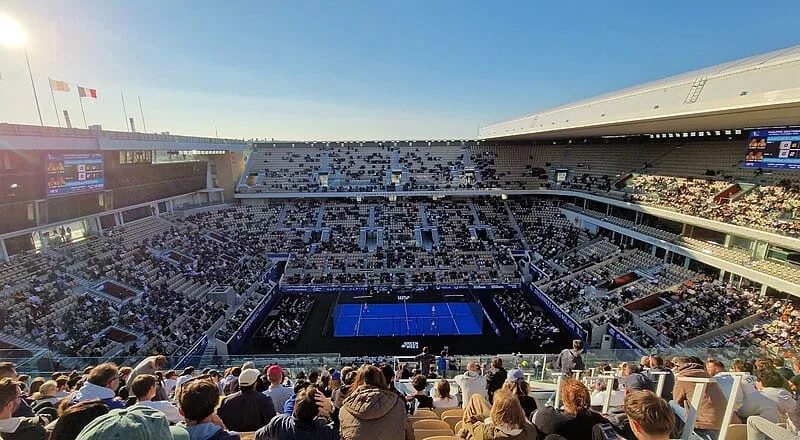
Where is Roland Garros played? Stade Roland Garros in the 16th arrondissement of Paris, France. The main show court is Court Philippe-Chatrier.
Why is Carlos Alcaraz not playing? He withdrew on April 24, 2026 with a wrist injury that requires extended rest. He is the defending Roland Garros champion.
Who is the favourite to win Roland Garros 2026? Jannik Sinner is the heavy favourite at -260, riding a five-tournament Masters 1000 winning streak. Roland Garros is the only Grand Slam he has not yet won.
What is the prize money for Roland Garros 2026? Approximately €58 million total pool, with around €2.4 million for the singles champions. Distribution became controversial in May after a player letter signed by Djokovic, Sabalenka, and 20+ top players.
How can I watch Roland Garros 2026? In the US: Tennis Channel and NBC. In the UK: Eurosport and Discovery+. Live streaming also available through Tennis Channel Plus and Eurosport apps.
Last updated: August 2026
🎾 Gear from this story
HeadHead Speed MPJannik Sinner's racket of choiceView on Amazon →As an Amazon Associate, SUPER.TENNIS earns from qualifying purchases.