In the end, the most chaotic Roland Garros in living memory handed its two trophies to opposite ends of a career. One went to a 29-year-old who had lost three Grand Slam finals and waited his entire professional life for this exact feeling. The other went to a 19-year-old who is only just beginning hers. If you wanted a single image to sum up the strangest, most wide-open fortnight tennis has produced in a generation, it is those two champions standing on Court Philippe-Chatrier: Alexander Zverev, finally, and Mirra Andreeva, already.
Let's tell you how it ended — and then let's remember, together, how on earth we got here.
Alexander Zverev, finally
For years, Alexander Zverev was the best player never to have won a major. He lost the 2020 US Open final from two sets up. He lost the 2024 Roland Garros final. He lost the 2025 Australian Open final. He won Olympic gold and built a career most players would trade almost anything for — and still, the one thing that defines greatness in this sport, a Grand Slam title, kept slipping away at the last step. There is a particular cruelty reserved for the player who keeps reaching the final and keeps coming up one match short, and for half a decade Zverev lived inside it.
Not anymore. Zverev beat Italy's Flavio Cobolli 6-1, 4-6, 6-4, 6-7(5), 6-1 to win the 2026 Roland Garros title — his first Grand Slam, at last, in his fourth major final. It went five sets, because of course it did; a man who had suffered this much was never going to be allowed an easy coronation. He took the first set in a rush, lost his grip in the middle, survived a fourth-set tie-break that could have broken him all over again, and then ran away with the fifth as the weight of all those years finally lifted. When it was over, the German sank to the clay. You did not need to be a Zverev fan to feel it. Some wins are about the trophy. This one was about everything that came before it.
He also got there through exactly the kind of open draw he had waited his whole career to be handed — beating the lucky-loser fairytale Jesper de Jong and the young Czech Jakub Mensik on the way. He did not have to beat Carlos Alcaraz, or Jannik Sinner, or Novak Djokovic to win this, and there will be people who whisper about that. Let them. Zverev played the draw in front of him, on the surface that has tormented him as much as anyone, and he did not flinch when it finally mattered. After three lost finals, nobody gets to tell him he did not earn this.
Mirra Andreeva, already
At the other end of the age scale, and the other end of the emotional spectrum, stood Mirra Andreeva — not relieved, but radiant. The 19-year-old beat the Polish qualifier Maja Chwalinska 6-3, 6-3 to win the first Grand Slam title of her career, and where Zverev's win was the release of years of pressure, Andreeva's was the bright, almost casual arrival of a talent everyone has seen coming for a while.
Coached by the former Roland Garros champion Conchita Martinez, Andreeva — who, like all Russian players, competes under neutral status — has spent two years being described as the future. On Saturday she stopped being the future and became the present, the youngest kind of champion this sport periodically produces and then spends a decade building itself around. She did not win an ugly, nervous final. She won a clean, controlled, two-set final against an opponent who had nothing left to give, and she did it with the unbothered confidence of someone who fully expects this to be the first of many. The contrast with Zverev could not be sharper: he waited his whole career for this; she looks like she is just getting started.
The two who fell short — and what they did to get there
Spare a thought, and more than a thought, for the two finalists who went home with the runner-up plates, because their fortnights were miracles in their own right.
Flavio Cobolli, the 23-year-old Italian, reached the first Grand Slam final of his life — another data point in the extraordinary depth Italian tennis now has, even on a weekend when its biggest star, Sinner, was long gone. Cobolli pushed Zverev to five sets in a major final. A year ago that would have sounded absurd. This fortnight, it was just another piece of the chaos.
And Maja Chwalinska — where do you even start. A Polish qualifier ranked 114th in the world, she came through the qualifying rounds just to make the main draw and then did not stop until she had reached a Grand Slam final. A qualifier. In the final of Roland Garros. It is one of the most improbable runs the women's game has ever produced, the natural endpoint of a tournament that spent two weeks rewarding exactly this kind of fearless, nothing-to-lose tennis. She lost the final, but she leaves Paris having authored a fairytale that belongs on the same shelf as Jesper de Jong's lucky-loser run on the men's side. This was the tournament of the underdog, and Chwalinska was its patron saint.
How on earth we got here
To understand why two first-time champions lifting the trophies feels less like an upset and more like destiny, you have to remember the carnage of the two weeks that produced them.
On the men's side, it was total. Carlos Alcaraz, the two-time defending champion, never made it to Paris at all, withdrawn with a wrist injury. Jannik Sinner, the world No. 1, led by two sets and 5-1 and then cramped his way out against the Argentine clay specialist Juan Manuel Cerundolo — one of the biggest upsets in the sport's history. Novak Djokovic was sent home by the 19-year-old Joao Fonseca, who came back from two sets down to do it. For the first time since 1968, the men's last sixteen contained no former Grand Slam champion at all.
On the women's side, the collapse came later but hit just as hard. Coco Gauff, the defending champion, went out. Iga Swiatek, the four-time champion, was dismantled by Marta Kostyuk. Elena Rybakina fell. And then the world No. 1 Aryna Sabalenka served for a place in the semis and lost the final ten games to Diana Shnaider. Two days earlier we had written that the women's favourites were holding while the men's draw burned; within 48 hours, every one of them was gone too.
What was left, on both sides, was a collection of players who had spent their careers waiting for a door like this to open — and a few who were not even supposed to be in the building. Kostyuk became the first Ukrainian woman ever to reach a Roland Garros semi-final. Mensik became the youngest man in a major semi in years. Chwalinska, a qualifier, reached a final. And all of it played out on the same unforgiving red clay that quietly decides everything in Paris — the surface whose long rallies and brutal heat broke the favourites' bodies and rewarded the patient, the fit, and the fearless.
What Roland Garros 2026 will be remembered for
Years from now, this is the tournament people will tell newcomers about — the one where everything fell apart, and somehow that turned out to be the most wonderful thing that could have happened.
It will be remembered for guaranteeing, on both sides of the draw, a first-time Grand Slam champion, and for the perfect symmetry of who those champions turned out to be: a 29-year-old finally breaking through after years of heartbreak, and a 19-year-old announcing the start of what looks like an era. The old guard's certainties — Alcaraz, Sinner, Djokovic, Swiatek, Gauff, Sabalenka — all swept aside in a single fortnight, and in their place a German veteran's redemption and a teenager's coronation.
It is tempting to call it a fluke, a weak field, an asterisk. Resist that. Zverev and Andreeva did not ask for the favourites to fall; they simply did what champions do, which is win the seven matches in front of them on the sport's most demanding surface. The draw was open for everyone. They are the two who walked all the way through it.
What is confirmed, and what is just mood
Confirmed: Alexander Zverev (Germany, 29) won the 2026 Roland Garros men's singles title, his first Grand Slam, beating Flavio Cobolli 6-1, 4-6, 6-4, 6-7(5), 6-1 in the final — his fourth major final, after losing the 2020 US Open, 2024 Roland Garros and 2025 Australian Open finals. Mirra Andreeva (19, competing under neutral status) won the women's singles title, her first Grand Slam, beating Polish qualifier Maja Chwalinska 6-3, 6-3. Both are first-time major champions. Confirmed: the tournament's favourites — Alcaraz (withdrawn injured), Sinner (lost to Cerundolo), Djokovic (lost to Fonseca), Gauff, Swiatek (lost to Kostyuk), Rybakina and Sabalenka (lost to Shnaider) — all failed to reach the final, and the men's last 16 contained no former major champion for the first time since 1968.
Just mood: what this means for the next few years. It is tempting to read a Zverev breakthrough and an Andreeva arrival as the start of a new order — but tennis has a way of restoring its giants, and Alcaraz, Sinner and the rest will be back, hungry and healthy. Whether 2026 Roland Garros was a one-off act of chaos or the first crack in the old order is the question the rest of the season will start to answer.
The bottom line
Roland Garros 2026 was supposed to be a coronation for the men and women who already rule this sport. Instead it became the opposite — a two-week demolition of every certainty, ending with two trophies lifted by hands that had never held one before. Alexander Zverev finally got the title that a brilliant career had been missing, and wept on the clay when it came. Mirra Andreeva got the first of what may be many, and grinned like a teenager who always knew this was coming.
One champion who waited forever. One who is just beginning. A fortnight that ate its kings and queens and crowned the patient and the fearless in their place. We will be telling stories about this Roland Garros for a very long time — and every one of them will start the same way: you would not have believed it if you hadn't watched it happen.
Sources
- ATP Tour: Alexander Zverev wins first major title at Roland Garros, completes lifelong dream
- Roland-Garros official: Zverev breaks Grand Slam duck in Paris (Zverev d. Cobolli final report)
- Olympics.com: French Open 2026 men's final — Zverev beats Cobolli in five sets
- NPR: Alexander Zverev wins the French Open to finally earn a 1st Grand Slam title
- Olympics.com: French Open 2026 — Mirra Andreeva defeats Maja Chwalinska to claim first Grand Slam crown
- Roland-Garros official: Martinez proud of Andreeva's evolution
- ATP Tour: What were the Roland Garros results?
- WTA: Roland Garros 2026 past winners
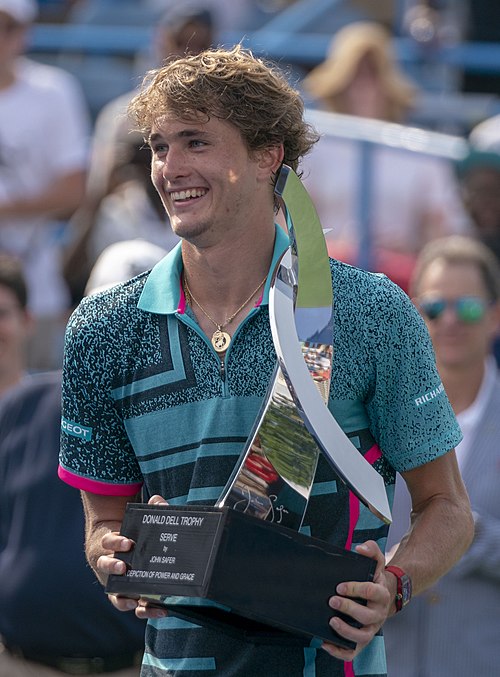
Photo: Alexander Zverev with a tour trophy / Keith Allison / Wikimedia Commons / CC BY-SA 2.0
Last updated: September 2026
🎾 Gear from this story
HeadHead Extreme TourAlexander Zverev's racket of choiceView on Amazon →As an Amazon Associate, SUPER.TENNIS earns from qualifying purchases.