The trophies have been handed out, the confetti swept up, and the grass on Centre Court is already being nursed back to health for a year of quiet rest. And here is the strange part: that's basically it for grass tennis. Not for the month. For the year.
You just watched the most famous tournament on the planet, played on the surface everyone pictures when they picture tennis — the green lawn, the white kit, the strawberries. And now that surface all but disappears from the professional game until next summer. If that seems odd for the sport's signature look, you're not wrong. Grass-court tennis is a beloved, gorgeous, wildly impractical thing that the sport very nearly abandoned altogether. Here's the story of why the game's most famous surface barely exists.
Five weeks, and then nothing
Let's start with the scale of it, because it's genuinely startling once you notice.
The professional grass-court season lasts roughly five weeks. It begins in early June, just after the clay of Roland Garros, and it ends with the Wimbledon final in the middle of July. In that tiny window the tour crams in a handful of events — Stuttgart and Halle in Germany, Queen's Club in London, 's-Hertogenbosch in the Netherlands, Mallorca and Eastbourne as Wimbledon warm-ups, a stop in Newport in the United States just after — and then the circus packs up and moves onto hard courts for the long North American summer.
Add it all up and grass accounts for something like a tenth of the tennis calendar. Out of a season that runs from January to November, across dozens and dozens of tournaments, only a small cluster are played on the surface that defines the sport in the public imagination. Clay gets a couple of months. Hard courts get most of the year. Grass gets five weeks and a fond goodbye.
We just wrapped up everything that happened at this year's grass Slam — two new champions, a British fairytale, the whole fortnight — and by the time you finish reading this, the players who contested it will already be practising on hard courts hundreds of miles away. The lawns are done for another eleven months.
It wasn't always this way
Here's what makes the modern grass season feel so strange: grass used to be the sport, not a footnote to it.
Rewind to the middle of the last century and grass was the dominant surface in tennis, full stop. Three of the four Grand Slam tournaments were played on it. The Australian Open, Wimbledon, and the US Championships were all grass-court events; only the French threw in its lot with clay. If you were one of the best players in the world, you spent most of your biggest days sliding around on lawns.
Then, one by one, the great grass tournaments walked away. The US Open played its last grass championship in 1974 — Jimmy Connors won it — before switching to clay for a few years and then, from 1978, to the hard courts it uses to this day. The Australian Open held on longer, but it too abandoned grass, moving to hard courts at the end of the 1980s. In the space of a decade and a half, grass went from the surface of three major titles to the surface of exactly one.
That one, of course, is Wimbledon — and its stubbornness is the only reason grass-court tennis survives at the top of the sport at all. Strip Wimbledon out of the equation and grass would be a historical curiosity, something your grandparents watched. Instead it's the crown jewel of the calendar, kept alive almost single-handedly by an institution that simply refused to change.
Why grass is so hard to keep
So why did everyone else bail? The short answer is that grass is a nightmare to look after, and almost nobody wants the job.
A grass court is not a surface so much as a living thing. It's a field, and like any field it grows, wears, browns, and reacts to the weather in ways that concrete never will. Wimbledon mows its courts to a precise eight millimetres, rolls them, feeds them, waters them, and reseeds them — a year-round operation carried out by a small army of groundstaff for the sake of two weeks of play. The courts you see gleaming on television in July are the product of eleven months of quiet, expensive labour.
And they're fragile. A grass court can only take so much tennis before the baseline turns to dust and the bounce goes haywire. Rain doesn't just interrupt play, it can end it for the day, because wet grass is slippery and dangerous and takes hours to dry. The surface that looks so perfect on a sunny final Sunday is, in truth, high-maintenance and temperamental, and it needs long stretches of rest to recover.
Now multiply that cost and hassle across an entire tour, and you can see why cities and clubs said no. Why pour a fortune into a surface that's unplayable in the rain, wears out in a fortnight, and demands a full-time crew — when a hard court can be laid down cheaply, sit outside all year, and shrug off both weather and heavy use? For the same reason the modern game increasingly happens in conditions the old guard never dealt with — a shift we explored in our guide to tennis in serious heat — the sport gravitated toward surfaces that are predictable and cheap. Grass is neither.
The surface that changes the game
There's a second reason grass matters out of all proportion to its five weeks: it doesn't just look different, it plays like nothing else.
Grass is the fastest surface in tennis. The ball skids off the lawn low and quick, the bounce stays down around the knees, and because the surface is uneven in a way clay and hard courts aren't, that bounce can do unpredictable things. For most of the sport's history this rewarded a very particular style: the big serve, the rush to the net, the volley put away before the opponent could set their feet. Grass was the home of serve-and-volley tennis, of players who treated the baseline as somewhere to leave as fast as possible.
That's why grass throws up surprises that other surfaces don't. A huge server having a hot fortnight can trouble anyone. A player whose game is built on soft hands and quick reflexes suddenly looks like a genius. The margins are thinner, the points shorter, the whole rhythm of a match compressed. Watch a grass-court match right after a clay one and it can feel like a different sport entirely — faster, sharper, more like a shootout than a chess game.
The day Wimbledon changed its grass
Here's a detail even a lot of fans don't know: Wimbledon quietly changed the way its own game plays, and it did it by changing the grass itself.
Back in 2001, the All England Club altered the make-up of its lawns, switching to a hardier, 100% perennial ryegrass. The old blend had been softer and quicker to break down; the new grass was tougher, held up better under two weeks of pounding, and — crucially — produced a slightly higher, slightly slower bounce. It was a groundskeeping decision, made for durability. But it changed tennis.
With a higher bounce and a touch more time, the pure serve-and-volley game that had ruled Wimbledon for generations started to fade. Baseliners, once at a disadvantage on the lawns, could suddenly stand their ground and trade groundstrokes. The classic image of a player charging the net behind every serve gave way to longer rallies and modern all-court tennis. Purists mourned it; plenty of others thought the matches got better. Either way, it's a lovely reminder of how physical this sport really is. Change the plant, and you change the play.
The surface that makes legends
For all that it's the smallest slice of the season, grass has an outsized habit of separating the merely great from the immortal — and of handing the occasional fairytale to someone nobody saw coming.
Think about the names most associated with Wimbledon. Martina Navratilova won the singles title there a record nine times, her serve-and-volley game a perfect fit for the lawns. Roger Federer won it eight, gliding across the grass like the surface had been invented for him. Pete Sampras owned it through the 1990s. These weren't just champions; they were grass champions, players whose particular gifts — timing, touch, a great serve, soft hands at the net — were amplified by the surface until they looked untouchable. Grass doesn't reward the same qualities clay does, and that's exactly why mastering it means so much.
Because here's the thing modern fans sometimes forget: winning across all three surfaces is the sternest test in the sport. Clay demands patience and endurance; hard courts demand power and consistency; grass demands nerve, quick hands, and the courage to shorten points. A player who can win on all of them has proven something a clay specialist or a hard-court metronome never has to. The rare few who complete that set are the ones we end up calling the greatest of all time — and grass, awkward and fleeting as it is, is the piece of the puzzle that trips up the most players.
And then there's the chaos it invites. Because the surface is so fast and so specialised, grass has always been the place where an outsider can catch fire for a fortnight — a big server on a hot streak, a shot-maker who suddenly can't miss. On no other surface does raw form matter more than ranking. That unpredictability is part of what makes the grass Slam such compelling theatre: on the lawns, more than anywhere, anything can happen.
Why nobody builds new grass courts
If you've ever wondered why you can't just pop down to a local grass court the way you can find a hard court in almost any town, the economics tell the whole story.
A hard court is the sensible choice for basically everyone. It's relatively cheap to build, it sits outdoors in any climate, it needs almost no upkeep beyond the occasional resurfacing, and it plays the same on Monday as it does on Sunday. Clay is a step up in maintenance but still manageable, which is why it blankets Europe and South America. Grass sits at the far, luxurious end of the scale: costly to lay, brutal to maintain, useless in bad weather, and playable for only part of the year even in the right climate.
So clubs, councils, and developers make the rational call, over and over, and the world's stock of grass courts keeps shrinking. New ones are almost never built. The grass courts that remain tend to survive on heritage, tradition, and money — the handful of historic clubs and championship venues that keep the flame burning because it means something to them, not because it makes financial sense. Grass is the surface equivalent of a vintage car: beautiful, thrilling, and something almost nobody would choose on practical grounds.
So why do we still love it?
All of which raises the obvious question. If grass is expensive, fragile, weather-dependent, and endangered — why do we care about it so much? Why is the grass Slam the one that stops the world?
Because scarcity, it turns out, is the whole point. Grass tennis is rare, and rare things feel precious. Those two weeks in July carry a weight the other fifty don't precisely because they don't come around often. The whites, the tradition, the ritual — even the strawberries and cream that have become their own small institution — all of it lands harder because it's a once-a-year event on a surface you'll barely see again until next summer.
There's romance in the impracticality, too. In a sport that has otherwise chosen the cheap, the consistent, and the all-weather, grass is a glorious act of stubbornness — a refusal to let the most beautiful version of the game die just because it doesn't pencil out. Every July, for a few short weeks, tennis puts on its best clothes and plays on a lawn, and we all remember why we fell for it in the first place.
Can you still play on grass yourself?
Yes — just barely, and it takes some hunting. A small number of clubs, mostly in Britain and a few other pockets of the world, still keep grass courts and open them for a short summer window. If you ever get the chance, take it: the low skid of the ball and the give of the turf underfoot is an experience the hard-court game simply can't replicate.
A word of warning if you do. Grass is slippery, and ordinary tennis shoes with a smooth or standard tread can be treacherous on it — which is why dedicated grass-court shoes exist, with tiny rubber nubs or a pimpled sole designed to grip the turf without tearing it up. If you're planning a rare day on the lawns, a proper pair of grass-court tennis shoes is genuinely worth it, both for your footing and out of respect for a surface that's far more delicate than it looks. Play a set on grass and you'll understand, in your knees and your footing, exactly why the pros make it look so hard.
Until next summer
So that's the paradox of grass. It's the face of the sport and one of its smallest slices. It's the surface every casual fan pictures and the one hardly anyone plays. It nearly disappeared, survives on the stubbornness of a single club, and returns each year for five fleeting weeks that somehow outshine the other forty-seven.
The lawns are resting now. The tour has moved on to the hard courts, where most of the tennis actually happens. But the grass will be back next June, mowed to eight millimetres and greener than anything, ready for another impossibly brief, impossibly lovely season. Enjoy it while it's here. That's rather the point.
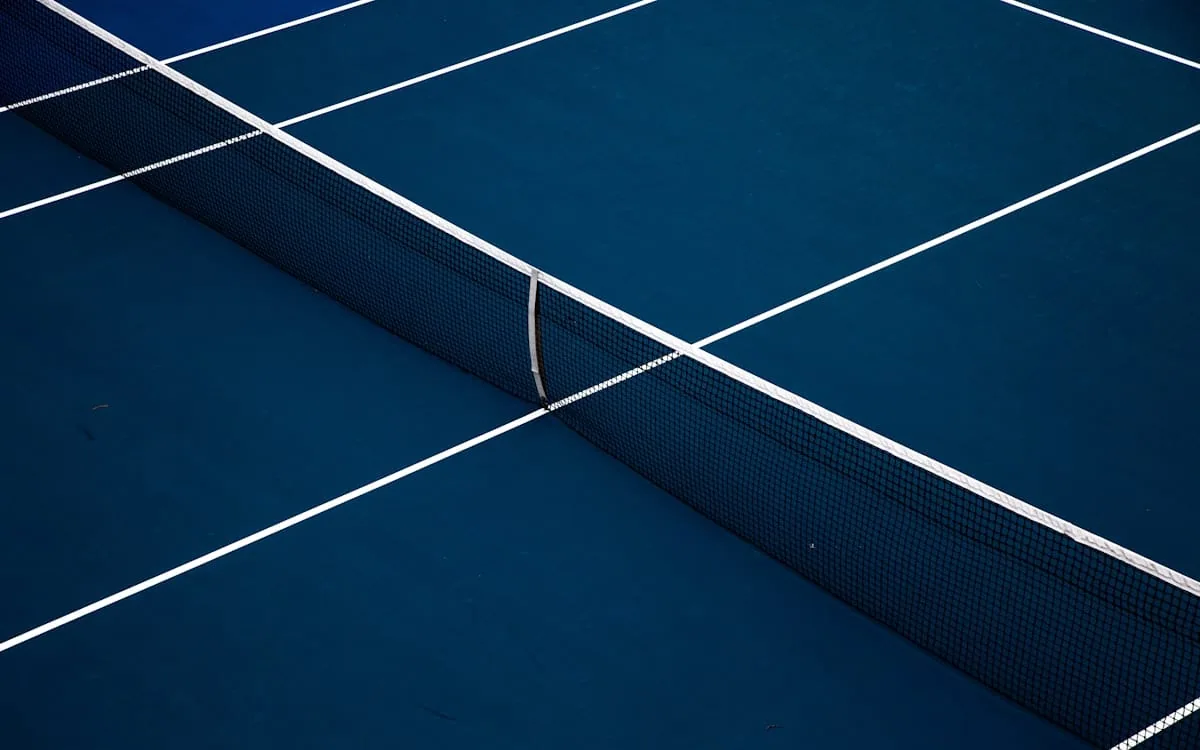
Photo: Wimbledon Centre Court out of season, by Daniel (United Kingdom), CC BY 2.0, via Wikimedia Commons.
Last updated: October 2026