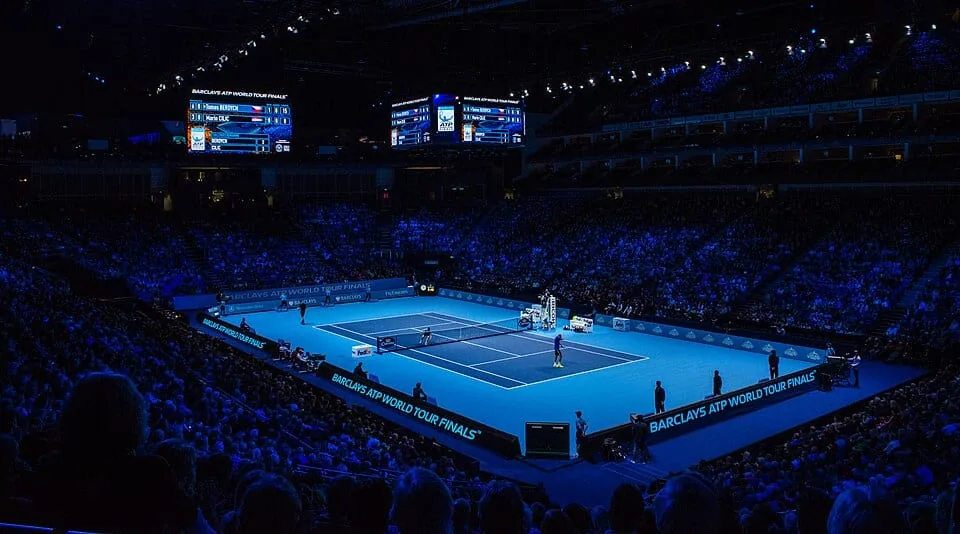
There is a particular sound a tennis crowd makes when it decides, all at once, that it has found someone to love. It isn't applause exactly. It's lower and hungrier than that — a rolling roar that builds every time their new favourite wins a point, until the whole stadium is leaning forward, willing her on. New York made that sound for two straight weeks in the late summer of 2021, and the person it was making it for was a 19-year-old left-hander from Montreal that almost nobody outside tennis had heard of.
Her name is Leylah Fernandez. Five years on, she is not a Grand Slam champion, not the world number one, not any of the things that breathless fortnight seemed to promise. What she is instead is something quieter and, in its own way, more interesting: a fighter who has kept fighting, a fan favourite who never stopped being one, and a Canadian who is about to come home. As the tour swings back to the hard courts of North America — her surface, her season — Leylah Fernandez is heading home for the run of North American tournaments that made her name. It feels like the right moment to tell her story.
The fortnight that made her
To understand why people adore Leylah Fernandez, you have to go back to that 2021 US Open, because what she did there still barely makes sense on paper.
She arrived ranked outside the world's top 70, unseeded, a teenager nobody had pencilled in for anything. She left having beaten a murderer's row of champions. In the third round she took down the defending champion, Naomi Osaka — then one of the biggest names in all of sport — turning the match around and sending a superstar packing. Then she beat former champion Angelique Kerber. Then Elina Svitolina, a top-five player, in the quarterfinals. Then Aryna Sabalenka, the world number two, in the semifinals. Four elite players, one after another, dispatched by a 5-foot-6 lefty who simply refused to believe she was supposed to lose.
She actually turned 19 in the middle of it all, celebrating a birthday between rounds while dismantling the WTA's best. And the timing gave the whole thing an extra charge: the tournament fell around the twentieth anniversary of September 11, and Fernandez's on-court speeches — poised, heartfelt, aimed straight at a wounded city — turned a hot young player into a folk hero. New York didn't just admire her. It adopted her.
Only in the final did the fairytale meet another fairytale. Across the net stood Emma Raducanu, a qualifier on an equally impossible run, and the Briton edged it 6-4, 6-3 — a story we told from Raducanu's side too. Two teenagers, a combined ranking that read like a typo, contesting a Grand Slam final that nobody could have scripted. Fernandez lost the match and won the hearts. She walked off Arthur Ashe Stadium in tears, but the crowd was on its feet, and everyone watching understood they had just seen the arrival of someone special.
Where she came from
The fearlessness wasn't an accident. It was built, deliberately, by a family that had no business producing a Grand Slam finalist and did it anyway.
Leylah Fernandez was born in Montreal in 2002 to an Ecuadorian father and a Filipino-Canadian mother — a fact that tells you, immediately, that this was never a traditional tennis-academy story. Her father, Jorge, had been a professional footballer, not a tennis player. He knew next to nothing about the sport when his daughter fell for it. So he did the only thing a stubborn, driven parent could do: he taught himself. He read, he watched, he studied, and he became her coach, shaping her game and her mentality from the ground up on the public courts of Quebec.
What he couldn't give her in pedigree he gave her in philosophy. The Fernandez household ran on fearlessness, relentless work, and a refusal to be intimidated by bigger names or bigger reputations. Leylah was small and would stay small by professional standards, never going to overpower anyone. So instead she was taught to out-think, out-scrap, and out-believe them — to treat a champion on the other side of the net not as an obstacle but as an opportunity. Watch her beat those four stars in New York and you are watching that upbringing in real time. The giant-killing wasn't a fluke. It was the plan.
What her tennis actually looks like
If you have never watched Fernandez play, it is worth knowing what you are looking for, because her tennis is a lesson in how to win without the one thing modern tennis seems to demand: overwhelming power.
Almost everyone at the top of the women's game today hits enormous. The template is a tall player with a huge serve and groundstrokes that can end a point in two shots. Fernandez is the opposite of that template — small, left-handed, and armed not with a cannon but with a puzzle. Being a lefty is her first weapon: it flips the geometry of the court, sending her serve and her cross-court forehand into awkward corners that right-handers spend their whole lives not practising against. Her second weapon is her defence, which is really disguised offence. She runs down balls that should be winners, absorbs the pace her bigger opponents give her, and redirects it into sharp, unexpected angles until the power player is the one out of position and out of ideas.
Then there is the part that doesn't show up in any coaching manual: her energy. Fernandez plays with her whole body and her whole face, fist-pumping, shouting, feeding on the crowd and feeding it right back. Against a nervous favourite, that theatrical intensity is a weapon of its own — it turns a stadium into a co-conspirator and makes every tight moment feel like it is tilting her way. Power players can beat her, and often do. But on the days it all clicks, watching Fernandez dismantle a bigger, higher-ranked opponent is one of the genuine pleasures of the sport: proof that tennis, at its best, is still a game of wits as much as muscle.
The hard years after the fairytale
Here is the part of the story the highlight reels skip. What happens to a 19-year-old the year after she nearly wins a Grand Slam?
For a while, it went well. In 2022 Fernandez backed up her New York run by reaching the quarterfinals of the French Open, proving the US Open had been no one-off. And then the body intervened. A stress fracture in her foot, suffered mid-season, knocked her out for months at exactly the moment her career needed momentum. Injuries at that age are cruel in a way that goes beyond the ranking points: they steal the rhythm, the confidence, the sense of forward motion that a young player runs on.
She came back, but tennis had moved on, the way it always does. New teenagers arrived. The ranking that had climbed so fast now wobbled. The expectations that a Slam final creates — win one soon, they whisper, you clearly belong — became a weight rather than a wind at her back. For a few years Fernandez lived in the difficult middle country of professional tennis: good enough to beat anyone on a given day, not yet consistent enough to do it week after week, and carrying the quiet burden of a career that had peaked, in the eyes of the world, before she was old enough to legally drink in her own country.
Plenty of players never make it out of that middle country. What makes Fernandez worth writing about is that she kept knocking.
The night she made history for Canada
If you want the moment that captures who Leylah Fernandez really is, forget the individual results for a second and look at what she did in a team shirt.
In late 2023, Canada won the Billie Jean King Cup — the World Cup of women's tennis — for the first time in its history. And it won it because of her. Fernandez went undefeated across the entire week, an 8-0 record in the biggest pressure matches of the team season, and sealed the title with a straight-sets win over Italy's Jasmine Paolini in the final. She dropped only a couple of sets all week. When her country needed a player to carry it into the record books, she carried it.
That's the thing about Fernandez that a bare ranking never shows. She is at her absolute best when she is playing for something bigger than herself — a nation, a crowd, a cause. The same quality that made New York fall for her in 2021 is the quality that delivered Canada its historic trophy in 2023. She is, in the truest sense, a big-occasion player, and there is no statistic on the WTA website that measures that particular kind of heart.
Finding her level again
The good news, for anyone who has kept a soft spot for her all these years, is that the talent never went anywhere — and in 2025 it resurfaced properly.
That season, Fernandez did something she had never managed before: she won multiple titles in a single year, lifting the trophy at a WTA 250 event in Osaka and then, more impressively, at the WTA 500 in Washington DC. Two titles in one calendar year might not sound like a revolution, but for a player who had spent years being defined by a single glorious fortnight, it was proof of a different, more durable kind of success. Not a lightning strike, but a foundation.
The present is more complicated, and it would be dishonest to pretend otherwise. Her 2026 has been a grind — a losing record through the first half of the year and a ranking hovering around the twenties, with tough defeats to the very top players she used to ambush. This is the honest, unglamorous reality of a pro career past its first fairytale: some seasons you are the story, and some seasons you are just trying to find your game again. Fernandez, right now, is in the second kind of season. But she is still ranked among the best two dozen players on earth, still capable of beating anyone when it clicks, and still — crucially — heading into the part of the calendar she likes best.
Home, and the summer that suits her
Because here is why now is the moment to watch her. The tour has left the grass of Europe behind — Wimbledon has crowned its champions — and it is heading to the hard courts of North America for the long summer build-up to the US Open. And that stretch, for Leylah Fernandez, is home in every sense.
It starts, this year, with the National Bank Open, which stages its women's event in Toronto at the beginning of August — a home tournament, in front of a Canadian crowd, on the hard courts she grew up on. There is no tournament on the calendar that means more to a Canadian player, and few players who feed off a home crowd the way Fernandez does. From there the road runs through the American hard-court summer and lands, at the end of August, back at the US Open — the stage where, five years ago, a teenager made an entire city believe. She won't sneak up on anyone this time. But she has never needed to be the favourite to be dangerous.
Nobody sensible is predicting she will win either title — the depth in the women's game right now is ferocious, and her 2026 form says a run of two or three good wins would be a fine result, not a fairytale. But that is exactly why this stretch is worth watching. Fernandez has never been a player you scout by her ranking; she is a player who catches fire when the stage and the crowd are right, and there is no combination of stage and crowd more likely to light her up than a home Masters and the US Open back to back. All she needs is one hot night to remind everyone what she can do. She has done it before, on the biggest court of all, when far fewer people believed in her than believe in her now.
She is part of a genuine Canadian tennis wave, too, one that has turned a cold country with no great tennis tradition into a producer of champions — from Félix Auger-Aliassime flying the flag on the men's side to US Open champion Bianca Andreescu. Fernandez is woven right through that story, both a product of Canada's rise and one of its brightest symbols. When she walks out in front of a home Canadian crowd this summer, she carries a bit of all of it.
Why we root for her
So no, Leylah Fernandez is not the world number one, and the Grand Slam that once looked inevitable has not arrived. If you only measure players by trophies, you might file her under unfulfilled promise and move on.
But that would miss the whole point of her. What Fernandez offers is something tennis is often short of: pure, uncynical fight, wrapped in obvious joy. She is the undersized underdog who stares down giants, the daughter of a self-taught coach who bet everything on belief, the player who saves her best for her country and her crowd. She reminds the rest of us — the ones watching from the couch, who will never hit a backhand like hers — why we love an underdog in the first place. Not because they always win, but because they always, always come to fight.
The hard courts are calling, and home is waiting. Leylah Fernandez is coming home to the summer that made her — a little older, a little more scarred, and every bit as fearless as the kid who made New York roar. Pull up a chair. This is the time of year she was built for.
Photo: Leylah Fernandez by Hameltion, CC BY-SA 4.0, via Wikimedia Commons.
Last updated: October 2026
🎾 Gear from this story
WilsonWilson Blade 98Emma Raducanu's racket of choiceView on Amazon →As an Amazon Associate, SUPER.TENNIS earns from qualifying purchases.