There is a moment in almost every Alex de Minaur match when the point is over and nobody has told him.
You know the moment. His opponent has hit the shot he has been building the whole rally towards, the one that has finished a thousand points against a thousand other players, and it is arrowing into the corner with the crowd already halfway out of their seats. And then a small figure in a bucket hat and a scowl arrives from somewhere he had no business arriving from, gets a racquet on it, and floats the ball back over the net. Not desperately. Not a scrambled lob that begs to be put away. Back down the middle, deep, with enough shape on it that the man who thought he had just won the point now has to hit another one.
That is the sound of a de Minaur match: a slightly delayed groan from the far side of the court, over and over, for two hours.
If you follow tennis for the drama rather than the technique, he is one of the most rewarding players on tour to give an afternoon to. You do not need to understand a single thing about grip changes or court positioning. You just need to be able to see a ball that should have bounced twice and did not. This week he begins again in Montreal at the National Bank Open, three weeks after the biggest day of his personal life and three days after handing back one of his favourite titles. It is worth knowing who you are watching.
A boy split between two countries
He was born in Sydney on 17 February 1999, to a Uruguayan father, Anibal, and a Spanish mother, Esther, who met in Australia, where Anibal ran an Italian restaurant and Esther worked as a waitress. It is the kind of family origin story that could only happen in a big immigrant city, and it gave their son three languages and two passports before he had any idea what to do with either.
When he was five the family moved to Alicante, his mother's home town on the Spanish coast. That is where tennis found him properly. At eight he began working with Adolfo Gutierrez, a coach who is still in his corner all these years later, which in a sport where players change teams the way the rest of us change phone contracts is remarkable in itself. He grew up on Spanish clay, drilled in the Spanish tradition, which is where the willingness to stay in a rally for twenty-five shots comes from.
But he never became Spanish. At thirteen he went back to Sydney. He has said, in more or less these words, over and over, that he always felt Australian and always intended to play for Australia, and when the moment came to choose a flag there was no drama about it at all. He speaks English with an Australian accent, Spanish like a local in Alicante, and enough French to be dangerous in a press conference in Montreal.
It matters to how he plays. Almost nobody else on tour is a genuine hybrid of the two great tennis cultures: the Spanish patience and footwork, the Australian refusal to be impressed by anybody. Watch him closely and you can see both. The construction of the point is Iberian. The body language between points is pure Sydney.
Why they call him the Demon
The nickname arrived early and stuck, because it is one of the rare sporting nicknames that describes something you can actually see. De Minaur is not big. He is not a bomber. He does not win many points before the rally has properly started. What he has instead is a level of court coverage that turns other people's best shots into ordinary ones.
Speed in tennis is usually talked about as though it were a defensive quality, something you fall back on when your plan has failed. With him it is the plan. He runs down the first shot to buy the second, gets his body behind the second to flatten out the third, and by the fourth he is the one dictating from a position that had no right to exist. Opponents talk about him the way boxers talk about a fighter who will not go down: it is not that any single thing hurts, it is the accumulation, the sense that the match will simply keep happening to you until you make a mistake you would not normally make.
That is the source of the groan you hear from the other side of the net. It is not pain. It is arithmetic. Every player on tour has a mental budget for how many good shots a point should require, and he blows through it in the first ten minutes.
He is also, in a sport that has lately gone very glossy, cheerfully unglamorous. The look is functional. The interviews are dry and self-deprecating in that particular Australian way. If you have ever browsed the stories behind the great tennis nicknames, you will know that plenty of them were invented by marketing departments. This one was invented by the people who had to play him.
The seven-quarterfinal problem
There is one number that hangs over him, and it would be dishonest to write about him without it.
De Minaur has reached seven Grand Slam quarterfinals. He has done it at all four majors: the Australian Open in 2025 and again in 2026, Roland Garros in 2024, Wimbledon in 2024, the US Open in 2020, 2024 and 2025. Reaching the last eight of every major in the world is something only a small group of players in history can claim, and it puts him permanently among the best of his generation.
He has never reached a semifinal.
Seven times he has walked out for a quarterfinal, and seven times he has walked off again. Some of those defeats were close and cruel. Some of them came against opponents in the middle of the sort of run nobody stops. He did reach the semifinals of the season-ending ATP Finals in 2025, which is the strongest evidence that the ceiling people talk about is less a real thing than a run of hard draws at the wrong moment. But the number sits there, and every August and every January somebody asks him about it, and he answers patiently again.
His career-high ranking is world No. 6, reached on 15 July 2024, and he has essentially lived in the top ten ever since. In a different era he would have a major or two by now. In this one he has spent his prime years running into Jannik Sinner and Carlos Alcaraz in the second week, which is less a flaw in him than an accident of birth date.
Rotterdam, at the third time of asking
The best day of his tennis year came in February, indoors, in the Netherlands.
De Minaur had reached the final of the ABN AMRO Open in Rotterdam in each of the two previous years and lost both. Turning up a third time to a building where you have twice been beaten on the last day is its own kind of test, and he passed it emphatically, beating Felix Auger-Aliassime 6-3, 6-2 in a final that was over almost before the crowd had settled. It was his eleventh tour-level title, his first in Rotterdam, and it made him the first player in the tournament's history to reach three consecutive finals there.
The scoreline matters less than what it says about him. Losing a final hurts. Losing the same final twice starts to feel like a verdict. Going back and winning it at the third attempt is the most de Minaur thing imaginable: no sudden transformation, no new weapon unveiled, just the same player turning up again with the same plan until the plan finally worked.
The rest of the year has been a solid top-ten year rather than a breakthrough one. Another Australian Open quarterfinal in January, in front of the home crowd who adopt him completely for a fortnight every summer. Then Wimbledon, where he went out in the fourth round to the Italian Flavio Cobolli, 7-5, 7-6, 6-3, on a day when the returns that usually come back kept finding the net cord instead.
A wedding on the final Sunday
And then, two days after Wimbledon finished, he got married.
De Minaur and the British player Katie Boulter had been together publicly since March 2021 and engaged since December 2024, and they chose the one week in the calendar when two professional tennis players are guaranteed to be in the same country with nothing scheduled. On 12 July, the final Sunday of the Championships, they married in a church near Boulter's family home at Old Woodhouse in Leicestershire.
They kept it small on purpose. Boulter's grandfather Brian, who she is extremely close to, was there, and the whole shape of the day was built around making sure he could be. She wore a custom lace dress by Caroline Castigliano with a piece of fabric from her late grandmother's wedding dress hand-stitched into it. No magazine deal, no sponsored arrival shots, no drone footage. For two people who spend most of the year being photographed at work, that reads like a decision made carefully.
It has been a busy couple of seasons for this generation in that respect, and if you have followed the wave of tennis weddings and engagements this year you will recognise the pattern: a group of players who came up together, reached their late twenties, and started building lives that will outlast the ranking points. De Minaur has always been open about wanting the ordinary things. He got one of them in the two-day window the sport allowed him, and then he flew to America to go back to work.
Washington, and a title handed back
Which is where the last week gets complicated.
He arrived at the DC Open in Washington as top seed and defending champion, holder of a title he won in 2025 that suits him about as well as any event on the calendar: fast hard courts, brutal humidity, long matches, a tournament that rewards the man still moving properly in the third set. He beat Brandon Nakashima in the quarterfinals there a year ago on the way to lifting it.
On Friday, Nakashima took it back. The American won 7-6(5), 6-4 in one hour and fifty-five minutes, and he did it in the one way that neutralises de Minaur completely: by never giving him anything to chase. Nakashima hit ten aces, won 83 per cent of the points behind his first serve, and saved six of the seven break points he faced. When a server is that clean, the returner's greatest weapon is switched off at the wall. There is no rally to extend if the rally never begins.
That is the honest weakness in the de Minaur model, and it comes around a few times a year. He does not have a shot that ends a point on demand, so on the days an opponent serves out of his mind, he can be beaten without ever really playing badly himself. He walked off having lost the 500 ranking points that came with last year's trophy, and they now have to be replaced somewhere else, in the most crowded five weeks of the season.
Montreal, and the month that decides everything
Somewhere else starts today.
The National Bank Open runs from 1 to 13 August, and this year the men are at IGA Stadium in Montreal while the women play in Toronto, the two cities swapping the two halves of the tournament as they have done for more than forty years. It is the 136th edition of the men's event, a mandatory Masters 1000, and the first-round matches begin on 2 August. From here the tour goes to Cincinnati, and from Cincinnati to New York, where the last major of the year is waiting at the end of the month. If you want the map of how the summer fits together, the US Open guide lays out the whole run.
For de Minaur, this month is where a season like his is genuinely decided. He is not going to win a Masters 1000 by out-hitting anybody. What he can do, in the humidity, on courts that reward movement and punish players who quietly stopped training in June, is win four matches in six days because he is the only man left in the draw who does not seem to get tired. Some of his very best results have come in exactly these conditions, when everybody else is running on fumes and the man who never stopped running still looks fresh at nine in the evening.
Then there is autumn, and the Davis Cup, where he has been Australia's talisman for years, carrying them to back-to-back finals in Malaga and producing tennis in a green and gold shirt that he sometimes cannot find for himself alone. If you have never watched him in a team tie, the atmosphere is nothing like a normal tournament, and the Davis Cup guide explains why the format pulls that extra gear out of certain players.
What you actually get when you watch him
Some players are worth watching because they might do something you have never seen before. De Minaur is worth watching for the opposite reason: because he will do the same thing four hundred times without ever getting bored of it, and somewhere in the second set you will realise you are not bored either.
You will start counting shots. You will catch yourself leaning forward when the ball goes into the corner, because you have learnt in about twenty minutes that the corner is not safe against this man. You will watch a top-ten player on the other side of the net go through the five stages of grief in real time, from confidence, to irritation, to that particular flat-eyed stare that means he has accepted he will have to hit six winners to win a single point. There is not much better theatre in a sport that has plenty of it.
He is twenty-seven. He has a wife, a coach he met when he was eight, eleven titles, no major semifinal yet, and a full calendar between here and December to do something about that last part. Montreal starts today, in a stadium in Jarry Park where the crowd will adopt him within about three games, partly because he shouts at himself in French when it goes wrong.
Find a match this week and watch the first ten points. Then stop watching him, and watch the man on the other side of the net when the rally he thought he had already won keeps going. That reaction is the thing Alex de Minaur has spent his whole career collecting, and it is free.
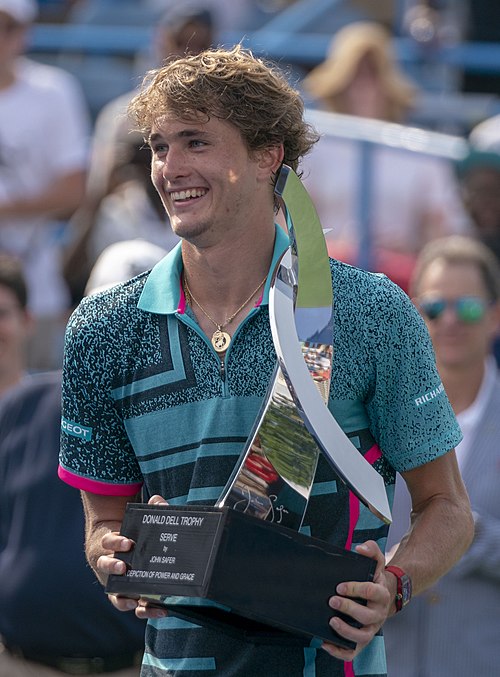
Photo: Alex de Minaur at the Laureus World Sports Awards 2024 by Barcex, CC BY-SA 4.0, via Wikimedia Commons.