On Sunday, in five cities that have nothing much to do with each other, five tennis matches will decide a title.
Almaty, Brussels, Lyon, Ningbo, Osaka. Three small men's tournaments and two women's, all of them indoors or nearly so, all of them the sort of event that gets fifteen seconds on a highlights reel. Trophies will be lifted. Somebody will cry. Somebody else will lose and go straight to the airport.
And in each of those five matches there will be one person on court whose name you will never learn, whose face you will not recognise, and whose entire professional ambition is that you finish watching with no memory of them at all.
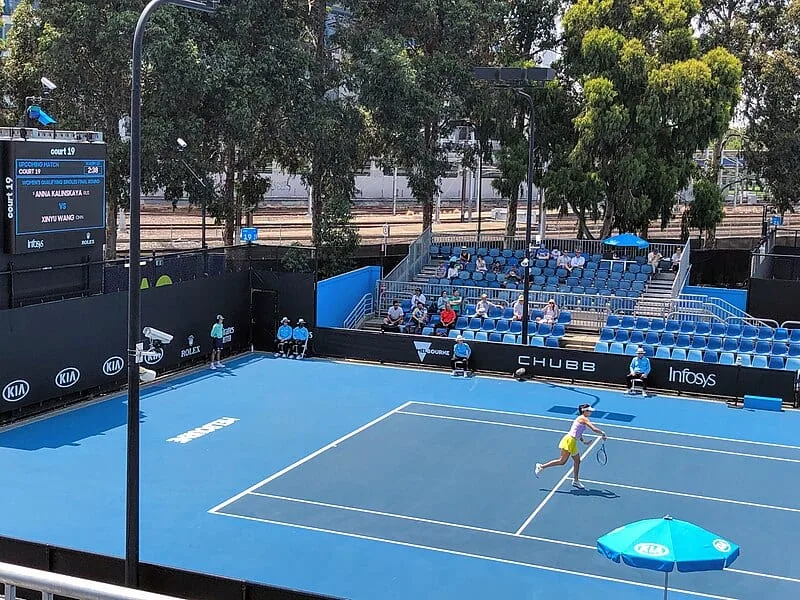
They sit about two and a half metres above the net, on a chair that is deliberately uncomfortable, holding a microphone and a scorecard. If they do the job perfectly, you will not notice them once in three hours. If they make one mistake, it will be on every tennis account on the internet by dinner time, with their surname in the caption.
It is one of the strangest jobs in professional sport, and over the last two years the machines have quietly taken away the part of it that everyone assumed was the whole thing.
The job is not what you think it is
Ask most people what a chair umpire does and they will say: calls the ball in or out.
That has not been true for a while. At the Australian Open since 2021, at the US Open since 2022, across the whole men's tour since 2025, and at Wimbledon since 2025 as well, there are no line judges and no challenges. A camera system makes the call, a voice says "out", and that is the end of it. The chair umpire has no vote. They cannot overrule it, and nobody can ask them to.
So what is actually left?
Everything else, it turns out. The chair umpire announces the score before every point, which sounds trivial until you consider that they are doing it in a second language, over a crowd, while tracking a tiebreak where the ends change every six points. They run the 25-second shot clock and decide whether to start it after a 30-shot rally or let the arena breathe for a moment first. They enforce the code of conduct: audible obscenity, racket abuse, unsportsmanlike conduct, coaching, time violations. They approve or refuse a medical timeout, and they are the one who has to say no to a 22-year-old who has just felt something go in their hamstring. They manage the ball change every nine games, the towel routine, the toilet break clock, the photographers, the roof, the rain, the light, and a crowd that may have been drinking since one in the afternoon.
They are, in other words, the referee, the timekeeper, the host and the safety officer, all at once, and the one thing they no longer do is the thing you thought they did.
For a sport that has spent two years getting used to matches with no line judges at all, that is a strange kind of promotion. The chair has lost its oldest power and kept every difficult one.
Green, white, bronze, silver, gold
The part that surprises people is this: you cannot simply be good at this and turn up.
Tennis officials are certified on a ladder of coloured badges. Green and white are national level, the badges you earn working club tournaments and junior events in your own country. Then come the three international badges: bronze, silver and gold. Bronze is where a chair umpire enters the professional world. Gold is the top, and it is run jointly by the ATP, the WTA, the ITF and the four Grand Slams, who meet at the end of each year and decide, as a panel, who goes up.
How many gold badge chair umpires are there in the world? When the ITF announced a promotion a few years ago, it described the newest member as one of only 35 on the planet. Thirty-five people, for a sport played professionally in more than sixty countries, fifty weeks a year.
The climb takes eight to ten years of lines and small events and long drives, and it comes with a cruel economic shape: for most of those years the money is nowhere near enough to live on, so you need another job, and then at some point around silver badge the travel makes any other job impossible. One WTA umpire described the moment plainly in an interview: once you reach silver or gold, you cannot hold down anything else. It becomes your career, whether or not you had planned for it to be.
Aurelie Tourte, who in 2019 became the first full-time woman umpiring on the men's tour, used to work as an emergency room nurse in France. Think about that pairing for a second. The skills transfer better than you would guess: stay calm, make the call, do not let the room see you hesitate.
Twenty weeks, thirty weeks, no applause
The schedule is the part nobody warns you about.
A chair umpire on contract to one of the tours works somewhere between twenty and thirty weeks a year, and those weeks are not holidays with tennis attached. They are 7am briefings, a court assignment pinned to a wall, three matches in a day if the schedule backs up, a late finish, a 6am flight, and a new city where you do not speak the language and the hotel is forty minutes from the site.
The hierarchy is invisible from the outside but ruthless from within. Getting the Sunday final is the reward for a good week, and the week is assessed by a supervisor who has been watching you work the whole time. Nobody tells the crowd. There is no announcement, no graphic, no moment where the broadcast says this official has been given the biggest match of their season. They simply climb the chair, adjust the microphone, and say two names.
What they get paid for it is genuinely hard to establish, and anyone who tells you a precise figure is guessing. The tours do not publish a pay scale for officials. The numbers that circulate in articles come from estimates, old federation documents and the occasional leak, and they disagree with each other by a factor of five. What is reliably true is the structure rather than the sums: Grand Slams pay far better than tour events, finals pay better than first rounds, most officials below the very top are self-employed and fund their own gaps, and almost nobody in that chair is wealthy.
They are doing it for the same reason the player is. They got good at a thing nobody else could do, and the thing happens to take place in beautiful buildings in front of crowds.
The two ways it goes wrong
There are exactly two famous chair umpires, and both of them became famous on the same bad weekend in 2018, which tells you something about how this job is judged.
Carlos Ramos worked the US Open women's final that year and gave Serena Williams three code violations: a warning for coaching from her box, a point penalty for a smashed racket, and a game penalty after she called him a thief. Every individual decision was, by the letter of the rulebook, correct. The ITF said so afterwards and so did the fines that followed. It made no difference. The final was ruined, a 20-year-old won her first Grand Slam in tears, and the USTA quietly arranged that Ramos would not be assigned to a Williams match again.
Two weeks earlier, in the second round of the same tournament, Mohamed Lahyani climbed down out of his chair during a changeover, crouched in front of a struggling Nick Kyrgios and said, "I want to help you." Kyrgios, a set and a break down, turned the match around and won it. Lahyani was suspended by the ATP from his next two tournaments, Beijing and Shanghai, for compromising the impartiality the job requires. He came back three weeks later in Stockholm.
One man applied the rules exactly and was buried for it. The other broke a rule out of what looked like kindness and was suspended for it. Taken together they describe the actual job description with unpleasant precision: be invisible, be correct, be human, and understand that those three instructions will eventually contradict each other in front of fifteen thousand people.
It is the same pressure that shows up in the rules around defaults and code violations, where one person has to decide in real time whether a moment of temper has crossed a line that ends somebody's tournament.
What the machines took
The arrival of electronic line calling was sold as the end of argument, and in one narrow sense it has been. Nobody shouts at a camera.
But the arguments did not disappear. They moved.
First, though, spare a thought for the people who did disappear. Wimbledon employed something like 300 line judges before the switch, many of them returning year after year, some for decades, in uniforms designed specially for them, for a fortnight that was the centre of their calendar. Since 2025 around 80 remain, re-employed as match assistants. They stand ready in case the system fails and they help the chair umpire with the running of the court, but they do not judge anything. It is a strange sort of survival: the same courts, the same two weeks, the same early starts, and no call to make. The sport did not lose an occupation so much as hollow one out and keep the shell for safety.
In Beijing this month, Alexander Zverev stopped mid-game to tell the chair that an advertising board behind the baseline had changed during his service motion. The umpire agreed it was a distraction and ordered the point replayed. Novak Djokovic, on the other side of the net, was furious, and his objection was not about the board at all. It was about the principle: if a player can claim a distraction after the fact, must they first lose the point to be allowed to complain? There is no camera for that question. There is a person in a chair, deciding in about four seconds, with two of the most decorated players in history staring at them.
At the US Open in September, Kader Nouni, whose extraordinarily deep voice is the one thing casual fans can actually identify about any umpire, had to stop a match because a group of influencers in a suite were running a photo shoot loudly enough to be heard on court during a Naomi Osaka point. No rule covers that. No system flags it. Somebody just has to say, politely and over a microphone, that this needs to stop now.
Those are the calls the machines cannot take, and they are the ones that actually decide how a match feels.
And what they handed back
Here is the twist nobody expected: having removed the chair umpire from line calls, tennis has started handing them a different kind of judgement.
At Wimbledon this year, video review arrived on six courts. Centre Court and No. 1 Court had it throughout, with No. 2, No. 3, Court 12 and Court 18 covered for their singles matches. Crucially, it does not touch line calls, which belong to the cameras and are final. It covers the human calls: not-up, when the ball bounces twice before a player reaches it; foul shot; touch, when a player or their racket makes contact with the net. A player can ask for a review as many times as they like. The footage goes to a screen on the chair, and the umpire who made the original call is the person who rules on it.
Look at that arrangement for a moment and you can see how much faith it quietly places in one individual. The system does not replace the umpire. It asks them, on camera, in front of the crowd, to look at their own decision and either confirm it or publicly reverse it.
Meanwhile Roland Garros has refused the whole thing. The French federation confirmed it will keep human line judges for 2026, which leaves it as the only Grand Slam where you will still see people in uniform crouched at the baseline, and the only one where a chair umpire can still climb down and inspect a mark in the clay. On clay the ball leaves evidence. Everywhere else, evidence is a camera and a sound file.
The sound of the sport
One small thing changed that almost nobody talks about, and it is the thing you actually hear.
For a century, "out" was shouted by a person twenty metres away, and every voice was different, and you could hear a nervous line judge losing their nerve on a big point. Now it is a recording. Wimbledon decided against the generic automated voice used elsewhere and instead recorded its own staff, including tour guides and people who work behind the scenes at the club, with different voices assigned to different courts so that players on neighbouring courts do not react to the wrong call.
So the sound of an out ball at Wimbledon is now a real British voice belonging to someone who will never be named, played back at a tenth of a second, on a loop, all fortnight. It is a lovely, slightly eerie compromise: the club automated the job but refused to let it sound like a machine.
What has not been automated, and cannot be, is the voice on the microphone saying "Thirty-fifteen" with exactly the right amount of calm, in the fourth hour, when the whole building is shouting. That is still a person. Most nights it is a person who has been awake since five.
On Sunday
If you watch any of the five finals this weekend, try something.
In the Ningbo semifinals, Elena Rybakina is still in the draw. In Lyon, Taylor Fritz and Tommy Paul set up an all-American semifinal. All of that is the indoor autumn stretch doing what it does, feeding the last ranking points of the year to people who need them.
But at some point, between points, look up and to the side, at the chair. Watch for the small signals. The flat palm that tells a ball kid to wait. The glance at the clock, then at the server, then back. The half-second pause before a score announcement while they decide whether the crowd has finished. The way they lean forward, very slightly, when the rally goes past twenty shots, because they are human and this is a good one.
Then notice the thing that is genuinely strange about this job. Everyone else on that court on Sunday, right down to the people in the player box, wants one of the two players to win. One person does not, and is sitting closer to the match than anyone alive.
By Sunday night two of them will have handed over a trophy they do not get to touch for more than a second, and then climbed down, collected their bag, and gone to find out which city they are in next week. If their name ever reaches you, something has gone wrong. Give them a look anyway, before the first serve.
🎾 Gear from this story
YonexYonex Ezone 98Naomi Osaka's racket of choiceView on Amazon →As an Amazon Associate, SUPER.TENNIS earns from qualifying purchases.