By this evening there will be a new US Open champion, the gates at Flushing Meadows will start closing behind the last of the crowd, and the tennis season will do the thing it always does in the middle of September. It will pack up and vanish.
Except it does not vanish, not quite. Twelve days after the last ball is struck in New York, a dozen of the men who were there will walk into a dark arena on the eastern edge of London, sit down on two long benches, and play for something that does not exist anywhere on a ranking list.
The Laver Cup is back at the O2 from Friday 25 to Sunday 27 September. If you have never watched it, or you watched once and could not work out whether it counted, this is the guide. It is one of the strangest and warmest three days in the sport, and this year it comes home to the building where it produced the most-watched goodbye tennis has ever staged.
The Ryder Cup idea, borrowed
Start with the shape of it, because the shape is the whole point.
Six players from Europe. Six from everywhere else. Three days, one court, twelve matches: three singles and one doubles each day. Everybody sits together on a bench like a football squad, which means that a 19-year-old from Madrid spends his weekend a metre away from a man who has won a Grand Slam, and the man who has won a Grand Slam is allowed to shout advice at him during changeovers. That is not how tennis normally works. Tennis normally leaves you alone out there with your own head for three hours, and the loneliness is half of what makes it hard to watch.
The scoring is the clever bit. A win on Friday is worth one point. A win on Saturday is worth two. A win on Sunday is worth three. First team to 13 takes the trophy. Do the arithmetic and you find the design: a team could win all eight matches on Friday and Saturday, arrive at Sunday with twelve points, and still have to go out and win one more. The event is built so that it almost never finishes early, which is either shameless or brilliant, depending on how cynical you are feeling.
No ranking points are awarded. The prize money is real and substantial, the head-to-head records count, and the trophy is named after Rod Laver, who turned 88 in August and who remains the only man to have won all four majors in a single calendar year twice over, in 1962 and 1969. He has been a fixture at the event that carries his name since it started in 2017, usually somewhere just behind the benches, watching the sport he shaped being played by people young enough to be his great-grandchildren.
Why this building, of all buildings
The Laver Cup moves. Prague, Chicago, Geneva, Boston, London, Vancouver, Berlin, San Francisco. Europe one year, the rest of the world the next. Nine editions in, London gets it for the second time, and there is no way to write about the O2 hosting this event without writing about a Friday night in September 2022.
That was the night Roger Federer played his last match. He had announced eight days earlier that the Laver Cup would be the end, and he chose doubles, and he chose Rafael Nadal as his partner, and the two of them lost a match tie-break to Jack Sock and Frances Tiafoe in front of an arena that had stopped caring about the score some time in the second set. Afterwards Federer sat on the bench and cried, and Nadal, sitting beside him, cried too, and the photograph of the two of them holding hands went round the world in about ninety seconds.
Whatever you think of the Laver Cup as a competition, that hour is now part of the sport permanently, and it happened here. There is something worth noticing in that. Federer could have said goodbye at Wimbledon, on the grass he practically owned. He could have done it at the Australian Open or in Basel. He chose a team event he had helped invent, in a concert venue on the Thames, because he wanted his last match to be a doubles with the people he had spent twenty years playing against.
The O2 will not manufacture that again. Nobody could. But arenas keep things, and this one is going to feel different on the Friday night for anyone who was watching four years ago.
Team Europe: a French captain, a Spanish teenager
Bjorn Borg and John McEnroe captained the first eight editions, which was a piece of casting so obvious it was almost a joke, and a very good joke for eight years. They stood down after Berlin in 2024. Since 2025 the benches have belonged to Yannick Noah for Europe and Andre Agassi for the World, with Tim Henman and Patrick Rafter as their deputies, and if you grew up watching tennis in the 1980s and 1990s that is a sentence with a lot of nostalgia packed into it.
Noah brings six players to London. Carlos Alcaraz is the headline, and he arrives from a New York fortnight that ended in a quarterfinal against Ben Shelton that did not finish until 3.33 in the morning, which is the kind of match that gets talked about for a decade and probably felt, to the man who lost it, like being hit by a bus in slow motion.
Alexander Zverev is the second name, and depending on how his afternoon goes today he will land in London either as a two-time major champion or as a man who has now lost a US Open final twice. Either way he is the top seed in New York and the most decorated European in this team, and his season deserves the run-out it has had here: we wrote about the shape of his year back in Cincinnati, before any of this.
Then it gets interesting. Casper Ruud, the Norwegian who has been to three Grand Slam finals and who is one of the very few players in the locker room that nobody has a bad word about. Jakub Mensik, the Czech who beat Novak Djokovic in a Masters final at 19 and has the serve of somebody much older and much ruder. Flavio Cobolli, the Italian, who celebrates a won point the way most people celebrate a job offer.
And Rafael Jodar, who is the story of this team. He is from Madrid, he is 6ft 3in, he spent one season playing college tennis at the University of Virginia, and he turned professional in 2025 with almost nobody outside Spain paying attention. This year he won his first tour title in Marrakech, made a semifinal in Barcelona, reached quarterfinals in Madrid, Rome and at Roland Garros, beat Alex de Minaur for his first top-ten win and pushed the world No. 1 in a match that had people sitting up. He has climbed to a career high inside the top 15. He turns 20 on 17 September, eight days before the Laver Cup begins.
Put him next to Alcaraz on that bench and you have a picture of where Spanish tennis is: not waiting for the next one, already holding him.
Team World: the side that stopped being the underdog
For four years the Laver Cup had a problem, and the problem was that Europe kept winning. 2017, 2018, 2019, 2021. Federer, Nadal and Djokovic were all European, all available, and all still at or near their peak, and the event that had been designed as a contest kept turning into an exhibition of continental superiority.
Then 2022 happened at this same arena, and Team World won for the first time, 13-8. They won again in Vancouver in 2023. Europe took Berlin back in 2024, Alcaraz beating Taylor Fritz to seal it, and then last year in San Francisco Team World won again, 15-9, with Fritz landing the decisive blow against Alcaraz on the Sunday. The all-time score is Europe five, World three, and the last four editions have gone World, World, Europe, World.
Agassi brings a squad to London that has no obvious weak seam. Ben Shelton, who is playing for a Grand Slam title as you read this and whose week in New York we followed all the way through to his first major final. Taylor Fritz, who has now clinched this thing twice and treats it with a seriousness that ought to settle the exhibition argument on its own. Alex de Minaur, the fastest man in the sport and the one who makes every match a physical negotiation, profiled here in the summer. Alexander Bublik, on debut, who is capable of hitting an underarm serve on a break point and then laughing at himself for the next three games. Learner Tien, the young American left-hander with the anti-gravity defence. And Tommy Paul, who has been a semifinalist at a major and who is, on the evidence of every team event he has played, precisely the sort of person you want on a bench.
At the time the team was announced, four of those six were inside the world top eleven. That is not a plucky insurgency any more. That is a favourite with a captain who has won eight majors.
The absences are worth a sentence too. There is no Novak Djokovic and no Jannik Sinner among the twelve. That is partly the calendar, partly personal scheduling, and it will be used by anyone who wants to argue the event has a status problem. It is also how team tennis has always worked: nobody fields a full-strength roster every year, and the Davis Cup has lived with the same gaps for a century.
So does it actually count?
This is the fair question, and it deserves an honest answer rather than a defensive one.
No, it does not count in the way a Slam counts. Nobody moves up the rankings. Nobody puts it on the mantelpiece in the same place as Wimbledon. The event is a commercial product, part-owned by a player who retired in this building, scheduled in a crowded autumn that already asks a great deal of the people who have to play it. We have written before about how much tennis the calendar demands, and the Laver Cup sits squarely inside that argument, not outside it.
And yet.
Watch what happens to a player on that bench when a teammate saves a break point. Watch Fritz in San Francisco last year, or Alcaraz in Berlin in 2024, playing a third-set tie-break with an entire team standing up behind him. Watch a 19-year-old debutant get the crowd going while someone else does the hitting. The stakes are invented, which is the standard objection, but every stake in every sport is invented. A line on a court is invented. A trophy is a piece of metal somebody decided to care about. What makes something matter is whether the people inside it behave as though it does, and for three days in September these people reliably do.
There is also a quieter case. For eleven months of the year, tennis is the loneliest of the big sports. You cannot be substituted, you cannot pass to someone else, and you cannot be told anything useful by your coach while you are drowning. The Laver Cup switches all of that off. You get a bench, you get a captain crouching by your chair, you get somebody handing you a towel who actually needs you to win. For a lot of these players it is the only weekend of the year that feels like being on a team, and you can see it in their faces from the first Friday afternoon match.
Watching it, if you do not play
A few practical things, because the event is oddly easy to enjoy cold.
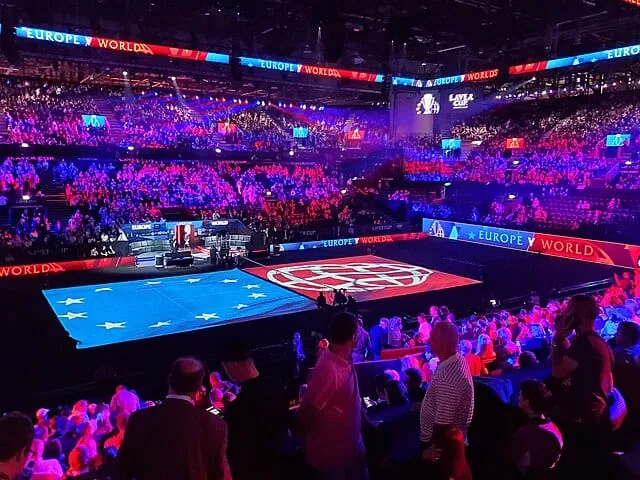
It is one court, indoors, under stage lighting, with the surface laid dark so the ball reads bright on television. Five sessions across three days, two each on Friday and Saturday, one long one on Sunday. The crowd is split by colour, red for the World and blue for Europe, and unlike the polite quiet of a Grand Slam nobody is asked to behave.
The best reason to watch, if you are not a tennis person, is the sound. Coaching is permitted and audible. You hear what a captain actually says to a player who is losing, which turns out to be far less tactical and far more human than you would imagine. You hear teammates arguing about whether to challenge. It is the closest the sport comes to letting you inside the huddle, and it makes the players legible in a way that four hours of Grand Slam silence never quite does.
The doubles are the other reason. Every day ends with one, and the pairings are often ridiculous on purpose: two enormous servers who have never played together, a veteran and a debutant, whoever the captain thinks will enjoy themselves. The quality can be scruffy. The entertainment almost never is.
Three days, and then the season keeps going
Between now and then there is one more thing on the calendar: the Davis Cup qualifiers on 18, 19 and 20 September, when fourteen national teams play for seven places in the Finals in Bologna in November. Some of the men who will be sitting on those benches at the O2 will have spent the previous weekend playing for their countries in half-full arenas in places the tour never visits. That is a good week for team tennis, and a hard one for anybody hoping these players get a rest.
After London the sport heads east for the autumn swing, the indoor season starts grinding towards the year-end finals, and the whole thing accelerates towards November. The Laver Cup sits in that gap deliberately: late enough that the Slam is done, early enough that everybody is still sharp, in a building that seats around 17,000 for tennis and treats the sport like a concert.
Go into it without expecting a Grand Slam and it gives you something a Grand Slam cannot. Twelve of the best players in the world, in one room, for three days, with nothing on the line except each other.
Four years ago in this arena that arrangement produced a man in a dark blue jacket weeping on a bench while the person he had spent his whole career trying to beat wept beside him. That is what happens when you put tennis players on a team and tell them the result matters. They believe you.
Photo: the Laver Cup arena during the opening ceremony, Team Europe in blue on one side of the court and Team World in red on the other.
🎾 Gear from this story
BabolatBabolat Pure AeroCarlos Alcaraz's racket of choiceView on Amazon →As an Amazon Associate, SUPER.TENNIS earns from qualifying purchases.