There is a number sitting underneath Sunday afternoon in New York, and the number is twenty-three.
That is how many years it has been since an American man won a Grand Slam singles title. Andy Roddick beat Juan Carlos Ferrero at this tournament in 2003, held the trophy over his head on a warm September evening in Queens, and nobody from his country has done it since. Twenty-three years is long enough that a child born the week Roddick won it is now old enough to have graduated, moved cities and started complaining about rent. It is long enough that an entire generation of American tennis fans has grown up without ever seeing one of their own lift a major.
On Friday night, in front of a home crowd that spent four sets shouting itself hoarse for both men, Ben Shelton beat Frances Tiafoe 4-6, 6-3, 6-3, 7-5 and put himself one match away from ending it. He is 23 years old. He is left-handed, absurdly powerful, coached by his father, and on Sunday at two o'clock he walks onto Arthur Ashe Stadium to play Alexander Zverev for the US Open title.
You do not need to know a forehand from a backhand to feel what is stacked up behind that sentence. Here is the story of how Shelton got here, who is standing in his way, and why Sunday is worth rearranging your afternoon for.
The night it turned, and the game that decided it
For about forty minutes on Friday, this did not look like Shelton's night at all.
Tiafoe, seeded eleventh and playing the kind of loose, joyful tennis that has made him one of the most watchable men in the sport, was the sharper player from the start. He broke in the ninth game of the first set, held to love to close it out, and Shelton spent that opening half hour making fourteen unforced errors and looking like a man trying to hit the ball through the back wall of the stadium rather than past the person in front of him.
Then he settled. Not dramatically, not with a roar, but the way a big serve settles: one clean hold, then another, then the sense creeping across the court that Tiafoe was going to have to play a perfect point to win an ordinary one. Shelton started leaning on the serve. He started making Tiafoe run to the forehand corner over and over, and eventually that forehand, the shot Tiafoe plays with such flair when he is comfortable, began to break down under the weight of it.
The whole match funnelled into one game at the end of the third set. Fifteen minutes long. Nineteen points. Shelton had to earn the break four or five different ways before he finally got it, and when he did, something went out of the match. Tiafoe still needed to break serve to survive, and against 20 aces and a man hitting through the court the way Shelton was by then, that was a tall order in the fourth set. Shelton finished with 47 winners to Tiafoe's 27, which is the statistical way of saying he was the one making things happen.
Afterwards, Shelton dedicated the win to his grandmother, who died earlier this year. She was the one, he said, who got his father into tennis in the first place. Every family in this sport has a person like that somewhere in the story, the one who drove to the courts or paid for the lessons or simply said yes when it would have been easier to say no. Most of them never get mentioned on a microphone in front of 23,000 people.
What twenty-three years actually looks like
It is worth being precise about the American wait, because the numbers get muddled in the telling.
The title drought is 23 years: Roddick, here, 2003. That is the last major won by an American man, and it has now outlived Roddick's entire playing career, his broadcasting career and a fair chunk of his coaching one.
The finals drought is shorter and more recent. Taylor Fritz reached this final in 2024, losing to Jannik Sinner, and in doing so became the first American man in a US Open final since Roddick himself in 2006. So Shelton is not breaking new ground simply by being here. What he would be breaking, if he wins on Sunday, is the thing that has actually hurt: not the reaching, but the finishing.
There is one more line in the record book that landed on Friday, and it is the one that gives the weekend its weight. Shelton is the first Black American man to reach the US Open final since Arthur Ashe in 1972, and the first to reach any major final since MaliVai Washington at Wimbledon in 1996. Ashe, of course, is the reason the enormous blue building Shelton will walk into on Sunday has the name it does, a story about far more than tennis that we have written about at length before. There is a neatness to it that nobody planned and everybody noticed: an American who looks like Ashe, playing for the title, in the stadium named after him, fifty-four years after Ashe last stood in a final on this ground.
Shelton is also the youngest American man in a US Open final since a 21-year-old Roddick in 2003, which is the sort of statistic that tells you how thin the pipeline has been at the very top, even in years when American men have filled the second week.
Six matches, and one that ended at 3:33 in the morning
Nobody hands you a run like this. Look at the list of players Shelton had to get past.
Round one: Tallon Griekspoor, a top-fifty Dutchman with a flat, heavy ball, who took the opening set 6-1 before Shelton found his range and won 1-6, 6-1, 7-6(3), 6-2. Round two: Hubert Hurkacz, a former Wimbledon semifinalist whose serve is one of the few in the sport that genuinely stands comparison with Shelton's, in four sets. Round three: Denis Shapovalov, the shot-maker, another lefty, another man capable of playing forty minutes of unplayable tennis. Round four: Stefanos Tsitsipas, twice a major finalist.
And then the quarterfinal, which is the match this fortnight will be remembered for.
Carlos Alcaraz arrived in New York as the defending champion and the second seed, carrying an 18-match winning streak at Grand Slam level. He and Shelton went five sets and four hours and 28 minutes on Arthur Ashe, and the thing did not finish until 3:33 in the morning, the latest finish in the history of the US Open, breaking a record that had stood since Alcaraz and Sinner played until ten to three in 2022. Shelton won 6-7(5), 6-1, 6-3, 1-6, 7-6(7). A tie-break in the fifth, at half past three in the morning, against the best hard court player of his generation.
You can argue, as plenty have this week, that a tournament should not be finishing matches at that hour, that it is bad for the players and worse for the people who buy tickets and have to work on Wednesday. Those are fair arguments and the sport should probably listen to them. But if you were awake, you saw something you will describe to people for years.
It matters, too, that the draw around Shelton had already been torn up. Sinner, the Wimbledon champion, withdrew before the tournament with a knee injury. Novak Djokovic went out in the first round. When this fortnight began we wrote that nobody had the faintest idea who was going to win it, and that turned out to be the most accurate thing anyone said all summer. Alcaraz losing in the quarters guaranteed that this tournament would crown a first-time US Open champion, whatever happened next.
The serve that was not 158 miles per hour
One small, delightful subplot from Friday, because it says something about how tennis now works.
Midway through the third set, the stadium screen flashed up a Shelton serve at 158 miles per hour. Arthur Ashe went up like a firework. That would have been the fastest serve in the history of the tournament by a distance, past the 153 mph Taylor Dent hit here in 2004, and quite possibly the fastest ever struck at a Grand Slam.
It was not real. Hawk-Eye reviewed the reading and corrected it to 144 mph, a radar misread rather than a record. Shelton's genuine fastest of the match was 149 mph, which remains a preposterous thing for a human being to do with a piece of graphite while standing still.
The correction is a footnote, but a telling one. This is a tournament that has handed its line calls over to the machines entirely, and we now trust the tracking system so completely that when the stadium gun said 158 and the computer said 144, nobody seriously argued for the gun. The number on the big screen is not the truth any more. The number in the system is.
The college kid who skipped the queue
If you have not followed Shelton closely, the short version is that he took a route almost nobody at this level takes any more.
Most players in a Grand Slam final left school early, moved to an academy at 13 or 14, and spent their teenage years in airports. Shelton went to university. He played for the Florida Gators, where his father Bryan, a former professional who spent years on tour himself, was the head coach. In 2022 he won the NCAA singles title, and only then did he turn professional, at an age when most of his rivals had already been on tour for four or five years. It is a path we spent some time on this summer when he reached a Masters 1000 final against another product of the American college system and then won the thing.
The catching up was fast. Within a year he had reached the Australian Open quarterfinals and then the semifinals here in 2023, beating Tiafoe in that quarterfinal too. This season has been the best of his life: four titles, including the Masters 1000 in Montreal, a 2026 record of 38 wins and 13 losses, and a ranking of world No. 9 that made him the eighth seed in New York.
And through all of it, the man in his box has been his father. Bryan Shelton is still the coach. That is rarer than it sounds at this altitude of the sport, where family members are usually eased out and replaced by specialists somewhere around the top twenty. On Sunday a father whose own playing career never came close to an afternoon like this will sit in the corner of Arthur Ashe Stadium and watch his son play for a major title.
The man on the other side of the net
Alexander Zverev has been almost champion for so long that it became the defining fact about him. Then this June it stopped being true.
The German won Roland Garros, beating Flavio Cobolli 6-1, 4-6, 6-4, 6-7(5), 6-1 in the final, and became the first German man to win a major since Boris Becker three decades earlier. He had been to three major finals before that and lost all three. He had, most famously, led Dominic Thiem by two sets in the 2020 US Open final on this very court and lost in a fifth-set tie-break, 8-6, after both men served for the championship and both were broken. If you want to understand why Zverev spent five years carrying a slightly haunted look into big matches, that is the reason.
Since Paris, he has been the most consistent man in the sport. He reached the Wimbledon final in July and lost to Sinner in four. He has reached the quarterfinals of all four majors this year and the semifinals of all four, a run of 24 wins against two defeats at Grand Slam level in 2026. Sunday is his third consecutive major final and the sixth of his career. He is the top seed. He turns up here at 29 having finally answered the only question anyone ever asked him, which is the kind of thing that can free a player or flatten him, and so far it has clearly freed him. We wrote in August, when he arrived in Cincinnati as the man everyone was chasing, that the pressure on him had changed shape rather than disappeared. It still has.
His route here was less theatrical than Shelton's and no less effective. He beat Luciano Darderi 6-2, 6-2, 7-6(3) in the fourth round, took apart the unseeded Botic van de Zandschulp 6-2, 7-5, 6-1 in the quarters, and then in Friday's semifinal came through against Karen Khachanov 6-3, 7-6(7), 7-6(6), surviving two tie-breaks in which Khachanov held the advantage and could not cash it. Straight sets on the scoreboard, nothing like straight sets in the living.
Five-nil
Here is the sentence that should temper everyone's enthusiasm in the United States this weekend: Zverev has played Ben Shelton five times and won all five, four of them in straight sets.
That is not a coincidence or a run of bad luck. It is a stylistic problem. Shelton's game is built on overwhelming force, on serves that arrive before you have finished thinking and forehands hit at a speed that makes the geometry of the court feel smaller. That works beautifully against players who need time. Zverev does not need time. He is 6ft 6in, he stands well behind the baseline, he has one of the best returns of serve in the game precisely because he is content to block the first ball back and start the rally from there, and he has the rally tolerance of a man who could play tennis until Tuesday.
So the shape of Sunday is fairly clear. Shelton has to find a way to end points before Zverev gets comfortable, which means first serves, which means the second serve becomes the entire match. Zverev has to absorb, extend, and make Shelton play one more ball than he wants to, over and over, until the errors start arriving in clusters the way they did in the first set on Friday.
What Shelton has that the head-to-head does not capture is this fortnight. Nothing in those five previous meetings involved a 23-year-old who had just gone toe to toe with the defending champion for four and a half hours and won a fifth-set tie-break in the dark. Players change. Some of them change in a single week.
What Sunday looks like
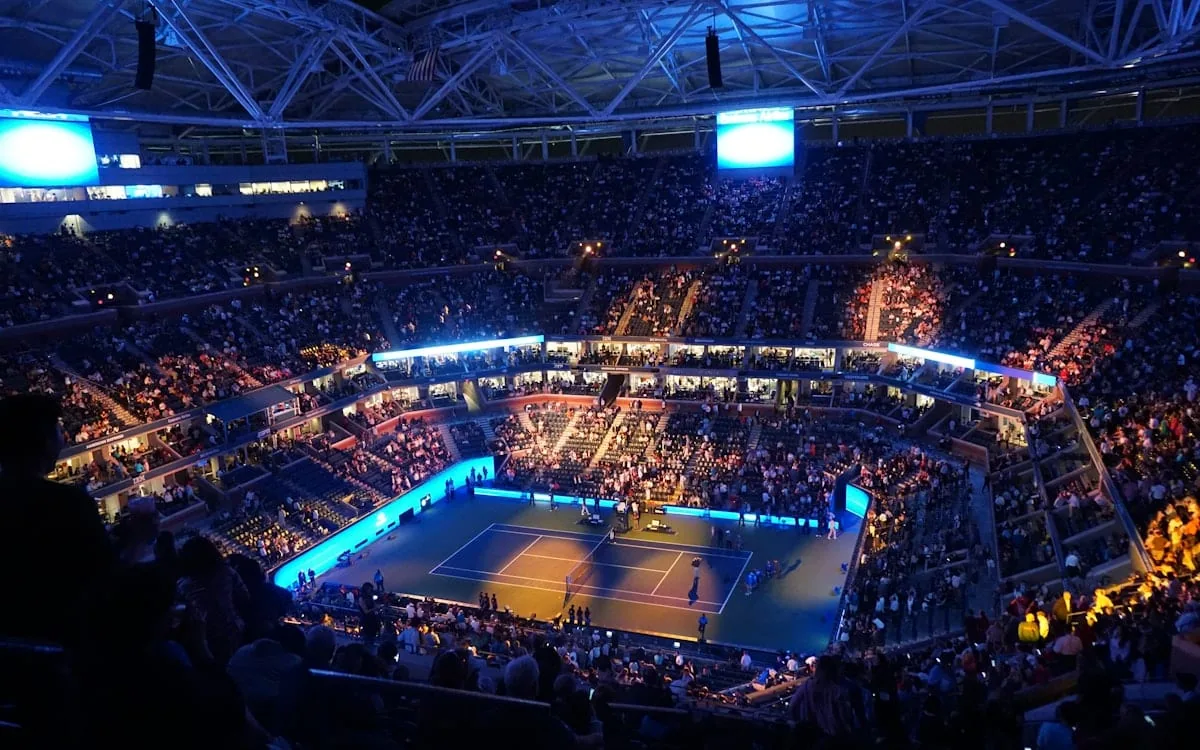
Two o'clock in the afternoon, Arthur Ashe Stadium, Flushing Meadows. Best of five sets. A stadium that holds nearly 24,000 people and will be, for the first time in a men's final in two years, loudly and unashamedly partisan.
If you are watching with people who do not follow tennis, the things to point out are these. Watch Shelton's second serve, because that is where the match will be decided. Watch how far behind the baseline Zverev stands to receive, and how quickly Shelton is willing to come forward to cut the rally short. Watch the scoreboard in the second and third sets rather than the first; Zverev is a slow starter who wins matches in the middle, and Shelton lost the opening set in both the quarterfinal and the semifinal here and won them anyway.
And watch the crowd, which in New York is a participant rather than an audience. Tiafoe against Shelton was already a party. Shelton on his own, with a nation's 23 years riding along, will be something else again.
What we know for certain is that one of them will be holding something on Sunday evening that he has never held before. For Zverev it is the trophy that got away from him on this court six years ago, the one that would confirm that Paris was a beginning rather than a release. For Shelton it is the first major of a career that has not yet had a serious setback, and a piece of history his country has waited most of his lifetime to see.
The wait ends or it does not. Either way, at two o'clock on Sunday, somebody finds out something about himself in front of 24,000 people who will not be sitting down.
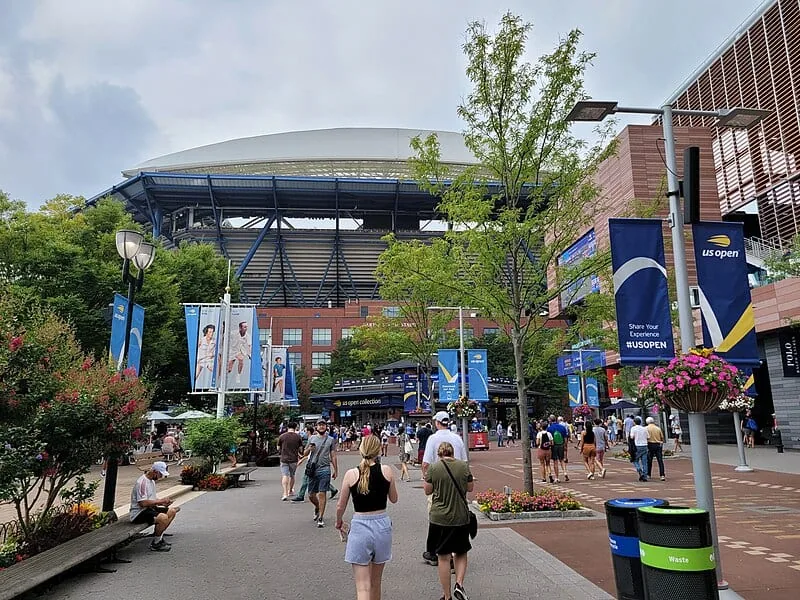
Photo: the grounds at the Billie Jean King National Tennis Center during the US Open.
🎾 Gear from this story
YonexYonex VCORE 98Ben Shelton's racket of choiceView on Amazon →As an Amazon Associate, SUPER.TENNIS earns from qualifying purchases.