There is a particular kind of tennis story that never makes the front page, and this is one of them: on Tuesday night, in a converted rugby stadium on the western edge of Paris, a 30-year-old man from Rome won a tennis match in a building that had never once given him anything.
The score was 6-4, 3-6, 7-6(8). The opponent was Brandon Nakashima, the 14th seed, which means Matteo Berrettini was the lower-ranked player and nobody had him down as the favourite. Twice in the final tie-break Nakashima stood two points from the handshake. Berrettini did not let it happen.
And with that, quietly, on a Tuesday, in front of a crowd that was still finding its seats, he finished something he started years ago.
The one that was missing
The men's tour has nine tournaments that sit just below the four Grand Slams. They are called Masters 1000 events, and if you follow the sport casually you know them by their cities rather than their sponsors: Indian Wells and Miami in the spring, Monte Carlo, Madrid and Rome on the clay, Canada and Cincinnati in the American summer, Shanghai in the autumn, and Paris to finish.
Nine buildings. Nine draws. Every player who stays healthy long enough collects wins across them the way you collect stamps in a passport, without ever thinking about it as a collection.
Berrettini had won matches at eight of them. Not Paris. Paris was the empty page. He had come to this tournament before and left again without a single victory to show for it, year after year, which is the kind of statistic that means nothing at all until someone points it out and then suddenly means quite a lot.
On Tuesday he filled it in. All nine, finally. There is no trophy for that and no ranking points attached to it, and you will not find it on a list of career honours. It is the sort of thing that matters mostly to the person it happened to, and to the people who have been quietly following him through the worst five years of his professional life.
Two points from nothing, again
If you watched the match, the part you will remember is the end.
A deciding-set tie-break in an indoor arena is one of the better things this sport does. The roof traps the noise. Every ball sounds like it has been hit twice. There is no wind to blame and no sun to misjudge, which means there is nowhere to hide either, and both players know exactly how few points are left.
Nakashima got to two match points. Not one. Two. That is the moment where a career of near-misses usually asserts itself, where the body remembers every other time it was asked to do this and politely declines.
Berrettini won it 10-8 in the end. Two hours and a bit of tennis, the last twenty minutes of it played on a knife edge, and he came through on the side he has not often been on lately.
There is a detail here that makes it sweeter. Nakashima had beaten him only weeks earlier, in Shanghai in October. So this was not a stranger across the net; it was the man who had just done this to him. Getting that one back, in the building where nothing had ever gone right, is about as neat as sport gets without trying.
What the last five years actually looked like
To understand why a single win in Paris is worth all these words, you need to know what Berrettini was and what happened to him.
In the summer of 2021 he walked onto Centre Court at Wimbledon in a final. He was the first Italian man ever to do it. He had beaten Hubert Hurkacz in the semi-final, and in the final he took the first set off Novak Djokovic in a tie-break before losing the next three. For a fortnight that July he was one of the most famous athletes in Italy.
He was 25 years old. The serve was enormous, the forehand was heavier than almost anyone's, and the assumption, reasonable at the time, was that there would be more finals.
There were not. What followed instead was a catalogue of injuries: surgery on his hand, abdominal tears, and a hip that has come back more than once to take things away from him at the exact moment they started going well. He has missed Grand Slams he was fit enough to win matches at. He has come back, played four good weeks, and broken again. If you have followed the sport at all over those years you will have seen his name appear on a withdrawal list and felt that small, specific disappointment that is reserved for players you like who cannot stay on court.
This season began the same way. He pulled out of the Australian Open with an abdominal injury before it started, and his 2026 did not begin until February, in Buenos Aires, with a 7-5, 7-5 win over Federico Coria. That is not where a former Wimbledon finalist expects to be restarting his year, on clay in South America in the southern summer, trying to find out whether the body will hold.
What he looks like out there
If you have never sat down and watched Berrettini properly, here is what you are getting, because none of it is subtle and you do not need to understand technique to enjoy it.
The serve comes first. He is a big man and the motion is slow and almost lazy until the final instant, at which point the ball leaves at a speed that makes good returners look clumsy. When it is working he plays whole service games that are over in ninety seconds. There is a particular noise a flat first serve makes when it is struck properly in an indoor arena, a dry crack with no echo in front of it, and he produces that noise more often than almost anyone on tour.
The forehand is the other weapon. It is a heavy, looping swing that he hits from an open stance, usually after shuffling around his backhand to reach the ball, and it lands deep and climbs to shoulder height. Opponents rarely get hurt by one forehand. They get worn down by forty of them.
The long-standing criticism is that there is not a great deal else. The backhand is a slice more often than it is a threat, and against the very best movers he can run out of ideas by the second set. That is a fair reading. It is also exactly why he is a good watch for someone who does not play the sport: the plan is legible from the sofa. Big serve, heavy forehand, get forward, keep the points short. You can follow his tactics in real time without a commentator explaining them to you, which is more than can be said for most matches on tour.
Rome, which explains some of it
He is from Rome. Born there in April 1996, raised there, and he still carries the city with him in a way that Italian players often do.
That matters because of what Italian tennis has become in the years since his Wimbledon final. When Berrettini reached that final he was an outlier, the one Italian man at the very top. Now he is one of a crowd. The country has built something extraordinary in a decade, and if you want the full version of how that happened, we went through it in detail in how Italy built a tennis empire.
There is a version of this story where that is sad: the pioneer overtaken by the people who came after him, reduced to a supporting part in someone else's era. Berrettini has never played it that way. He turns up for the team events, he is visibly delighted when the younger ones win things, and he has spent this season in the role of older brother to a generation that is now ranked above him.
One of those younger ones, Flavio Cobolli, spent the autumn chasing a place at the season-ending finals in Turin. Berrettini is not in that conversation and has not been for years. He was chasing something smaller this week, and he got it.
The other two match points
Here is the part of 2026 that will stay with people.
In May he went back to Roland Garros for the first time since 2021. In the third round he played Francisco Comesana and won 7-6(3), 5-7, 6-7(4), 6-4, 7-6(13). Read the last set again: a tie-break that went to 15-13. He saved two match points in that one too.
It took him to the quarter-finals, his first at a Grand Slam since the 2022 US Open. Four years of waiting, ended on a Saturday in Paris in front of a crowd that had decided somewhere around the fourth set that it was on his side.
Then, in the quarter-final, against his compatriot Matteo Arnaldi, the hip went again. He stopped at 5-7, 2-5 down and walked off in tears. Arnaldi went through to the semi-finals. Berrettini went back to the treatment table.
That is the shape of his career now. Two match points saved in May, in a run that ended with him crying on court. Two match points saved in November, in a match that ended with him winning. Same player, same stubbornness, wildly different endings, and no obvious way to predict which one you are going to get when you sit down to watch him.
Wednesday, and a French crowd
He plays again on Wednesday, and the draw has handed him something genuinely difficult: Ugo Humbert, in Paris, in front of a French crowd that will not be neutral.
Humbert is a good indoor player having a mixed year. He was the runner-up here in 2024, beaten by Alexander Zverev in the final. He missed last year's edition with a back injury, which arrived a week after he retired from the semi-finals in Basel. He opened this week by surviving Botic van de Zandschulp 7-6(5), 6-7(9), 6-3 in the Monday night session, which is the sort of three-set scrap that tells you his level is there but not yet settled.
The two of them have met before and there is nothing between them historically. One win each since 2022.
The crowd is the extra ingredient. No Frenchman has won this tournament since Jo-Wilfried Tsonga in 2008, and every year the home players walk out into a room that wants it badly. Berrettini will be the away player in a loud building, which, given where he has spent the last five years, is probably the least of his problems.
Practically, it is a Wednesday match in central European time, which makes it early evening in Europe, the middle of the working day on the American east coast, and an unreasonable hour almost everywhere else. Indoor tennis is at least predictable: no rain delays, no light fading at the wrong moment, matches that start roughly when the schedule says they will.
If you want the fuller picture of the venue itself, the tournament moved out of its old home this year and we wrote about what that change actually feels like in Paris without Bercy. It is a strange, enormous room, and this is only its second autumn as a tennis arena.
What you are actually watching
Let us be honest about the stakes. Berrettini is not going to win this tournament. He is not going to Turin. If he wins on Wednesday he will have had a nice week, and if he loses, the headline from his Paris Masters career will still be that single Tuesday night.
So why care?
Because the thing that makes this sport worth following for years rather than weeks is watching what people do with the back half of a career. The front half is easy to enjoy and easy to narrate: a young player arrives, the results climb, everyone agrees on what is happening. The back half is where the interesting decisions live. A player who was once in a Wimbledon final has to decide, repeatedly, whether to keep doing this — whether to have the next surgery, rebuild the next time, fly to Buenos Aires in February to find out if the abdomen holds.
Berrettini keeps deciding yes. He said during the French Open that he is the last person who wants to retire, and everything he has done since has backed that up.
There is a specific experience involved in following a player like this, and if you have one of your own you will recognise it immediately. You stop reading ahead. You enjoy the match in front of you rather than the season, because the season has a habit of being taken away in the second week of something that was going well. You learn to treat a healthy fortnight as the prize rather than as the route to a prize. It is a slightly anxious way to be a fan, and it is also why a Tuesday night like this one lands far harder than the rankings say it should.
You can see the same instinct elsewhere on tour, in players who came back from things that should have finished them. Hubert Hurkacz — the man Berrettini beat to reach that Wimbledon final — spent seven months off this year after knee surgery and came back to play Djokovic in Shanghai. It is a small club and its members tend to recognise each other.
A tie-break on a Tuesday night
The detail I keep returning to is how ordinary the setting was.
This was not a final, and it was not the match the evening had been built around. It was a Tuesday fixture between an unseeded Italian and the 14th seed, the kind of fixture that exists mainly as a thing to be got through on the way to the weekend. For most people following the tournament, it was a line on a results page.
And in the middle of it, a man who has spent five years being told by his own body that he cannot have the thing he wants stood two points from another loss in the one building that had never given him a win, and held.
Nobody will build a statue for that. The scoreboard now says 6-4, 3-6, 7-6(8) and will say it forever, and it contains no information whatsoever about what it cost.
But the passport is full. Nine cities, nine tournaments, nine ticks, the last one collected at 30 years old on a November night in Nanterre, years after the first. He walks out again on Wednesday to see what else is left.
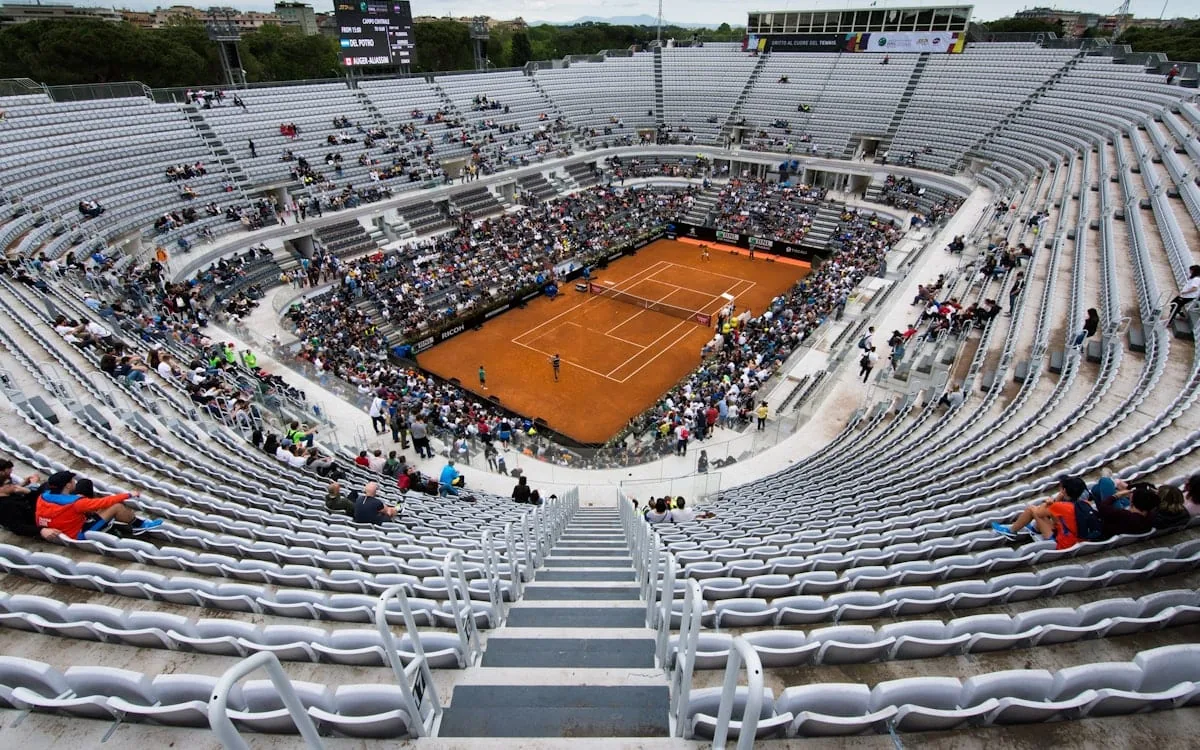
Photo: Campo Centrale at the Foro Italico in Rome, from our picture library.
🎾 Gear from this story
WilsonWilson Blade 98Hubert Hurkacz's racket of choiceView on Amazon →As an Amazon Associate, SUPER.TENNIS earns from qualifying purchases.