The handshake lasted about two seconds. Novak Djokovic put a hand on the back of Hubert Hurkacz's neck, said something short, and walked off to pack his bag. Hurkacz raised a hand to the Shanghai crowd, picked up his towel, and looked for all the world like a man who had just finished a decent practice set.
He had beaten Djokovic 6-4, 6-3. It took him 87 minutes. He had played Djokovic eight times before in his career and lost all eight.
That was Friday night. By Sunday he had beaten a Chinese wild card ranked No. 277 and reached the last sixteen of the Rolex Shanghai Masters, which is the kind of sentence that gets four lines on a results page and no headline at all. Nobody is making a documentary about this. And yet if you follow tennis even loosely, this is the best story in the draw, because of where this particular player was standing two years ago, and what he had to do to get back onto a court at all.
Eight losses, and then not
Start with the number, because the number is the whole thing. Zero and eight. Hurkacz had played the most successful male player in the history of the sport eight times, across eight years, on three surfaces, and had never beaten him. He had come close a couple of times, in the way everyone comes close to Djokovic and then watches the match slip through a trapdoor in the third set.
On Friday he served first, held, broke, and never let the pattern go. Djokovic, who had flown in from Beijing after winning the China Open on the Tuesday, looked like a man playing his third match in six days at the age of 39, because he was. Hurkacz, who is not one for a big claim, said afterwards that of course Djokovic had been struggling a bit, that he had just had an amazing week in Beijing, that it is not easy to recover after a few days.
It was also, as the record books noted immediately, the earliest Djokovic has ever lost in Shanghai. A second round. A tournament he has owned for years, at a venue where the crowd treats him like a local.
None of that takes anything off Hurkacz. It just tells you something about the kind of win it was: not a seismic upset in the moment, but the end of a long private argument. Nine attempts. One result.
The player he used to be
Here is the part a lot of newer fans will not know, because he disappeared for long enough that a whole year of viewers never saw him.
Hubert Hurkacz, from Wroclaw in western Poland, is six foot five. He was born in February 1997, which makes him 29. He has one of the cleanest, least complicated serves on the tour: no theatrics in the ball toss, no grunt, just a very tall man who gets the ball very high and hits it very hard, over and over, until the hour mark goes past and his opponent realises he has had three break points all match.
On 5 August 2024 that serve carried him to No. 6 in the world. That is the highest ranking any Polish man has ever reached in the Open era, and it was not a fluke week. He had been a top-ten regular for the best part of two years.
Before that he had already produced two of the most memorable afternoons of the early 2020s. In Miami in 2021 he beat a teenaged Jannik Sinner in the final, 7-6(4), 6-4, to become the first Polish man ever to win a Masters 1000 title. Three months later, at Wimbledon, he walked onto Centre Court against Roger Federer in the quarter-finals and won 6-3, 7-6(4), 6-0. The third set took 29 minutes. Nobody knew it at the time, but it was the last singles match Federer would ever play. Hurkacz then lost the semi-final to Matteo Berrettini, having become the first Polish man in a major semi-final since Jerzy Janowicz in 2013.
And then there is the one that matters most this week. In October 2023, seeded 16th and ranked 17th, he won the Shanghai Masters. He beat Andrey Rublev in the final 6-3, 3-6, 7-6(8), saving a championship point on the way, firing 21 aces, winning a tie-break that went deep into the extra points. It was his second Masters 1000 and his seventh tour title.
So the man who walked out to face Djokovic on Friday was not a qualifier having the week of his life. He was a former champion of that exact tournament, standing on the exact court where he won it, ranked 34th in the world.
The knee
Wimbledon, 2024. Second round, against the young Frenchman Arthur Fils. Hurkacz went for a ball, something in his right knee gave, and he could not continue. He had torn the meniscus.
If you have never had a knee injury, the thing to understand about a meniscus is that it is cartilage, it does not have much blood supply, and it does not heal the way a muscle heals. It gets repaired, or it gets trimmed, and then you wait. He had surgery. He missed the Paris Olympics. He started the long process of coming back.
And then the knee did not behave. The 2025 season turned into a sequence of stops: a withdrawal here, a back problem there, a tournament entered and abandoned. His last match of that year came in June, at the grass event in s-Hertogenbosch, where he won his opening match and then pulled out of his second with a back issue. He withdrew from Wimbledon. On 2 July 2025 he went back under anaesthetic for arthroscopic surgery on the same right knee, this time to remove an overgrown synovial membrane that had been quietly inflaming the joint from the inside.
Two operations on the same right knee, about a year apart.
In September 2025 he posted the message that every injured athlete eventually has to write: he would not play another tournament that year. He said he would come back when he was 110 per cent ready.
Read that as a sportsman talking. Then read it as a 28-year-old doing arithmetic about how many more seasons he gets.
What falling out of the top 100 actually does
Fans tend to see ranking as a scoreboard. For a player it is closer to a passport, and this is the part worth understanding if you want to know why Shanghai means something.
Ranking points fall off exactly one year after you earn them. If you are injured, you are not merely failing to add points, you are watching last year's points evaporate on a schedule you cannot alter, week after week, from a sofa. Hurkacz had the points of a top-six player to lose, and he lost them in public, one Monday at a time. By late September 2025 he was 69th. By the time he actually played again he was outside the top 50, and across the early months of 2026 he dipped into the 90s and, briefly, out of the top 100 altogether.
What that costs you is not pride. It is access. Inside the top 100 you get into the main draw of the Grand Slams automatically. Below it you qualify, which means three extra matches in the week before the tournament even starts, against players who have nothing to lose. A protected ranking helps with entries for a while, but it does not buy you a seeding, and an unseeded former top-ten player is the single worst thing that can appear in anybody's first round. Everybody in the locker room knows who you are. Nobody has to respect your number.
So the comeback is not one grand moment. It is a year of walking into draws where you are the dangerous floater nobody wanted, and winning enough of those to climb back into a world where the draw protects you again. Hurkacz is currently 34th, which is roughly two places away from being seeded at a major. That is what he has been playing for all season.
January, Sydney, a deciding rubber
The return, when it came, could not have been better scripted.
Poland had reached the United Cup final in 2024 and lost. They reached it again in 2025 and lost. In January 2026 they got there a third time, against Switzerland, and the man they sent out to keep them alive was playing his first tournament in seven months.
Iga Swiatek had already lost the opening rubber to Belinda Bencic. Hurkacz went out against Stan Wawrinka, a 40-year-old with three major titles and absolutely no interest in being a sentimental footnote, and won 6-3, 3-6, 6-3, hitting 18 aces to force a deciding mixed doubles. Katarzyna Kawa and Jan Zielinski then won that 6-4, 6-3, and Poland had their first United Cup.
Swiatek, who had watched the whole thing from the bench, summed it up in four words that travelled further than any press release: Hubi, what a comeback.
He said the trophy tasted incredible. He also said, more quietly, that seven months of difficult times with his team had been very challenging. Earlier in the same event he had beaten Alexander Zverev, which is not something a man ranked outside the top 50 is supposed to do in his first week back.
His coach Nicolas Massu, who knows something about long roads, put it plainly: nothing is impossible if you maintain the work ethic.
A season of nearly
What followed was not a fairy tale. It was ten months of grind with the texture of real life.
In May he was in Cagliari, on clay, playing a Challenger: the tier below the main tour, the level a former world No. 6 does not expect to see again. He lost the final to Matteo Arnaldi, 6-4, 6-4. He got to the fourth round at Wimbledon, on the surface where his game has always made most sense, and had to retire against Jan-Lennard Struff with abdominal trouble. Anyone watching that would have felt the same cold thought: here we go again.
In late September he reached the Chengdu final, his first at tour level since the knee went, beating Lloyd Harris and then coming from a set down against Denis Shapovalov. In the final he led a second-set tie-break 6-3 and did not win it. Alejandro Davidovich Fokina took six of the last seven points and the title, 6-4, 7-6(7). Hurkacz climbed to 39th anyway.
Then Beijing, and a genuinely good week: he made the semi-finals. And midway through the second set against Alex de Minaur, with a place in the final in reach, he stopped. An adductor problem. He retired.
That was Monday 5 October. He was back on a match court in Shanghai on the 8th, beating James Duckworth with 19 aces. He beat Djokovic on the 9th. He beat the wild card Zhou Yi 6-2, 3-6, 6-3 on the 11th to reach the last sixteen.
Three days off, then three wins. Put next to two knee operations, that is the detail that tells you what his autumn has actually been.
Why this tournament, of all tournaments
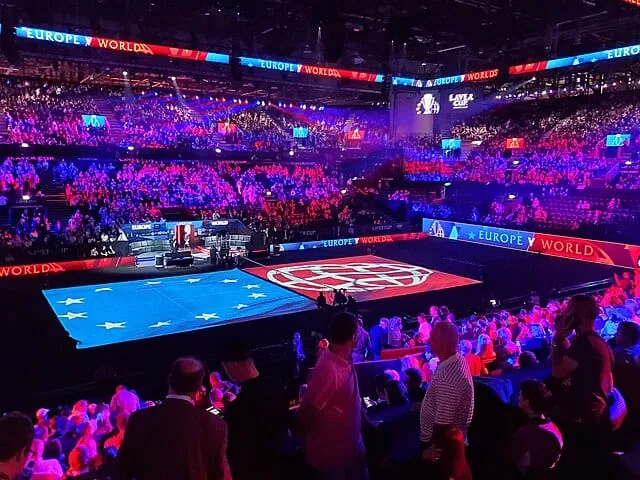
Shanghai is a twelve-day Masters 1000 played at the Qi Zhong Tennis Center, and it is one of the great sensory experiences in tennis if you ever get the chance: enormous, loud, with a roof built to look like a magnolia flower opening above the court. It ran from 7 October this year and finishes on the 18th. Alexander Zverev is the top seed, Carlos Alcaraz is in the field, and the defending champion is Valentin Vacherot, whose own story last year was so improbable that it has become the reference point for everything strange that happens here.
For Hurkacz the place carries a different weight. This is where the best week of his career happened, in a fortnight in 2023 when his serve simply did not break down. Courts remember nothing, but players do. He is one match into the second week at the venue where he is a former champion, in the same city, in a draw where the two highest-profile names he might have had to face have already been removed, one of them by him.
He is not going to the ATP Finals. The eight chairs in Turin were never part of this conversation, and he would be the first person to say so. What is at stake is smaller and, for him, probably more valuable: ranking points that firm up a seeding at the Australian Open, and the simple evidence that the body will now hold for a fortnight.
The rematch nobody planned
And here is the draw doing what draws do.
Waiting in the last sixteen is Alejandro Davidovich Fokina, the 25th seed, the Spaniard who took that Chengdu final off him thirteen days ago. Davidovich Fokina arrived at this round by beating Frances Tiafoe 7-6(4), 4-6, 7-6(6), saving a match point in the final tie-break, in a match several people watching called the best of the tournament so far. It was his first win of the season over a top-ten player, and he celebrated like a man who had been waiting for permission.
So you get two players in roughly the same place in their lives, both of them recently back from injury layoffs, both of them currently playing the best tennis they have produced in a year, meeting for the second time in a fortnight with a quarter-final at a Masters 1000 on the table. One of them lost a tie-break from 6-3 up the last time they did this.
If you are planning to watch anything from China this week, that is the one. Meanwhile in Wuhan, the last big women's event of the season, Iga Swiatek is in a draw that has lost its world No. 1 and its defending champion to injury and fatigue, so Polish tennis has two things worth following at once for the first time in a long while.
The part that does not show up in the result
Here is what I keep thinking about, and it has nothing to do with Djokovic.
Somewhere in a clinic in the summer of 2025, a surgeon went into the right knee of a 28-year-old man for the second time, to clean out a membrane that had grown where it should not have grown. Outside, the tour carried on. Players Hurkacz had beaten were winning titles. His ranking fell every Monday morning like a slow leak. And he had to decide, with no audience and no scoreboard, whether to do several thousand repetitions of extremely boring rehabilitation on the chance that it might eventually lead to a Friday night in Shanghai.
He did them. The chance came in. He did not celebrate much when it landed, because by then the result was almost the least interesting part of it.
If you want a way to watch his next match, ignore the ranking next to his name and watch his movement in the fourth and fifth games of a set, when a tall man with two knee surgeries has to change direction twice in one point. That is where you will see whether the comeback is finished or still going. The serve was never the question.
Photo: two rackets on a court floor, the strings and the frames close enough to read.
🎾 Gear from this story
HeadHead Speed ProNovak Djokovic's racket of choiceView on Amazon →As an Amazon Associate, SUPER.TENNIS earns from qualifying purchases.