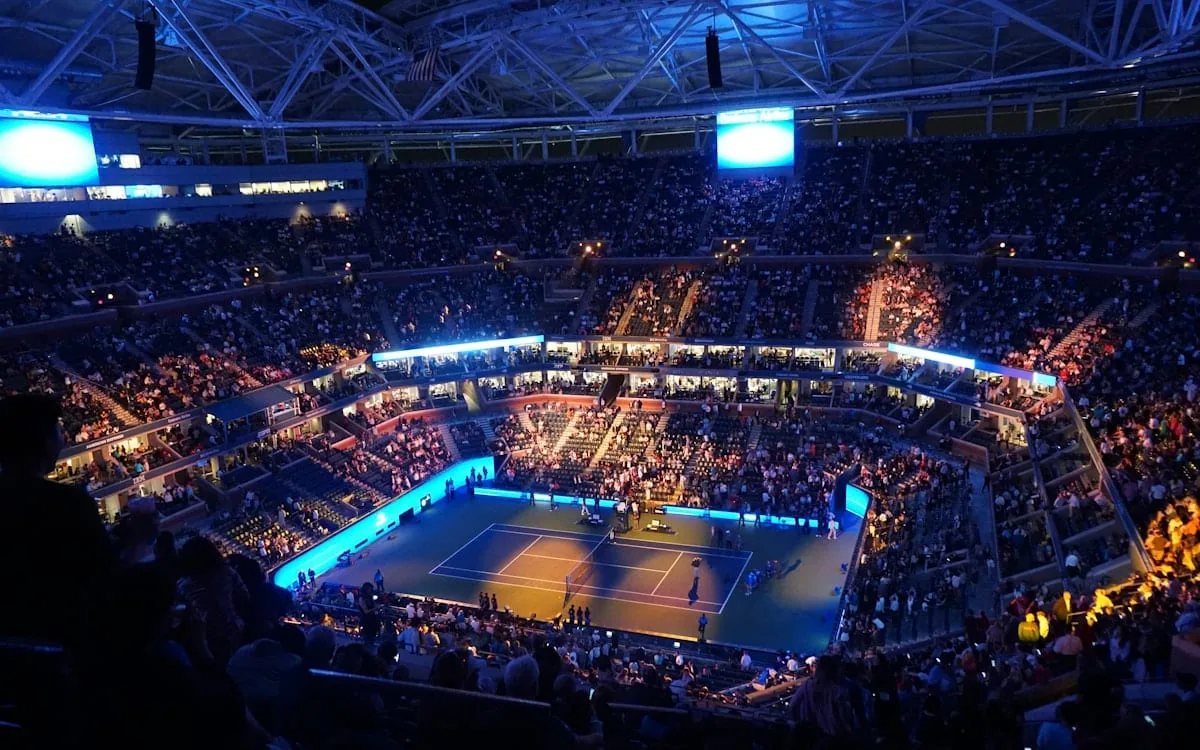
On Sunday afternoon, in five different cities, somebody is going to be handed a large silver object by a man in a suit whose name they will not catch.
It will happen in Almaty, where the Almaty Open finishes its week. It will happen in Lyon and in Brussels, where two more ATP events end the same day. It will happen in Ningbo, where the WTA 500 closes, and in Osaka, where the Japan Open does the same at the Utsubo Tennis Center. Five tournaments, all of them running from 19 to 25 October, all of them ending on the same Sunday, all of them finishing with the same small ceremony: a presentation table, a sponsor, a short speech, and a trophy.
And almost nobody watching can answer the obvious follow up questions. Who made it? Where was it made, and by whom, and out of what? Is it the real one, or a copy? Does the winner take it home, or does somebody quietly collect it afterwards and put it back in a box?
These sound like trivial questions. They are not. The trophy is the one object in the entire sport that exists purely to be given away, and the stories behind the good ones are better than almost anything else in the game.
The thing you are watching is usually not the thing
Start with the biggest surprise, because it changes how you watch every final from here on.
When a player lifts a trophy at a Grand Slam, they are almost never holding the object they will keep. At Wimbledon the gentlemen's cup, silver gilt, made in 1887 and standing about eighteen and a half inches tall, belongs to the All England Club and stays there. The ladies' prize, the Venus Rosewater Dish, is the same story: the original lives in the museum. Champions get replicas. From 1949 until 2006 that meant a miniature, about eight inches across. Since 2007 it has been a three quarter size version, around fourteen inches, with every previous champion's name on it.
The Australian Open works the same way. So does Roland Garros. So does the US Open, where Tiffany and Company has made the silverware since 1987 and where, as the house describes it, the winner leaves with a keepsake replica rather than the perpetual trophy.
Once you know this, the trophy ceremony changes shape slightly. The long pause while a player holds the cup over their head, turning slowly for the photographers, is a pause with a rented object. The real one goes back into a display case about an hour later, and a different, slightly smaller one gets couriered to a house in Monte Carlo or Mallorca or Minsk some weeks afterwards.
This is not a scandal. It is the only sensible way to run a championship that has been going for a hundred and forty years and intends to keep going. But it does mean the most emotional thirty seconds in tennis are staged around a loan.
Three workshops, three countries, one very old craft
Follow the trophies back to where they come from and you end up in a small number of workshops, most of which have nothing to do with sport.
The Australian Open cups are made in Sydney. Since 2022 the Daphne Akhurst Memorial Cup has been crafted by W.J. Sanders, a Sydney silversmith, working with ABC Bullion, out of Australian silver. The men's prize, the Norman Brookes Challenge Cup, was first presented in 1934, financed by the state tennis associations, and its shape is usually traced back to the Warwick Vase, an enormous second century Roman marble vase that has nothing whatsoever to do with tennis and everything to do with the fact that the 1930s thought Roman vases looked important.
The US Open trophies come out of a Tiffany workshop in Rhode Island. The house says each one takes around six months to produce and roughly sixty six hours of actual hand labour, using the old techniques, spinning and chasing and engraving. The men's and women's singles trophies were different sizes until 2023, when they were finally made to match.
Paris names its cups after people rather than describing them. The men's prize is the Coupe des Mousquetaires, for the four French players who dominated the late 1920s and were nicknamed the Musketeers: Jean Borotra, Jacques Brugnon, Henri Cochet and Rene Lacoste, the last of whom you have worn without necessarily knowing it. The women's prize is the Coupe Suzanne Lenglen, for the player who made women's tennis a thing people bought tickets for in the first place. There is something quietly confident about a tournament that does not bother explaining its trophies on the trophy, on the assumption that you already know the names.
And then there is London, where a firm called Thomas Lyte quietly makes or looks after an improbable share of the sport. They hold a Royal Warrant as goldsmiths and silversmiths. They make the trophies for the season ending ATP Finals, singles and doubles. They make the year end world number one trophies. They make the Billie Jean King Trophy that goes to the winner of the WTA Finals, which this year moves to Indian Wells in November. They are the restorers of the Davis Cup and the Billie Jean King Cup.
Sit with that for a second. If you watch the back end of the season, from the chairs at the ATP Finals through to the team events, a very large proportion of the silver you see on television has passed through one building in London. The people who polish out the dents are the same people who made the thing in the first place.
It is the same kind of invisible expertise that keeps the rest of the tour standing up. The people who actually make the week work are rarely the ones in shot, which is also true of the stringing rooms that turn out six hundred rackets a day at a big event.
The engraving problem
Here is a problem nobody designing a trophy in the 1880s thought about: what happens when you win too much?
Every champion gets their name on the cup. For a few decades that is fine. Then the surface fills up. On the Venus Rosewater Dish, the names of the champions from 1884 to 1957 are engraved on the inside. From 1958 onwards they had to go on the outside, because the inside was full. The men's cup eventually ran out of room on its body altogether and had a plinth added beneath it, a dark band of extra real estate purely so the engraver had somewhere to put the next thirty years.
I find this unreasonably moving. Somewhere in the paperwork of a sport that likes to talk about eternal glory is a committee meeting about running out of space. The solution was not to stop engraving. It was to build the trophy a small extension.
There is a related detail that has defeated everybody who has tried to explain it. On top of the Wimbledon men's cup sits a pineapple. Nobody is certain why. The museum's working theory is that in the seventeenth century pineapples were an extraordinary luxury in Britain, imported at vast expense and displayed at feasts as a show of honour and wealth, so sticking one on a lid was a way of saying that this was a serious prize. Historians have also pointed out, more bluntly, that it has nothing to do with Wimbledon or tennis at all. It is just there, polished, on top of the most famous trophy in the sport, and it has been there since the Victorians.
The dish has a similar quirk. The figure in the middle is not Venus. It is Sophrosyne, the personification of temperance and moderation, from a design that goes back through a German craftsman to a sixteenth century French pewter dish. The name Venus came later, from the decoration. The most coveted object in women's tennis is a Birmingham made copy of a Renaissance plate about the virtue of self restraint, and it is handed to someone who has just spent two weeks refusing to lose.
The small cup on the enormous stack
The best trophy story in tennis belongs to the Davis Cup, and it starts with a student buying something with his own money.
In 1900 Dwight Davis, then a Harvard undergraduate, paid about a thousand dollars of his own funds for a silver bowl from Shreve, Crump and Low in Boston. The design came from the William B. Durgin firm in Concord, New Hampshire, and the actual silversmithing was done by an Englishman, Rowland Rhodes. The cup itself is not large: around 217 ounces of silver, about thirteen inches tall and eighteen across. A good sized punchbowl.
What makes it absurd is everything underneath. Over the decades the winners' names filled the bowl, so plinths were added. Then more plinths. The whole assembly now stands over a metre tall, more than a metre wide, and weighs in the region of a hundred kilograms. The trophy has become mostly base. The original object, the bit Dwight Davis actually bought, sits on top like a lid on a wedding cake.
It was not even called the Davis Cup officially until after he died in 1945. For most of its early life it was simply the international lawn tennis challenge trophy, which is the kind of name that tells you nobody expected it to last.
And the Laver Cup, which is only a few years old, did something lovely with the same idea. Its trophy was made in London from molten metal taken from one of Rod Laver's own early singles trophies. Somebody melted down a piece of a man's youth and recast it as the prize that now carries his name. If you watched the event return to the O2 in London this year, that is what was standing between the two benches.
The trophies that are not trophies
Not every tournament hands over silver.
In Stuttgart, at the Porsche Tennis Grand Prix, the champion gets a car. This has been true since the first edition in 1978, when Tracy Austin was given the keys to a sports car at eighteen years old. The model changes every year. In 2026 Elena Rybakina won the title and drove away in a 911 Carrera S Cabriolet.
The genuinely clever part is where they put it. The car sits on a rostrum at one end of Centre Court for the entire week, in full view, while the matches are played around it. Every player who walks out to serve can see exactly what she is playing for, gleaming under the lights, not quite hers. Angelique Kerber, who won there twice, called it the most beautiful trophy on the WTA Tour.
Rybakina is the top seed in Ningbo this week, where she is also the defending champion, having won the title on her first appearance there last season. If she retains it on Sunday the prize will be considerably easier to get into a taxi.
The ones nobody photographs
Which brings us back to Almaty, Lyon, Brussels, Ningbo and Osaka.
At this level of the calendar there is no museum waiting. There is no perpetual cup that gets wheeled out for the ceremony and wheeled back into a vault. The trophy handed over on Sunday is, in all likelihood, simply the trophy. It belongs to whoever wins it from the moment it touches their hands.
That creates a small logistical comedy that goes almost entirely unreported. A player finishes a tournament in Kazakhstan on Sunday evening and is due in Europe for the indoor swing. They now own a large, awkward, non collapsible silver object with sharp handles. It does not fit in a racket bag. It is not going in the hold unwrapped. Somebody on the team ends up carrying it through an airport by hand, in a cardboard box, like a man taking a cake on a train.
Nobody designs for this. Trophies are designed for the photograph: the moment when a player lifts the thing above their head against the sponsor wall and the week becomes permanent. What happens to the object in the forty eight hours afterwards is somebody else's problem, usually a coach's, and it is the least glamorous task in professional sport.
There is also the plain fact that most of these trophies will be the only one that player ever wins. The tour produces perhaps sixty or seventy singles champions in a season across both tours. The overwhelming majority of professionals never become one of them. For a player ranked in the eighties who comes through a week in Brussels, that object is not one of a collection. It is the proof.
Where they end up
So where do they go?
The honest answer, for most players, is: a parent's house. A shelf in a childhood bedroom, or a cabinet in a hallway in a town nobody visits, dusted occasionally by somebody who was there when the kid was nine and could not hit a backhand.
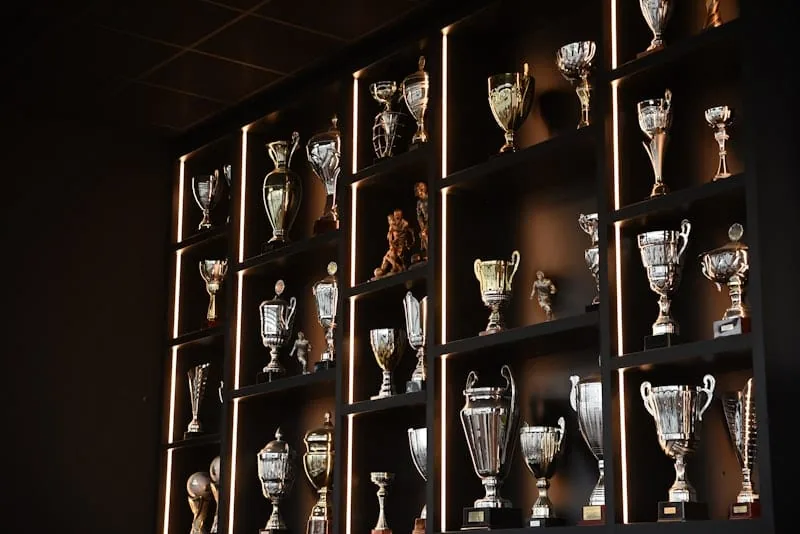
For the very small number at the top, it becomes an architectural problem. Rafael Nadal solved it by building a museum. His trophies are displayed at the Rafa Nadal Museum inside his academy in Manacor, arranged chronologically, starting with the junior titles and running up through the Grand Slams, so that visitors walk the length of a career in a few rooms. Other players keep them at home, in rooms they rarely show, and find they stop looking at them after a while.
And there is a whole further market that most fans never see, where rackets and shirts and the occasional piece of silver change hands between collectors. If that idea appeals, we went through how to start collecting tennis memorabilia earlier this month, including the question of what is actually worth owning.
The season has about six weeks left. There are more trophies coming: the indoor events, the Paris week, the eight men in Turin fighting over the last chairs at the ATP Finals, the eight women at Indian Wells in November, and the team events after that. Each one has a maker, a history, and in a few cases a pineapple.
What the object is actually for
Watch the hands on Sunday, in whichever of the five finals you end up with.
There is a very specific thing a player does in the first second after the trophy is passed to them, before the lifting and the turning and the photographs. They look down at it. Not at the crowd, not at the camera, not at their box. Down, at this cold heavy thing that has just been placed in their arms, with an expression that is not quite triumph. It looks more like someone checking that an object is real.
That is what the silver is for. Not the engraving, not the pineapple, not the replica policy or the Rhode Island workshop or the hundred kilograms of Boston punchbowl on its tower of plinths. Those are just the apparatus. The actual function of a trophy is to be heavy enough and solid enough that for one second a person who has spent their whole life chasing something abstract can hold it in two hands and confirm, by weight, that the week happened.
The ones in Almaty and Lyon and Brussels and Ningbo and Osaka will do that job just as well as the famous ones. And at this time of year, with the light going early and the season winding down, five of them in a single afternoon feels like quite a lot of proof to hand out at once.
🎾 Gear from this story
YonexYonex Ezone 98Naomi Osaka's racket of choiceView on Amazon →As an Amazon Associate, SUPER.TENNIS earns from qualifying purchases.