Jasmine Paolini had three set points in a row on Tuesday in Tokyo, all of them on Naomi Osaka's serve, in the twelfth game of the second set. The home crowd at the Ariake Coliseum made the noise a home crowd makes when it is trying very hard not to panic: loud, then suddenly not loud at all.
Osaka saved all three. She won the tiebreak 7-4, closed the match out 6-3, 7-6(4), and walked off with thirty winners and six aces next to her name. If you were watching from Europe or the Americas, you were watching at an unsociable hour, on a stream you had to hunt for, in the last week of October, in a tournament a lot of people could not name.
That tournament is the Toray Pan Pacific Open. It has been going, under one name or another, since 1973. It is older than the Miami Open, older than Indian Wells as we know it, older than almost everyone currently playing in it. And it is one of the quiet pleasures of the tennis year, if you know what you are looking at.
It started with a fabric company
The event began life in 1973 as the Toray Sillook Championships. Toray is not a sports brand. It is a Japanese materials company, the sort that makes synthetic fibres and carbon composites, and it put its name on a women's tennis tournament in Tokyo and then simply never stopped.
In 1984 the event took the name it mostly still carries, the Pan Pacific Open, and the first champion under that banner was Manuela Maleeva of Bulgaria, who beat Claudia Kohde-Kilsch 3-6, 6-4, 6-4. Maleeva was nineteen. Kohde-Kilsch would go on to win two Grand Slam doubles titles. Neither of them is a household name now, which is rather the point: this tournament has been quietly collecting champions for longer than most sponsorship deals survive.
Think about how rare that is. Tournaments change names every few seasons as backers come and go. Cities lose events. Whole weeks vanish off the calendar and reappear somewhere else. Toray has been there for more than fifty years. If you want to understand why Tokyo still has a serious women's tournament in a crowded, contested calendar, start there.
Twenty-four years on carpet
For most of its modern life, the Pan Pacific Open was an indoor event, and that is a different sport from the one you will watch this week.
From 1984 to 2007 it was played at the Tokyo Metropolitan Gymnasium in Yoyogi, on carpet. Carpet courts were fast and low. The ball skidded. Points were short, angles were brutal, and players who could flatten the ball out and get to the net had a genuine edge. It rewarded a kind of tennis that has very nearly disappeared.
The roll of champions from that era reads like a tour of the game's recent history. Martina Navratilova won it in 1989, beating Lori McNeil. Kimiko Date won in 1995 and became the first Japanese champion of her own national tournament, a result that still gets mentioned in Tokyo three decades later. Martina Hingis won in 2002 and again in 2007. Maria Sharapova took the title in 2005 and 2009.
Carpet has since all but vanished from professional tennis. The tour moved towards slower, more uniform hard courts, partly because long rallies make better television and partly because a surface that rewarded flat hitting and net rushing was squeezing out the players who had grown up grinding. Watch a clip of a Tokyo final from the 1990s and the ball moves differently. It stays low, it hurries people, and matches end in an hour. There is no professional week left on the calendar that looks like that.
In 2008 everything changed. The tournament moved across the city to the Ariake Coliseum and out of doors, onto hard courts, and the character of it shifted with the surface. No more skidding carpet. Longer rallies, heavier conditions, a bigger stadium, weather as a factor again. It became a recognisably modern event almost overnight.
The building with the sliding roof
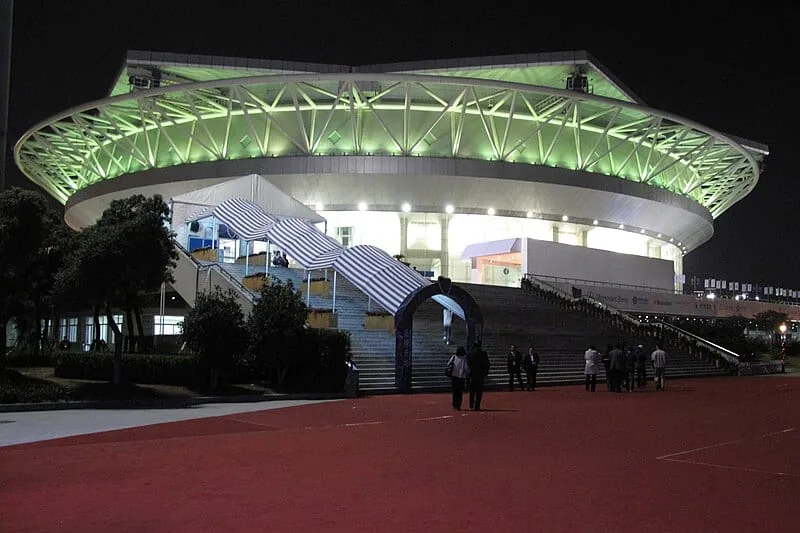
Ariake Coliseum is worth a paragraph of its own, because it is one of the more unusual tennis stadiums in the world and most fans have only ever seen the inside of it on a late-night broadcast.
It opened in April 1987 as an open-air arena with a single hard court, built by the Tokyo Metropolitan Government in a stretch of reclaimed waterfront. Four years later, in April 1991, a sliding roof was added, making it the first retractable-roof stadium in Japan. Wimbledon would not have a roof over Centre Court until 2009. Tokyo got there eighteen years earlier.
It holds around ten thousand people, which is small by Grand Slam standards and generous for a tour event. It sits inside Ariake Tennis Forest Park, surrounded by outside courts, out on the reclaimed waterfront a short ride from the centre of the city. It was refitted in 2019, and it hosted the Olympic tennis at the Tokyo Games.
If you ever get the chance to go, the park is the appeal as much as the stadium. Tour events in big arenas can feel sealed off from the places they are held in. Ariake does not: there are courts in every direction, matches happening at the same time within earshot of each other, and the sound of a dozen separate rallies carrying across the walkways between them.
That last line carries more weight than it looks. The Games were postponed, then played in 2021, and the tennis at Ariake was played in front of empty seats. A stadium built for a city that loves watching tennis spent its biggest fortnight in silence, with the roof open over ten thousand unused chairs. People in Tokyo have not forgotten that. Part of what you hear on the broadcast this week is a crowd making up for it.
The title that took Osaka six years
If you want the human story of this tournament, it is the one about the player who kept not winning it.
Naomi Osaka reached the final in 2016 and lost to Caroline Wozniacki. She reached the final again in 2018, at the height of her first great run, and lost to Karolina Pliskova. Twice she had walked out in front of a home crowd with the trophy in sight, and twice she had carried the runner-up plate off.
Then in 2019, by an accident of scheduling, the tournament left Tokyo for a single year. The city was preparing for the Olympics, so the event was moved west to the ITC Utsubo Tennis Center in Osaka. Naomi Osaka was born in Osaka. She went back to the city she is named after and won the thing in straight sets, beating Anastasia Pavlyuchenkova 6-2, 6-3 in sixty-nine minutes without dropping a set all week.
It was her first title in the country of her birth, and the first time a Japanese woman had won the Pan Pacific Open since Date in 1995. She said afterwards that she had wanted to win it really badly, which is not a complicated quote but is an honest one. Her 2026 season has been a slower, stranger thing than her early years, full of restarts and recalibration. Tokyo is where she gets to stop explaining herself for a week.
She plays again on Thursday, against Mia Pohankova, an eighteen-year-old from Slovakia who won the Wimbledon girls' title in 2025 and arrived in Tokyo ranked outside the top one hundred. Pohankova beat the Czech Tereza Valentova 6-1, 6-4 in the first round and did not look remotely bothered by the occasion. That is how this sport renews itself: the junior champion of one summer turns up in a main draw eighteen months later and starts taking sets off people.
What the number next to the name means
You will see this tournament described as a WTA 500, and that number has moved around a lot over the years, which tells you something about how the calendar has been reshuffled.
It was a Tier II event from 1990 to 1992. Then Tier I, the top rung below the Grand Slams, from 1993 to 2008. Then Premier 5 from 2009 to 2013. Then Premier from 2014 to 2019. It was not played in 2020 or 2021. It came back in 2022 as a WTA 500, which is where it sits today.
For a fan, the practical difference is size and field. This year the main draw holds twenty-eight players rather than the thirty-two or more you get at a bigger event, with eight seeds, and the top four of those seeds get a bye straight into the second round. Fewer players, a shorter week, a slightly thinner field than a WTA 1000.
None of which makes it a lesser watch. A 500 in late October has a particular texture: players chasing the last ranking points of the year, players trying to finish a bad season with something good, young players grabbing the chance that the tired and the injured have left behind.
The draw as it stands
Elena Rybakina is the top seed here, and she arrives as the world number one, the first Kazakh player ever to hold the top ranking, sitting on a comfortable cushion of points over Aryna Sabalenka. She had a first-round bye and starts in the second round.
Belinda Bencic, who won the title here last year by beating Linda Noskova 6-2, 6-3, is not in the field. Defending champions miss tournaments all the time at this stage of a season, and it leaves the draw conspicuously open.
Elsewhere, Yulia Putintseva knocked out Maria Sakkari in straight sets, which continues a long-running theme of Sakkari's season. The two Japanese wild cards, Himeno Sakatsume and Moyuka Uchijima, both went out early, so the home interest narrows to Osaka very quickly. Elise Mertens and Sorana Cirstea are both still alive in the top half, and Alexandra Eala is seeded eighth in the bottom half, still building a season that has already dragged Philippine tennis somewhere it has never been.
It is a draw with no obvious story written into it, which usually means a good week.
It is also not the only tennis on. This same week the men are split between two ATP 500 events in Europe, the Swiss Indoors in Basel and the Erste Bank Open in Vienna, and there is a second WTA event running in Guangzhou. Four tournaments, three time zones, one exhausted fortnight before the season folds. If the autumn calendar feels like it is being played at double speed, that is because it is.
Watching it from a long way away
Here is the honest part. Watching Tokyo from the other side of the world means late nights or very early mornings, and it means caring about matches that will not change anyone's year.
The big questions of the season are already answered. The eight places at the season-ending WTA Finals were settled on 21 October, when Karolina Muchova took the last one. The race is over. What is left is the part of the sport that nobody markets: a player trying to win three matches in a row for the first time since June, a teenager finding out what a main-draw crowd sounds like, a former champion working out whether she still wants another year of this.
Matches in Tokyo typically start in the late morning Japan time and run through the evening, which puts the good stuff somewhere between the small hours and breakfast for most of Europe, and in the middle of the night for North America. You can chase it live, or you can do what most sensible people do and watch the replays the next morning while carefully avoiding the result. Neither is wrong. The second one is better for your sleep and worse for your nerves.
That is a strange thing to love, and a lot of people do love it. The crowds in Asia have grown enormously in the last fifteen years, pushed along by home heroes like Zheng Qinwen in China and by the sheer scale of the swing itself. Tokyo in late October is the tail end of that: the last stop before the tour folds up its chairs for the year.
And the viewing experience is genuinely different. A Tokyo crowd watches. It applauds the winner of the point rather than the player it came to see, it goes quiet for second serves, and it stays until the handshake. If you have spent a summer in the loudest, rowdiest stadiums in tennis, Ariake is a palate cleanser. The noise, when it comes, means something specific.
Why Tokyo keeps hold of it
Japan has had three distinct eras of tennis obsession, and the Pan Pacific Open has survived all of them.
There was Kimiko Date in the 1990s, who reached three Grand Slam semi-finals and then retired at twenty-six, and then unretired at thirty-seven and played on into her forties. There was Kei Nishikori, who reached a US Open final and spent years as the most famous athlete in the country. And there is Osaka, who became a four-time Grand Slam champion and one of the most recognisable people in world sport before she turned twenty-five.
In between those peaks, the tournament just kept happening. Through the carpet years and the hard-court years, through the move from Yoyogi to the waterfront, through the lost pandemic seasons and a silent Olympics, through the reshuffling of its own status on the calendar. Five decades of Tokyo putting on a tennis tournament because Tokyo wants a tennis tournament.
That is not nothing. Half the arguments in tennis right now are about where events should be held and who should pay for them. Here is one that has simply been there, in the same city, with the same sponsor, since 1973.
What to watch for this week
Three things, if you only dip in.
First, Osaka against Pohankova on Thursday: an eighteen-year-old with nothing to lose against a four-time major champion playing in front of her own people. Those matches are rarely straightforward.
Second, Rybakina. World number ones do not usually play 500-level events in the final fortnight of a season, and when they do you learn something about how badly they want to finish the year in form.
Third, the half of the draw nobody is talking about. Somebody in that section is going to win three matches this week and change their ranking, their off-season and possibly their next twelve months, and almost nobody will be watching when it happens.
The final is on Sunday. The roof will be open or closed depending on the weather off Tokyo Bay, and whoever lifts the trophy will have their name added to a list that starts in the 1970s and runs through Navratilova, Date, Hingis and Sharapova. Fifty-three years on, the tournament is still the thing that outlasts everybody in it. That is the kind of durability you only notice when you stop and look at the engraving.
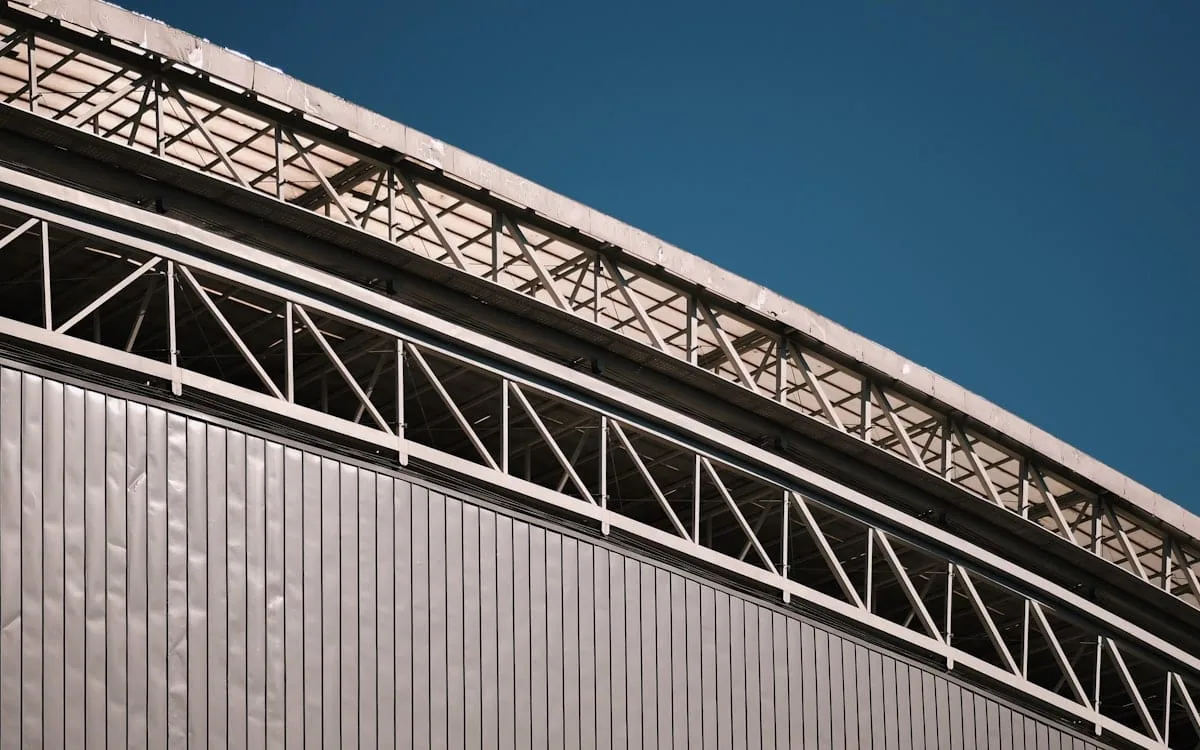
Photo: the curved roof of a large arena against a clear sky, from our picture library.
🎾 Gear from this story
YonexYonex Ezone 98Naomi Osaka's racket of choiceView on Amazon →As an Amazon Associate, SUPER.TENNIS earns from qualifying purchases.