On Thursday afternoon in Shanghai, Alejandro Davidovich Fokina won the biggest match of his year without being allowed to finish it.
He was leading Arthur Gea 4-1 in the first set of a Masters 1000 quarter-final. Gea, a Frenchman playing the first quarter-final of his life at this level, had already taken a medical timeout for a problem with his right quad and hip, and it had not helped. He walked to the net, shook hands, and that was it. Four games and change, and a man who has spent nine years being described as one of the most gifted players on tour was into the semi-finals of one of the biggest tournaments in the sport.
There is no good way to celebrate that. You raise a hand to the crowd, you say something kind into the on-court microphone about your opponent, and you go and sit down with a towel over your head while twelve thousand people work out what just happened. Davidovich Fokina did all of it well. He was generous about Gea, who had earned that quarter-final the hard way, and honest about his own luck, and then he went off to prepare for Alexander Zverev.
If you have never watched a match end that way, it is a strange few minutes to sit through. The crowd does not know whether to clap. The player who has just advanced looks faintly embarrassed, because he has spent his whole life learning how to earn one of these and this one simply arrived. And the man walking off with a towel round his neck has lost the biggest week he has ever had to something in his own leg. Tennis has no substitutes and no injury time. When a body stops, the afternoon stops with it.
But here is what makes it worth your attention, even if you only half follow the men's tour: this is the best story of the week, and it has been building for a very long time.
It is also worth saying what a quarter-final like that is actually worth, because the men's tour is terrible at explaining itself. A Masters 1000 is the tier directly below a Grand Slam: nine of them a year, the whole top of the game in one draw, a fortnight long in Shanghai rather than a week. There are only thirty-six semi-final places in the world in a season, and most of them go to the same dozen men. Getting into one is the difference between a good year and a year that changes what the rest of your career looks like.
The kid who was always about to happen
He was born on 5 June 1999 and grew up in La Cala del Moral, a small place strung along the coast just east of Malaga, the kind of town where the beach is at the end of the street and the tennis club is a short drive inland. His father, Eduard Mark Davidovich, is Swedish-Russian and used to box. His mother, Tatiana Fokina, is Russian. The double-barrelled surname that commentators have been mangling since 2017 is simply both of his parents, in order, the way Spanish names work.
His father put a racket in his hand at around two and a half. By seventeen he was the best junior on the planet: a semi-final at the boys' event at Roland Garros, then, two months later, the Wimbledon boys' title, won without dropping a set, with Axel Geller beaten in the final.
If you follow tennis you know what usually happens next, which is nothing much. Junior Wimbledon champions become club coaches and university players and, occasionally, very good professionals. Davidovich Fokina turned pro the same year and became the third thing, and for most of the next decade the sport filed him under a single word.
Talented
It is a lovely word when you are nineteen and a slightly cruel one by the time you are twenty-six.
He had the results that keep you interesting. The fourth round at the US Open in 2020. The quarter-finals at Roland Garros in 2021, at twenty-one, playing the kind of tennis that makes neutrals sit forward: drop shots from nowhere, hands like a doubles specialist, a willingness to run into walls. And then the fortnight that defined him for years, Monte-Carlo in April 2022, where he beat Novak Djokovic in the second round, came through David Goffin, came from a set down against Taylor Fritz, beat Grigor Dimitrov 6-4, 6-7, 6-3 in the semi-final and lost the final to Stefanos Tsitsipas 6-3, 7-6(3).
A Masters 1000 final at twenty-two. Everybody wrote the same column. The ceiling was enormous, the game was gorgeous, the breakthrough was coming.
The ranking did climb, eventually. He reached a career high of world No. 14 last November, which is a very good life in a brutal profession. But there is one column on a player's page that does not care how pretty your backhand is, and his stayed empty. Five tour-level finals, five losses. Four of those defeats came on hard courts, the surface he plays most. He lost finals at twenty-two and at twenty-four and at twenty-six, and every one of them added a sentence to the story people told about him, the one where the talent was never in doubt and something else always was.
Players hear that story. They read it in their own match reports. It becomes a thing you carry onto court in the second set of a final, when the arm goes heavy and a memory arrives uninvited.
Santa Ponsa, in June, at the sixth attempt
The place where it finally broke was not a glamorous one. The Mallorca Championships are a small grass-court week squeezed between Roland Garros and Wimbledon, the sort of tournament the top players use as a tune-up and skip half the time. He arrived as the top seed and got to another final, his sixth, against the young American Ethan Quinn.
He won it 7-6(4), 6-3, and he finished it with an ace.
Twenty-seven years old. Nine years and three weeks after winning Wimbledon juniors. A first ATP title, on grass, in front of a few thousand people in Santa Ponsa, and a man standing at the baseline afterwards looking like somebody who had put down something heavy. He talked that week about learning from the finals he lost and about finding some peace with himself, which is the sort of line players give to a press room all the time and which, in his case, turned out to be load-bearing.
Then the summer fell apart.
The disappearance
He lost in Umag in July and then he was gone. An injury, roughly two and a half months away from the tour, no US Open at all. For a player who had just worked out how to win, the timing was almost comic: the first title of his career, and then a season that stopped before the biggest hard-court swing of the year.
This is the part of a tennis career that fans never really see. There are no highlights of a rehab block. You do not get a crowd for the ninth week of not being allowed to serve properly. Ranking points fall off every Monday morning, the number next to your name keeps dropping, and the question that every injured athlete over twenty-five has to answer in the dark arrives on schedule: what if the good version of this does not come back?
He came back in Asia in late September, in Chengdu, ranked outside the top twenty-five.
Chengdu, and the thing he had never done
An ATP 250 in southwest China is not where anybody plans a comeback; it is simply where the calendar put one. He won the lot. In the final on 29 September he beat Hubert Hurkacz 6-4, 7-6 to take the title, his second of the year, and the first of his career on a hard court after losing four hard-court finals.
That is a significant sentence for a player who has spent his career being told what he cannot do. Two months earlier he had never won anything. Now he had two trophies in a season, and the second one came on the surface that had beaten him four times, in his first tournament back from injury.
He was emotional about it afterwards, and specific. He dedicated it to his team, the people who had sat with him through the quiet summer.
Then the tour moved to Shanghai, where the defending champion had his own improbable year to answer for, and nobody expected the man from La Cala del Moral to still be there in the second week.
Eight straight wins in China
Count them: five in Chengdu, and now four here, which is the sort of streak that happens to a player roughly once every few years and almost never while he is coming back from an injury.
The Shanghai run has been the opposite of the easy afternoon he got in the quarters. He got past Jenson Brooksby in the second round. In the third he played Frances Tiafoe, saved a match point, and won 7-6, 4-6, 7-6, which is as close as a tennis match gets to a coin landing on its edge. In the round of sixteen he met Hurkacz again, lost the first set 6-1 in about half an hour, and somehow turned it round to win 6-3 in the second and the third on a tie-break, converting his third match point.
Hurkacz, remember, was having a story of his own here: seven months away from the sport, then a win over Novak Djokovic in this same draw. Two men coming back from lost seasons, playing each other in the fourth round of a Masters 1000, ten days after they had played each other for a title in Chengdu. That is the kind of coincidence that tennis produces about once a month and then never mentions again.
Four wins, and the quarter-final that lasted four games, and a fourth Masters 1000 semi-final. Among active Spanish players, only Carlos Alcaraz has reached more; Alcaraz has fourteen, which tells you something about Alcaraz, and Davidovich Fokina now has four, which tells you something about how thin the air gets at this level.
Saturday
Which brings us to the problem, and the problem is six foot six and has won sixty matches this season.
Alexander Zverev has been the most consistent man in the draw. He came through Quentin Halys 6-4, 6-7(8), 6-3 in the third round, which was a scrap, and then handled Alex de Minaur 6-4, 6-4 in the quarters, which was not. He has been world No. 1, he has played in these rooms a hundred times, and against this particular opponent he has been close to a lock.
The head-to-head reads 6-1 to Zverev across seven meetings. The last time they played, indoors in Paris last October, Zverev won 6-2, 6-4. The one that got away from him was in Toronto in August 2023, where Davidovich Fokina won 6-1, 6-2 in about an hour, which is the thing about this particular Spaniard: when the day goes right, he can beat anybody on earth by a street, and that has always been both his gift and his trap.
They play on Saturday, around lunchtime in Shanghai, which is roughly six in the morning on the Malaga coast. The final is on Sunday.
What he is actually playing for
Not the season finale in Turin, if you were wondering. That race belongs to a different group of players and has been running all year; the eight chairs are close to being filled, and a man who missed six weeks of the hard-court season is not sitting in one of them.
What he is playing for is smaller and, from where he stands, probably sweeter. A second Masters 1000 final, four and a half years after the first. A ranking climbing back up toward the career-best 14 he held last autumn, which means better seedings in Australia in January and fewer brutal second-round draws. The last six weeks of a season that is about to move indoors, where the whole tour disappears under a roof until the middle of November and quick conditions suit a player with his hands and his serve rather better than a slow outdoor court in the heat.
And something harder to put on a stat sheet. He is twenty-seven, he spent nine years being the most entertaining man in the sport without a trophy, and in four months he has won two titles and reached the last four of a Masters. The question that follows him is no longer whether he can do it. It is how long he can keep doing it.
How to watch him, if you have not before
Turn it on for the shot selection. He plays a kind of tennis that has gone slightly out of fashion in an era of enormous, clean, flat hitting: slice, drop shots hit from positions where no sensible person would attempt a drop shot, angles that open up a court sideways rather than straight through it. He goes to ground constantly, because he chases things that are not worth chasing and occasionally gets them, and he will stay down there for a beat with his face in the court.
You will also see every single thing he is feeling, which is the whole point. There is no mask. The crowd gets the delight and the despair and the long muttered conversations with his box, and crowds adore him for it, because watching a player feel something in public is most of why anybody buys a ticket.
What has changed in 2026, by the look of it, is not the emotion but what happens after it. The old version lost the thread when a set went. The one in Shanghai lost a set 6-1 to Hurkacz and won anyway, saved a match point against Tiafoe and won anyway. The talent was never the missing piece.
Six in the morning in La Cala del Moral
On Saturday, a fair number of people in a small town on the Malaga coast will set an alarm they do not need to set, because a man who grew up on their street is playing Alexander Zverev for a place in a Masters final. The sun will barely be up over the water. The coffee machines in the beach bars will not be on yet.
If he wins, it is the second-biggest match of his life on Sunday. If he loses, he flies to Europe with two trophies, a repaired body and the best three weeks he has had since he was twenty-two, and the indoor season starts on Monday anyway.
Nine years is a long time to wait for a career to start. It is worth being awake for the part where it does.
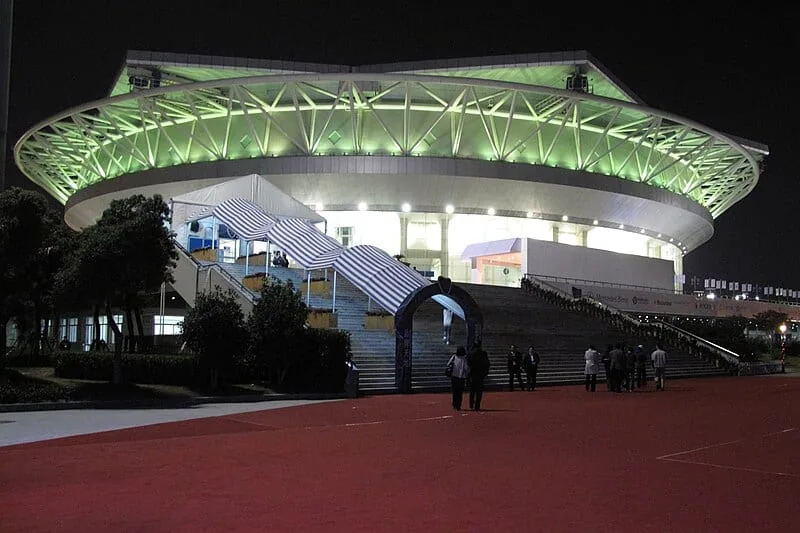
Photo: a Masters 1000 arena lit for a night session, from our picture library.
🎾 Gear from this story
HeadHead Extreme TourAlexander Zverev's racket of choiceView on Amazon →As an Amazon Associate, SUPER.TENNIS earns from qualifying purchases.