Alex de Minaur made it one game into the second set before he sat down.
It was the final of the China Open in Beijing this week. He had lost the first set in a tie-break, held serve to start the second, and then walked to his chair and told the umpire he was finished. A groin injury. Novak Djokovic came round the net and put a hand on his shoulder, the way you do when you have just been handed a trophy rather than won it.
Djokovic got plenty out of the afternoon anyway: a seventh China Open title, a record there that now reads 34 matches played and 34 won, the 102nd tour-level title of his career, and the distinction of being the oldest man to win an ATP 500 event since that category was invented in 2009. He is 39. He keeps finding new ways to be the oldest person to do something.
But the part of that afternoon that will still matter in six weeks had nothing to do with the trophy. It had to do with a list. In the middle of November, eight men will walk out into an arena in Turin for the last and strangest tournament of the year, and right now five of those eight places are still unclaimed. De Minaur is on the wrong side of the line. So, by a margin you could lose in a single bad afternoon, are about four other people.
If you watch tennis without playing it, this is the best thing on offer between now and Christmas, and almost nobody explains it properly.
The one tournament you cannot sneak into
Everything else in tennis is a draw. You turn up, you get a bracket, and if you play the fortnight of your life you can win a title you had no business winning. That is most of the romance of the sport. It is how a qualifier reaches a Grand Slam quarter-final and how a man ranked outside the top 50 can end up holding a Masters trophy.
The ATP Finals is the exception. There is no draw to be lucky in, because there is no way in at all except to have been one of the eight best players in the world across an entire year. You qualify in January and February and May as much as you do in October. Every match from the first week of the season onwards has been quietly feeding a table, and in November the table closes and the top eight names get on a plane.
This year the plane goes to Turin, from 15 to 22 November, for the fifth season running. The venue is the Inalpi Arena, which most people over a certain age still think of as the Palasport Olimpico: a vast Arata Isozaki box in the south of the city, built for the 2006 Winter Olympics, where the ice hockey was played. It is the biggest indoor sports arena in Italy. For one week a year somebody lays a hard court down the middle of it and the season ends there.
The format is as unforgiving as the entry requirement. Eight men, two groups of four, everybody plays everybody in their group. There is no hiding behind one good day and no sudden-death escape from one bad one. Then the top two from each group go into semi-finals, and the winners meet on the Sunday.
The qualifying rule itself has one wrinkle worth knowing, because it comes up every year and confuses people. The top seven men in the Race go automatically. The eighth place is held back: if a player who won a Grand Slam this season finishes somewhere between ninth and twentieth in the Race, that eighth chair is his. If there is no such player, it simply goes to whoever finishes eighth. This season all three men who won majors are already comfortably inside the top seven, so the wrinkle stays flat and the eighth seat belongs to whoever can hold on to eighth.
Three men are already in
Jannik Sinner qualified on 10 July. Alexander Zverev followed on 6 August. Carlos Alcaraz joined them on 16 September, for the fifth consecutive season.
Between them they took every major played this year, which tells you how top-heavy 2026 has been. Alcaraz won the Australian Open in February, beating Djokovic in a four-set final and completing the career Grand Slam at 22 years and 272 days, the ninth man to do it and the youngest. Zverev won Roland Garros, his first major after years of being the best player never to have one, and then won the US Open as well. Sinner won Wimbledon, beating Zverev in the final.
So the top of the list is settled and has been for weeks. What is not settled is almost everything else, including the identity of the man who will finish the year ranked first in the world.
The ghost at the top of the rankings
Here is the oddity of this autumn. Sinner is the world No. 1 and has not hit a competitive ball since July.
He beat Zverev at Wimbledon and then a problem with his right knee took the rest of his year apart. He missed the hard-court swing in North America. He missed the US Open entirely. He missed Beijing. On 3 October he withdrew from the Shanghai Masters as well, saying he was sorry, which by then surprised nobody. There is still no confirmed return date.
It is a strange thing to watch a ranking defended by a man who is not there. Points come off a player's total on the anniversary of the week he earned them, so every tournament Sinner misses is not a neutral event but a subtraction. His lead has been eroding on its own all autumn, in the way a sandcastle goes while you are looking at something else.
Zverev is the man standing closest when it happens. He has been No. 2 for most of the season and he leads the Race to Turin on 8,750 points, ahead of Sinner on 7,950, which is the correct way round for a year in which one of them won two majors and the other won one and then disappeared.
The year-end No. 1 ranking is a different table from the Race, and the margins there are tighter and change weekly, so anyone quoting you an exact gap today is quoting you something with a short shelf life. The shape of it is clear enough, though: Zverev has never held the No. 1 ranking in his life, Sinner cannot add to his total while he is injured, and there are now only a handful of tournaments left in which the thing can be decided. Shanghai is one of them. It began this week and runs to 18 October, with Valentin Vacherot defending the title he won last year, a story that still seems unlikely written down.
For a player who has spent a decade being told he is the best man never to win a major, and who answered that in June and again in September, the ranking would be a strange and late sort of vindication. He is 29. These chances do not come round often.
The man who nearly stopped him
Ben Shelton is fourth in the Race on 4,430 points, and he got most of them in one astonishing fortnight in New York.
The 23-year-old American reached his first Grand Slam final at the US Open, beating Alcaraz in the quarter-finals along the way for the first top-three win of his career, before running into Zverev in the final. He has won 39 matches at tour level this season, only three fewer than his best ever year.
He also left New York with a shoulder problem, which cost him weeks. He is back this week in Shanghai, and he has been perfectly open about why: qualifying for Turin, he said, is a massive motivation. It is the sort of thing players say, except in his case the arithmetic backs it up. Fourth is a comfortable-looking position that stops being comfortable the moment you miss two tournaments.
Six men who have never been
The part of this race that deserves more attention than it gets is how many of the contenders have never set foot in the thing. Six of the top 15 in the Race have never played the ATP Finals. Three of them are currently inside the eight.
Flavio Cobolli is fifth on 3,530 points, and if he gets there he will arrive as the home player. He is 24, Italian, and until March of this year he had never been ranked higher than No. 17. Then he reached the Roland Garros final, losing to Zverev, and went to a career high of No. 6 in August. He has three tour titles now: Bucharest on clay in 2025, Hamburg, where he beat Andrey Rublev, and Acapulco this year, where he beat Frances Tiafoe for his first on a hard court. An Italian qualifying for the season finale in Italy, in the year Sinner spent injured, is the kind of story a tournament cannot buy.
Frances Tiafoe is sixth on 3,380. He has been one of the most watchable players in the sport for the better part of a decade, has reached major semi-finals, has carried American tennis through several thin years, and has somehow never made the eight. He is 28 now. There is a version of this autumn in which he finally does it, and a version in which he spends another winter as the best player never to have been.
Arthur Fils is seventh on 3,275, which makes him the most precarious of the three. The Frenchman has spent two years being described as the next thing, which is an exhausting way to live, and this is the first season in which the description has come with a Race position to match.
None of the three can afford a quiet six weeks. Between them there is a gap of about 250 points, which in a sport where a Masters 1000 semi-final is worth hundreds is nothing at all.
The last chair
Eighth, and holding on, is Daniil Medvedev on 3,220.
He should have more. In Beijing he was defaulted from his semi-final against Djokovic, which cost him the 200 points he had already earned and a sum of prize money north of two hundred thousand dollars, and turned a workmanlike week into a disaster. He arrived in Shanghai with his cushion over ninth place considerably thinner than it had been a fortnight earlier.
Ninth, now, is Djokovic, who went to Beijing needing points and came away with a title. He leads tenth place by 140 points and has said he intends to be in Turin this time, which is not something he has always said. He has won this tournament seven times. The idea of a 39-year-old qualifying for the eight on merit, in a season in which he also reached an Australian Open final, is faintly ridiculous and entirely in character.
Tenth is de Minaur, with the groin injury he picked up in that Beijing final. He had played beautifully all week. He reached the final after Hubert Hurkacz retired in their semi-final, and then had to retire himself the following day, which is a cruel sort of symmetry. He is one of the fittest men in the sport and injuries tend not to hold him long, but he has very little time to spare.
So the real race, the one worth following, is five men chasing four chairs, with a sixth and seventh close enough behind to matter. Ninth and tenth do get to travel to Turin as alternates, which is a strange consolation: you fly to Italy, you practise all week, and you play only if somebody else breaks down.
What is actually left to play for
Not much, which is the point.
Shanghai is on now, a Masters 1000 with a serious pile of points, and it is the single biggest opportunity any of the chasing group has left. After that the season narrows quickly: a run of indoor events through late October, then the Paris Masters at the start of November, which is the final chance for anyone to force their way in, and which this year carries its own long goodbye in Gael Monfils. Then the list closes.
This is the part of the calendar that rewards the fan who pays attention. In March a first-round match between two men ranked in the twenties is just a match. In the third week of October, the same match can be the difference between a season that ends in Turin and a season that ends in an airport. Players know it, and you can see them knowing it. The body language in a late-October second round is nothing like the body language in a late-February one. There is a whole shape to this autumn run-in that the summer simply does not have.
Why a league table is good for you
Tennis is a sport almost entirely without standings. You watch a tournament, somebody wins it, everyone flies somewhere else and starts again from zero. It is thrilling and it is also strangely amnesiac. Football gives you a table that remembers February in May. Tennis mostly does not.
The Race is the exception, and that is why it is worth your attention for the next six weeks even if you have never once looked at a ranking. It gives the autumn a plot. It means that a Tuesday afternoon match in Shanghai between Medvedev and somebody ranked 40th has a consequence attached to it, and that the consequence is legible: he either stays in the eight or he does not.
It also produces the only tournament of the year where everybody on court genuinely earned the right to be there over twelve months rather than twelve days, which is a different and colder kind of achievement, and worth something precisely because nobody gets in on a hot streak.
In the third week of November, somebody will walk into a converted Olympic ice rink in Turin, see his name on a locker, and understand that he spent a whole year getting into a room. Four or five men who badly wanted that will be at home instead, watching on television, doing the arithmetic on what they would have needed. The list is still open. For the next six weeks you can watch it being written, one ordinary-looking match at a time.
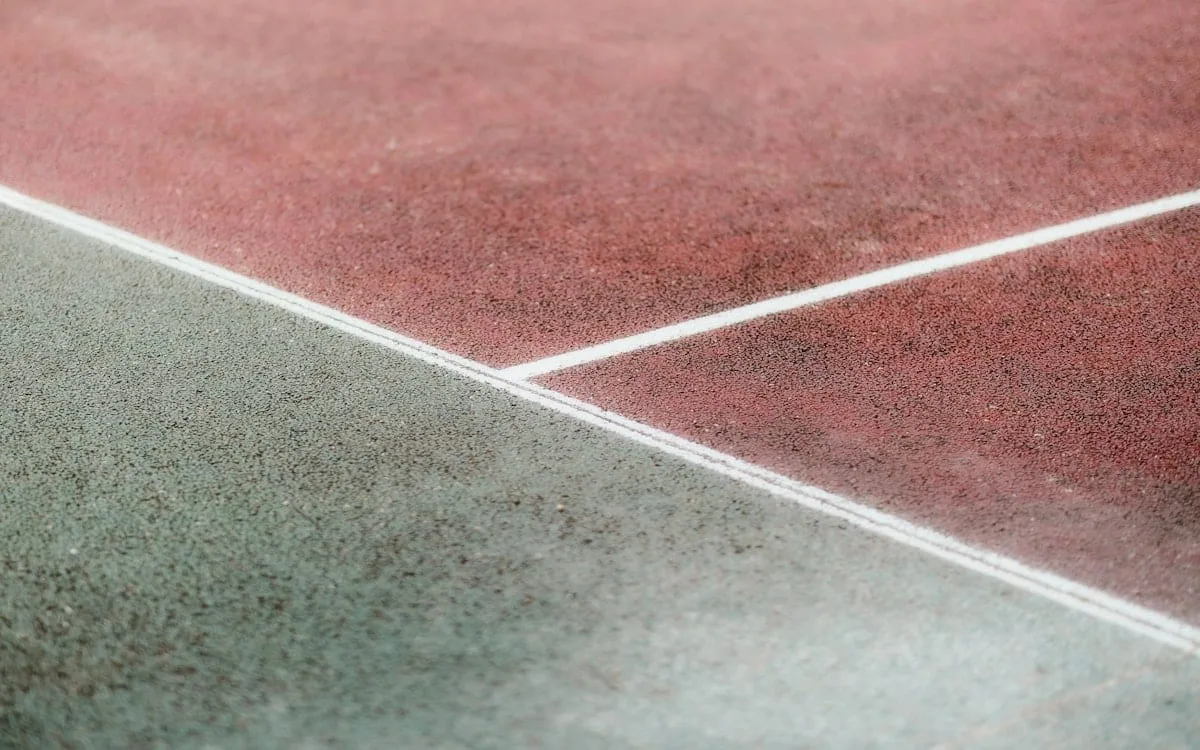
Photo: a hard court surface marked out in red and green, the kind of court the tennis season finishes on.
🎾 Gear from this story
HeadHead Extreme TourAlexander Zverev's racket of choiceView on Amazon →As an Amazon Associate, SUPER.TENNIS earns from qualifying purchases.