On Sunday afternoon in Ohio, a 23-year-old from Lisbon who had spent the previous week grinding through qualifying walked out against the man who had just won Montreal, and beat him in straight sets without ever appearing especially startled by what he was doing.
You almost certainly did not watch it. Ben Shelton against Jaime Faria was not the match on the main channel, and it was not the match anyone had circled. It was a second-round tie between a top-ten player arriving on a six-match winning streak and a Portuguese qualifier whose name most commentators had to check the pronunciation of. Then Faria won 6-4, 6-4, and by Tuesday night something had happened in Cincinnati that had never happened before in the history of Portuguese tennis.
This is a story about two players you may not know, from a country you do not associate with tennis, having the best week of their lives at the same time in the same American city. It is also, if you stand back a little, a story about how small countries stop being small in this sport — slowly, unevenly, and then all at once on a Tuesday in August that nobody was paying attention to.
The match that started it
Faria came into the Cincinnati Open through the qualifying draw, which is the tennis equivalent of arriving at a party through the kitchen. Qualifiers get the ugly courts, the early start times and the opponent nobody wanted. What they also get, occasionally, is a top seed who has been on a plane for six hours and has not adjusted to the conditions.
Shelton had. He had just won the National Bank Open in Montreal, beating Brandon Nakashima in the final without dropping a set all week — his second Masters 1000 title and the first successful defence of that trophy by anyone since Rafael Nadal in 2019. He came to Ohio as one of the favourites and the most in-form player on the American hard courts.
What happened next was not a smash-and-grab. Faria broke early in the first set and then had to survive the response, and it is the shape of the second set that tells you the most about him. He went down 1-4. Against a player of Shelton's ceiling, on a fast court, 1-4 in the second set is where careers quietly end and everyone politely says the qualifier had a good tournament anyway.
Faria won the next five games. Shelton created twelve break points across the match and converted exactly one of them. That statistic is the whole story: a young player who had never beaten anyone in the top ten spent two hours refusing to blink while a much more decorated opponent kept knocking on the door.
Afterwards, asked what had changed, Faria gave one of those answers that sound like nothing and are actually everything. He talked about changing his mentality and his work ethic, about trying to focus more on the process. His original target for the season, he said, had simply been to get into the top 100.
Then he beat Adam Walton 4-6, 6-4, 7-6(3), coming from a set down and from a break down in the second, to reach the fourth round of a Masters 1000 event for the first time in his life.
Meanwhile, on another court
While Faria was doing the improbable thing, the other Portuguese man in the draw was doing the difficult thing very well.
Nuno Borges is 29, from Maia in the north of Portugal, and he has been Portugal's best player for several years now without ever quite becoming a name that travels. His Cincinnati week began with a three-set survival job against Thanasi Kokkinakis — 5-7, 7-6(3), 7-6(4), two tie-breaks, the kind of match that leaves you with nothing in the tank and everything to play for. He beat Francisco Cerundolo 6-4, 6-4 in the next round.
And then he beat Andrey Rublev.
Rublev was the 13th seed. He and Borges had played five times before and Borges had lost all five. On Tuesday, Borges won 6-3, 6-4, and did it with the sort of unfussy competence that gets you very little television time and a great deal of respect from other players. First win over Rublev, sixth attempt, best possible timing.
That result, arriving on the same day as Faria's comeback against Walton, produced the line that ran across every Portuguese sports page on Wednesday morning: for the first time ever, two Portuguese men were in the last 16 of the same Masters 1000.
What Portugal had never done before
It is worth being precise about how unusual this is, because "first time ever" gets thrown around loosely in tennis.
The Masters 1000 tier has existed in its modern form since 1990. In all that time, across nine tournaments a year on three continents, Portugal had never once had two men reach the fourth round of the same event. Not in the 1990s, not in the 2000s, not during the best years of the only Portuguese player most casual fans could name.
For most of that period, Portuguese tennis was not a group. It was a person. And when it was a person, it was almost always Joao Sousa.
The one man country
If you followed tennis at all in the 2010s, you saw Sousa without necessarily registering him: a compact, relentless competitor who turned up in the second week of majors, played long matches against better-ranked players and occasionally won them.
In September 2013 he became the first Portuguese man in history to win an ATP Tour title, at the Malaysian Open in Kuala Lumpur. He beat David Ferrer, then the world No. 4, in the quarter-finals, and then came through a final against Julien Benneteau 2-6, 7-5, 6-4. He was 24 and ranked 77th in the world when he did it. He climbed to a career high of No. 28 in May 2016. He won the title at home in Estoril in 2018. He retired in 2024.
Before Sousa, the high-water mark for Portuguese men's tennis was Frederico Gil reaching the Estoril final in May 2010 and losing it. That was, genuinely, the best any Portuguese man had ever done. An entire country's tennis history could be summarised in one runner-up trophy and then one man's career.
That is a very particular kind of sporting existence, and if you come from a country that produces champions in your sport it is hard to imagine. It means every result rests on one set of shoulders. It means the national federation, the sponsors, the television rights, the junior programme and the entire public conversation about the sport all rise and fall with whether one man's back is holding up. And it means that when he retires, there is a real chance the whole thing simply stops.
Football has always been the sun in Portugal, and everything else grows in whatever light gets through. Tennis had a lovely coastal ATP event at Estoril, a handful of clubs, and one very good player at a time, if that.
Which is why two men in the last 16 of the same Masters 1000 is a bigger deal than the phrase makes it sound. Two is not twice as good as one. Two is a different category of thing. Two means the result was not a fluke of one exceptional individual. Two means there is a system somewhere behind it, or at the very least a culture that has started producing more than one answer.
The long way round: Nuno Borges
The two men who did it could hardly have arrived by more different routes.
Borges took the slowest, least glamorous path available, and it is the reason he is still improving at 29 while players five years younger are already talking about their bodies.
He went to America. From 2015 to 2019 he played college tennis at Mississippi State, took a degree in kinesiology, was named SEC Player of the Year three years running in 2017, 2018 and 2019, and reached the NCAA singles final in his last season. Then he turned professional properly, at an age when the sport's prodigies have already had their first injury layoff, and started the long climb through Challenger events — ten Challenger finals, titles in Antalya, Barletta, Monterrey, Phoenix twice, and one in Maia, the town he grew up in.
The payoff came in July 2024 in Bastad, Sweden, in the most improbable circumstances imaginable. Borges reached his first ATP final and found Rafael Nadal on the other side of the net, on clay, in what everyone understood was the closing chapter of the greatest clay-court career the game has produced.
Borges beat him 6-3, 6-2. He broke Nadal five times. He became only the fifth man to beat Nadal in a tour-level clay-court final, joining Novak Djokovic, Roger Federer, Andy Murray and Horacio Zeballos on a list that reads like a misprint with his name attached. He also became just the second Portuguese man in the Open era to win a tour singles title, after Sousa.
"I am living in the clouds," he said afterwards. Two months later he was ranked No. 30 in the world, a career high, and the highest a Portuguese man had ever climbed.
He has come back down since — the tour is unsentimental about late developers — and he arrived in Cincinnati somewhere in the high forties. But a player who beat Nadal in a final and Rublev in a Masters 1000 is not a player having lucky weeks. He is a player who took eight years longer than the phenomenons and got to roughly the same place.
The fast way round: Jaime Faria
Faria is the other model entirely: a Lisbon kid who turned 23 exactly two weeks before he beat Shelton, six foot two, right-handed, two-handed backhand, and in a considerable hurry.
His breakthrough was one of those runs that looks absurd written down. In the early part of 2024 he won twenty consecutive matches on the ITF World Tennis Tour, taking four straight M25 titles — all of them in Portugal, in front of people who knew exactly who he was. He qualified into the main draw at the Estoril Open that spring for his ATP debut, in his home city, which is either the best or the most terrifying way to start a professional career. In May he won his first Challenger, at Oeiras just along the coast.
He broke into the top 100 in 2025 and hit a career high of No. 87 that February. This June he made the third round at Roland Garros. In July, when the Estoril Open shifted to a new summer slot on the calendar, he was handed one of the tournament's wild cards — the local boy the event now wants on its posters.
He still had to qualify for Cincinnati. He is still, by the standards of the players he has been beating, an unknown. What he clearly is not is intimidated, and there is a specific kind of player who is dangerous precisely because nobody has told him yet which matches he is supposed to lose.
What Wednesday took away
Sport does not usually let two stories run at once for very long, and Wednesday evening was where this one narrowed.
Borges drew Nakashima in the fourth round, an American having his own remarkable fortnight — runner-up in Montreal, a career-high ranking of No. 22 secured, and fresh from saving three consecutive match points to beat Daniil Medvedev 6-7(3), 7-6(4), 6-1 in the previous round. They had never played each other before.
It went the distance. Borges lost the first set 3-6, took the second on a tie-break, and lost the third 3-6. Nakashima went through to the quarter-finals. Borges went to the airport with the best Masters 1000 win of his year and a defeat he will replay for a while.
Faria is still in it. He plays Lorenzo Musetti in the fourth round on Thursday, which may well be happening while you read this, and the tournament runs to its singles finals on Sunday 23 August. Whatever the scoreboard says by tonight, the fortnight has already rewritten a page of his country's record book.
Why two matters more than one
There is a pattern in tennis that repeats often enough to be worth naming: countries do not produce one great player and then stop. They produce one, and if the conditions are right, the one becomes the reason for the next several.
Italy is the loudest current example — a country that spent decades as a respectable tennis nation and then, within a handful of years, turned into the dominant force in the sport, with depth so absurd that players who would headline any other country's team are fourth choice for theirs. That did not come from one prodigy. It came from federation money, a coaching structure, and crucially a group of players close enough in age to drag each other upwards.
You can see the same mechanism in smaller versions everywhere. It is what makes a run like Alexandra Eala carrying the Philippines onto the tour so significant beyond the results themselves: a child somewhere sees a person with their flag winning on television, and the arithmetic of what is possible changes in their head.
Portugal is at the very beginning of that process, and it may not go anywhere. Plenty of promising fortnights do not. But it now has a 29-year-old proving that the long route works and a 23-year-old proving the fast route works, both ranked high enough to be in the main draw of everything, both beating top-20 players in the same week on the same hard courts.
For a kid in Porto or Braga who has just watched two men with their flag next to their name beat Rublev and Shelton on consecutive days, that is not a statistic. That is an instruction.
The part that does not show up in the record books
Here is what I keep coming back to about this week.
Nobody in Cincinnati went out of their way to make it a story. There was no ceremony, no montage, no interview panel about Portuguese tennis. Borges beat Rublev on a court where the seats were half full because the marquee names were playing elsewhere. Faria beat Shelton in a second-round match that most of the tennis world found out about from a push notification.
The history was made almost accidentally, in the ordinary machinery of a Masters 1000 week, by two men who were mostly just trying to win their next match. That is how it usually happens. The moments that later get described as turning points look, at the time, like an unremarkable Tuesday with two results on it.
The Cincinnati Open will crown its champions on Sunday and those names will go on the trophy and into the highlight packages. Nobody is going to put "first time two Portuguese men reached the last 16" on a plaque. It will live in a federation press release, a few Portuguese sports pages, and the memory of whoever was on court 8 with a Portuguese flag over their shoulders on Tuesday afternoon.
But if Portuguese tennis turns out to have a proper generation in ten years' time, this is the week people will point back to. Not because anyone won a title. Because for the first time, when the draw sheet was printed, there were two of them.
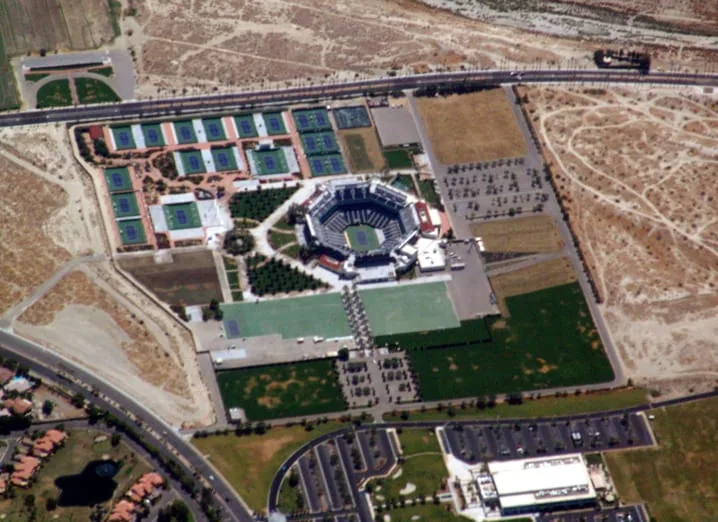
Photo: hard court tennis complex from above, via Unsplash.
🎾 Gear from this story
YonexYonex VCORE 98Ben Shelton's racket of choiceView on Amazon →As an Amazon Associate, SUPER.TENNIS earns from qualifying purchases.