The last professional tennis match Lesia Tsurenko ever played finished 6-1, 6-1, and nobody in the building knew that was what they were watching.
It was November 2024. She was playing for Ukraine in the Billie Jean King Cup, which is the competition where a tennis player stops being a self-employed small business and becomes, for a few days, somebody representing a country. She lost to Sinja Kraus in two quick sets. There was no announcement afterwards, no speech, no towel over the head while a crowd stood up. She packed her bag the way you pack a bag when you fully expect to unpack it again in January.
She never did. This week, at thirty-seven, two years after that afternoon, Tsurenko finally wrote the thing down and made it official. Her farewell message opened with three words: thank you, tennis.
If you follow the sport casually, you may not have noticed. There was no ceremony at a Grand Slam, no video montage on a big screen, no rival waiting at the net to hug her. That is not a slight against her. It is simply what retirement looks like for almost everybody who plays this sport for a living, and it is worth sitting with for a few minutes, because the careers that end quietly are the overwhelming majority, and they are far more interesting than the sport usually lets them be.
A town you have almost certainly never heard of
Tsurenko was born on 30 May 1989 in Volodymyrets, a small town in the north-west of Ukraine. Her father Viktor worked in international relations for a nuclear power plant. Her mother Larisa is an economist. Her older sister Oxana became a lawyer. It is, on paper, a completely ordinary provincial family with no tennis in it at all.
Her parents put a racket in her hand when she was six. At seventeen she moved to Kyiv to study physical education and sport, which she did for about a year and a half. In 2007 she started playing her first events on the ITF circuit, which is the sport's lowest professional tier, the one with the empty bleachers and the prize cheques that barely cover the flight.
Here is the part that ought to reframe how you think about the next decade of her life. She turned professional in 2007. She did not win a WTA title until 2015.
Eight years. Eight years of qualifying draws, of first-round losses in countries whose airports she came to know better than their cities, of being the name in the small type. Tennis sells you teenagers. It loves a prodigy, because a prodigy is a clean story. Tsurenko was twenty-six when she first lifted a trophy on the main tour, in Istanbul, and by the standards of the sport's marketing department she was already late.
Istanbul, Guangzhou, and then a city that became hers
The Istanbul title in 2015 was the breakthrough. Guangzhou followed in 2016. And then she found Acapulco.
Every player who sticks around long enough finds a place that fits them. Nobody can fully explain why. Sometimes it is the surface, sometimes the altitude, sometimes the way the ball sits up in humid air, sometimes nothing more scientific than the fact that you once played well there and so the court looks friendly when you walk onto it. For Tsurenko it was the Mexican Pacific coast. She won Acapulco in 2017. She came back and won it again in 2018.
Four WTA singles titles in total, then: Istanbul, Guangzhou, Acapulco, Acapulco. It is not a haul that gets you into the history books. It is also four more than almost every person who has ever tried to do this for a living, and two of them came in consecutive years at the same tournament, which means that for a while there was a corner of the world where Lesia Tsurenko was simply the best player who turned up.
Two weeks in New York
Then came the fortnight that still defines her, the 2018 US Open.
In the second round she drew Caroline Wozniacki. This was not a faded Wozniacki. This was the reigning Australian Open champion, the No. 2 seed, a former world No. 1 who had finally broken her Grand Slam duck seven months earlier and arrived in New York as one of the favourites. Tsurenko beat her.
In the fourth round she played a nineteen-year-old Czech named Marketa Vondrousova, who would go on to win Wimbledon five years later. Tsurenko lost the first set in a tie-break, won the second 7-5, and took the third 6-2. At twenty-nine years old, in her thirty-fourth Grand Slam main draw, she had reached a major quarter-final for the first time.
And then Naomi Osaka beat her 6-1, 6-1 in fifty-seven minutes.
It is tempting to skate past that, and I do not think you should. Osaka was about to win the whole tournament in the most chaotic final of the modern era, and she was playing the best tennis of her life. Tsurenko, by her own later accounting, finished the match with more unforced errors than points won. It was the biggest day of her career and it lasted under an hour.
That is also, more than the trophies, the honest texture of a career spent in the twenties and thirties of the rankings. You get one shot at the room where the real contenders live, and sometimes the door shuts in fifty-seven minutes, and there is no guarantee you get another invitation. She never did reach another Grand Slam quarter-final.
Twenty-three
The peak arrived a few months later. In January 2019 she reached the final in Brisbane, her first at that level of tournament, and on 18 February 2019 the computer put her at No. 23 in the world. She was twenty-nine.
It is worth explaining what No. 23 actually buys you, because it is a number most fans glance at and discard. Inside the top thirty-two you are seeded at Grand Slams, which means you cannot draw one of the game's monsters in the first week. You get into every tournament you want on your ranking alone, with no qualifying. You fly at reasonable hours. You can afford a coach and a physio on the road at the same time, which sounds trivial and is not.
Below that line, all of it gets harder, more expensive and more precarious, and the gap between what a career earns on paper and what a player actually keeps is one of the least understood things in the sport. We went into that arithmetic in detail in a piece on what players really take home from prize money, and Tsurenko lived on both sides of that line. Her career earnings finished north of six million dollars across nearly two decades, which is a genuinely good living and is also, after coaching, travel, tax and the years of losses at the start, nothing like six million dollars.
She ended 2018 ranked No. 27. She ended 2019 ranked No. 70. That is how fast it moves.
February 2022
And then the context of her entire life changed.
When Russia launched its full-scale invasion of Ukraine, Tsurenko was one of a group of Ukrainian players who kept competing while their country was being bombed, which is an arrangement with no good version. You are on a practice court in a warm place, working on your backhand, and your phone is full of air raid alerts from the people you love. There is no training manual for that. Elina Svitolina, who has carried much of the public weight of Ukrainian tennis and who came back to the WTA Finals this month after seven years away, has spoken about it often. Tsurenko was in the same group, with less of the spotlight and the same impossible arithmetic.
It eventually broke through the surface in the most public way possible.
Indian Wells, March 2023
At Indian Wells in March 2023, Tsurenko was due to play Aryna Sabalenka in the third round. Shortly before the match, the tournament announced she had withdrawn for personal reasons.
Tsurenko said afterwards that this was not the truth, or at least not the useful part of it. She had suffered a panic attack. She described it bluntly: officially it would be written down as personal reasons, she said, but in fact it was breathing problems and, as she put it, hysteria.
She tied it directly to a conversation she had had with Steve Simon, then the chief executive of the WTA, about how tennis was handling the war. By her account, Simon told her that he personally did not support the war, but that if players from Russia and Belarus did, that was their own opinion, and the opinions of other people should not upset her.
That sentence is the hinge of the next three years of her life. She said she had raised the matter privately and received no response, and she accused the tour of covering up what had happened to her. Ukrainian players asked for a conference call with the WTA board. The tour replied that it had consistently reflected its full support for Ukraine and strongly condemned the actions brought forth by the Russian government.
Whatever you think about the politics of it, there is something worth noticing in the plain mechanics of the story. A player had a panic attack severe enough to stop her competing, and the public record said personal reasons. Tennis has got significantly better at talking about the inside of a player's head over the last decade, and we have written before about why the sport is unusually hard on mental health, but the default institutional instinct is still to make the difficult thing disappear into a line of administrative language.
The case
In April 2025 she took it to court, suing the WTA and Simon personally, with claims including breach of contract, negligence and emotional distress. It was an extraordinary thing for a player to do: a sitting professional suing the body that runs her own sport, on the record, under her own name.
She lost the central argument. The judge found she had not established that the tour owed players the kind of legal duty she was claiming, a duty to protect them from emotional harm. That is a narrow legal finding rather than a verdict on what happened to her in the desert in 2023, but narrow legal findings are how these things end, and it ended.
By then she had not hit a competitive ball in months.
The elbow
The physical ending was quieter and more ordinary. Her right elbow had been a problem. She played no tournaments in the early part of 2025, and in June of that year she had it operated on.
Surgery at thirty-six is a different proposition from surgery at twenty-six. The rehabilitation is the same length and the runway afterwards is much shorter. She missed the rest of 2025. She missed all of 2026. Somewhere in those two years the comeback went from a plan, to an intention, to a thing she talked about in the future tense, to this week.
What she actually said
The farewell did not try to make any of it sound better than it was, which is why it is worth quoting.
She said her body had often let her down, and that mentally she had not always been able to cope with the challenges she faced. She said, flatly, that she had not fulfilled her childhood dreams.
That is a remarkable thing for an athlete to publish about herself. The convention is to go out insisting that you would change nothing, that every setback was a lesson, that you left it all out there. Tsurenko went out saying that she had wanted more, that her body had not cooperated and that her mind had sometimes buckled. It is harder to read than the standard version and considerably more honest.
And then, at the end, a different note entirely: for the first time in a long time, she said, she is curious about what comes next.
The accounting, done properly
So what does the ledger say.
Four WTA singles titles. A career-high ranking of No. 23. One Grand Slam quarter-final, lost badly. Wins over Caroline Wozniacki, and over Naomi Osaka and Ons Jabeur along the way. Two Acapulco trophies. Somewhere north of six million dollars earned over eighteen years. Thousands of hours in airports. One panic attack that became a lawsuit. One elbow that would not hold.
Measured against Serena Williams, that is a rounding error. Measured against the roughly fifteen hundred women who try to make a living from this sport in any given year, the great majority of whom will never break into the top two hundred, never play a main draw at a major and never see a WTA final from the inside, it is a serious life's work.
Most players do not get a farewell tour. Most of them get what Tsurenko got: a last match nobody flagged as the last one, a long silence, an injury that does not heal on schedule, and eventually a post. The ones who leave through a tunnel of applause at Wimbledon are the exceptions, and we tend to mistake the exceptions for the pattern. If you want a sense of what actually happens to players after the ranking disappears, life after the tour is a stranger and more varied country than the highlight reels suggest.
The court after everyone goes home
There is an image I keep coming back to with this one. Not the Acapulco trophies, not New York in 2018. The Billie Jean King Cup tie in November 2024, the 6-1, 6-1, the handshake at the net. Somewhere in that building a scoreboard was switched off and a net was taken down and a woman who had been a professional tennis player since 2007 walked out through a door she assumed she would walk back through.
She was wrong, and she did not know she was wrong, and that is how it goes for nearly everyone. The sport does not usually tell you when you are finished. It just stops phoning.
Lesia Tsurenko has spent two years finding that out, and she has come out the other side saying she is curious about the rest of her life. After the fortnight in New York, after the desert, after the elbow and the courtroom, curiosity is not a bad thing to leave with.
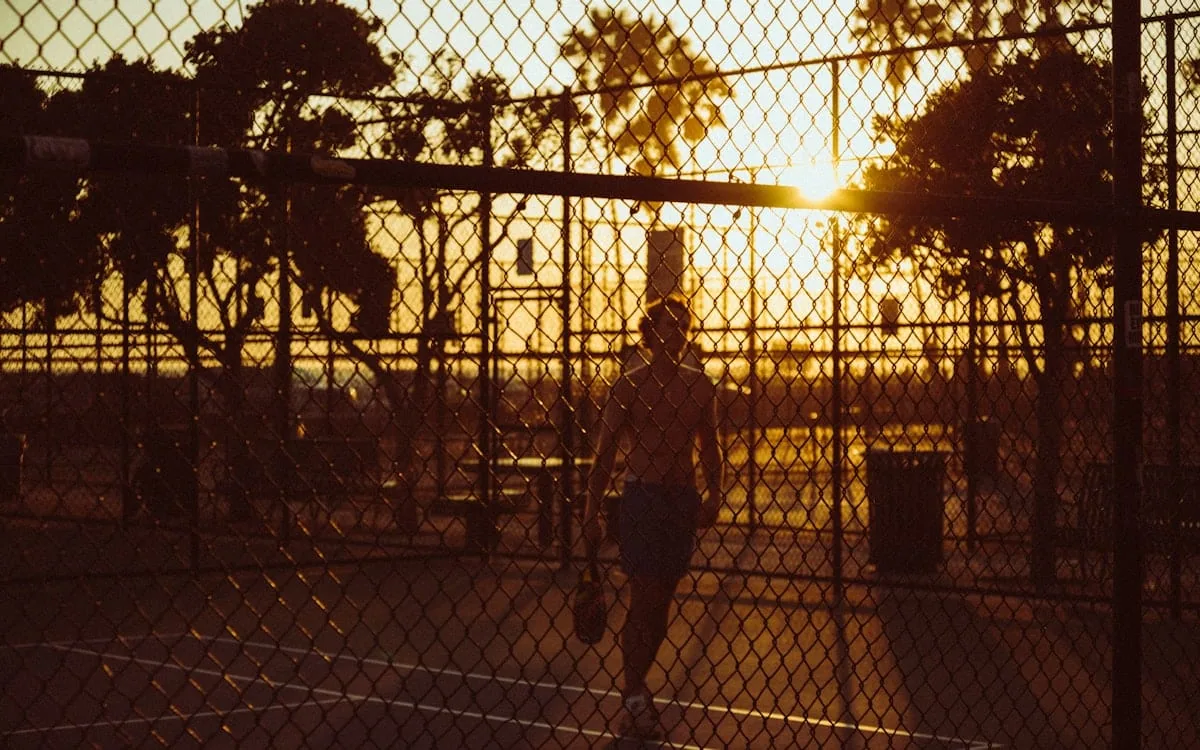
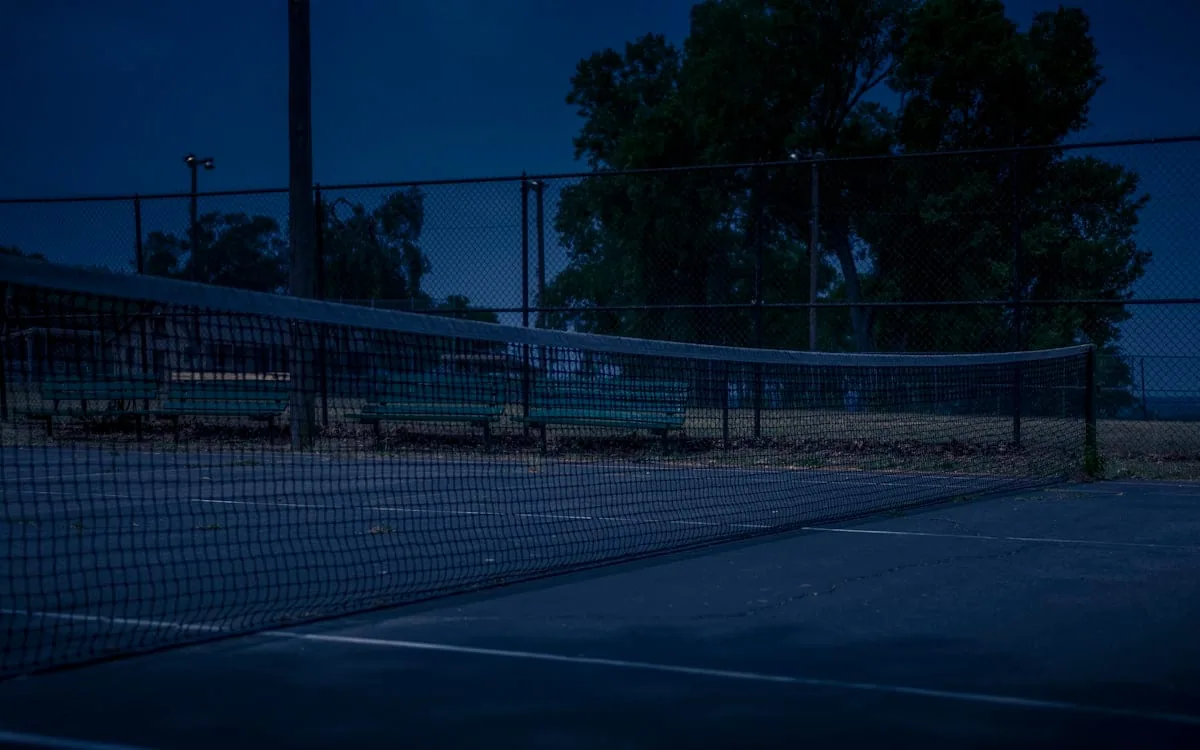
Photo: an empty court at dusk, from our picture library.
🎾 Gear from this story
YonexYonex Ezone 98Naomi Osaka's racket of choiceView on Amazon →As an Amazon Associate, SUPER.TENNIS earns from qualifying purchases.