There is a moment on the 7 train, somewhere out past Junction Boulevard, when the carriage stops being a commuter train and becomes a tennis crowd. The suits thin out. Sunhats appear. Somebody is holding a rolled-up draw sheet like a treasure map. And then the elevated track swings and the whole thing arrives at once through the window: a giant white bowl, a silver globe, a baseball park, and beyond all of it the flat grey shine of Flushing Bay with planes lifting off LaGuardia every ninety seconds.
That is the US Open. Not the tennis yet, just the arrival. And the strangest thing about it is that almost nobody on that train knows they are standing on top of one of the great civic transformations in American history.
Today is day eight in New York. The round of 16 opens on Arthur Ashe Stadium, and the ground is finally down to the players who look like they might win it. But before the first ball goes up, it is worth knowing what is underneath the concrete. Because this place — this loud, hot, brilliant, unlovely, unforgettable place — used to be where New York City took its rubbish.
Fitzgerald saw it first
If you read The Great Gatsby at school and remember one image from it that was not a green light, it is probably this one: the valley of ashes. A desolate stretch between the money of Long Island and the money of Manhattan, where ash-grey men move dimly through powdered air, and a faded billboard for an optician watches over everything with enormous, unblinking eyes.
Fitzgerald did not make it up. He was describing the Corona Ash Dumps, a real and enormous heap of burnt coal residue in the marshland south of Flushing Bay, right in the middle of Queens. New York in the 1920s heated itself with coal, and all that coal left ash, and the ash had to go somewhere. The Brooklyn Ash Removal Company carted it out to Corona and piled it up, year after year, until there were hills of the stuff — hills tall enough to be landmarks, tall enough to have names.
It stank. It smoked. It was, by every account of the period, one of the most miserable landscapes in the city. And Fitzgerald, driving past it on the road between Great Neck and Manhattan, turned it into the moral centre of the most famous American novel of the century.
You are, right now, watching Grand Slam tennis on top of it.
Robert Moses moves eight million cubic yards
The man who erased the ash was Robert Moses, the parks commissioner who spent four decades rearranging New York with a bulldozer and a very sharp elbow. Moses wanted a World Fair, and he wanted it in Queens, and he decided that the ash dumps were going to become a park whether or not anybody thought it was possible.
Between 1936 and 1937, crews moved somewhere between seven and eight million cubic yards of material to level the Corona dump — well over a thousand acres of it. It remains one of the largest land reclamation projects the city has ever attempted. What rose in its place was the 1939 World Fair: the Trylon and the Perisphere, the World of Tomorrow, futuristic optimism built on a foundation of literal soot.
Moses knew exactly what he had done, and he was not shy about it. Decades later he was still boasting about reclaiming the fetid meadow blocked by the biggest ash dump in municipal history — and he cited Fitzgerald by name when he did it. He had read the book. He had taken it personally.
That is the first thing to hold onto about Flushing Meadows: it is not a natural landscape and it never pretended to be. Every blade of grass out there is an argument that a place can be changed.
The Singer Bowl, and a trumpeter from Corona
The fair came back in 1964, and this time it left behind two things that matter to tennis.
The first is the Unisphere, the enormous stainless-steel globe that sits at the heart of the park and that you will see in roughly every establishing shot the US Open broadcast cuts to. It was built for the 1964 fair as a symbol of a shrinking world, and it has been quietly rusting into beloved-landmark status ever since. If you have ever wondered why the tennis keeps showing you a giant metal Earth, that is why. It was there first.
The second thing the 1964 fair left behind was a stadium called the Singer Bowl, put up by the Singer sewing machine company. Its very first concert, on 30 June 1964, was headlined by a trumpet player who was then at the absolute peak of his fame, riding the ridiculous global success of Hello, Dolly!
His name was Louis Armstrong, and he did not have far to travel. He lived about five minutes away, in a modest brick house on 107th Street in Corona, where he and his wife Lucille had settled in 1943 and where he stayed for the rest of his life. He could have lived anywhere. He was one of the most famous human beings on the planet. He chose a working-class block in Queens with neighbours who called him Pops and kids who came to the door for ice cream.
Armstrong died in 1971. Lucille, who spent the rest of her life protecting his legacy and his neighbourhood, pushed for the stadium down the road to carry his name — and on 4 July 1973 the Singer Bowl officially became Louis Armstrong Memorial Stadium.
So when you hear a commentator say a match has been moved to Armstrong, that is what they are saying. A jazz musician from Corona, honoured by his widow, on a piece of ground reclaimed from an ash heap, at a fair about the future. Tennis simply moved into the building afterwards.
1978: tennis leaves the garden party
For sixty-odd years the US Championships had been played at the West Side Tennis Club in Forest Hills, a few miles south. Forest Hills was gorgeous and Tudor and hushed, a garden party with a scoreboard, and by the 1970s it was also far too small for what tennis was turning into.
The move happened in 1978. The United States Tennis Association took over the derelict Singer Bowl site in Flushing Meadows, built courts around it, and on 29 August 1978 the US Open opened at what was then simply the National Tennis Center. Armstrong Stadium became the main court. The tournament went from a private club to a public park, from grass and clay to hard courts, from genteel to loud.
It is fashionable to be sentimental about Forest Hills, and the old place really was beautiful. But the move to Flushing was the single most important decision in the modern history of American tennis. It swapped exclusivity for capacity, and it put the tournament in a park that anybody can walk into for eleven months of the year, next to a subway line that runs to the middle of Manhattan for the price of a single fare. If you want to understand why the US Open sounds different from every other Slam, start there. The building was always meant to let people in.
1997: the biggest room in tennis
By the mid-1990s Armstrong was too small in its turn, and the USTA built something that nobody has yet matched. Arthur Ashe Stadium opened in 1997 with a capacity of 23,771 — still, nearly thirty years later, the largest tennis stadium in the world by a distance.
Numbers do not really convey it. What conveys it is the walk. You come up the ramps, you turn into your section, and the bowl simply keeps going up beyond where your brain expects a stadium to stop. From the very top rows, players are small enough that you track the rally by watching the crowd turn its heads. On a still afternoon the place can feel cavernous and slightly absurd. On a night session it is the most intimidating room in the sport, and we have written before about what Ashe becomes after dark — the noise, the late finishes, the strange collective mania of twenty-three thousand New Yorkers who have had a long day.
The name matters too. Ashe won the first US Open in 1968, and then spent the rest of his life on work that had very little to do with forehands: desegregating tennis, campaigning against apartheid, writing history, and finally speaking publicly about AIDS in a decade that punished people for it. He died in 1993. Four years later they put his name on the biggest arena in the sport, and if you want the full story of the man rather than the building, we told it here.
2006: a woman gets her name on the gate
In 2006, the whole complex was rededicated as the USTA Billie Jean King National Tennis Center — making King the first woman in the United States to have a major sporting venue named for her.
Put that alongside everything above and it lands harder. This is a site built on a landfill by a man who thought in bulldozers, named in part for a Black champion who spent his life on causes bigger than tennis, and in part for a jazz musician from the neighbourhood, and in whole for a woman who fought the sport she dominated until it started paying women properly. There are worse ways for a piece of ground to spend a century.
The roofs, and the reason August in New York is unbearable
The most recent chapter is architectural, and it is the reason today looks the way it does on television.
For decades the US Open was tormented by rain. Finals slid into Mondays. Whole days vanished. So between 2013 and 2016 the USTA built a retractable roof over Ashe — a genuine engineering problem, because the stadium had been constructed on reclaimed marshland that could not support the weight of a conventional roof, so the whole structure sits on its own set of columns driven deep into the ground beside the bowl. It cost around 150 million dollars and it was finished for the 2016 tournament.
Then came the rest. A new Grandstand, an intimate 8,000-seat court tucked into the south-west corner, opened in 2016. And the old Armstrong — beloved, crumbling, famously the court with the best atmosphere and the worst seats — was demolished, replaced by a new 14,000-seat Louis Armstrong Stadium that opened in 2018. That building did something no tennis venue had done: it paired a retractable roof with a naturally ventilated bowl, so that when the roof is open the stadium breathes through louvred openings instead of being sealed and air-conditioned.
Which brings us to the weather, because you cannot write about this ground honestly without it. Flushing Meadows in late August and early September is a heat trap: humid air off the bay, acres of hard court soaking up sun all day and radiating it back all evening, and very little shade for spectators on the outside courts. Court-level temperatures routinely run well above whatever the forecast says. It is the single most physically punishing environment of the four Slams, and it is why the tournament has an extreme heat policy at all. If you are heading out there this week, our guide to what to actually pack for a day at the grounds will save you a lot of misery.
What it is like now
Here is the part the history books do not capture.
The grounds hold twenty-two courts across roughly forty-six acres, with more out in the surrounding parkland, and on the early days of the tournament almost all of them are live at once. That is the great secret of the US Open as a spectator experience: the show courts are for television, but the tournament happens on the outside courts, where you can stand two metres from a top-fifty player and hear the sound a ball makes when it is hit properly. Nothing on a screen prepares you for that sound.
The park never really lets you forget where you are, either. Planes climb out of LaGuardia directly overhead, close enough to read the airline. Citi Field sits across the boardwalk, so on a September evening you can get the roar of a tennis crowd and a baseball crowd within a minute of each other. The 7 train rattles past on the elevated track. Somewhere behind you the Unisphere is lit up, a monument to a version of the future that had flying cars in it.
And the food queues are enormous, and the drinks are absurdly expensive, and the whole place smells like sunscreen and grilled onions, and the crowd talks through points in a way that would get you removed from Wimbledon. It is not elegant. It has never once tried to be elegant. Roland Garros has its terre battue and its Parisian hauteur; Wimbledon has its all-white dress code and its queue; Melbourne has its summer-festival ease. New York has volume. If you want the practical version of all this — dates, courts, tickets, how the fortnight is structured — our full US Open guide lays it out.
Back to today
So: the round of 16, day eight, the tournament narrowing.
Aryna Sabalenka and Taylor Townsend are scheduled on Ashe, which is the kind of matchup that arena was built for — the world number one against a New York crowd that will adopt an American opponent within about four minutes. Carlos Alcaraz meets Tommy Paul under the lights. Anna Kalinskaya faces Emma Navarro. Daniil Medvedev and Frances Tiafoe are somewhere in the evening, which historically has ended with at least one of them shouting at something.
By tonight, half of them will be finished for the year. That is what the second week does. The draw stops being a bracket and starts being a countdown.
But before the first serve, look at the wide shot when the broadcast takes it — the bowl, the globe, the water, the planes. A hundred years ago a novelist stood roughly there and saw a wasteland so bleak he used it to explain what money does to people. Then a city decided the wasteland could be something else, and built a fair on it, and a stadium, and named the stadium after a trumpet player from down the road, and then handed the whole thing to tennis.
Grand Slams like to talk about tradition, and usually they mean ivy and dress codes and the way things have always been done. Flushing Meadows means something different by it. Its tradition is that nothing here was inherited. The ground was made. That is worth thinking about while you watch someone chase down a drop shot on television tonight.
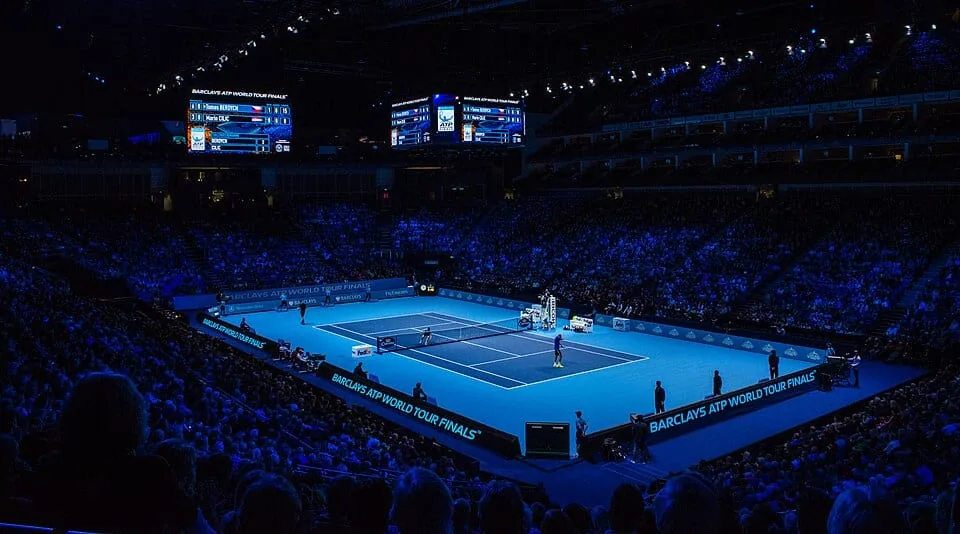
Photo: Arthur Ashe Stadium by Alexisrael, CC BY-SA, via Wikimedia Commons.