On 8 December, in a stadium in Bulacan province built to hold fifty-five thousand people, a 21-year-old from Manila will walk out to play a tennis match that counts for absolutely nothing.
Fifty-five thousand seats. For an exhibition.
This is in a country that, by its own tennis federation's reckoning, has fewer than a thousand tennis courts in total — across more than seven thousand islands and something north of a hundred million people. If that strikes you as an absurd mismatch between supply and demand, you have understood the story perfectly. Hold onto it, because everything else follows from it.
The Philippines did not have a tennis culture two years ago. It had basketball, which it has in roughly the way Brazil has football — in the bloodstream, played on every spare slab of concrete. It had boxing, which for two decades meant one man and the days the nation stopped. Tennis was something you half-watched on cable at three in the morning, if you watched it at all, featuring people you had no particular reason to care about.
Then Alex Eala happened, and she happened very fast.
The part you may have already seen
If you watch tennis at all casually, there is a decent chance you first noticed her in Miami in March 2025. She was nineteen, ranked outside the top 100, and in the draw on a wild card — which is to say she was in the tournament because somebody decided to be nice to her, not because she had earned a place.
What followed was one of those weeks that rearranges a career in public. She beat Jelena Ostapenko, a French Open champion, in the third round. She beat Madison Keys, who had won the Australian Open eight weeks earlier, in the fourth. And then in the quarterfinal she beat Iga Swiatek, 6-2, 7-5, with the kind of clean, unbothered ball-striking that does not look like an upset while it is happening and only afterwards makes you check the rankings again.
She lost the semifinal to Jessica Pegula. She also became the first Filipina to reach the last four of a WTA 1000 event, and the clips of the crowd — a wall of blue, red and yellow flags in the Miami stands, people who had driven from three states over — went round the world before the match had finished.
That was the trailer. The feature took another year.
A childhood spent somewhere else
The thing worth knowing about Eala, and the thing that makes the Philippine reaction to her slightly complicated and much more moving, is that she did not learn the game at home. She could not have. She moved to Mallorca at thirteen, to the Rafa Nadal Academy, and grew up on a Spanish island in a Spanish training system, several thousand miles from the place whose flag she carries.
That is the standard route out for a talented player from a country without a tennis infrastructure, and it is a brutal bargain for a child: you get coaching, sparring partners, courts that are not booked solid, a path — and you give up your home, your family dinners, your friends, your language in daily use, from an age when most children are still being walked to school.
It worked. In 2022 she won the US Open girls' singles title, beating Lucie Havlickova 6-2, 6-4 in the final, and became the first Filipino player to win a junior Grand Slam singles title. She was seventeen. Even then the reaction at home was out of proportion to the event — junior titles do not usually make the national news anywhere — which should have been the first sign of how much was waiting to be released.
The near miss that made people believe
Before the breakthrough there was a heartbreak, and in some ways it did more for her than a win would have.
Eastbourne, June 2025, grass, her first tour-level final. She led. She had four championship points. Maya Joint saved every one of them and won 6-4, 1-6, 7-6, the match finishing in a final-set tiebreak that went past ten points each.
Four championship points. There is no gentler way to lose a first final. For a sporting public that was still learning the rules, it was an odd and painful initiation — the first time most Filipinos had sat through a tennis match that mattered to them, and it ended with their player one point away, four separate times, and then not.
What it also did was confirm that she belonged there. Losing a final is still reaching a final, and she had done it as the first Filipino to play for a tour-level title in the open era.
Washington, and the Monday that changed it
The title came thirteen months later, in Washington, in circumstances that could not have been better designed for drama if somebody had written them.
The Mubadala DC Open final, 2 August 2026. Eala against Jessica Pegula, the top seed and world number three. Pegula took the first set 6-4 and led 1-2 in the second when the sky over Washington opened — heavy rain, lightning, play suspended, everybody sent home. In a way it was the cruellest possible interruption: a 21-year-old one set down in her second career final, now given an entire night to think about it.
They came back at midday on the Monday. Eala won the last nine games of the match. Not the last nine points — the last nine games, including a 6-0 third set, closing it out 4-6, 6-4, 6-0 in a total of one hour and forty-five minutes of actual tennis.
She had beaten the top three seeds on the way to the trophy, which nobody had managed at a tour event since Barbora Krejcikova in Dubai in 2023. She became the first player from the Philippines, man or woman, to win a WTA Tour singles title. And she went into the top 20 for the first time, reaching a career high of world number 18 on 24 August.
The footage from the Philippines that afternoon — a Monday afternoon, in offices, in malls, in sari-sari stores with a television in the corner — looked like the old Pacquiao fight days. People have made that comparison constantly over the last year, usually to Eala's visible embarrassment. She has been careful to point out that she has not done anything like what he did. She is also, demonstrably, the biggest thing in Philippine sport.
The loudest new fans in the game
Here is the part that has genuinely altered the texture of tennis matches, and it has nothing to do with Eala's forehand.
Filipino crowds have arrived on the tour, and they do not behave the way tennis crowds are supposed to behave. They chant. They sing. They bring drums and horns and enormous flags into stadiums where the traditional etiquette is a polite ripple between points. At the US Open this year her matches drew the kind of noise normally reserved for a night session on Arthur Ashe, except it was happening in the afternoon on an outside court, in a language most of the people in the stadium did not speak.
Some of the sport's traditionalists have found this difficult. Most people have found it wonderful. If you have ever wondered what tennis sounds like when it is being watched by people with no inherited sense of how one is meant to watch tennis, we wrote about the loudest crowds in the sport and where the noise actually comes from, and the Filipino contingent has now comfortably joined that list in about eighteen months flat.
Her coach, Joan Bosch, who has been with her since before Miami, has said more or less openly that the team did not see it coming. They never imagined the support would be like this, he admitted earlier in the year — and he was not talking about a few hundred people with flags. He was talking about a national mood.
It has shown up in the fan votes too, which sounds trivial and is not. Eala has twice this season won the WTA's Star of the Swing poll, a fan-voted thing the tour runs after each segment of the calendar. In the grass-court vote in July she took 89 per cent of the ballot — 2,164 of 2,442 votes cast. After the North American hard courts she took 78 per cent. There is a point at which a fanbase that organised stops being a fanbase and starts being a constituency.
What a star does to a country with no courts
Now back to that number from the opening, because this is where it gets interesting.
Fewer than a thousand courts, nationwide. Clubs reporting that they are fully booked. Junior programmes that used to beg for enough children to fill one group class now keeping waiting lists. Decathlon, the French sporting-goods chain, says sales of beginner rackets in the Philippines jumped 66 per cent in a single year and has reworked its store displays and its social media around the surge. Communities that have never had a court are writing in asking for sponsorship to build one.
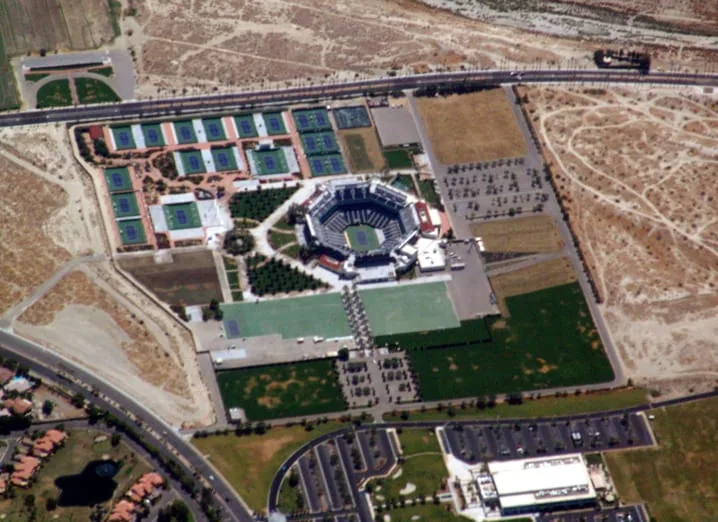
The federation is responding at the scale of actual concrete: it is due to break ground this year on a government-backed national tennis centre north of Manila, with an academy attached and a stadium holding eight thousand.
That is the real measure of the Eala effect, and it is a far better one than her ranking. A ranking is one person's property. A tennis centre with an academy is the machinery that means the next Alex Eala might not have to move to Mallorca at thirteen to get a decent hitting partner. Whether it works is a question for ten years from now. That it is being built at all is a direct consequence of one woman winning tennis matches in another hemisphere at hours when most of the country was asleep.
The last few weeks have been hard
All of which makes the current moment a slightly strange one to be writing about her, because the past fortnight has not gone well, and that is worth being honest about.
At the Asian Games in Aichi-Nagoya she was the top seed and the clear favourite for gold. She won the first set of her semifinal against Wang Xiyu, the world number 85, and then lost the next two: 6-3, 3-6, 2-6 in the end, and Wang went on to take the title. Eala left Japan with a bronze — her second in a row, after Hangzhou in 2023, where the player who beat her in the semifinal was Zheng Qinwen, on her way to becoming the face of Chinese tennis.
Before that she had gone out in the last 16 of the Singapore Open to Tatiana Prozorova, ranked 180. Then she skipped the China Open in Beijing altogether, which cost her ground in the race to qualify for the season-ending championships.
This is the unglamorous reality of being a top-20 player who is also a national symbol: the losses are no longer private. Every early exit is covered at home as a minor national event, dissected by people who learned the scoring system last year, and the player has to find a way to be twenty-one years old inside all of that.
Wuhan, and what she needs
She is next in Wuhan, where the WTA 1000 runs from 12 to 18 October. She is seeded 16th, which buys her a first-round bye and a slightly gentler start, and the field is about as serious as the tour gets outside the slams: the entire current top 10 is entered, from Elena Rybakina at number one through Aryna Sabalenka, Pegula, Coco Gauff, Mirra Andreeva, Linda Noskova, Elina Svitolina, Karolina Muchova, Swiatek and Marta Kostyuk.
What is actually at stake is the race for the eight places at the WTA Finals, and Eala is not comfortably inside it. A deep run in Wuhan would change the arithmetic substantially. A first match loss would more or less end the conversation for this season, which is not a disaster for a 21-year-old in her second full year on tour, but it would sting, because she has made the year close enough to touch.
If you want to follow it from Europe or the Americas, the matches fall at the usual awkward hours — we put together a guide to surviving the Asian swing time zones when the swing started, and it applies here in full.
Back to the fifty-five thousand
And then, whatever happens, there is December.
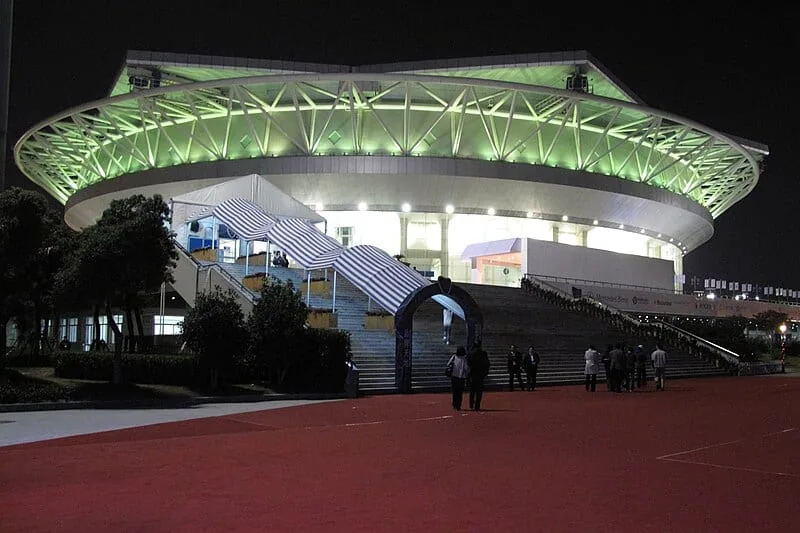
The event is called Alex Eala Live: Game. Set. Celebrate, it is at the Philippine Arena in Bulacan on the eighth, and her opponent is Janice Tjen of Indonesia — a neat piece of casting, two Southeast Asian players in a region that has produced almost no tour-level tennis at all. There will be a celebrity match, live music, the whole production. Tickets went from six hundred pesos to twenty-five thousand, and the pre-sale registration drew more than fifteen thousand sign-ups within hours of the announcement.
The world record for the largest crowd at a tennis match is 51,954, set in Cape Town in 2020 when Roger Federer played Rafael Nadal for charity. The Philippine Arena seats fifty-five thousand. The organisers have not been subtle about what they are aiming at.
There is something quietly extraordinary about the shape of that. The record was set by the two most famous players in the history of the sport, at the peak of a rivalry that two generations grew up on, in a country with a deep and complicated tennis history. If it falls in December, it will fall to a 21-year-old with one tour title, in a country where most of the people in the building will be watching live professional tennis for the first time in their lives, in a stadium normally used for religious gatherings and concerts, for a match with no ranking points attached.
Nobody is pretending the exhibition is sport. It is a homecoming, staged at the scale of a national holiday, for someone who left at thirteen and has spent eight years being brilliant at a distance.
What I keep thinking about is the gap between those two numbers — fifty-five thousand seats and fewer than a thousand courts. For now it is a gap that says something slightly sad: a country that has learned to love watching a game it has almost no way to play. The federation is pouring concrete to close it. Decathlon is reordering rackets to close it. Several thousand children who said this year that they want to be Eala are, in their own way, closing it.
Give it a decade and the ratio might look completely different, and a kid from Quezon City with a good backhand might get to stay home. That is a far larger thing than a trophy in Washington, and she did it by accident, simply by being worth watching.
Photo: public outdoor tennis courts at dusk, from our picture library.
🎾 Gear from this story
HeadHead Gravity MPJessica Pegula's racket of choiceView on Amazon →As an Amazon Associate, SUPER.TENNIS earns from qualifying purchases.