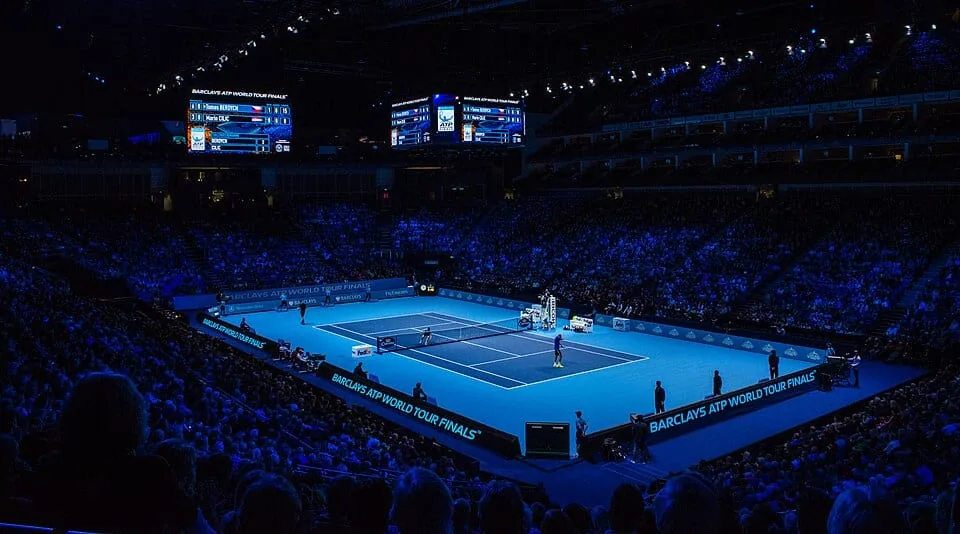
Your alarm goes off at ten to four. It is dark, the heating has not come on, and somewhere in your head a sensible voice is pointing out that you have work in five hours and that the result will still be there at lunchtime. You get up anyway, because a first-round match in Beijing is about to start and you have decided, for reasons you could not entirely defend in court, that you would like to watch it live.
If that sounds familiar, welcome. For the next five weeks, professional tennis relocates to the other side of the planet and leaves most of its audience behind in the wrong time zone. From today the sport belongs to Beijing, Tokyo, Shanghai, Wuhan and Ningbo, and if you live in Europe or the Americas, the best matches of the autumn are going to happen while you are asleep, at work, or arguing with yourself about whether to set an alarm.
This is a guide to doing it properly. Not a lecture about sleep hygiene, and not a pretence that you can watch everything. Just the actual schedule, the actual time maths for where you live, and the handful of things that make watching tennis at four in the morning feel like a treat rather than a punishment.
The five weeks in question
Here is what is on, in order, so you can pick your battles.
The main draws in Beijing begin tomorrow, 30 September. The China Open is really two tournaments sharing one enormous site: an ATP 500 that runs from 30 September to 6 October, and a WTA 1000 that keeps going until 11 October. The showcourt, the Diamond Court at the China National Tennis Center, holds around 15,000 people, which makes it one of the biggest tennis arenas anywhere outside New York.
At the same time, in Tokyo, the Japan Open runs from 30 September to 6 October at the Ariake Coliseum. It is the 52nd edition, the oldest tour-level event in Asia, and Carlos Alcaraz arrives as defending champion after beating Taylor Fritz in last year's final. It also happens to be the last tournament of Kei Nishikori's career, which gives the whole week a lump in its throat.
Then the calendar gets serious. The Shanghai Masters takes over from 7 to 18 October, a twelve-day Masters 1000 with a 96-player singles draw, which means byes, second-week rhythms and the feel of a Grand Slam squeezed into a fortnight. On the women's side, Wuhan hosts a WTA 1000 from 12 to 18 October, Ningbo a WTA 500 from 19 to 25 October, and Tokyo comes back around for the Toray Pan Pacific Open from 26 October to 1 November.
Add it up and it is roughly thirty-three consecutive days of tennis that starts, from a European or American point of view, at an antisocial hour. If you want the wider picture of how this stretch fits into the rest of the season, we laid it out in what happens to tennis after the US Open, and there is a full breakdown of the biggest stop of the lot in our Shanghai Masters guide.
What time is the tennis, really
This is the part nobody does for you, so here it is in plain numbers.
China runs on a single time zone, eight hours ahead of UTC. Japan is nine ahead. Day sessions at these events typically get going at 11am local, which is where the trouble starts.
An 11am start in Beijing is 4am in London, 11pm the previous evening in New York, and 8pm the previous evening in Los Angeles. An 11am start in Tokyo is 3am in London, 10pm the night before in New York, 7pm the night before on the west coast.
Look at those numbers again from the American side and something wonderful appears: the Asian swing is the one month of the year when tennis is genuinely convenient in the United States. The first matches of a Beijing day land in your evening. You can watch live tennis after dinner, in your own living room, without setting anything. Fans in California get the whole opening session as prime time. For once, the people who usually have to stay up for Wimbledon and Roland Garros are the lucky ones.
From Europe it is the reverse. The tennis that starts at 4am in Britain runs through the morning, so a match that begins at 4am might not finish until you are on your way to work, and the marquee matches, the ones scheduled last, can land at lunchtime. An evening session that starts around 7pm in Beijing is midday in London and 7am in New York, which is why the biggest names often turn out to be the most watchable for European fans: the night matches in Asia are the daytime matches in Europe.
One trap to keep in mind. The clocks move during this swing, and not at the same time everywhere. Britain and most of Europe go back on Sunday 25 October, the United States on Sunday 1 November. China and Japan do not change at all. That means that from 26 October, every Asian start time lands an hour earlier on a European clock than it did the week before, and from 2 November it does the same for Americans. If you have been setting alarms by habit for three weeks, the habit will quietly betray you in the last week of October.
Three ways to survive this
There is no single right approach. There are three, and the trick is picking one per day rather than drifting between them and getting the worst of all three.
The dawn shift
Set the alarm, watch one match live, go back to bed. This works better than people expect, as long as you are honest about the "one". The failure mode is the 4am fan who tells themselves they will watch the first set and is still there at 7.15am watching a deciding tie-break with a cold cup of coffee, having decided that work can wait.
Pick the match the night before. Check the order of play, not just the draw, so you know whether your player is first on or third on a court that has already run long. First on is the only slot you can trust. Anything else, and the start time is a suggestion, because a three-hour first match pushes everything behind it into the afternoon.
There is one refinement worth knowing. The tournaments publish the next day's schedule in the local evening, which is late afternoon in Britain and late morning in New York. So you can make the decision about whether to set the alarm at a civilised hour, with the actual order of play in front of you, rather than gambling on it before bed.
The breakfast replay
The most underrated option, and the one I would recommend to most people. You do not watch live at all. You get a normal night of sleep, wake up at your usual time, and watch the match you care about from the start with your first coffee, while the tournament is still going on somewhere behind you.
This is not second-best. A replay at 8am is a better viewing experience than a live match at 4am, because you are conscious for it. You can skip the changeovers, which cuts an hour off a three-setter. The only thing you give up is the possibility of surprise, and that is entirely solvable, which brings us to the hard part.
The blackout
Watch nothing, read nothing, and save the whole week for the weekend. Some fans genuinely prefer this for the Masters and the WTA 1000 events: they let the first five days happen without them, then watch the semi-finals and final properly, with the context of knowing who survived. If your life does not have room for thirty-three days of dawn tennis, this is not giving up. It is triage.
How to dodge a score for nine hours
If you are using the replay approach, the enemy is not your schedule. The enemy is your phone, which is desperate to tell you who won.
Turn off sports notifications for the duration. All of them, not just the tennis apps. Football apps will cheerfully push a tennis headline at you in October because there is nothing else on.
Mute the obvious words in whichever social app you use. Player surnames, the tournament names, and the word "final" will cover most of it. If your app lets you mute for a set period, mute for a month and forget about it.
Be careful with video platforms. The thumbnails on highlight clips give away results without you clicking anything, and the recommended row will find you the moment you open the app. If you are watching a replay on a smart TV, start it from a direct link or from the tournament's own player, and avoid the home screen entirely.
Group chats are the real danger. There is no technical fix for a friend who sends a one-word message at 6.40am. Tell them what you are doing. Most people respect it once they know, and the ones who do not will at least be funny about it.
One more habit that helps: do not check how long the match lasted before you watch it. Knowing that a match ran four hours and twenty minutes tells you almost as much as knowing the score, and every streaming platform puts the running time on the thumbnail. Start the replay and let it be whatever length it turns out to be.
And accept that you will lose one occasionally. Somebody will shout a result across an office, a radio bulletin will ambush you in the car, and that is the cost of caring. It stings for about ten minutes, and the match is usually still worth watching.
The kit that makes it bearable
None of this requires much. But a handful of small things genuinely change what a 4am tennis habit feels like, and they are worth having before the swing gets to its best week rather than after.
The single biggest upgrade is sound. A pair of decent wireless earbuds means you can have commentary, crowd noise and the sound of the ball at a proper volume while the rest of the house sleeps through it. Watching tennis on mute is watching half a match; the rhythm of a rally lives in the sound.
If you are getting up in the dark, a sunrise alarm clock is far kinder than a phone alarm, and it has the enormous secondary benefit of keeping your phone, and its notifications, out of the bedroom. A soft sleep mask does the opposite job for the hour of sleep you reclaim afterwards, which matters more in October as the mornings get brighter later and your body clock stops knowing what is going on.
For the watching itself: an adjustable tablet stand is a small thing that fixes a real problem, because nobody wants to hold a screen at head height for three hours at dawn. If you would rather have the match on the television, a streaming stick puts whichever service carries tennis where you live onto the big screen without waking the household by hunting for cables in the dark.
Then the comfort layer, which sounds frivolous and is not. A big throw blanket on the sofa is the difference between watching a fourth set and giving up at 5.30am because you are cold. An insulated travel mug keeps one drink hot for the entire match, which saves the trip to the kitchen that always seems to coincide with the break of serve you waited two hours for.
Two more, if the sleep side is what you struggle with. Blackout curtains make the hour you go back to bed actually count, and a white noise machine covers the household waking up around you when your day has started in the middle of the night and theirs has not.
If the room you watch in is becoming a permanent fixture of your autumn, we went further into that in the tennis room at home, and if you are still working out which service actually shows what where you are, start with our guide to how to watch tennis.
What you are actually staying up for
It would be easy to treat this stretch as filler between the US Open and the end of the season. It is not, and the standings explain why.
The women's game arrives in Beijing with a new world number one. Elena Rybakina went top of the rankings on 14 September, having won the Australian Open and the US Open in the same season, beating Aryna Sabalenka in both finals and ending a run of 99 weeks at number one for the Belarusian. She is the first player from Kazakhstan, of either sex, to lead the rankings. She has also never won Beijing, and neither has Sabalenka, who arrives as the second seed with Coco Gauff behind her. Amanda Anisimova is the defending champion and has the whole thing to protect.
The men's draw in Beijing has Alexander Zverev, Felix Auger-Aliassime and a 39-year-old Novak Djokovic, who has won this tournament six times and has never lost a final here. In Tokyo, Alcaraz defends, Fritz is back, and Nishikori plays the last matches of a twenty-year career in front of the crowd that watched him become the best player Asia has produced.
And everything counts twice over. The ATP Finals in Turin run from 15 to 22 November at the Inalpi Arena, the WTA Finals from 8 to 15 November, and the qualification races for both are decided in exactly these five weeks. Shanghai alone can move a player four or five places in the standings. Every one of those 4am matches is somebody trying to make November mean something, which is why the tennis in this stretch has a particular edge: nobody is coasting, because there is nothing left to coast towards.
There is also the simple fact that these crowds are magnificent. Beijing and Shanghai sell out enormous arenas to audiences who have waited all year for one week of tennis, and the noise on a Chinese showcourt at match point is unlike the noise anywhere else on tour. Tokyo is the opposite and just as good: quieter, more precise, a crowd that applauds a drop shot from the losing player.
So set one alarm this week. Not five, not every day, just one, for a match you have actually chosen. Make the coffee the night before. Sit down at four in the morning with the sound low and the rest of the street asleep, and watch a tennis match that thousands of other people, in other dark living rooms, in other countries, have got up for as well. Nobody will ever ask you about it. It is between you, the sport, and a sunrise that arrives somewhere around the third set.
Photo: low sun through the fence of an empty court, the hour when the tennis in Asia is already well into its afternoon.
🎾 Gear from this story
BabolatBabolat Pure AeroCarlos Alcaraz's racket of choiceView on Amazon →As an Amazon Associate, SUPER.TENNIS earns from qualifying purchases.