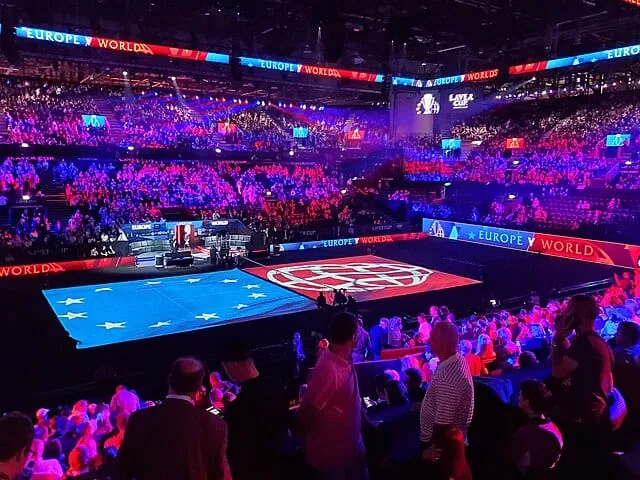
Somewhere in the middle of this week, in an indoor arena in Singapore that holds a few thousand people, Amanda Anisimova will walk out to play a tennis match that most of the sporting world will not notice.
Twelve months ago she was standing on the last Saturday of the US Open, in the final, in a stadium holding nearly 24,000 people, with a global television audience watching her try to win the biggest title in American tennis. Two months before that she had played the Wimbledon final. Between the two of them she had beaten the world No. 1 and the greatest clay-courter of her generation, and by the time the season finished she was ranked in the top four in the world.
This week she is the second seed at a WTA 500 in the Kallang district of Singapore, and her first opponent will be whoever wins a first-round match between Fiona Ferro and Talia Gibson.
Nothing has gone wrong, exactly. Nobody has been sacked, nothing has collapsed, there is no scandal. What has happened to Anisimova over the last nine months is the most ordinary thing in professional tennis and the least discussed: she had the best year of her life, and then she had to play the year after it.
What she did last year, in plain numbers
It is worth setting out, because the scale of 2025 is the reason 2026 has felt the way it has.
She won two WTA 1000 titles, in Doha in February and Beijing in the autumn. Those are the biggest events on the calendar outside the four majors. She reached the Wimbledon final, beating the world No. 1 Aryna Sabalenka in the semi-final 6-4, 4-6, 6-4 to get there, on her first appearance on Centre Court. Eight weeks later she reached the US Open final, and on the way she beat Iga Swiatek in the quarter-finals.
She finished that fortnight at a career-high world No. 4, and by the first ranking list of this January she was No. 3. For a player who had walked away from the sport entirely two and a half years earlier, it was one of the most complete seasons anyone has produced in the modern women's game.
Today she is ranked 11th.
The 57 minutes that followed her around
Before anything else, there was the Wimbledon final, and if you watched tennis last July you already know how that went.
Swiatek beat her 6-0, 6-0 in 57 minutes. Anisimova won 24 points in the whole match. She made 28 unforced errors. She became the first woman to lose a Wimbledon final without winning a single game since 1911, which is the kind of statistic that follows a person around whether they deserve it or not.
What she did afterwards is the part that stayed with a lot of people. She stood on the court, in front of a full house that had come to watch a final and got 57 minutes, and said out loud: "It has been an incredible fortnight for me, even though I ran out of gas a bit today." Then she thanked her mother, who had flown in that morning.
She said later that she cried for about half an hour, then rang a friend who made her laugh about it, and that this was roughly the whole process. "I think I was a little bit in shock after, but I told myself, I will definitely come out stronger after this."
Eight weeks later she was in another major final. That is not a person who took the loss badly. That is a person who took it and put it down.
What the year after actually looks like
Here is the part that fans of other sports find strange, and it explains most of this season.
Tennis rankings are a rolling twelve months. Every point a player earns has to be earned again a year later, on the same week, or it comes off the total. Win a big title in February and you do not get to enjoy it; you get to carry it. Come back the following February and you have to win the same title again just to stand still.
Anisimova came into 2026 carrying a year of those. Doha, Beijing, Wimbledon, New York. All of it had to be defended.
The first attempt went wrong in a way nobody could plan for. In February she went back to Doha as defending champion and No. 3 seed, and in her opening match against Karolina Pliskova she split the first two sets 7-5, 6-7(3), then called for a medical timeout early in the third to have her blood pressure and vital signs checked. She tried to carry on, could not, and retired trailing 4-1. It was a head cold, she said afterwards. It cost her 990 ranking points in a single afternoon, and with them the American No. 1 spot.
That is the year after, in one match. A cold in February that would barely register for anyone else erases the best week of your previous season.
It carried on from there. She lost in the fourth round at Indian Wells to Victoria Mboko. Belinda Bencic beat her 6-2, 6-2 in Miami. In late March she parted ways with Rick Vleeshouwers, the coach who had rebuilt her game and been named the WTA Coach of the Year for the work they did together in 2025. Then her left wrist went, and it kept her out for roughly two months in the spring, which wiped out Charleston, Madrid and Rome and most of the clay court season with them.
She reached the third round at Roland Garros, the third round at Wimbledon, and the third round at the US Open. She is 25 years old, she is healthy again, and she has not been past the quarter-finals of anything since January.
The coach, and what she said about it
The coaching story is the most human thing in her season.
Vleeshouwers started working with her in 2024, when she came back to the tour after eight months away, and the two of them turned a player outside the top 400 into a Grand Slam finalist inside eighteen months. When they split in March, she wrote publicly that she wanted to thank him for treating her as a human being first.
She spent part of the spring on a trial with a different coach, Sebastian Sachs, while her wrist healed. Then, at the start of August, she turned up to practice in Toronto with Vleeshouwers beside her again.
Her explanation was disarmingly simple. She was missing what they had the previous year, she said: the energy, the connection. She also took the blame for the split herself, saying their closeness had let her spiral rather than steady her.
Players change coaches constantly and it usually means nothing. This one is worth noticing because of who she is. Anisimova is not a player who grinds through discomfort until it goes away. She is a player who, when something in her working life stops making sense, stops.
She has done the hard version of this before
In May 2023 she posted a note saying she had been struggling with her mental health and with burnout since the summer of 2022, that it had become unbearable to be at tennis tournaments, and that she was stepping away for a while.
She was 21. She had been a professional since she was a teenager. She had reached a Roland Garros semi-final at 17. And in August 2019, a week and a half before her eighteenth birthday, her father Konstantin, who was also her coach, died of a heart attack at 52.
The break lasted eight months. She came back in January 2024 in Auckland, ranked nowhere, and had to play qualifying at Wimbledon that summer. By the end of that season she had reached a final at the Canadian Open in Toronto with a win over Sabalenka in it. By the end of the next one she was the fourth best player in the world.
That sequence is why the current flat patch reads differently for her than it would for someone else. When she says, as she did before the US Open this year, that she is trying to find enjoyment in the sport again, it is not a press-conference platitude. It is the same word she used in 2023, and the last time she used it she disappeared for eight months and came back better. If you want the wider context of how the tour has changed its language about all of this, we wrote about tennis and mental health as a subject in its own right.
Why Singapore, and why now
The tournament she has turned up to is a genuinely interesting one.
The Singapore Tennis Open is played at the OCBC Arena at the Kallang, indoors, on hard courts, from 21 to 27 September. It is only the second edition of the revived event, and it has been promoted to WTA 500 status and moved from February to September for this year, which is why the field is as strong as it is.
If the location rings a bell, it should. Kallang is where the WTA Finals lived from 2014 to 2018, at the Singapore Indoor Stadium a few hundred metres away, back when the season ended in Southeast Asia every October. That deal ran out, the Finals went to Shenzhen and then elsewhere, and the tour effectively left Singapore behind. This week is the largest women's tennis event the city has staged since that era.
The draw is small and sharp: 28 players, which means the top four seeds sit out the first round. Mirra Andreeva is the top seed. Anisimova is second. Alexandra Eala is third, playing the biggest tournament of the Asian swing as one of the faces of it, and Elise Mertens is fourth. Behind them are Maja Chwalinska, a wild card in Leylah Fernandez, the former world No. 3 Maria Sakkari and Donna Vekic. For a 500 in its first year at that level, that is a serious week of tennis.
The points on offer read like this: 500 for the champion, 325 for the runner-up, 195 for a semi-final, 108 for a quarter-final, 60 for winning a round. Modest numbers next to a major. In the last seven weeks of a season, they are the currency everybody is fighting over.
The arithmetic she is up against
The reason all of this matters in September rather than January is the WTA Finals, and this year the Finals have moved somewhere unexpected.
After two seasons in Riyadh, the WTA and the Saudi federation ended their three-year deal a year early, and the 2026 edition will be played at the Indian Wells Tennis Garden in the California desert from 8 to 15 November. It is the first time Southern California has hosted the year-end event since 2005. Eight players qualify. Only Elena Rybakina, who won the Australian Open and the US Open this year, has mathematically made it.
The rest of the field is being decided right now, in Singapore and Beijing and Wuhan and Tokyo, by players who will spend the next seven weeks crossing time zones with a calculator running in their heads. Sabalenka, Jessica Pegula, Coco Gauff, Andreeva, Elina Svitolina, Karolina Muchova and Linda Noskova currently hold the places behind Rybakina, and the gaps between the contenders are small enough that one good week changes the order.
Anisimova is not in that group. She dropped out of the top ten in the race when the points from her 2025 US Open final came off her total this month. To get back into the eight she would need something close to the run she had last autumn, starting here, and she would need it while players above her keep winning.
Realistically, Singapore is not a qualifying week. It is 500 points at the very most, and the honest version is that her season is unlikely to end in the desert in November.
That is exactly why this week is interesting rather than sad. Take the Finals off the table and what is left is the thing she actually needs: matches, indoors, against good players, with a coach she trusts sitting in her box and nothing behind her to defend. There is nothing left of her 2025 to lose. Everything from here is addition. If you want the full map of what these last weeks look like across both tours, our guide to the autumn run-in lays out where everyone goes next, and the WTA Finals guide explains how the eight places are settled.
What to watch for if you tune in
Anisimova is one of the most watchable ball-strikers in the women's game, and you do not need to know anything technical to see why.
She stands close to the baseline and takes the ball early, which means she is hitting it while it is still rising and the other player is still recovering from her own shot. Her backhand, hit flat and very hard down the line, is the best of that shot in women's tennis and has been since she was a teenager. When it is working, rallies are two shots long and the noise off the strings is different from everyone else's.
When it is not working, the same shot lands a foot long, over and over, because the margin she plays with is tiny by design. That is the trade. It is why she can beat the world No. 1 on a Thursday and lose 6-0, 6-0 on a Saturday. It also means that as a viewer you know within four or five games which version you are watching, which is more than you can say for most matches.
Singapore is eight hours ahead of London and thirteen ahead of New York, so her matches will land in the European morning and the American small hours. If you are in the UK, the tennis will be finishing about the time you sit down to lunch. Her own page has the rest of the background: Amanda Anisimova.
The part that does not show up in the ranking
There is a version of this story where the point is whether she qualifies for Indian Wells, and it is not a very good version, because she probably will not.
The better one is that a player who has twice decided that tennis was costing her more than it was giving her has, on both occasions, worked out how to come back to it. Once from grief and burnout, with eight months away and a ranking in the 400s. Once, this year, from a season that punished her for the best thing she ever did.
The second comeback is the harder one to see from outside. There is no dramatic absence, no comeback headline, no ranking in the hundreds to climb out of. There is just a very good player, 25 years old, flying into a city she has never won anything in, to play a tournament nobody will remember in five years, because that is what the job is when the year has not gone your way.
The people in the OCBC Arena this week will get to watch her do it in a building where they can hear the ball. Not a bad place to start over.
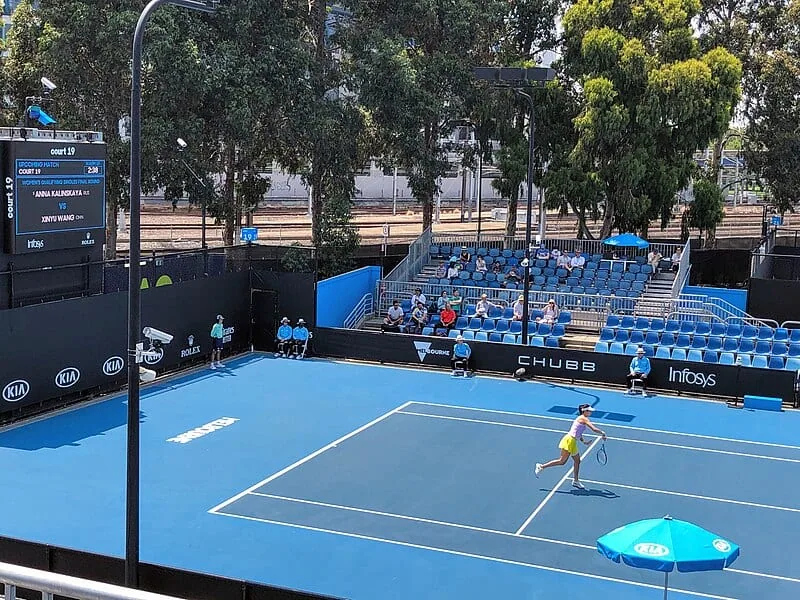
Photo: a women's hard-court match on a small show court, from our picture library.
🎾 Gear from this story
WilsonWilson Blade 104Aryna Sabalenka's racket of choiceView on Amazon →As an Amazon Associate, SUPER.TENNIS earns from qualifying purchases.