On Sunday evening Alexander Zverev stood on a blue court in New York holding a silver trophy and looking like a man who had been waiting most of his adult life for it. He had beaten Ben Shelton 6-3, 7-6(2), 5-7, 6-2 across three and a half hours, and it was his second major of the year after Roland Garros in June. The night before, Elena Rybakina had beaten Aryna Sabalenka 6-4, 5-7, 6-2 in the same stadium, adding the US Open to the Australian Open she won in January.
And then, on Monday morning, nothing. No night session. No draw sheet on your phone. If you are the kind of tennis fan who watches the four Slams properly and gets on with your life in between, this is the week the sport goes quiet and stays quiet until Melbourne in January.
Except it does not. Not even slightly.
The sport that never really stops
Tennis has one of the most punishing calendars in professional sport. Eleven months of it, played across six continents and four surfaces, with an off-season so short that some players get about five weeks between their last match of one year and their first of the next. What most of us think of as "the tennis season" is really just the four fortnights that get on terrestrial television and into the news bulletins. The rest of it happens anyway, in arenas most fans could not point to on a map, in time zones that make it inconvenient, in front of crowds that are often enormous and almost never mentioned.
The autumn is the clearest example. From this week until the last weekend of November there is tennis every single week, including some of the best events of the year, and it is played largely out of sight of the casual audience that was gripped by New York for a fortnight.
That is a shame, because the autumn has a completely different flavour from the summer. The Slams are grand and slow and ceremonial. The autumn is compressed, slightly unhinged, and full of players making desperate late runs at things they have spent nine months chasing. The crowds are different. The light is different. By the end of it the courts are indoors, the ball is flying, and everyone on tour is exhausted and pretending not to be.
Here is what is actually coming, and why some of it is worth your evening.
This week: exhale, then play for your country
The first week after a Slam is always strange. Players who lost in the first round have been resting for a fortnight. Players who reached the second Sunday are still somewhere between elated and destroyed. Physios earn their money. Nobody wants to hit a tennis ball.
They do not get long. On 18, 19 and 20 September the Davis Cup Qualifiers second round takes over, and this is the part of the autumn that fans of the old competition still love best. Fourteen nations, seven ties, home or away, four continents in one weekend. The thirteen winners from February plus Spain, who went straight through as last year's runners-up. Win and you go to the Final 8 in Bologna in November. Lose and your year as a national team is finished.
The venues tell you what kind of weekend it is. Great Britain play Ecuador at the Copper Box Arena in London on 19 and 20 September, a 7,000-seat box built for the 2012 Olympics where the noise has nowhere to escape. There is a tie in Vienna, one at the O2 arena in Prague, one at the Seoul Olympic Park tennis centre, one in Quebec City. Home nations choose the dates and, crucially, the surface, which is why a team with two clay-courters will suddenly discover a passionate commitment to clay in mid-September.
This is home-and-away tennis, and it is the loudest tennis there is. No neutral crowd, no polite hush, no queueing for a cocktail. Just a few thousand people who have taken a Friday off work screaming at a man they have never met to hold serve. If you have only ever seen the modern week-long Davis Cup finals on television, the old format in a small arena is a different sport entirely. Our Davis Cup guide explains how the competition ended up with this two-part shape, and why the format argument has been running for the better part of a decade.
Team tennis, twice more
A week later the sport does something it does nowhere else on the calendar: it plays two team events back to back and pretends that is normal.
The Billie Jean King Cup Finals run from 22 to 27 September at the Shenzhen Bay Sports Centre, indoors on hard courts, with the best women's national teams playing for the trophy that used to be the Fed Cup. It is the women's world cup of tennis, and if you have never watched a tie you should know the emotional temperature is completely unlike the individual tour. Players who spend the year as rivals sit on a bench together in matching tracksuits shouting themselves hoarse. Captains give speeches. People cry over doubles matches.
Then, from 25 to 27 September, the Laver Cup arrives at the O2 in London for its ninth edition: Yannick Noah's Team Europe in blue against Andre Agassi's Team World in red, Carlos Alcaraz and Zverev on one bench, Taylor Fritz and Alex de Minaur on the other, on that famous black court under concert lighting. We wrote about what that weekend actually feels like in Red Against Blue: The Laver Cup Comes Back to London, so I will only say this: it is the one event where the best players in the world sit close enough to touch each other for three days, and it shows.
Spare a thought for the men who play a Davis Cup tie one weekend and the Laver Cup the next. That is two intercontinental flights, two teams, two sets of national anthems, and no actual rest, eight days after a Grand Slam final.
Then the whole sport moves east
From late September the tour packs up and goes to Asia for a month, and this is the swing the casual audience misses most completely, because it is on while you are asleep or making breakfast.
The men start with Chengdu and Hangzhou from 23 to 29 September, then Beijing and Tokyo from 30 September to 6 October. The women have the China Open in Beijing from 30 September to 11 October, one of the biggest and best-attended events on their calendar, running as a two-week tournament with a draw deep enough to feel like a fifth Slam in everything but name. The Rolex Shanghai Masters follows from 7 to 18 October, also spread across a fortnight, in a stadium shaped like a magnolia blossom that seats around 15,000. Then Wuhan, from 12 to 18 October, at the Optics Valley centre.
Asian crowds are worth the alarm clock. They are young, they are enormous, and they treat players with a kind of open delight that is rare in European arenas. Shanghai in particular has produced some of the most-watched matches of recent seasons, partly because the conditions are humid and slow enough to make rallies go on forever, and partly because by October everyone has stopped being careful.
The practical problem for fans in Europe and North America is the clock. A Shanghai afternoon session is breakfast in London and the middle of the night on the American west coast. My honest advice is not to try to watch all of it. Pick the second week. Pick the quarter-finals onwards, when the draw has thinned out and the matches start to matter, and accept that you will be watching tennis with a coffee rather than a beer. If you are still working out how to follow the sport outside the Slams at all, our guide to how to watch tennis is a decent place to start.
And then the roof goes on
At the end of October the sport comes back to Europe and moves inside, and the change is more dramatic than it sounds.
Indoor tennis is faster. There is no wind, no sun, no heat, no bad bounces, so the ball does exactly what it was hit to do, and big servers who struggled all summer suddenly look unplayable. The sound changes too: instead of the flat open noise of an outdoor stadium you get the boom of a ball inside a sealed building, every grunt audible, the crowd noise pressing in. It is the closest tennis gets to boxing.
Vienna and Basel both run from 24 October to 1 November, two of the most atmospheric weeks on the men's calendar, in buildings where the crowd sits practically on the tramlines. Then comes the Rolex Paris Masters from 31 October to 8 November at Paris La Defense Arena, the last Masters 1000 of the year and the largest indoor tennis venue in the world, a converted rugby stadium that can take tens of thousands of people and feels like a rock venue that happens to contain a tennis court.
Paris in early November is where the season starts to bite. Players who need one more good week to qualify for the year-end finals arrive already limping. Some withdraw. Some play on painkillers and pay for it in Turin. It is compelling and slightly grim, and it is the clearest evidence for the argument that the calendar has simply got too long, an argument we looked at when the biggest names started skipping events in the summer, in Montreal Without Its Biggest Names.
Where the year is actually decided
Then, in three consecutive weeks in November, the season ends three times.
The WTA Finals come first, from 8 to 15 November, and this year they are somewhere new: Indian Wells, California. The WTA announced the move in July, ending the run in Riyadh, and the tournament will now be played at the Indian Wells Tennis Garden, a desert site with a 16,000-seat main stadium that most fans associate with sunshine in March rather than the last act of the season. Eight singles players, eight doubles teams, round-robin groups, and a format where you can lose your first match and still win the title.
The Nitto ATP Finals follow immediately, from 15 to 22 November at the Inalpi Arena in Turin, the sixth straight year in the city. Same shape: eight men, two groups, no draw luck to hide behind. You have to beat the best players in the world three or four times in a week, indoors, in November, having already played eleven months of tennis. The Italian crowd is one of the great sporting audiences and treats the whole week like a festival.
And then, finally, the Davis Cup Final 8 in Bologna from 24 to 29 November, at the SuperTennis Arena, where Italy as host nation are joined by the seven teams who come through next weekend. One week, eight countries, knockout ties, and a trophy that has existed since 1900 and has been lifted by almost every great player in the history of the men's game.
That is the real end of the tennis year: not a Sunday in New York, but a Sunday in Bologna at the end of November.
What is still on the line
If you want a reason to care beyond the venues, the numbers are unusually good this season.
On the men's side, Jannik Sinner is world No. 1 on around 12,800 points, roughly 5,000 clear of Zverev in the official rankings, which count the last twelve months. But the Race to Turin, which resets every January and counts only this calendar year, tells a completely different story: after New York, Zverev leads it on 8,650 points, about 700 ahead of Sinner, with Shelton up to third on 4,420 after his run to the final. The Race is what decides year-end No. 1, and it is now genuinely, unpleasantly close for both of them. Ten weeks, one long fight, two men who have already played each other in a Wimbledon final this year, which Sinner won.
The women's race is even tighter. Rybakina leads it with 5,492 points, Sabalenka is on 5,185, Mirra Andreeva on 5,184, Jessica Pegula on 5,045 and Coco Gauff on 4,874. Six hundred points cover the top five, which in practical terms means one good tournament in Beijing or Wuhan reorders the entire thing. Year-end No. 1 is unresolved and will probably stay that way until the last week of the season.
And it has been that kind of year all round. Six different players won the eight Grand Slam singles titles: Alcaraz in Melbourne, Zverev at Roland Garros and now New York, Sinner at Wimbledon, Rybakina in Melbourne and New York, Andreeva in Paris at nineteen, Linda Noskova at Wimbledon. Nobody has controlled 2026. That is why the autumn matters more than usual this time round.
How to watch it without losing your evenings
You do not have to follow all of it. Almost nobody does, including the people who write about tennis for a living.
Pick your moments. The Davis Cup weekend, if your country is playing, because nothing else in tennis sounds like that. The Laver Cup, because it is designed to be watched. The second week of Shanghai. The last three days of Paris. And then the two finals weeks in November, when the fields are small, the matches are meaningful, and every single player on court is someone you have heard of.
Treat the rest as background. Have it on while you cook. Check a score at lunch. Learn the name of one player you did not know in September and follow them through to Turin. The autumn rewards that kind of low-effort attention far more than the Slams do, because the fields are smaller and the stories repeat week after week until they become familiar.
Bologna, and then quiet
There is a specific moment coming at the end of November that almost nobody who watched the US Open final will see. It will be in an indoor arena in northern Italy, late on a Sunday, after a doubles rubber has decided a tie, and it will be two teams of exhausted men in matching tracksuits shaking hands while a few thousand Italians make an extraordinary amount of noise.
Then the lights go off and tennis takes its five or six weeks away. The players go to the Maldives or to a gym in Dubai, the courts sit empty, and for a short while there is genuinely nothing on.
It will not last. The first balls of 2027 get struck in Australia while most of us are still taking the decorations down. Until then, there are ten weeks of the sport left, played in Prague and Shenzhen and Shanghai and Vienna and Paris and Turin and Bologna, and you now know where all of it is.
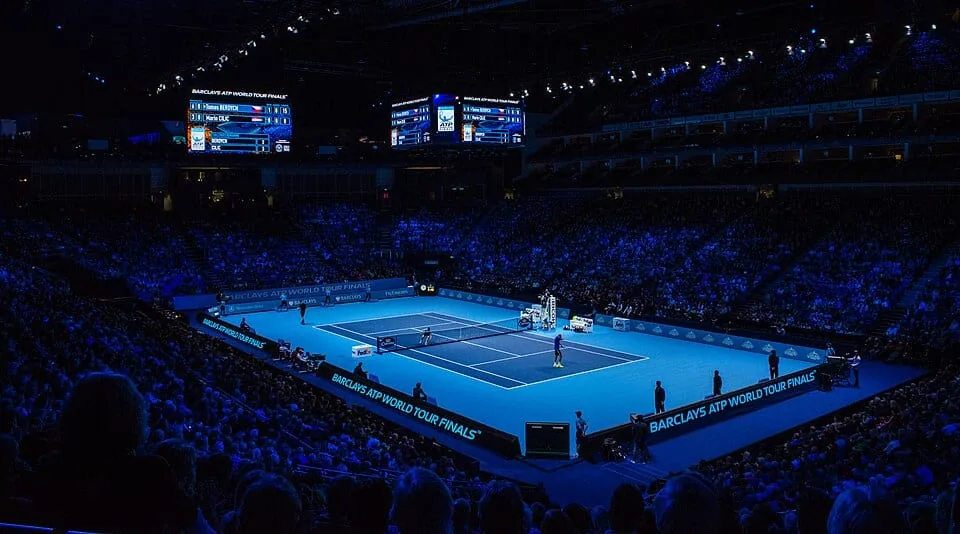
Photo: an indoor arena during a season-ending final, the court lit blue under a full house.
🎾 Gear from this story
HeadHead Extreme TourAlexander Zverev's racket of choiceView on Amazon →As an Amazon Associate, SUPER.TENNIS earns from qualifying purchases.


