There is a moment on the walk in to the China Open that catches first-time visitors out. You come up from the subway at Olympic Green, in the north of Beijing, and you follow the crowd past the Bird's Nest and the Water Cube, the two buildings everyone half recognises from 2008. The path bends. And then, sitting on the plaza like something dropped from a great height, there is a vast faceted shape with light coming off its sides, and you realise that this is not an opera house or a museum. This is where the tennis is.
They call it the Diamond Court, and for the next ten days it is the busiest room in the sport. The China Open is on right now: the men until Tuesday, the women until 11 October, both tours in the same complex at the same time, with Novak Djokovic back in the building for the first time in eleven years and a home crowd that treats the whole thing, in the words of its best-known player, like a fifth Grand Slam.
If you follow tennis from a sofa rather than a baseline, Beijing can slide past you. It arrives in the small hours, it is full of names you half know, and it lands in the strange hungover weeks after the US Open when nobody is quite sure what the season is still for. But this fortnight is worth your attention, and the easiest way in is not through the draw sheet. It is through the buildings. Because the story of how tennis ended up with a gemstone and a flower in the middle of an Olympic park is also the story of how the sport ended up spending every autumn in Asia.
A jewel standing next to a flower
Start with the older of the two stadiums, because it came first and because it is the prettier building.
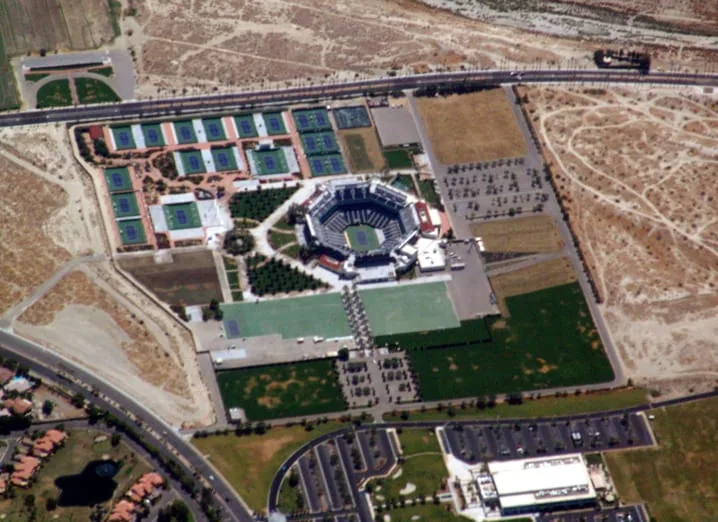
The China National Tennis Center opened in October 2007, purpose-built for the Beijing Olympics the following summer. Its centre court seats 10,000 people and is made of twelve separate curved stands that lean out above the seats. Seen from the air, or from the top of the stairs on the plaza, the twelve stands read as twelve petals. Everyone calls it the Lotus Court, and once you have seen the shape you cannot unsee it.
That is where the 2008 Olympic tennis happened, which gives it a guest list most stadiums would take. Rafael Nadal won the men's singles gold there, and went to world No. 1 immediately afterwards. Elena Dementieva won the women's gold, the biggest title of a career that never got a major to go with it. Roger Federer and Stanislas Wawrinka won the men's doubles, which remains the Olympic medal Federer actually got to keep hold of. Venus and Serena Williams won the women's doubles, their second together. Four finals, one fortnight, in a building that was eight months old.
Then the Olympics left town, as they do, and the question became what the city does with a tennis park built for two weeks of August. The answer arrived in 2009, when the China Open packed up and moved in.
What happened next is the part that tells you how fast this was all moving. Within a year the tournament had outgrown the 10,000 seats. Construction on a second, bigger stadium started in late 2009, and the Diamond Court was finished and in use by August 2011, with its grand opening on 25 September that year. It holds 15,000. It was designed by the Beijing practice Atelier 11, and it is named for exactly what it looks like: the facets catch the light and throw it back at you from across the plaza.
It also has a roof, and the roof is the detail I find hardest to let go of. It is built in two layers and four units, it slides open east and west, and the full opening procedure takes twelve minutes. Twelve minutes, every time, while fifteen thousand people watch the sky appear in instalments. When it was built it had the largest opening span of any stadium roof in Asia.
Around those two stadiums the complex sprawls: the 4,000-seat Moon Court, a 2,000-seat show court, a dozen match courts and six more for practice, with a combined capacity somewhere north of 32,000 if you filled every seat on site at once. On the busy middle days, they come close.
The court named after a man you have probably never heard of
That 2,000-seat show court has a name on it that means nothing to most fans, and I think it is the most human thing in the whole park.
It is called the Brad Drewett Court. Drewett was an Australian, a former tour player who became an administrator, and from 2006 he ran the ATP operation covering Asia and the Pacific before taking over as the tour's executive chairman. If you want to know who did the unglamorous work of persuading the men's tour that its future ran through Beijing and Shanghai and Tokyo, a large part of the answer is him.
He was diagnosed with motor neurone disease and died in May 2013, aged 54. Later that year, before the China Open final, the tournament renamed Court 1 after him. There is no statue and no ceremony you would notice on a tour of the grounds. There is just a name on a show court in a city he spent a decade arguing for, which is a quieter kind of memorial than tennis usually goes in for, and a better one.
From a club court near a shopping centre to a 96-player draw
The tournament itself is older than either stadium, though not by much. The China Open started in 2004 at the Beijing Tennis Center, a modest venue on the south side of the city that everyone knew by the name of the sports complex next door. For five years that was the event: a decent hard-court week, a long way from the game's centre of gravity, with a draw that filled up on goodwill and appearance fees.
Then the Olympic park opened its gates, and the thing began to swell. The women's event became one of the tour's biggest mandatory stops. The men's event settled in as an ATP 500. And in the last few years it has stretched sideways across the calendar in a way that would have been unthinkable in 2004.
Here is the shape of it in 2026. The women's tournament runs from 30 September to 11 October, with a singles draw of 96 players, the top 32 seeds handed a bye into the second round, and total prize money of $9,415,725. The champion walks away with $1,151,380. The men's tournament is tighter, running from 30 September to 6 October, with prize money of $4,089,385. Last year the whole operation stretched to three weeks of professional tennis in the same park, which is believed to be the longest continuous run any tennis venue in Asia has staged.
Put plainly, a tournament that began in a converted municipal venue twenty-two years ago now runs for longer than Wimbledon and pays its women's champion more than a million dollars.
What 45,000 people in a day actually looks like
Numbers about crowds are usually dull. These ones are not.
During last year's edition, the day Zheng Qinwen played her comeback match, more than 45,000 people came through the gates of the National Tennis Center. Not across the fortnight. In a day. Occupancy on the show courts went past 90 per cent and the tournament recorded the biggest attendance day in its history. By the Thursday of that week, ticket revenue had passed 88 million yuan, something like 12.3 million US dollars, with another 33.56 million yuan spent on site, up more than a third on the previous year.
Zheng, who grew up with all of this and carries most of its expectations, put it in a way that explains the noise better than any figure. Playing in China, she said this week, is like playing a fifth Grand Slam.
You can trace where that comes from. When Li Na won Roland Garros in 2011, the match was watched by an estimated 116 million people in China, which remains one of the largest audiences any tennis match has ever had anywhere. The generation that saw it is the generation filling the Diamond Court now, and the one supplying the players too; we have written before about how Li Na's win reshaped the sport in China and what Zheng inherited from it. Estimates of how many people play tennis in China now run into the low tens of millions, from barely a million in the late 1980s. That is not a marketing story. That is a demographic one, and the tour has been building stadiums to catch it for fifteen years.
The man who has never lost here
Which brings us to the oddest statistic in Beijing, and the reason a lot of people bought tickets this week.
Novak Djokovic has played the China Open six times. He has won it six times, in 2009, 2010, 2012, 2013, 2014 and 2015. In all those years he has never lost a match in this city. Not one. His record at the tournament, after beating Nuno Borges on Wednesday, stands at 30 wins and no defeats.
He had not played here since 2015, so the return is its own event: eleven years away, a six-time champion walking back into a building that has not seen him since the roof was still fairly new. He is 39 now. The opening match was not a procession either. He beat Borges 6-3, 7-6(2) in an hour and 51 minutes, took a medical timeout at 2-3 in the second set, looked physically uncomfortable for long stretches of it, and then produced a near-flawless tie-break, which is more or less the summary of his last two seasons. It was also his first win since Wimbledon. His player page has the full ledger if you want it.
Next he gets Bu Yunchaokete, the Chinese wild card who came through 6-2, 5-7, 6-4 against Juan Manuel Cerundolo. A home player with a full house behind him, against a man who has never lost a match in that building. If you want one reason to stay up, it is that one.
Who else is in town
The women's field is the stronger half this year, and it arrived almost intact from New York.
Elena Rybakina is the top seed, as world No. 1 and the reigning US Open champion. Aryna Sabalenka is seeded second, Coco Gauff third, Mirra Andreeva fourth and Linda Noskova fifth. The one notable absence is a painful one: Amanda Anisimova, who won the title here last year, withdrew before the start with a wrist injury, so there is no defending champion on the grounds.
The draw has already set up two collisions worth circling. Gauff, the 2024 champion, could meet Iga Swiatek, the 2023 champion, in the quarter-finals, which would be the seventeenth meeting of a rivalry Swiatek leads comfortably but which Gauff has recently started to even up. In the other half, Sabalenka could meet Naomi Osaka, who won this title back in 2019, for the fifth time this season alone. Zheng opened against a fellow Chinese player, the qualifier Shi Han, on Thursday, in front of the crowd that produced those attendance figures.
On the men's side Alexander Zverev is the top seed, and the draw lost one of its headliners immediately when Karen Khachanov beat second seed Felix Auger-Aliassime in the first round. Jannik Sinner won the title here last year, beating Learner Tien 6-2, 6-2 in a final that lasted barely more than an hour.
Why a fortnight in October matters more than it looks
The season is not winding down. It is being decided.
Beijing is the second-to-last WTA 1000 of the year, which makes it one of the final chances for anybody outside the top eight to force their way into the season-ending championships, and one of the last chances for the players already in to make their place safe. The men's calendar does the same thing in a different order: Beijing and Tokyo feed straight into the Shanghai Masters next week, which is the last Masters 1000 before the indoor stretch, and if you want the lay of that land we have a full Shanghai Masters guide.
That is the practical answer. The other answer is simpler. For about six weeks a year, the centre of professional tennis is in Asia, and the sport looks and sounds different there: louder in some places, more formal in others, with crowds who arrive early, stay late and treat a first-round match on an outside court as an event worth photographing. European and American tennis has spent a century convincing itself it is the default. Eight time zones east, nobody is working from that assumption.
Watching it from six thousand miles away
The catch, of course, is the clock. Beijing is eight hours ahead of UTC, which means the good matches land at breakfast in London, in the middle of the night on the American east coast, and somewhere deeply inconvenient almost everywhere else. Every autumn, a certain kind of fan rearranges their sleep around it and regrets nothing. If you are trying to work out which sessions are worth the alarm, our guide to watching the Asian swing across time zones lays the week out hour by hour.
My own suggestion is that you give it one night properly, rather than ten nights in fragments. Pick a session with a Chinese player in it, ideally on the Diamond Court, and watch what the room does. The noise is not the polite ripple of a European crowd. It arrives in waves, it has a rhythm to it, and it does not much care whether the point was technically impressive.
The twelve minutes
I keep coming back to that roof, and to the twelve minutes it takes to open.
Twelve minutes is a long time in a sport that plays its points in five seconds and its changeovers in ninety. It is longer than most of the matches that end 6-2, 6-2. It is the length of time it takes a stadium built in 2011 to decide, slowly and mechanically, that the weather in Beijing is now acceptable.
In 2004, the tournament this roof was eventually built for was a modest week on the south side of a city with no tennis tradition to speak of. Twenty-two years later it runs for twelve days, draws 45,000 people on a good day, pays out more than thirteen million dollars across two tours, and has a 39-year-old Serb in the draw who has never lost a match inside it.
The players will leave on Sunday week and go to Shanghai, and then to Vienna and Paris and Turin, and the Diamond will sit empty on its plaza through a Beijing winter with the Lotus beside it, twelve petals, ten thousand seats, waiting. Somebody will be out there practising on the back courts by February. That is the thing about building for an Olympics: if you are careless, you get a ruin, and if you are lucky, you get this.
Photo: the roof of a large arena against a clear sky, from our picture library.
🎾 Gear from this story
HeadHead Speed ProQinwen Zheng's racket of choiceView on Amazon →As an Amazon Associate, SUPER.TENNIS earns from qualifying purchases.