By Sunday night somebody will be holding the last big trophy of the men's season, and you will have had precisely nothing to do with it.
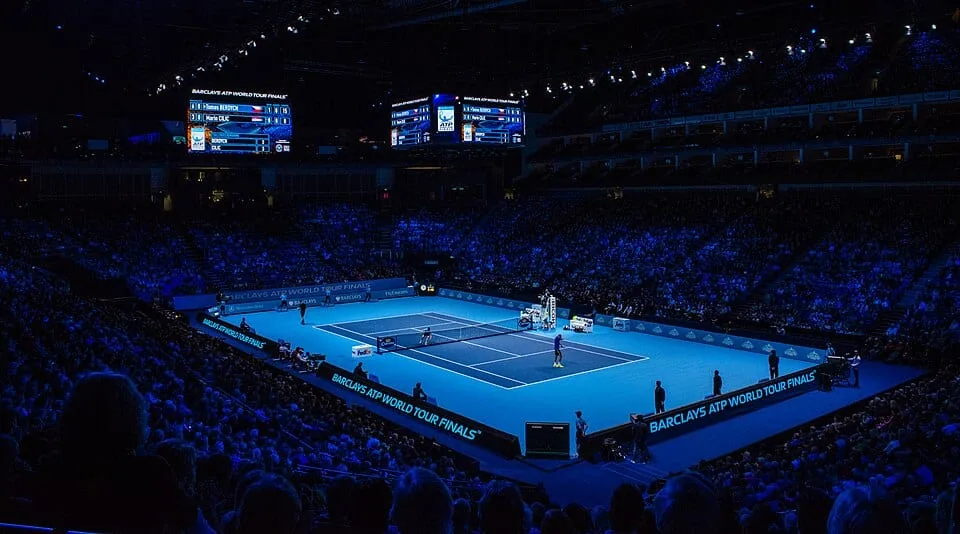
That is exactly as it should be. Turin spends this weekend settling the argument the honest way: on a court, indoors, in front of a full house. Saturday's semifinals put Alexander Zverev against Daniil Medvedev and Carlos Alcaraz against Ben Shelton, and Sunday's final decides who carries the season-ending title out of the Inalpi Arena. Alcaraz came through his group without losing a match and is still chasing the one enormous title he has never won. Medvedev got into the last four by beating Frances Tiafoe 6-3, 6-4 in a straight shootout for the final semifinal place. There is nothing to vote on there. You watch, you shout at the television, and the better player on the day wins.
But there is one trophy handed out at the end of every men's season that nobody can win by hitting a ball, and the ballot for it is open right now. It closes at 11:59pm GMT on Thursday 3 December. It takes less than a minute to fill in. The only qualification required is that you care about this sport, which, if you have read this far on a Saturday morning, you clearly do.
The only ballot with your name on it
The ATP hands out a cluster of awards at the end of each season. Most of them are decided behind closed doors by people who work in tennis: by the players themselves, by coaches, by the small and slightly mysterious group of former world No. 1s who still get a vote, by the writers who spend forty weeks a year in press rooms eating the same sandwich.
One award is different. The Fans' Favourite is decided by a public vote, and the public means you. There are two of them, in fact: one for a singles player and one for a doubles team. The mechanics are gloriously unglamorous. You go to the voting page on the tour website, you pick one name from a dropdown menu for singles and one pairing from a dropdown for doubles, and you submit. No essay, no justification, no tiebreak. Just a name you have decided to put your hand up for.
It is worth sitting with how unusual that is. Almost everything else in professional tennis is a measurement. Rankings are points. Prize money is results. Seedings are maths. Even the honours that look like opinion, like a Hall of Fame induction, run through committees and thresholds and formal ballots of former players and historians. The Fans' Favourite is the one moment in the calendar where the sport turns round and asks the people in the stands and on the sofa a question that has no correct answer: who did you most want to watch this year?
Who is actually on the list
The candidate list is not infinite, and the cut-offs are specific enough to be worth knowing before you open the page expecting to find your particular favourite.
For singles, the names on the ballot are the players inside the top 100 of the PIF ATP Rankings as of 19 October 2026. For doubles, it is the top 20 teams in the doubles team rankings on that same date. The 19 October line is drawn deliberately early, before the indoor swing reshuffles everything, which means the list was fixed while several of the autumn's better stories were still unfolding.
There is one humane exception built into the rules. Players holding a protected ranking are included on the list if they have played at least one tour-level match during 2026, and they appear with a small "(PR)" beside the name. That is the tour quietly making room for the people who spent most of the year in a rehabilitation gym rather than on a court, and if you want to use your vote as a message to somebody who has had a wretched twelve months, the mechanism is right there.
The doubles ballot deserves a second look for a different reason, which we will come to.
Nineteen years of the same answer
For most of this award's life, the result was not in doubt.
Roger Federer won the Fans' Favourite in singles every single year from 2003 to 2021. Nineteen consecutive years. Not nineteen years out of twenty-five, not nineteen with a gap in the middle while he was injured: nineteen in a row, including seasons when he won nothing of significance, including the year he played almost no tennis at all, including the long stretch at the end when he was plainly no longer the best player alive and everybody including Federer knew it.
That streak is one of the strangest records in the sport, and it tells you something important about what this particular vote measures. It is not a popularity contest in the shallow sense, because popularity in the shallow sense moves with results and Federer's did not. It is closer to a loyalty contest, or a measurement of how deeply a player has embedded himself in the habits of a fanbase. People who had organised their summers around watching one man for fifteen years were not going to stop ticking his name because he had a bad clay season.
It also means the award spent two decades being almost completely uninformative, which is its own kind of charm. Every December a result arrived that surprised nobody, and every December a few hundred thousand people voted anyway, because the voting was the point.
What happened when the obvious answer left
Federer played his last match in 2022, and the vote had to decide what it wanted to be.
The first answer was sentimental and entirely predictable: Rafael Nadal took the 2022 singles award. The second answer was more interesting. Jannik Sinner has won it in 2023, 2024 and 2025, three years in a row, becoming only the second player to manage a three-peat since the award began in 2000.
Three straight years is not nineteen. But it is enough to show the pattern reforming: a fanbase settling around a player, deciding he is theirs, and turning up each December to say so. Sinner's three wins have come alongside an era in which he and Alcaraz have traded the biggest titles between them more or less continuously, which makes the fan vote one of the few places where the two of them can be compared on something other than a scoreboard. In 2025 Alcaraz finished second in that particular count.
Which brings us to the thing nobody says out loud about this ballot: it is close now. For nineteen years your vote was a gesture. It is no longer a gesture.
The doubles vote is the one where you really count
If you want your single click to carry actual weight, put it on the doubles ballot.
Simone Bolelli and Andrea Vavassori won the doubles Fans' Favourite in 2024 and again in 2025, and in doing so became the first pair to win it in consecutive years since Bob and Mike Bryan, who held it from 2005 all the way to 2017. Thirteen years of twins, then seven years of other people, then two years of two Italians who have made themselves genuinely beloved.
Doubles lives in a strange corner of this sport. It is frequently the best tennis on any given day at a tournament, played in front of a few hundred people on an outside court while thirteen thousand watch a routine singles match next door. The players know it. The doubles Fans' Favourite is one of the only pieces of public recognition that exists in that corner of the game, and the electorate is small enough that a few thousand votes genuinely move it.
If you have ever watched a doubles match and found yourself astonished that so few people were there, this is the one place a few seconds of your time registers as something more than a rounding error.
The awards you do not get a say in, and who does
The rest of the end of season list is decided by people inside the sport, and the voting bodies are oddly specific once you start looking.
The Stefan Edberg Sportsmanship Award is voted on by the ATP No. 1 Club: the group of players who have held the world No. 1 ranking. Alcaraz won it in 2025, his second after 2023, in a year that included him calling a foul on himself during a round of 16 match against Ben Shelton at Roland Garros. Being judged on sportsmanship by a jury composed entirely of former No. 1s is one of the more intimidating arrangements in professional sport, and it produces a result that tends to be taken seriously by the locker room.
Coach of the Year went in 2025 to Juan Carlos Ferrero and Samuel Lopez jointly, for their work with Alcaraz. Ferrero became the first coach to win it twice, having also taken it in 2022. There is something quietly satisfying about a coaching award going to two people at once, because the modern player's team is never one person, whatever the camera shows you of the player box.
Breakthrough of the Year is the newest category, and its first winner was Valentin Vacherot in 2025 after one of the least likely seasons anybody has had in years. The process is a two-stage affair: the International Tennis Writers' Association picks the shortlist, which in 2025 was Jack Draper, Joao Fonseca, Jakub Mensik and Vacherot, and then the 29 members of the ATP No. 1 Club choose the winner from it. Writers nominate, champions decide.
There is also the Arthur Ashe Humanitarian Award, which sits slightly apart from the rest, recognising work that has nothing to do with winning tennis matches.
The award that stopped existing
One category is missing from the 2026 list, and its absence is more poignant than you might expect.
Comeback Player of the Year has been retired. The last man to win it was Matteo Berrettini in 2024, after a season in which he won three titles following a long stretch broken up by injury. Since then the category has simply gone, which means there is now no formal mechanism for the tour to say out loud: this person was badly hurt, or badly lost, and found their way back.
You can see the administrative logic. Comeback awards are hard to define. Back from what, exactly, and how far back is far enough, and is a player returning from a long injury really comparable to one returning from a collapse in form? Those are genuinely awkward questions for a committee.
But the award existed because tennis is unusually cruel about absence. Ranking points fall off a cliff while you are away, so a player who misses eight months does not come back to where they were; they come back to qualifying, or to challenger events in small cities, with a protected ranking and a limited number of chances to use it. Getting out of that hole is one of the hardest things anyone does in this sport, and until recently there was a trophy that acknowledged it. Now there is a gap on the list, and Berrettini's name sits at the end of a sentence that has stopped being written. If you want to see what that kind of return actually costs, his 2026 run in Paris is a good place to start: we wrote about Berrettini completing his Masters 1000 set earlier this month.
When the players fill in a ballot of their own
There is a second electorate in all of this, and it produces the results that tell you most about what life on tour is actually like.
Each year the players vote on the Tournaments of the Year, one in each category, and the 2026 results were announced on 14 November. Shanghai took the Masters 1000 award for the first time since 2013. Doha took the ATP 500 award for the second year running. Almaty won the ATP 250 category for the first time, beating 29 other events to do it.
Read the reasons the players give and the glamour drains out of the exercise in the most endearing way. They praise practice courts. They praise the hotel. They praise the physio room and the recovery areas and the player restaurant. In Almaty's case, the catering operation is run by a chef with three Michelin stars, which is the sort of detail that sounds frivolous until you remember these are people eating tournament food for roughly forty weeks a year.
In other words, when the people who actually live inside this sport get a vote, they do not vote for the most beautiful stadium or the biggest crowd or the most famous champion. They vote for the place that looked after them. Several more events picked up Standards of Excellence awards for the quality of their organisation, which is the same instinct recorded a second time.
It is a useful corrective to the way the rest of us rank tournaments. We judge them on the matches we remember. They judge them on whether the courts were ready at eight in the morning.
What a fan vote is actually measuring
Let us be honest about the limits of the thing you are being asked to do.
A fan vote is not a ranking of merit. It does not establish who played best, and it was never designed to. What it measures is attachment: whose matches you went out of your way to find, whose losses ruined your evening, whose name you checked the draw for first. That is a softer quantity than a ranking, and it is also the only one that explains why the sport has any audience at all.
The formal honours sit elsewhere. The year-end No. 1 trophy goes to the man at the top of the rankings after a full season of accounting, which this year has meant a long conversation about Zverev's rise to the top of the rankings. The game's permanent recognition runs through Newport, where the class of 2027 has just been elected to the Hall of Fame by a committee weighing entire careers. Those are judgments about greatness, made carefully, by people appointed to make them.
The Fans' Favourite is not a judgment about greatness. It is a show of hands. Its only function is to record, once a year, where the affection in this sport actually sits, and that is information nobody else in the building can supply.
Between now and December
The practical calendar is short. Turin finishes on Sunday. Voting runs until 11:59pm GMT on Thursday 3 December. The winners are announced during December, in the stretch of the year when tennis goes quiet and the players disappear into the off-season, which is precisely when a bit of good news landing on somebody's phone is worth the most.
So: a suggestion for this weekend. Watch the semifinals. Watch the final on Sunday, and let the best player of the week take the trophy he has earned on court, because that is the part of the sport that works properly and needs no help from us.
Then, at some point before the first week of December runs out, go and spend forty seconds on the other ballot. Not necessarily on the player who won the most. On the one whose matches you kept clearing your calendar for, the one whose five-setter you watched to the end at two in the morning knowing full well how you would feel at work the next day, the one you found yourself defending in an argument you had no business joining.
Tennis spends the whole season counting things about its players. This is the fortnight it asks what they are worth to you, and the answer only exists if you give it.
🎾 Gear from this story
BabolatBabolat Pure AeroCarlos Alcaraz's racket of choiceView on Amazon →As an Amazon Associate, SUPER.TENNIS earns from qualifying purchases.