On Sunday evening in Turin, a 22-year-old Frenchman will walk out for the biggest match of his life, and the statistic following him onto the court is this: he has won one Grand Slam match all year.
One. Not one title, not one final — one match. At the four tournaments the whole sport is organised around, Arthur Fils won a single match and lost or missed the rest. By every normal measure that is the season of a man drifting out of the top fifty, the kind of year that ends with quiet talk about whether the early promise was real.
Instead he is one of the eight men at the Nitto ATP Finals, the invitation-only week that closes the season, playing Ben Shelton in the Sunday night match on day one. He is the sixth seed of eight. He is the first French player in that field for a decade. And the route he took to get there is the strangest and, honestly, the most moving story in the building this week.
If you only half-follow tennis — if you watch the Slams and let the rest of the calendar slide past — this is the one to understand before Sunday. The Finals field is usually a list of names you already know from the summer. This year it contains a man you probably last saw losing, or not playing at all.
The season that should not have added up
Here is how qualification works, briefly, because it explains why Fils being there is so odd.
Every tournament hands out ranking points, and the Slams hand out by far the most — 2,000 to a champion, serious numbers even for losing in the second week. The nine Masters 1000 events are the next tier down, then the 500s, then the 250s. Add up the season and the eight men at the top of that list get the invitation to Turin. No wildcards, no committee, no opinions. It is arithmetic.
Which means the usual way in is through the Slams. A quarter-final in Melbourne, a fourth round in Paris, a deep run at Wimbledon, and you are most of the way there before the autumn starts.
Fils did none of that. He did not play the Australian Open. He did not play Roland-Garros. He won once at Wimbledon and nothing at all in New York. In the four tournaments that matter most, he banked almost nothing.
So he built a Finals season out of everything else — and, in one extraordinary fortnight in Ohio, out of a single tournament that changed the shape of his entire year. When he qualified, a statistic did the rounds among tennis writers: no man had reached the season finale with so few Grand Slam wins since Brad Gilbert in 1989. Whether or not you care about a record from before most of us were paying attention, the point stands. This almost never happens.
May 2025: four and a half hours, and then nothing
To understand this year you have to go back to the last one, to a second-round match at Roland-Garros against Jaume Munar.
It went five sets. It took about four and a half hours. Fils lost it — and somewhere in that time on court, his lower back gave way. Not dramatically, not with a collapse that makes the evening news. The diagnosis came afterwards: a stress fracture in the lower back. A bone that had been asked to do too much, for too long, finally cracking.
If you have never had a back injury, it is hard to explain why this one is so frightening for a tennis player. A torn muscle heals on a timetable. A stress fracture in the spine does not negotiate. You cannot push through it, and the only treatment is the one thing a young player on the rise cannot stand: stop completely, for months, and wait for bone to knit.
He tried once. In August 2025 he came back in Toronto and felt what he later called a warning sign in his back. That was it. He shut the season down there and did not play again in 2025.
Then he withdrew from Hong Kong. Then Adelaide. Then, with the whole of French tennis hoping otherwise, the Australian Open. He said he would rather come back at a hundred per cent than come back early — the correct answer, and the hardest one to say out loud when you are 21 and your ranking is draining away week by week.
By the time he hit a ball in anger again, eight months had gone.
Coming back is not a moment, it is a hundred small decisions
There is a version of the comeback story that goes: he returned, he was rusty, then he was fine. That is not what happened.
He came back in February 2026 at Montpellier, an indoor week in the south of France, and won his first match against Valentin Royer. A first-round win in a 250 is normally the least newsworthy result in tennis. This one was a man finding out whether his body would hold.
What he changed afterwards is the part worth knowing. He started travelling with his own physio rather than relying on tournament staff — an expense most players below the very top treat as a gamble, and one that only makes sense once you have decided your body is the project. He cleaned up what he ate, down to the detail that gets quoted in interviews and sounds trivial until you realise it is about control. No cookies. A man who had spent eight months unable to control anything, deciding what he could.
And it worked, fast. By the end of February he was in the final in Doha, where Carlos Alcaraz beat him 6-2, 6-1 in a scoreline that looks brutal and was, in context, a sort of triumph. Eight months out, and he was already in a final losing to the best player in the world.
Barcelona, and the sound a season makes when it turns
In April he won the Barcelona Open, beating Andrey Rublev in the final 6-2, 7-6(2).
Read that back with the timeline in mind. A stress-fractured spine in May 2025. No tennis at all for eight months. A comeback in February. A 500-level title on clay by April, beating a man who has spent most of the last decade in the world's top ten.
Barcelona is also a particular kind of tournament to win: clay, the week after Monte Carlo, in a club with a hundred years of history and a crowd that knows exactly what it is looking at. It is not a tournament you sneak.
That title did two things. It put a serious block of points on his season total, and it told him the back was no longer a question he had to ask before every match.
For about three weeks, this looked like the great comeback year.
The day before Roland-Garros
Then Rome. On 9 May he retired from his match against Andrea Pellegrino after four games. Later, practising in Rome, he damaged his hip.
The timing was almost unbearable. Roland-Garros, his home Slam, the fortnight the French sports press builds its spring around, was two weeks away. He was seeded. He had the clay form. He was scheduled to open against Stan Wawrinka, the sort of first-round draw that fills a stadium.
On Saturday 23 May, the day before the tournament began, he withdrew.
There is a footnote to this that tells you how tennis works. When a seeded player pulls out that late, his place in the draw goes to a lucky loser — a player beaten in the final round of qualifying who gets a reprieve. The man who took Arthur Fils's spot was a Dutchman named Jesper de Jong, who promptly went on one of the best runs of his life. Somebody always walks through the door you could not get through.
"The pain is bothering me, I just cannot explain it," Fils said at the time, which is the most honest sentence an injured athlete can offer and the least satisfying one for everybody listening.
A summer of almost nothing
Wimbledon came and went with a single win. The US Open gave him nothing.
Put plainly: between January and the end of August, Arthur Fils played a full Grand Slam calendar and had one Grand Slam victory to show for it. Two of those tournaments he never reached the court for.
It is worth sitting with that for a second if you are the kind of fan who mostly watches the Slams. Those fortnights are the sport's shop window, where reputations get made and the general public learns your name. Missing them is not only missing points. It is being absent from the only version of tennis most people see.
And then, two weeks after New York, everything inverted.
Cincinnati: the Sunday that paid for the whole year
On 23 August 2026, Arthur Fils won the Cincinnati Open.
Not a quarter-final, not a brave run — the title, his first at Masters 1000 level, the tier directly below the Slams. He beat Frances Tiafoe in the final 6-3, 1-6, 6-0, and that scoreline hides a small horror story: serving it out, Fils had three championship points, and Tiafoe saved all three before Fils finally closed the match.
Three championship points saved against you, in your first Masters final, fifteen months after your spine cracked. Most players lose that game, then the set, then the match, then spend the winter explaining it. He won six games in a row to take the third set 6-0, which is not a scoreline that happens by accident at that level. It is what happens when somebody decides, in real time, that this one is not getting away.
He became the youngest French champion in Masters 1000 history at 22, and the first French man to win one since Jo-Wilfried Tsonga, more than a decade earlier.
In terms of the Turin arithmetic, Cincinnati was almost the whole thing. One tournament, and a man who had been nowhere in the race jumped eight places in it. Afterwards he sat in a press conference and said, slightly dazed, that he was very happy with his performance — which is what everybody says, and which did not begin to cover it.
Qualifying while somebody else played
The moment he actually clinched Turin is my favourite detail of the whole story, because it is so unglamorous.
It happened on 4 November, in Paris, and Arthur Fils was not on court. His place was confirmed when Quentin Halys — another Frenchman, ranked far below him, with no stake in any of this — beat Frances Tiafoe, the only man who could still catch him. Fils found out he was going to Turin because a compatriot he shares a locker room with had won a tennis match.
That is how qualification usually arrives in this sport: not with a roar and a trophy, but with a phone buzzing, or a scoreboard glanced at across a practice court. He called it a childhood dream, which from most athletes is boilerplate and from a man who spent eight months being told not to pick up a racket reads a little differently.
What France has been waiting for
Here is the context that makes this a national story rather than a personal one.
France has been one of the deepest tennis countries in the world for forty years. In the 2000s and 2010s it had four men — Jo-Wilfried Tsonga, Richard Gasquet, Gilles Simon and Gael Monfils — who between them made Grand Slam semi-finals, won Masters titles, carried Davis Cup teams and filled Bercy every autumn for the better part of two decades. The French press called them a generation. French fans called them theirs.
And then they got older, and then they retired, and nobody quite replaced them. Monfils, who finally said goodbye at Roland-Garros this year, was the last French man to qualify for the season-ending Finals. That was 2016. A ten-year gap, in a country with more registered tennis players than almost anywhere in Europe, with a Grand Slam of its own and a federation that never stops producing juniors.
Ten years of watching the last week of the season on television and recognising nobody in the draw.
That ends on Sunday. Whatever happens in the group stage, a French player is back in the room where the year gets settled, and the people who have been waiting for that will not care very much about the details of how he got there.
Sunday night, the John McEnroe Group
The practicals, so you know what you are watching.
The eight players are split into two groups of four, named after former champions. Fils is in the John McEnroe Group with Alexander Zverev, the top seed and the world's leading man this year, Ben Shelton, seeded third, and Rafael Jodar, the eighth seed, whose own route here — from outside the top 150 at the start of the season — is the one story in Turin stranger than Fils's. The other group has Carlos Alcaraz, Daniil Medvedev, Flavio Cobolli and Frances Tiafoe.
Everybody plays everybody in their group. The top two from each group go through to the semi-finals on Saturday 21 November, and the final is on Sunday 22nd. The crucial, wonderful thing about this format is that losing does not end your week — you can lose a match, even two, and still qualify, depending on how the other results fall. If you have never worked out how the group tables resolve, the countback rules are worth five minutes of your time, because at least one group every year comes down to them.
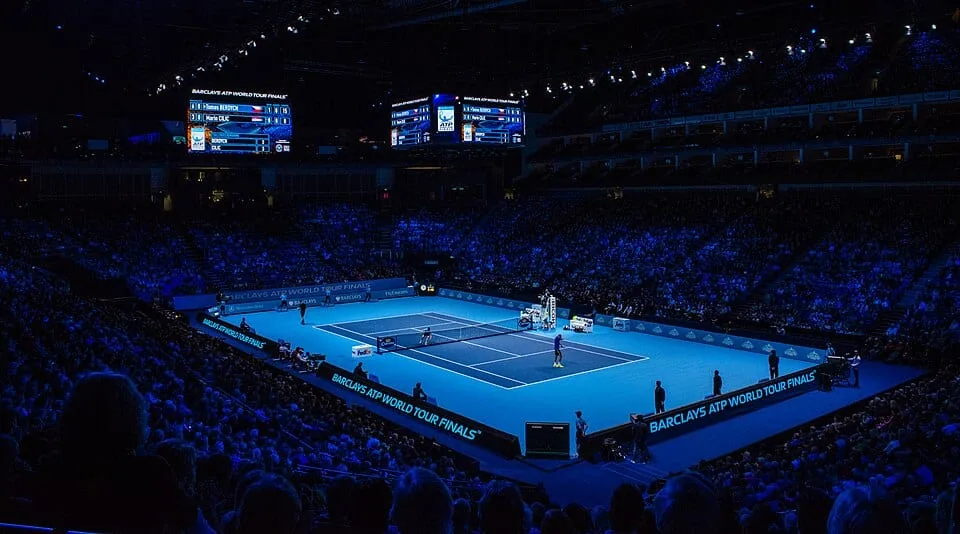
Fils plays Shelton in the Sunday evening session at the Inalpi Arena, not before 8.30pm local time — 7.30pm in the UK. If he gets through that, he is back out on Tuesday against the winner or loser of Zverev against Jodar.
It is, on paper, the harder group. Zverev has been the most consistent man of the season, and Shelton serves at a speed that makes indoor hard courts look unfair.
If you have never actually watched him play
A short guide, because plenty of people reading this will be meeting Arthur Fils properly for the first time on Sunday night.
He is a forehand player, which is an unfashionable thing to be in an era of complete, symmetrical baseliners. The shot is enormous and he looks for it constantly, running around his backhand to find it in a way that would get a junior told off. Indoors, on a quick court, with no wind and no sun and a ball that stays where you hit it, that forehand is worth more than it is anywhere else on the calendar. Turin suits him.
He is also, and this does not show up in any statistic, loud. Not obnoxious — expressive. He plays with his whole face. When a point goes well he tells the crowd about it, and when it goes badly you can read that too. In a week where the tennis can turn clinical, eight great players working through their patterns in a controlled indoor box, somebody who visibly feels every point is a gift to anybody watching at home.
And he will be nervous. Every player's first match here looks the same: slightly too fast, slightly too tight, a man working out whether he belongs in a room he has only seen on television. Some settle by the second set. Some never do.
Nobody will put Arthur Fils on a list of favourites this week, and they are right not to. He may lose all three group matches to three men who have had steadier, healthier years than his.
But think about what Sunday night actually is for him. Eighteen months ago his back broke in front of a home crowd in Paris. He spent most of a year not knowing whether the thing he had organised his life around was over. He came back, won a title in Barcelona, then had a hip take Roland-Garros away the day before it started. He went through the whole Grand Slam season with one win to his name. And on the last Sunday any of it could still have counted, he walked onto a court in Ohio and won the biggest title of his career from three championship points the wrong way.
Whatever the scoreboard says when he and Shelton finish on Sunday, that journey already happened. The arena in Turin is simply where he gets to stand and have it acknowledged.
🎾 Gear from this story
YonexYonex VCORE 98Ben Shelton's racket of choiceView on Amazon →As an Amazon Associate, SUPER.TENNIS earns from qualifying purchases.