The best match you will probably not watch this week starts at about half past ten at night in Turin, in an arena that has already half emptied, and it will be over before midnight.
Two Frenchmen against a Salvadoran and a Croatian. An hour and a bit of tennis played almost entirely inside the service boxes, at a range close enough that the four of them shout single words at each other between points. No billboard outside the Inalpi Arena carries their faces.
That is the doubles at the Nitto ATP Finals, and for the next eight days it runs alongside the famous tournament like a second film playing in the small screen at the back of the cinema. Eight teams, two groups, the same blue court, the same trophy handed over on the final Sunday. Almost nobody plans an evening around it.
You should, at least once this week. Not because doubles is secretly better than singles, but because it is a completely different hour of television, and because the eight teams in this particular draw have between them the strangest collection of stories in the building.
Same week, same court, different sport
The structure is identical to the one the singles players use, and if you read our explainer on how the group stage works you already know the shape of it. Eight teams, split into two groups of four, everybody plays everybody else in their group, the top two in each group go through. The winner of one group crosses over to meet the runner-up of the other in the semi-finals on Saturday 21 November. The doubles final is on Sunday 22 November at three in the afternoon, three hours before the singles final.
The groups are named after two Australians who spent most of the 1990s winning things together: the Todd Woodbridge Group and the Mark Woodforde Group. That is a small, lovely piece of respect, and it tells you something about how the sport thinks of this event. Nobody names a group after a doubles player by accident.
Here is where the difference starts. Every doubles match in Turin is played over two sets with no-ad scoring, and if the teams split those sets, the whole thing is settled by a match tie-break to ten points instead of a third set.
Translated for anyone who has never had to learn the scoring: in a normal game, once you reach 40-40 somebody has to win two points in a row to take the game. Under no-ad, 40-40 is simply the last point. One rally, game over, and the receiving team chooses which of them takes the serve. There is no grinding back from deuce six times. There is no safety net.
What that does to a match is remarkable. A singles set can meander for forty minutes while two men feel each other out from eight feet behind the baseline. A no-ad doubles set cannot. Every game has a cliff edge in it somewhere, usually arriving without warning at four-all, and both teams know from the first ball that the whole match might come down to a single return that clips the tape.
The matches land at around an hour and fifteen minutes. You can watch an entire doubles match in the time it takes a singles match to reach the end of the second set, and you will see roughly twice as many points decided at the net, where tennis is at its most physically obvious. A player stretched flat out at a volley is doing something you can read instantly. You do not need to know anything about tennis to understand it.
The Woodbridge group: champions, debutants and a French pair who would not stop winning
Harri Heliovaara and Henry Patten are the top seeds and the defending champions, a Finn and a Briton who have turned themselves into the most consistent pair in the sport. They are trying to become only the fourth team since 2000 to successfully defend this title. That sounds like a statistic until you consider what it actually asks: come back twelve months later, against seven other teams who have all spent the year getting better, and do it again in the last week of a long season when everybody is tired and nobody is injured enough to pull out.
Marcelo Arevalo and Mate Pavic, the fourth seeds, are the kind of pair you would build in a laboratory: a Salvadoran who reads a court like a chess player and a Croatian with a record of winning major titles with a succession of different partners. They are seeded below their reputation, which usually means trouble for somebody.
Theo Arribage and Albano Olivetti are the sixth seeds, and they are the reason this group is impossible to call. The two Frenchmen won six tour titles in 2026, the first team to reach six this season, scattered across Auckland, Montpellier, Dallas, Halle, Mallorca and Basel. Indoor, outdoor, hard court, grass. It is their first appearance in Turin and they open against Arevalo and Pavic on Sunday night.
Orlando Luz and Rafael Matos complete the group as the eighth seeds, and they got in by doing something only four other teams have ever done. In August they won Montreal, beating Arevalo and Pavic in the final for the first Masters 1000 title of either of their careers, and then went straight to Ohio and won Cincinnati as well, beating Constantin Frantzen and Robin Haase 6-4, 3-6, 10-7. Winning both of those back to back in the same summer is called the summer sweep. They are the fifth team in the Open era to manage it and the first since Pierre-Hugues Herbert and Nicolas Mahut in 2017. Four titles in total this year for the two Brazilians, with Buenos Aires and Santiago earlier in the season on clay. They open the doubles on Sunday against the champions.
The Woodforde group: two major titles, a 41-year-old, and the home team
The other group is, if anything, heavier.
Christian Harrison and Neal Skupski are the second seeds, and they won two Grand Slam titles in their first year together, which is not a thing that is supposed to happen.
Marcel Granollers and Horacio Zeballos are the third seeds and the reigning Roland-Garros champions, having beaten Heliovaara and Patten 6-4, 6-2 in Paris in June. Zeballos is 41 years old. He is still here, still playing a full season, still one of the three or four best doubles players alive, in a sport that usually starts quietly removing men from the calendar a decade earlier than that.
Simone Bolelli and Andrea Vavassori are the fifth seeds and the home team, which in Turin means something you can hear from the first point.
Kevin Krawietz and Tim Puetz are seeded seventh and are the 2024 champions here. They also reached the US Open final this September and lost it. Seventh seeds with a title in this building and a major final two months ago is not a seventh seed in any meaningful sense.
The man with eight surgeries
Of all of them, start with Harrison.
Christian Harrison is 32, from Shreveport in Louisiana, and the ATP tour site lists eight separate surgeries on his biography page. They run from an operation on his left femur in 2009, when he was fifteen, through to a second operation on the same femur in 2018, with his hip, his shoulder, his wrist and an adductor in between. Two of the gaps in his playing record are almost incomprehensible: he did not compete between May 2009 and October 2010, and he was gone again from August 2013 to July 2015.
Add those up. That is roughly three and a half years of his twenties spent not playing the sport he had organised his entire life around, in a career where most players peak and decline inside a decade.
His best singles ranking was No. 198, reached in 2018. For most people that number is the whole story: a talented kid, a body that would not hold, a career that quietly stopped. Then he hurt his foot in the first round at Wimbledon in 2022, had to withdraw from his next match, and made the decision that changed everything, which was to stop chasing singles and commit to doubles.
In 2025, playing with the American Evan King, he won titles in Dallas, Acapulco and Brussels and qualified for this tournament for the first time. In January 2026 he started a new partnership with Skupski in Adelaide. Two weeks later, at their second event together, they won the Australian Open, beating Jason Kubler and Marc Polmans 7-6(4), 6-4 in the final. It was Harrison's first Grand Slam title, at 31, after eight operations.
In September they won the US Open too, beating Krawietz and Puetz 6-4, 7-6(6), and did it without dropping a single set all fortnight, which only two other teams in the history of the event have managed. On 14 September he reached No. 4 in the world.
If you want one reason to put the doubles on this week, that is it. There is a man in Turin who has been cut open eight times and who spent three and a half years watching from a sofa, and he is now one of the best four doubles players on the planet. He will be on court on an ordinary weekday evening in an arena where most of the crowd came to see somebody else.
For Skupski, who is 36 and from Liverpool, the second half of that story matters too. He had been to two US Open finals before this year, in 2022 and 2025, and lost both. His previous majors had all come at Wimbledon. Winning in New York at the third attempt, with a partner he had known for a fortnight when the year began, is the kind of correction a career does not always get to make.
The pair playing at home without the one trophy they want
Then there is the Italian team, and the thing about Bolelli and Vavassori is the gap between what they have won and what they have not.
They won the Miami Open this year, beating Heliovaara and Patten 6-4, 6-2 in the final. It was the first Masters 1000 title of either man's career. Then they won Rome, beating Granollers and Zeballos 7-6(10-8), 6-7(3-7), 10-3 in a final that went to a match tie-break in front of their own crowd, and became the first all-Italian men's team to win that tournament in the Open era. They won Rotterdam as well. Somewhere in there, Bolelli became the first Italian man to win twenty tour-level doubles titles in the Open era.
What they have not won is a major. They have been close enough to see it. At Roland-Garros in June they reached the semi-finals and lost to Granollers and Zeballos, 7-6(4), 6-4, two sets that could have gone the other way with four or five points.
They qualified for Turin for the third year in a row by reaching the second round in Vienna, which is a reminder of how fine the margins are at the bottom of the standings. A single extra loss in October and they would be watching this on television like the rest of us.
The crowd here will be loud for them, in the specific way Italian crowds are loud, and it is one of the genuine pleasures of the week. If you are curious about the city they are playing in, we wrote a guide to Turin during Finals week that covers where the arena is and what to do with the hours before a night session.
What they are actually playing for
Doubles players are routinely described as the poor relations of the sport, and the gap at the top is real, but the numbers in Turin are not small.
A team that wins all five of its matches here, three in the group stage plus the semi-final and the final, takes $959,300. Each round-robin win on its own is worth $96,600 to the team, a semi-final win $178,500 and the final $356,800, and every team collects a participation fee of $134,200 for turning up and playing the week. An alternate who never gets on court still receives $51,700. The event as a whole is handing out a record total of $15,750,000 this year.
An undefeated champion also collects 1,500 ranking points, the same as the singles champion, which in a doubles season is an enormous share of a year's work in a single week. For a pair outside the top handful, a good week here can define the following twelve months, because ranking position determines which tournaments you get into, which determines everything else.
Those numbers also explain the texture of the matches. Nobody in a no-ad doubles match is saving themselves. There is no fifth set to pace yourself for and no reward whatsoever for a long, cagey rally. Everybody is swinging.
How to make it part of your week
The practical version is this.
The doubles matches sit either side of the singles. Most days you will find one in the afternoon session and one after the evening singles match, which in most of Europe means late. If you are watching from home, the late one is the one to catch, because it is short enough to finish before you give up on the night.
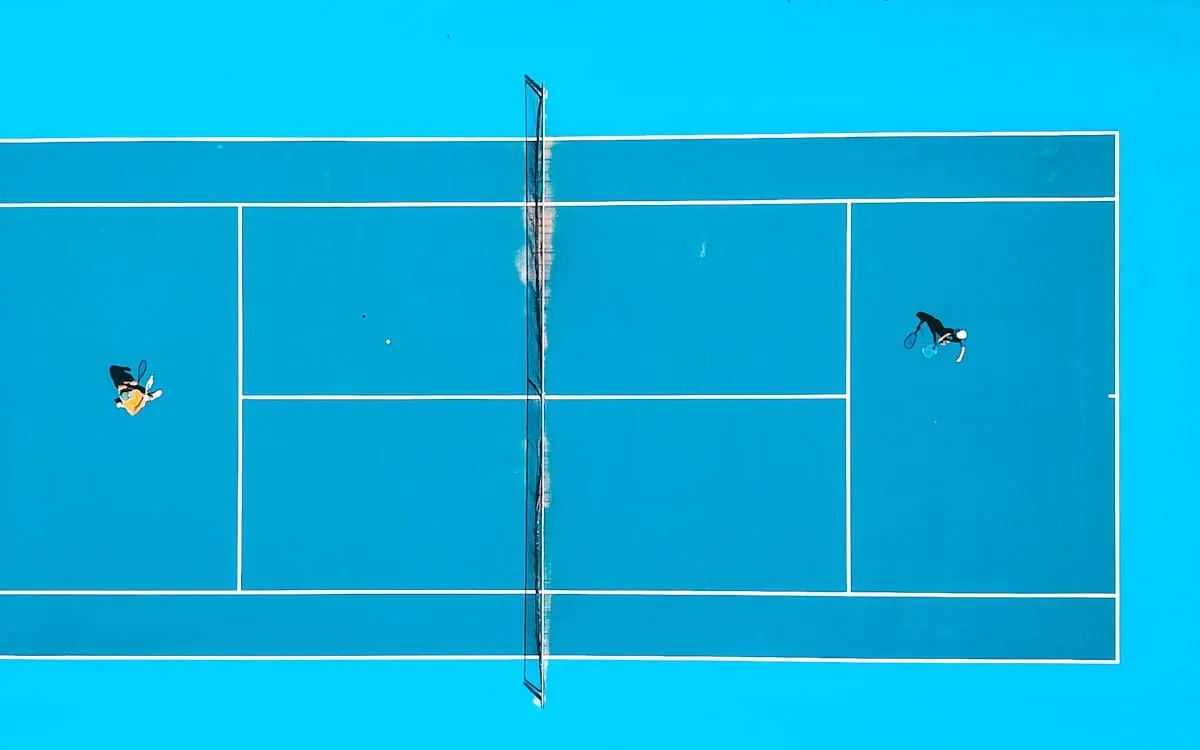
Watch the two players at the net rather than following the ball. In singles, your eye naturally tracks the yellow dot. In doubles that is the least informative thing on the court, because the match is being decided by the man at the net deciding, in about a fifth of a second, whether to move across and cut the ball off or hold his ground. Watch one of the net players for three or four points and the geometry of the whole thing opens up.
And if you want a primer on what the four of them are actually trying to do to each other, our piece on doubles strategy walks through the formations and why the server's partner keeps crouching.
The singles tournament this week will be covered everywhere, as it should be. Arthur Fils and his very strange route to Turin is a story worth the attention it is getting, and Alexander Zverev and Carlos Alcaraz will fill the headlines for eight days.
But the second tournament is right there, on the same court, played by people who have mostly had to fight harder to reach it. Give one of those late matches an hour. Start with Harrison and Skupski, and know what you are looking at while you watch: a man who was told, repeatedly, by his own body, that this was finished.