Three hours and twenty-four minutes. That is how long Belinda Bencic spent on court in Toronto this week, trading ground with Taylor Townsend in a third-round match that simply refused to end: 6-7(5), 7-6(4), 6-4, two tie-breaks, one of those evenings where the scoreline stops telling you anything useful and you just watch two people decline to leave.
If you tuned in without knowing the backstory, you saw a very good Swiss player grinding out a win at a big hard-court tournament in August. If you did know the backstory, you saw something else. Because Bencic has been in exactly this place before, on these exact courts, and the last time she walked out of Toronto she was carrying the trophy and a completely rearranged life.
That was 2015. She was eighteen years old. It has taken eleven years, one Olympic gold medal, a series of injuries that nearly ended things quietly, and the birth of a daughter for her to come back and find herself in the second week of the same tournament again. This is the story of how that happened, and why she is one of the most quietly astonishing people on the WTA tour right now.
The week an 18-year-old ran through four former world number ones
Start with the thing that made her famous, because it still reads like a typo.
In August 2015, the Rogers Cup was in Toronto and Bencic arrived as a teenager with promise and not much else. Over six days she beat Caroline Wozniacki. Then Ana Ivanovic. Then, in the semi-final, Serena Williams, who was the world number one and in the middle of the most dominant stretch of her career, 3-6, 7-5, 6-4. Then Simona Halep in the final, 7-6(5), 6-7(4), 3-0, when Halep retired hurt at the start of the third.
Four former world number ones in one week. At 18 years and 23 weeks old she became the youngest champion in the history of that tournament, taking the record off Ivanovic, who had set it in 2006. She also became the youngest player to beat Serena Williams in a completed match since a 17-year-old Maria Sharapova did it at the 2004 WTA Finals.
You can imagine what the coverage looked like. The next Hingis. The next big thing. Swiss tennis, which had spent a decade watching Roger Federer be Roger Federer, suddenly had a teenage girl who beat the greatest player alive on a Saturday afternoon.
Bencic has said since that beating Serena in Toronto is something she will always carry with her. What she does not tend to say out loud, but which anyone who followed the next few years could see, is how heavy a week like that can become once it is behind you.
A Swiss kid and Martina Hingis's mother
The foundations were laid a long way from Canada, in a country of eight million people that has produced an absurd number of great tennis players.
Bencic was born in Flawil, in eastern Switzerland, in March 1997, to Slovak parents. Her father Ivan coached her early. When she was around five, he went looking for advice from another Czech-and-Slovak-to-Swiss family and found Melanie Molitor, the mother and lifelong coach of Martina Hingis. Bencic joined Molitor's tennis school not long after and trained there through her childhood.
That is not a small detail. Molitor built Hingis, who became the youngest world number one in history on a game made of angles, timing and early ball-striking rather than raw power. Bencic learned the same language. She takes the ball early. She redirects pace instead of manufacturing it. She stands close to the baseline in an era when almost everyone has drifted back towards the fence, and she is still, at 29, one of the cleanest strikers on the tour.
The junior results told you the coaching had taken. In 2013, at 16, she won the girls' titles at both Roland Garros and Wimbledon in the same season, only the third player ever to do it. One of the others, inevitably, was Hingis.
The years that were harder than the highlight reel suggests
Here is the part that gets skipped when people tell this story quickly.
After Toronto in 2015, Bencic climbed into the top ten at 18 and then spent several years being interrupted. Wrist trouble. A back problem. Surgery. Ranking slides that took her out of the top hundred and into the qualifying draws of tournaments she had been winning. If you are a fan who dips in and out of tennis, this is the phase you probably missed entirely, because it happens in the parts of the calendar that do not get broadcast.
She rebuilt anyway. By 2019 she was back, and she reached the semi-finals of the US Open, her deepest run at a major at that point. In 2022 she won Charleston. She kept being good without ever quite recapturing the wild slipstream of that Toronto week.
And then Tokyo happened.
Tokyo, and the medal that reframed everything
At the Olympic Games in Tokyo, played in the summer of 2021, Bencic beat Marketa Vondrousova 7-5, 2-6, 6-3 in the final to win the singles gold medal. She was the first Swiss woman ever to do it.
Olympic tennis occupies a strange place in the sport. It is not a Grand Slam, the ranking points are odd, and half the tour treats it as an inconvenience wedged into an already brutal calendar. But for players from smaller tennis nations, an Olympic medal is the thing that follows your name forever, in every headline, in every introduction. Five years on, Bencic has said that everything which came afterwards has felt more like a bonus.
It is worth sitting with that sentence for a second, because it explains a lot about the person who came back to the tour three years later. She had already got the thing.
April 2024: the pause
Bencic and her husband Martin Hromkovic, a former footballer who also works as her fitness coach, had a daughter, Bella, in April 2024.
Tennis is not a sport that makes room for this. There is no off-season worth the name, no team to cover for you, no salary that keeps arriving while you are away. You stop, your ranking evaporates, and when you come back you come back to the bottom of the ladder against opponents who have spent your maternity leave getting better. The tour has a protected-ranking system, but a system is not the same thing as a soft landing.
Her return began at the United Cup in January 2025, seven months after giving birth. She lost 6-1, 6-1 to Jasmine Paolini. If you want a single scoreline that captures how far away the top of the game can feel, that is the one. She started that season ranked outside the top 450.
She has been honest about the doubts. Some days she felt sharp and confident, she has said; other days the doubt crept back in, and the thing that got her through was that she had already learned how to handle it during the injury years. Her life had completely changed, she said, but for the better, and her priorities had changed with it. Family first, tennis second, which sounds like the sort of thing athletes say and in her case appears to be simply true. Bella travels with her to every tournament.
What the comeback actually looked like
It looked like this.
In 2025, her first full season back, Bencic won Abu Dhabi, her first title as a mother. She won Tokyo later in the year, beating Linda Noskova in the final for the tenth title of her career. She reached the semi-finals of Wimbledon, the best Grand Slam result of her life, on grass, at 28, with a toddler in the players' box. She finished the year inside the top fifteen having started it outside the top 450, and the WTA named her its Comeback Player of the Year.
Her own summary was almost apologetic about it. Everything happened much faster than we expected, she said. Better results than we expected.
If you are a fan who mostly watches the majors, that Wimbledon run is probably where Bencic re-entered your field of vision, and you might have assumed she was having one good fortnight. She was not. She was three-quarters of the way through the most improbable season of her career.
You can read more about the wider shift she is part of in our look at the parenthood generation on tour, because Bencic is not doing this alone any more, and that itself is new.
The ranking that made history in February
On 2 February 2026, the WTA rankings came out and Bencic was ninth in the world. Elina Svitolina, whose daughter Skai was born in 2022, was tenth.
For the first time since the WTA rankings began in 1975, there were two mothers inside the top ten at the same moment. Half a century of professional women's tennis, and it had never happened before.
Rankings history is usually a dry sort of trivia. This one is not. For most of the sport's modern era, having a child was understood as a career ending, or at best a career interrupting, decision, and the handful of players who came back and stayed elite were treated as freaks of nature rather than as evidence that the model was wrong. Two at once, in the same top ten, in the same week, changes what a 24-year-old player weighing up her options is looking at.
Bencic had earned it the hard way. She began 2026 by going unbeaten through the United Cup group stage and knockouts, dragging Switzerland to their first final in the competition, winning her singles matches and then coming back out to play deciding mixed doubles. In the final against Poland she beat Iga Swiatek 3-6, 6-0, 6-3. Switzerland still lost the tie 2-1, sealed in the mixed doubles, and Bencic finished the week 5-0 in singles and was named the Finals MVP anyway. Losing a final while being unambiguously the best player in it is a very Bencic outcome.
Wimbledon this year ended in the fourth round, in a match she will think about for a while: Coco Gauff beat her 6-4, 4-6, 7-6(6), one point at a time, deep into the night.
Toronto, and the 21-year-old on the other side of the net
Which brings us back to Canada, and to the odd symmetry of what happens next.
The Canadian Open now runs as a two-city event, women in Toronto and men in Montreal, on an expanded twelve-day format with 96-player draws. Bencic came in seeded twelfth and ranked twelfth. She beat Sloane Stephens 6-3, 6-1 in her opening match, then survived Townsend across those three hours and twenty-four minutes to reach the last sixteen.
Waiting for her is Alexandra Eala, and you could not script it better if you tried.
Eala is 21, from the Philippines, and is currently living through the fortnight of her life. Last week she won the DC Open, beating Jessica Pegula 4-6, 6-4, 6-0 in a final that rain had pushed into an extra day, to become the first player from the Philippines to win a WTA Tour singles title. She arrived in Toronto on a winning streak that has now reached seven matches and a ranking of world number 20. We wrote about her breakthrough and what she means to Filipino tennis earlier this summer, and the noise around her in Toronto, a city with an enormous Filipino community, has been extraordinary.
So: the 21-year-old having her Toronto moment, against the woman who had hers in this city at 18 and then spent eleven years discovering what comes after. They have never played each other before. Whatever happens, one of those two stories continues this week and the other pauses.
The rest of the draw is not exactly quiet either. Leylah Fernandez, the Canadian, knocked out Mirra Andreeva in front of a home crowd that lost its mind. Diana Shnaider took out Pegula. And Elena Rybakina, the quietest superstar in the sport, is still in there working on the ranking maths. As second weeks go, Toronto is delivering.
What to look for if you have never really watched her
If you are going to watch Bencic for the first time, here is what makes her worth the ninety minutes.
She stands on the baseline. Not near it, on it. Most of the tour has quietly retreated two or three metres behind the line to buy reaction time against modern serving and modern forehands, and Bencic simply refuses to. She takes the ball as it rises. It means she gives her opponent almost no time between shots, and it means when she is slightly off, she is very off, because there is no margin built into where she is standing.
She redirects rather than overpowers. Watch what she does with a heavy cross-court ball: instead of adding pace to it, she changes its direction down the line early, so the point flips ownership in a single shot. It is a Hingis inheritance, and it is why she can beat players who hit the ball considerably harder than she does.
And she is a good watch under pressure now in a way she was not at 22. The Townsend match was decided by two tie-breaks and a single break in the third. The old Bencic might have lost that. The current one, by her own account, plays with the calm of someone for whom the result stops mattering the moment she gets back to the hotel room.
The thing about second chapters
There is a version of the Bencic story that ends in 2015. Teenage prodigy beats Serena, wins Toronto, is anointed, gets injured, drifts. Tennis produces that story constantly, and it is usually the whole story.
What makes this one worth your attention is that the second chapter turned out to be longer and better than the first. The Olympic gold came six years after Toronto. The Wimbledon semi-final came four years after the gold, and a year after she had a baby. She is playing the best sustained tennis of her career at 29, having taken eighteen months out of the middle of it, and the ranking history she is making now is the kind that will still be cited when Bella is old enough to understand it.
Eleven years ago in this city she was the answer to a question about the future. She is not that any more, and she seems entirely at peace with it. She is just an exceptional tennis player, in the second week of a big tournament, with a toddler in the box and nothing left to prove to anybody.
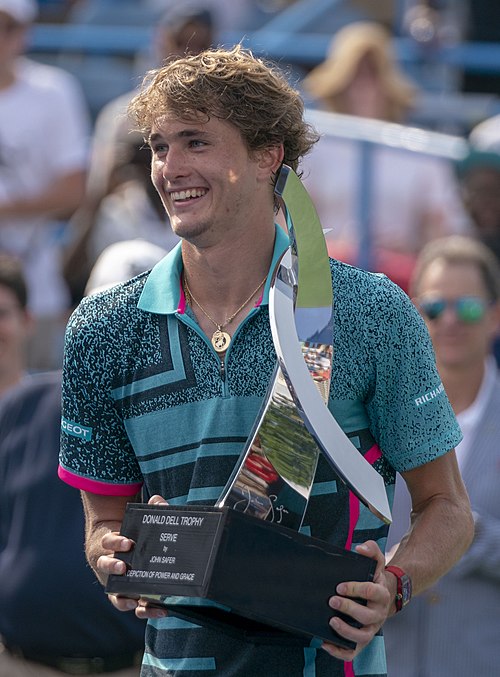
Photo: Belinda Bencic at the 2023 DC Open by Hameltion, CC BY-SA 4.0, via Wikimedia Commons.
🎾 Gear from this story
WilsonWilson Blade SW 104Serena Williams's racket of choiceView on Amazon →As an Amazon Associate, SUPER.TENNIS earns from qualifying purchases.