On the first night of September, on a court in New York that was far too loud for a first-round match, a 40-year-old man chased down a drop shot he had no business reaching, flicked it back at an angle that made no sense, and then stood on the baseline with his arms spread while fourteen thousand people came apart.
It was Gael Monfils' birthday. He had turned 40 that morning. By the end of the night he had beaten Adolfo Daniel Vallejo of Paraguay in four sets and become only the third man aged 40 or over to win a match at the US Open in the Open era, after Ken Rosewall in 1977 and Jimmy Connors in 1992. Two days later a 20-year-old American named Learner Tien beat him 6-3, 6-4, 6-3, and the Grand Slam career of the most watchable tennis player of his generation was finished.
Nobody stopped the tournament to say so. There was a lap of the court, a lot of noise, a camera on his face. Then the next match came on, because that is what tournaments do.
If you watch tennis rather than play it, Monfils has probably given you more pleasure per hour than any player who never won a major. And there are about six weeks of him left.
What is actually left
The arithmetic of the ending is unglamorous. He is ranked around No. 311 in the world. He has won barely a handful of matches this year. At that ranking you do not enter tournaments, you ask to be let in, and whether you play at all depends on people in offices deciding that your name on a poster is worth one of their invitations.
Two of them have said yes. From 18 to 25 October he plays a brand new ATP 250 in Lyon, the Grand Prix Auvergne-Rhone-Alpes, staged at the LDLC Arena and built out of the old Marseille week that used to sit in February. Monfils was the first player the tournament announced, which tells you exactly what a new event thinks he is worth. Vienna, at his coach's suggestion, is a maybe.
Then comes the part he has been steering towards since he announced all this. From 31 October to 8 November, the Rolex Paris Masters is held at Paris La Defense Arena, a 23,000-seat indoor bowl in the business district west of the city that took the tournament over from Bercy. Monfils has said for two years that he wants to finish there. Not in Melbourne, not in New York, not at Roland Garros. In a converted rugby stadium in the Paris suburbs, in the first week of November, in front of people who have been shouting his name since he was a teenager.
If he gets a wild card, which everyone expects, and if he stays healthy, which nobody can promise, that is the shape of the end: a week in Lyon, maybe a week in Vienna, a week in Paris. Six or seven matches if things go well. Two if they do not.
The numbers were never the point
Here is the career, stated flatly, the way a ranking computer would state it. Thirteen tour titles. A career-high of No. 6 in the world, reached in November 2016. Two Grand Slam semi-finals: Roland Garros in 2008, where Roger Federer beat him and then got demolished by Rafael Nadal in the final, and the US Open in 2016, where Novak Djokovic beat him. Twenty-two years on tour. No major.
On paper that is a very good career and not a great one. It is the resume of a player you would describe as "top ten at his best" and leave it there.
The paper is wrong, or at least incomplete, and everyone who ever watched him knows it.
In 2004, as a junior, he won three of the four junior Grand Slam titles in the same year and finished as the world's best teenager. Then he walked into a men's tour that had Federer at the top of it and Nadal arriving behind him, and later Djokovic and Murray, and he spent his entire prime playing the four best players of all time at the same time. That is not an excuse. It is a weather report. A generation of gifted men got the same forecast and most of them have already retired.
What made Monfils different was that he did not shrink to fit it. He played his own way, which was to say that on a good day he played tennis that nobody else on earth could play, and on a bad day he played tennis that nobody else on earth would try.
The most athletic man in the sport
He is 6ft 4in. He ran the 100 metres as a kid. He can still, at 40, get his hips above the level of the net when he jumps, and for twenty years he has been doing things on a tennis court that belong in a different sport entirely.
The splits, both legs flat on hard court, racket arm still swinging. The slide on a surface that is not built for sliding, which he did in Melbourne and New York long before it was fashionable and which cost him hips and knees and weeks of his career. The dunk smash. The between-the-legs winner played while running backwards. The dive that ends with his whole body on the floor and the ball somehow landing in.
And the other side of it: the drop shots from ten feet behind the baseline in a fifth set, the moonballs, the point where he suddenly decided to play from the back wall, the matches where he was two sets up and then simply stopped. He lost matches he should have won more often than almost any player of his standard. He has been criticised for it his whole life, usually by people who never bought a ticket.
But that is the bargain he offered. Every Monfils match came with the chance of something you had never seen before, and the risk of ninety minutes of nonsense. If you are a coach, that is frustrating. If you are somebody who put the television on at nine o'clock on a Tuesday, it is the best deal in the sport.
He understood the audience part of it, too, which very few players do. He conducted crowds. He danced after wins, in Montreal and Marseille and Bercy. He did the arm-wave thing until the whole stadium did it with him. He made eye contact with the people in row fifty. Tennis is a sport that spends a lot of money trying to work out how to be entertaining, and it had a man doing it for free for two decades.
A year spent saying goodbye
He announced this ending himself, on 1 October 2025, a month after his 39th birthday, in a post that said 2026 would be his last season. Since then the year has been a slow procession of last times, most of which did not go the way a script would have written them.
In January he played his 20th and final Australian Open, and lost in the first round to an Australian qualifier named Dane Sweeny after leading by a set and a break. He stayed on court afterwards, which is not how first-round losers usually behave, and told a packed night crowd that his journey had started a long time ago and that somehow it was 2026 and this was the finish line. The man who beat him went on to have a US Open of his own worth reading about.
In May he played his last Roland Garros, and lost a five-setter in the first round to a fellow Frenchman, Hugo Gaston. Then the tournament did the right thing: nobody left Court Philippe-Chatrier, and Richard Gasquet, Gilles Simon and Jo-Wilfried Tsonga walked out to stand beside him. Four men who had been the future of French tennis together in the mid-2000s, three of them already retired, one of them on his way.
In June, the All England Club met to hand out its wild cards and did not give him one. Dimitrov got one. Stan Wawrinka, who is also finishing this year and whose own New York farewell we wrote about, got one. Six British players got the rest. So the last time Monfils played Wimbledon turned out to have been 2025, a second-round loss he had no idea was his final visit. There was no ceremony, no speech, no clap from the Centre Court crowd. He simply never came back, and found out about it in a press release.
Then New York gave him the birthday, which was the best of the goodbyes, and the two-day-later exit, which was the most normal.
The French generation clocks off
To understand what France is losing, you have to see the four of them together. Tsonga, born 1985. Monfils and Gasquet, 1986. Simon, 1984. All four inside the world's top ten at some point. All four capable of beating anybody on a given afternoon. None of them ever won a Grand Slam.
For fifteen years that was the running joke and the running wound of French tennis: the most talented quartet in the country's modern history, arriving at exactly the wrong moment in the sport's history, collecting semi-finals and heartbreak. Two Davis Cup finals lost, in 2010 and 2014. And when France finally won the thing in 2017, Monfils was not on the court for the final.
But 2014 gave him the match that people in France will play at his testimonial, whenever there is one. In the final against Switzerland in Lille, in front of 27,000 people, he beat Roger Federer 6-1, 6-4, 6-3. Straight sets. Forty-four winners. Two hours. Switzerland still won the tie, because Wawrinka and Federer were Wawrinka and Federer, but for one Friday evening the whole country watched Monfils play the best tennis of his life at the exact moment it was needed.
That is the argument for him, in one match. He was not a player who compiled. He was a player who arrived.
Forty, in a sport that does not do forty
Tennis is brutal about age in a way that football and golf are not. There is no bench, no rotation, no team to carry you. You play best of three against a 22-year-old in 33-degree heat and either you can or you cannot.
Monfils kept being able to for an absurdly long time. In January 2025, at 38 years and 131 days, he beat Zizou Bergs to win Auckland and became the oldest man to win an ATP singles title since the tour began keeping its records in 1990. That was his 13th trophy and it came 20 years after his first.
This season, the body finally filed its complaint. Wins have been rare. The ranking has slid past 300, which for a man who lived inside the top 30 for a decade must feel like a different job entirely. He has spoken about wanting to do what Cristiano Ronaldo and LeBron James did, to keep going into his forties simply because he loves the work, and it is fair to say the tour has been less accommodating to him than those sports were to them.
Yet none of that is really the story of the year. The story is that a man with nothing left to prove decided to spend twelve months being applauded in person rather than disappearing in an Instagram post, and then had to earn the applause one wild card at a time.
The house he goes home to
There is a version of retirement that is frightening, and a version that is not. Monfils appears to have the second one.
He has been married to Elina Svitolina since July 2021. Their daughter Skai was born in October 2022, and if you have watched any Svitolina match since then you will have seen Monfils in the box with a small child on his knee, doing the least glamorous job in professional sport, which is being the spouse who is not playing today.
Svitolina, meanwhile, is having one of the better late chapters in the women's game, still competing at the level she reached before motherhood, as her summer in Toronto showed. One of the quieter things Monfils has done in the last four years is be the person who makes that possible, in a sport where the arrangement is almost always the other way round.
He has talked about coaching, about business, about a life with fewer airports. Whatever comes next, he is not a man who needs tennis to know who he is. That, more than the ranking, is why this farewell has felt lighter than most.
How to watch the end
If you want to see him play, your calendar is short and specific.
Lyon, 18 to 25 October, indoors at the LDLC Arena, a tournament that has never been held before and now gets Monfils as its first headline. Possibly Vienna the same week or thereabouts. Then Paris La Defense Arena from 31 October to 8 November, the biggest indoor tennis tournament in the world, 23,000 seats, the tournament he has said out loud he wants to be his last. It sits inside a busy autumn that also includes Shanghai, the Billie Jean King Cup and the season finale in Turin, and if you want the whole map of what remains of 2026, we set it out here.
Most likely you will watch it on a screen, late in the evening, with the sound up. He will be playing someone fifteen years younger who hits the ball harder and misses less. At some point he will go for something ridiculous, and it will work, and a French crowd will make a noise that belongs to a much bigger occasion than a second round.
That is the thing worth turning up for. Not the result. The result stopped mattering some time ago.
For twenty-two years Monfils was the player you texted a friend about mid-match, the one whose highlights got sent around by people who could not name the world No. 4. He never held a major trophy over his head, and he leaves behind something rarer than a line in a record book: several million evenings that were better because he was on. In November, in a converted rugby stadium in Nanterre, the people who spent those evenings with him get to say thank you to his face. Very few players in any sport get an ending that honest.
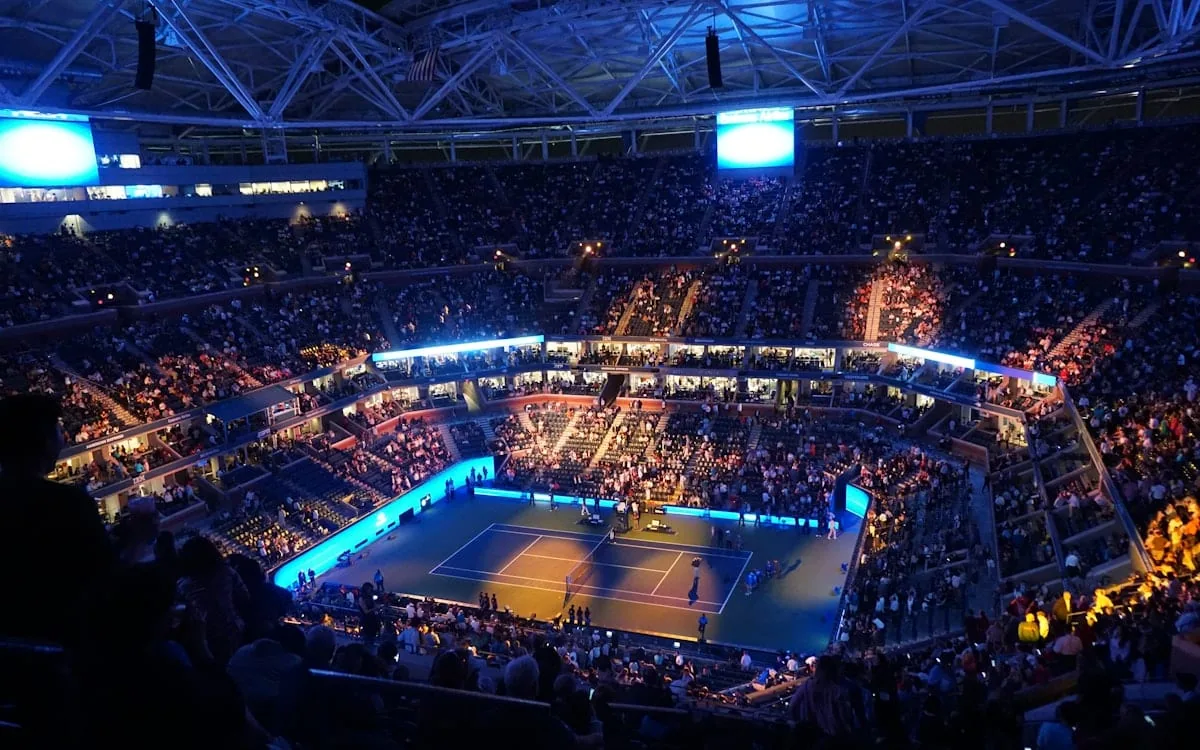
Photo: a full arena under the lights during a night session, the kind of stage Gael Monfils spent twenty years filling.
🎾 Gear from this story
WilsonWilson Pro Staff RF97Roger Federer's racket of choiceView on Amazon →As an Amazon Associate, SUPER.TENNIS earns from qualifying purchases.