Seventy minutes. That is all it took on Monday night in the desert for Elina Svitolina's return to the WTA Finals to stop being a lovely story and start being a scoreline: 6-4, 6-0 to Mirra Andreeva, the last seven games gone in a blur, the whole thing finished before a lot of the crowd had got through their first drink.
If you only read the result, you would file it under "veteran turns up, veteran gets beaten by teenager" and move on with your evening.
Please do not move on. Because the woman who walked off that court is the most interesting person in this tournament by a distance, and the score has almost nothing to do with why.
The last time she was here, the world was different
The last time Elina Svitolina played the WTA Finals, it was 2019. The tournament was in Shenzhen. She reached the final and lost it to Ashleigh Barty, 4-6, 3-6, on a night when Barty was winning her first season-ending title and everyone sensibly assumed Svitolina would be back in that eight-woman field most years for the rest of her career. She was 25. She had been world number three. Reaching the last tournament of the season was simply what she did.
She did not come back for seven years.
Seven years is an enormous amount of time in a sport where a bad eighteen months can end you. Think about what has happened in your own life since 2019 and then imagine trying to hold a top-ten ranking through all of it. Players who were in the locker room with her that week in Shenzhen have retired, had careers, come back, retired again. The tournament itself has moved country three times. And the whole time, the one trophy that proved she belonged in that room was sitting on a shelf somewhere with her name on it.
Because here is the part people forget. She did not just qualify for this thing once upon a time. She won it.
What she did in 2018
Singapore, the year before the Shenzhen final. Svitolina arrived as the sixth seed and nobody's pick, and then she did not lose a match. Not one, not in the round robin, not in the semifinal, not in the final against Sloane Stephens. She went through the strongest eight-player field in women's tennis unbeaten and walked out with the biggest title of her career.
That remains, to this day, the biggest thing she has won. She has a career of serious achievements around it, and a hole where a Grand Slam trophy would go, and sitting right in the middle of the collection is a week where she beat everybody.
If you want the texture of what that eight-woman week feels like from the inside, we wrote about the shape of this year's edition in the desert when the field was still being settled. It is the smallest, strangest, most claustrophobic tournament of the year. You cannot hide in it. There are no easy early rounds to find your range in. You walk out on the first night against a top-eight player and the week starts at full volume.
She won that. At 24. And then the sport took the next seven years off her.
The years in the middle
What happened was not one thing. It was a slow accumulation, which is how most careers come apart.
A back injury. A foot injury. The ranking sliding not dramatically but steadily, the way rankings do when you are losing in the third round instead of the quarterfinal. And then 2022, which rearranged the entire shape of her life in ways that had nothing to do with tennis, because Svitolina is Ukrainian, from Odesa, and in February of that year her country was invaded.
Her daughter, Skai, was born in October 2022.
She came back to the tour in April 2023, in Strasbourg, after more than a year away, essentially without a ranking. She won the tournament. Three months later she arrived at Wimbledon on a wildcard, beat Iga Swiatek in the quarterfinals, and reached the semifinal. It was one of the great returns in recent tennis, and the sport spent a fortnight telling her so.
And then the hard part started, which nobody writes about, because it is boring. The ranking did not come back. Not properly. She stayed useful, stayed dangerous, stayed the kind of draw nobody wanted in the second week, and stayed outside the top ten for four years. Four years of flights and hotel rooms and first-round matches in cities with a toddler in tow, knowing exactly what the top of the sport feels like from the inside and not being able to get back up there.
It is worth sitting with the logistics of that for a moment, because tennis makes them invisible. A tour season is roughly eleven months long and takes in something like twenty countries. A player travelling with a small child is travelling with a second adult to look after that child, which means a second flight, a second room, a second set of visas, and a schedule built around nap times as much as around surfaces. Players who do it almost never complain about it in public, so you end up watching a flat first-round loss somewhere at seven in the evening with no idea that the person losing it has been up since four. Svitolina has spent four years doing it that way.
Most players, at that point, make peace with it. They take the ranking they have, enjoy the back end of a good career, and leave quietly at 32.
And it is worth being precise about what she was refusing, because qualifying for this tournament is not a hot fortnight at the right moment. The eight places are decided by a table that runs from the first week of January to the last week of October, and every point in it has to be won on a court somewhere. There is no wildcard into the WTA Finals, no reputation discount, no selection committee that remembers you used to be very good. You play eleven months and you either finish in the top eight or you watch it on television. Svitolina had watched it on television six years running.
2026, the year she refused
She started in Auckland in January and won the title, beating Wang Xinyu in the final. A nice week. The kind of thing a veteran does before a Slam.
Then she went to Melbourne as the twelfth seed and did something considerably less nice. In the fourth round she beat Mirra Andreeva, 6-2, 6-4. In the quarterfinal she met Coco Gauff, the third seed, and beat her 6-1, 6-2 in fifty-nine minutes. Fifty-nine minutes. On Rod Laver Arena, against a player seven years younger and ranked nine places above her, Svitolina played one of the cleanest hours of tennis of the entire fortnight and was in the Australian Open semifinal for the first time in her life.
She lost that semifinal to Aryna Sabalenka, 6-2, 6-3, and the world number one went on to the final. But it was her fourth major semifinal and her first since that Wimbledon run in 2023, and it reset what the season could be.
Then came May, and Rome, and the week that actually put her back in this tournament.
She beat Elena Rybakina. She beat Iga Swiatek. And in a final that ran to nearly three hours she beat Coco Gauff again, 6-4, 6-7(3), 6-2, to win her third Italian Open title, nine years after her first one. Three top-five players in a single tournament, at 31 years and eight months old. No woman that age had ever won three titles at the same WTA 1000 event, and none had ever beaten three top-five players at one of them.
By the autumn she was back inside the top ten for the first time in four years. She goes into this week ranked sixth in the world, the sixth seed in a tournament she last entered in 2019, and her 2026 has been comfortably the best season of her thirties.
The man standing in her box
Her regular coach, Andrew Bettles, is not in Indian Wells. His wife is expecting a baby, and the timing was known about since the clay season, so this was always going to be the week he missed. He is due back with her in 2027, before Melbourne.
So Svitolina called Sergiy Stakhovsky.
If you watched tennis in 2013, you know exactly who that is, and you probably know where you were. Stakhovsky was ranked 116 in the world when he walked onto Centre Court at Wimbledon against the defending champion and beat Roger Federer in four sets, 6-7, 7-6, 7-5, 7-6. It ended Federer's run of thirty-six consecutive Grand Slam quarterfinals, a streak that had been going since 2004. It is still one of the loudest upsets in the history of the tournament. Stakhovsky got as high as 31 in the world in his own career and won four tour titles, but that is the afternoon he will always be introduced by.
He retired in January 2022. The following month Russia invaded Ukraine, and Stakhovsky went home and joined the army. He spent years of what would have been his post-playing life in uniform, and has only recently come back to the sport.
That is the person sitting in Elina Svitolina's box this week in the California desert.
She described the decision as an easy one, which it obviously was. They have known each other for most of their adult lives and have trained together at home. There is not a long list of people on earth who understand both what a round-robin match at the WTA Finals requires and what the last four years have been like for Ukrainians, and she has one of them in a chair six metres from the baseline.
The thing that happens at the net afterwards
When the Andreeva match finished, Svitolina did not shake her opponent's hand.
If you are a newer watcher and that looks shocking, here is the context, stated plainly. Since the full-scale invasion in 2022, Ukrainian players have declined to shake hands with Russian and Belarusian opponents. It is not personal to Andreeva, who was fifteen when the war started, and Svitolina has said as much repeatedly over the years. It is a position Ukrainian players took collectively and have held to ever since, through boos in some stadiums and silence in others. Svitolina has been one of its most consistent and most explained advocates. She walks to the net, she acknowledges the chair umpire, she raises a hand to the crowd, and she goes.
You will see it again this week if the draw puts her across the net from Andreeva's compatriots. It is worth understanding rather than being startled by. We looked at the teenager on the other side of that handshake in a piece about Andreeva's year and her sister Erika earlier in the autumn, and both things can sit in your head at once: a nineteen-year-old playing wonderful tennis, and a thirty-two-year-old who cannot do the normal thing at the end of it.
Where the week stands
This edition has already been reshaped before a ball was hit. Elena Rybakina, the top seed and the year-end world number one, withdrew on the eve of the tournament with a viral illness, saying her body simply was not ready to compete. We had just written about the season that took her to number one, and then she was gone before the first serve. Marta Kostyuk came in as first alternate and is making her debut in the eight.
That leaves Group 1 as Coco Gauff, Jessica Pegula, Linda Noskova and Kostyuk, and Group 2 as Aryna Sabalenka, Mirra Andreeva, Elina Svitolina and Karolina Muchova. Svitolina is in the harder half of a very hard field, and she is nought and one in it.
She has Muchova next, and then Sabalenka. Muchova is her own kind of problem. The Czech took the eighth and last place in this field, which undersells her badly: on her day she is the most inventive player in the women's game, a slicer and a drop-shotter who will refuse to give Svitolina the rhythm she feeds on, and the main reason she has not been a fixture at tournaments like this one is a body that keeps interrupting her. Those two meeting will be the least predictable hour on the schedule all week. Realistically she needs both, and she probably needs other results to fall for her as well, because losing a set-count argument is how these groups are usually decided. If the countback maths is unfamiliar, we explained how the group stage actually resolves last week, and it is worth five minutes before Thursday, because somebody always qualifies on a technicality and everybody always argues about it.
The round-robin matches run through Friday. The semifinals are on Saturday, the final on Sunday.
Why you should watch her anyway
Because of all eight women here, Svitolina has the best winning percentage in the history of this tournament. Not the most titles, not the biggest serve. The best record, across 2017, 2018, 2019 and now. This building suits her even when the form does not.
And because her tennis is genuinely good to watch if you know what to look for, which is not power. Svitolina wins by covering ground that other people have written off, by hitting one more deep ball than you expected to have to deal with, by turning the point you thought you had won into a point you now have to win twice. Watch the third or fourth shot of a rally rather than the first. Watch how often an opponent goes for a winner slightly earlier than they meant to because they can see her already standing where the ball was going. That is the whole game. It is why Gauff lost in fifty-nine minutes in January and why Swiatek lost on clay in May.
At 32, with a three-year-old at home, she is still doing it well enough to be one of the eight best players of the year.
When she walks back out against Muchova, the scoreboard will start at love-all and will tell you nothing about any of this. Seven years away, one daughter, one war, one ranking rebuilt from the outside in, one friend in the box who spent the last four years in uniform. None of that is listed anywhere on the court, and none of it will help her hold serve.
But she is in the building. For a long time that was the part that looked impossible, and she went and did it anyway, at an age when the sport had already finished writing about her.
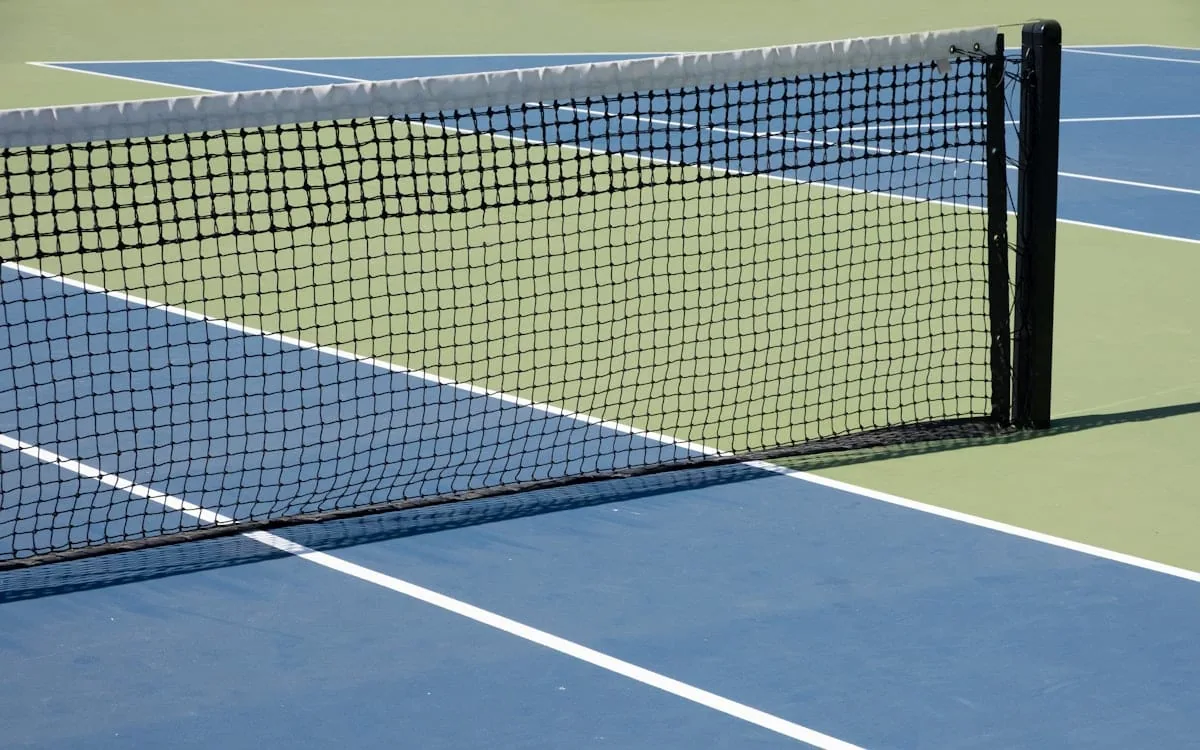
Photo: a sunlit outdoor hard court, blue inside the lines and green beyond them, from our picture library.
🎾 Gear from this story
BabolatBabolat Pure DriveMirra Andreeva's racket of choiceView on Amazon →As an Amazon Associate, SUPER.TENNIS earns from qualifying purchases.