On the evening of Sunday 8 November, the floodlights will come on over a tennis complex in the California desert, and eight women will walk out to settle the last big argument of the season. That much happens every year. What is different this time is the address.
The WTA Finals — the tournament that closes the women's season, the one every player spends eleven months trying to reach — will be played at the Indian Wells Tennis Garden from 8 to 15 November. Four months ago it was supposed to be in Riyadh. A year from now it will be in North Carolina. If you have found this event hard to keep track of, that is not your fault. It has moved house more often in the last decade than any other tournament in tennis, and this year it moved with only months to spare.
So before the first ball goes up, here is the whole thing laid out: how the Finals ended up in the desert, what the place is like, how the format works, who the eight are, and what the week will feel like from a sofa with a cup of tea going cold beside you.
A tournament with no fixed address
Most big events are inseparable from their postcode. Wimbledon is Wimbledon. Roland Garros has been on the same patch of Paris clay since the 1920s. The US Open belongs to Queens the way a sound belongs to a room.
The WTA Finals has never had that. It started in Boca Raton in 1972, moved to Los Angeles, then to New York, where for years it was played in Madison Square Garden and felt like a genuine Manhattan night out. It went back to Los Angeles. It crossed the Atlantic to Munich in 2001, the first time the women's season finale had been held outside the United States. Then Madrid. Then Doha. Then Istanbul. Then Singapore for five years, then Shenzhen, where a very long and very expensive contract was signed and then quietly fell apart in a pandemic.
Since then it has been Guadalajara in 2021, Fort Worth in 2022, Cancun in 2023 — an edition played in a temporary stadium by the sea that became notorious for wind and delays — and then Riyadh in 2024 and 2025. Indian Wells makes fifteen host cities by most counts, and the first American one since Fort Worth four years ago.
A tournament builds its character out of repetition: the same walk from the station, the same queue, the same light at six in the evening. The Finals has had almost none of that. Every few years it has had to introduce itself again to a brand new crowd.
Why Riyadh ended early
Riyadh was meant to be a three-year arrangement, 2024 through 2026, backed by Saudi money and announced as a turning point for the women's game. It ended a year early.
The reporting around the decision points at several things at once rather than one clean cause. The tour cited regional security and the conflict in the Middle East. Attendance in Riyadh had been thin — the matches were superb and the stands were not full, which is a difficult look for a tournament selling itself as the sport's showpiece. And there were signs that the enthusiasm on the Saudi side had cooled.
What is not in dispute is that leaving was expensive. The WTA's chair, Valerie Camillo, has acknowledged publicly that the early exit left a hole in the tour's finances and shaped the decision about where to go next. When the governing body of a sport walks away from a signed cheque, it is rarely because the paperwork was inconvenient.
In September the WTA announced the next chapter: Charlotte, North Carolina, will host the Finals from 2027 to 2029 at the Spectrum Center, and the tour will move its own headquarters there from St Petersburg, Florida. Just as significantly, the WTA intends to run the tournament itself rather than licensing it to an outside promoter, which is a different business model and a different kind of commitment.
Which leaves 2026 as a bridge year. Somebody had to stage a season finale in under five months, with a stadium, a television compound, hotel rooms and a crowd. There were not many candidates. Indian Wells put its hand up.
What Indian Wells actually is
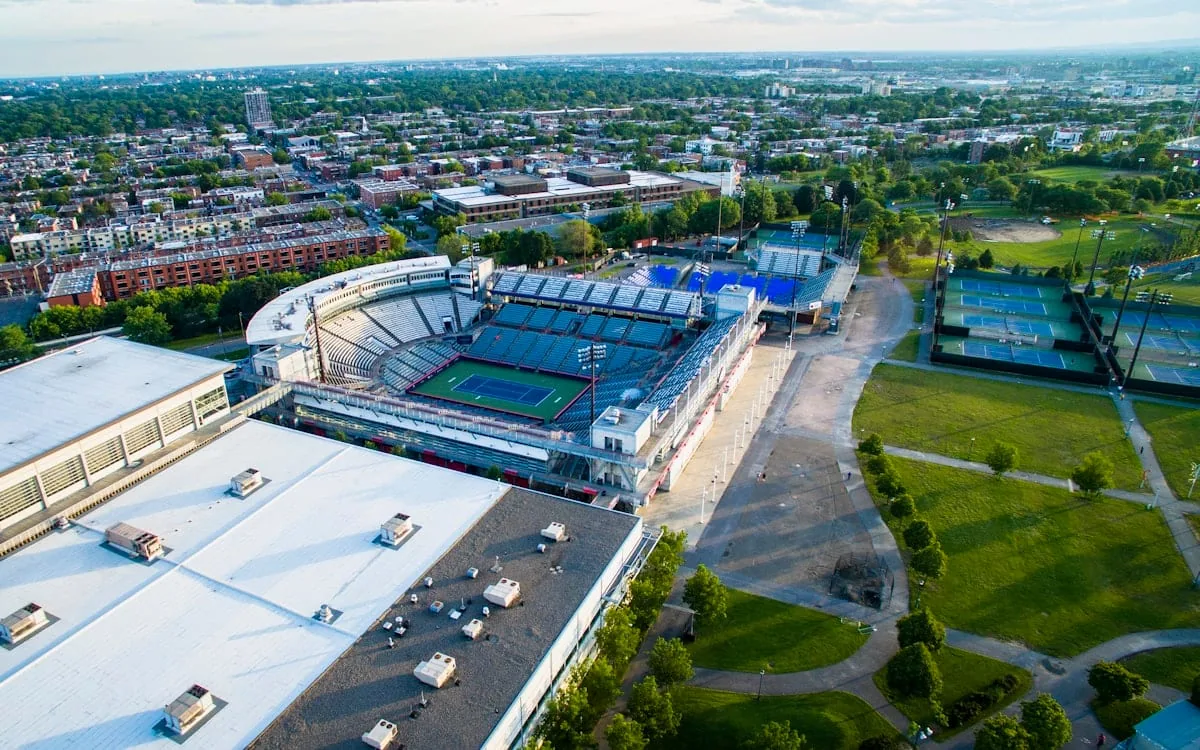
If you have watched tennis in March, you know the place without knowing you know it: the palm trees, the mountains sitting behind the stadium like a painted backdrop, the sunlight that makes everything look slightly over-exposed. That is the Indian Wells Tennis Garden, out in the Coachella Valley a couple of hours east of Los Angeles, and in spring it hosts the BNP Paribas Open, the biggest combined event outside the four majors. Our Indian Wells guide goes through that tournament in detail.
The headline number is Stadium 1, which seats 16,100 people. That makes it the second-largest tennis-specific stadium on earth, behind only Arthur Ashe Stadium in New York. Stadium 2 holds around 8,000, which is bigger than the main show court at a good many tour events, and behind them sits a sprawl of practice and match courts — enough that in March you can wander for an hour and never watch the same player twice.
The site has been owned since 2009 by Larry Ellison, the Oracle co-founder, who bought the tournament and its grounds for a reported 100 million dollars and has spent heavily on them ever since. Players talk about Indian Wells the way they talk about very few places, and it is routinely voted their favourite event of the year that is not a major.
November will be a different animal from March, though. The desert in early spring is warm and bright and faintly festival-like. The desert in November is pleasant by day and genuinely cold once the sun drops behind the mountains — the kind of cold where the ball goes heavy, the bounce drops, and anyone relying on pace through the air starts to have a harder evening than they expected. Players who like to hit flat and through the court may find the night sessions less friendly than the afternoons. That is not a small detail in a tournament where three matches can decide everything.
The format, and why it rewards you for watching all week
Here is the part that confuses people, so let us take it slowly, because once it clicks it is the best-designed week in tennis.
Every other tournament you watch is a knockout. Lose once and you are out, which is thrilling and also slightly cruel: a player can travel across the world, have one bad afternoon, and be on a flight home before dinner.
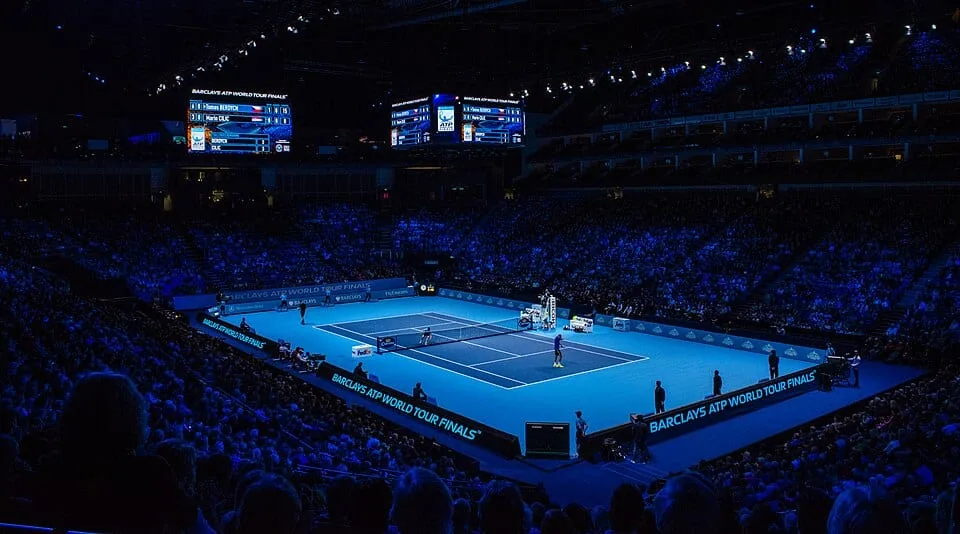
The Finals does not work that way. The eight qualifiers are split into two groups of four. Everyone plays the other three players in her group — three guaranteed matches, win or lose. At the end of the round robin, the top two in each group go through to the semi-finals, and from there it reverts to straight knockout: two semis, one final.
The consequences of that are lovely. A player can lose her opening match and still win the title; it has happened more than once. A player can win two matches and go home on a tie-break countback, which is the cruellest arithmetic in the sport and produces the strange spectacle of competitors doing mental sums about games won while they are still on court. And every single match matters, because a dead rubber on paper can still decide who qualifies in the other group.
For a viewer, the practical upshot is this: there is no day in this week where the tennis does not count, and no player you fall for on Sunday who is gone by Monday. You get at least three looks at everyone. By Thursday you will have opinions.
The men do the same thing a week or so later in Turin, and if you want the equivalent story from the other tour, we wrote about the eight chairs at the ATP Finals earlier in the autumn. Our evergreen WTA Finals guide covers the history and the records in more depth.
The eight
The field was completed in the last week of October, when Karolina Muchova took the final place. It is a genuinely interesting group: three former champions, two former finalists, and three women who have never played this tournament before.
Elena Rybakina arrives as world number one, defending champion, and — since a straight-sets win over Yulia Putintseva in Tokyo on 29 October — the confirmed year-end number one, the first player from Kazakhstan ever to finish a season on top of the rankings. Her 2026 has been extraordinary: the Australian Open in January, the US Open in September, the number one ranking that followed it, four titles in all. She won this event last year in Riyadh, beating Aryna Sabalenka 6-3, 7-6 in the final, and collected the largest single payday in the history of women's sport while she was at it. We wrote about her at length in the quietest superstar in tennis, and nothing about the last few months has made her any louder.
Aryna Sabalenka has three titles in 2026 — Brisbane, Indian Wells and Miami — which means she will walk onto a court in November that she already won on in March. She has reached the title match at this tournament before without winning it. Of all the players in the draw, she is the one for whom this particular trophy most obviously remains a piece of unfinished business.
Coco Gauff won this title in 2024 and qualified this year on the back of a Cincinnati title and runner-up finishes in Miami and Rome. She will also have something none of the others do this week: a home crowd. An American playing a season finale on American soil for the first time since 2022 is going to hear about it every time she wins a point.
Jessica Pegula is the second American in the field and a former finalist, and at this stage of her career she is the kind of opponent nobody wants in a round robin — relentless, unfussy, and perfectly happy to make an afternoon feel long.
Elina Svitolina is back at the Finals for the first time since 2019. She won the title in 2018 in Singapore, in what already feels like a different era of the sport, and she is now 32 and playing some of the best tennis of her life. Of the eight, she is the one whose qualification would have seemed least likely eighteen months ago.
Mirra Andreeva is 19, ranked at a career high, and arrives as a Grand Slam champion after winning Roland Garros, with titles in Adelaide and Linz alongside it. She was an alternate here last year, hanging around the site in case somebody pulled out. This time she has a chair of her own.
Linda Noskova is 21 and the Wimbledon champion, which is a sentence that would have sounded absurd in January and is now simply a fact. She makes her Finals debut, and she makes the Czech Republic a two-player nation in this field.
Karolina Muchova is the other half of that Czech pair and the story of the final qualifying week. She had qualified for this event once before, in 2023, and had to withdraw injured without hitting a ball. Three years and a lot of hospital corridors later, at a 40-11 record for the season with titles in Doha and Bad Homburg, she finally gets to play it. If there is a player in this draw whose arrival deserves a round of applause before she serves, it is her.
Between them: a Kazakh, a Belarusian, two Americans, a Ukrainian, a Russian and two Czechs. Four of the eight have won a major. Three are playing the biggest week of their lives.
The money question
The 2026 Finals carries a prize pot of around 10 million dollars. Last year in Riyadh it was 15.5 million, and Rybakina alone took home 5.235 million of it for going through the week unbeaten — the largest prize ever paid to a woman at a single sporting event.
That drop is worth being honest about rather than skating past. It is the direct cost of leaving a well-funded host early, and it is the number that explains why the WTA has spent the autumn talking about its finances. Ten million dollars is still an enormous amount of money for one week of tennis. It is also a reminder that the economics of the women's game are not settled, and that the decisions being made now about where this event lives are about far more than which city gets a nice week in November.
The counter-argument, and it is a real one, is that a season finale played in front of a full house in a time zone where most of the sport's broadcast audience is awake may be worth more over three years than a bigger cheque in an empty stadium. Charlotte will test that theory from 2027. Indian Wells gets to run the pilot.
What it looks like from your sofa
Practically speaking, this is the easiest WTA Finals to watch in years if you live anywhere in the Americas, and a late one if you live in Europe.
Indian Wells is on Pacific time. Day sessions will start in the late morning there, which is early evening in London and the middle of the night in much of Asia. Night sessions will be the real event — desert air, lights on, mountains invisible behind the stands — and those will land in the small hours for British viewers. In the United States the tournament is on Tennis Channel.
Order of play is typically published the evening before, which matters more here than at a normal tournament: because of the group format, the schedule is built around which matches have live qualifying implications, and the best match of the day is not always the one that was billed that way in advance.
The doubles, which you should not skip
Eight teams, same round-robin structure, often in the same sessions. Doubles at the Finals is consistently among the best tennis of the year and consistently ignored, largely because it tends to be scheduled when sensible people are at work.
It is worth finding. The points are shorter, the reflexes are faster, the margins at the net are measured in centimetres, and the players talk to each other constantly in a way that is oddly moving once you start listening for it. A week where every team is in the world's top eight is a good place to start.
A forwarding address at last
There is a version of this story that is purely about money and geopolitics, and it is accurate as far as it goes. But stand at the back of Stadium 1 on a cold November night with sixteen thousand people in it and that version will feel thin.
What actually happens on 8 November is that eight women who have spent a year grinding through airports and time zones get to play three matches each in a very good stadium in front of a crowd that chose to be there. Three of them have never played this tournament before, and some of them may never play it again. One of them waited three years for an injury to let go of her. One of them is nineteen and already a major champion. One of them has just become the first person from her country to finish a year as the best tennis player in the world.
And for the first time in a very long while, the tournament itself knows where it is going afterwards. Charlotte, for three years, run by the tour, in a building with a roof and a return address. The wandering is over. This week in the desert is the last stop before it settles down — which makes it worth watching twice: once for the tennis, and once because events this unmoored do not usually get a happy ending.
Photo: floodlights above a palm-lined court against a pale sky, from our picture library.
🎾 Gear from this story
HeadHead Speed MPElena Rybakina's racket of choiceView on Amazon →As an Amazon Associate, SUPER.TENNIS earns from qualifying purchases.