The ball is dead. It stopped rolling a second ago, somewhere short of the service line, and the player who dumped it into the net has already turned her back on it and is walking to the baseline with her head down, thinking about the next point.
Now watch what happens to the ball. Not the player. The ball.
Someone goes and gets it. Someone has been waiting, half-kneeling at the net post, for exactly this, and the moment the point ends they are moving. They collect it, they look up, they find the far corner of the court, and they roll it — not throw it, roll it, flat and fast along the ground so it does not bounce — to another person standing at the baseline with their hands behind their back. That person already has two balls. Now they have three. They will hold them until the server turns round and lifts a hand, and then they will feed two of them across the width of the court, and the match will carry on.
All of that takes about six seconds. It happens around two hundred times in an average match. And if the people doing it are good, you will finish the whole three hours without once registering that they exist.
That is the job. That is literally the brief. Be the fastest people on the court and be the least noticeable.
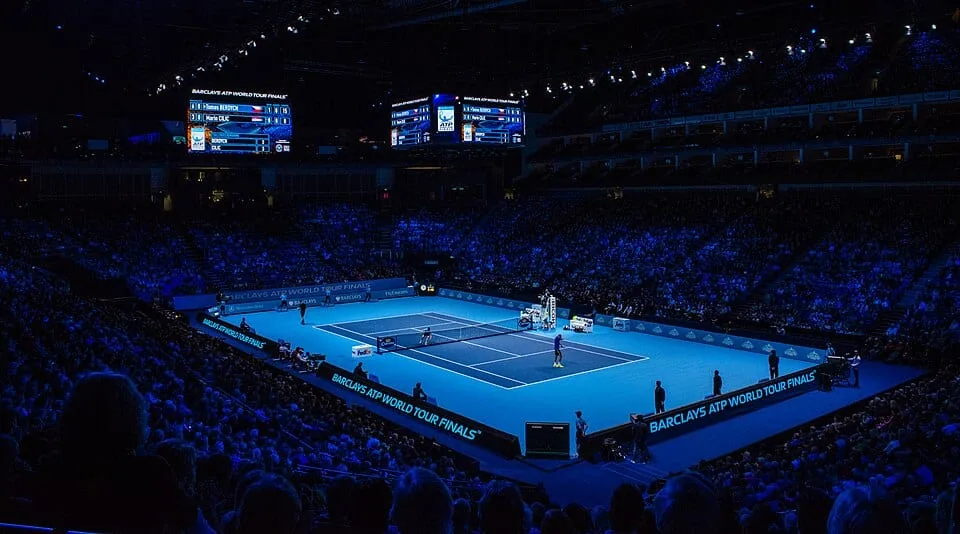
This fortnight is a decent time to notice them anyway. The WTA Finals in Indian Wells is running now in the California desert, eight women playing for the last trophy of their season, and a week on Sunday the men start theirs in Turin. These are the two smallest, most concentrated weeks in tennis, the ones where everything is turned up: the lighting, the entrance music, the quality. The ball kids at those events are the end product of a selection process that started, in some cases, with several thousand children and a stopwatch.
There are six of them, and they are standing in a shape
Start with the geometry, because once you see it you cannot unsee it.
A professional match is worked by six ball kids. Two of them live at the net, one at each end of it, tucked in by the posts. The other four stand at the four corners of the court, behind the baselines, out past the singles lines, pressed back as far as the space allows.
The two at the net are the retrievers. Theirs is the hot job. Every ball that dies in the middle of the court — netted, mishit, stopped dead by a drop shot — belongs to them, and they have to get it and get out before the players are ready again. They spend the point itself in a crouch, down low, deliberately below the sightline of a player looking across the net, because a kid standing upright at the net post is a distraction in a professional's peripheral vision.
The four in the corners are the suppliers. They are the ones you will occasionally catch in a wide shot, standing absolutely still with their hands clasped behind their backs, and they are holding the match. Balls flow to them from the net pair and from each other, and at the start of every point the ones at the server's end must have what the server wants, in the number the server wants, delivered the way that particular player likes it delivered. Some want two. Some want three so they can reject one. Some want them thrown to the hand, some bounced.
The traffic between those six positions is the whole skill, and it is governed by rules that are stricter than you would guess. Between a first serve and a second serve, for instance, the court is supposed to go quiet: the standard instruction in the sport is that you do not roll a ball across to another ball kid in that gap. Only the net kid on the side where the fault landed moves, and only if the ball is genuinely theirs. Everyone else freezes. One stray ball trickling across the baseline while a player is tossing for a second serve, and you have cost somebody a point in a match they may be paid a great deal of money to win.
That is the part that makes it a real job rather than a nice day out. The core of it is not running. It is knowing, continuously, where all six balls are, who has how many, which end the server is at, and whether this is a first serve or a second one — while standing still, in the heat, in front of fifteen thousand people, for an hour at a time.
Wimbledon picks from about thirty schools and starts in February
How you get there depends enormously on which tournament you want, because the four majors do this in four genuinely different ways.
Wimbledon runs the most closed and the most famous system. There is no public application. The All England Club works with a group of roughly thirty partner schools in the area around the club, and those schools nominate their own pupils, generally from Years 9 and 10 — so mostly fourteen and fifteen year olds. If your school is not on the list, you cannot apply, which is a slightly uncomfortable fact about the most prestigious version of this job in the world.
Around 1,400 young people are put forward each year. Somewhere between 250 and 280 make it onto the final roster, and that number includes a large block of returners: a typical year is something like 180 new recruits from the schools plus about 100 kids invited back because they were good the summer before. Being asked back is the real badge. It means you did a fortnight on the grass without anyone noticing you.
The training is the part that surprises people. It begins in February, around five months before anyone sets foot on a show court. There are selection sessions, then months of drills — rolling, feeding, posture, fitness, the rules of tennis tested in detail, because a ball kid who does not know what a let is will eventually be standing in the wrong place at the wrong moment. Candidates get cut along the way.
And for all of that, it is not really paid work. The Championships treat it as an expenses arrangement with meals while on duty rather than a wage, which is a long way from a summer job and is part of why the thing is so oversubscribed. You are not doing it for the money. You are doing it because for two weeks you get to stand four metres from the best players alive while they do the hardest thing they can do.
New York holds an open audition, and adults turn up
Now cross the Atlantic, where the whole philosophy inverts.
The US Open runs open tryouts. Every June, at the Billie Jean King National Tennis Center in Flushing Meadows, the USTA puts out a call and anyone aged fourteen or over can come and try. Not anyone at a partner school. Anyone.
The consequence is the single most charming fact in this entire subject: the US Open ball crew is not a children's crew. Because it is a properly paid position, there is no upper age limit, and the roughly 300-strong crew runs from fourteen-year-old schoolchildren to adults in their forties. People take annual leave from actual careers to do it. They queue up in the June heat with teenagers and run the same drills.
The numbers at the door are brutal in their own way — recent years have seen something in the order of 1,600 applicants, with a few hundred invited to tryouts held across a couple of days, for a crew of about 300. And unlike Wimbledon, it pays: reporting on the 2026 edition puts the rate somewhere around eighteen to nineteen dollars an hour.
That is a real difference in character, and you can see it on screen if you look. New York ball crew tend to be a bit more visible, a bit more theatrical in the throw, a bit more New York about the whole thing. It is the only major where the person rolling a ball to Carlos Alcaraz might be older than his coach.
Melbourne built a pipeline, and it now runs through other countries
The Australian Open has the biggest squad of the four. Recent editions have put something like 400 to 430 ball kids on site, with the 2025 cohort billed as the largest in the tournament's history. The applicant pool is correspondingly huge — depending on the year, reports range from around a thousand to more than 2,500 children, typically aged twelve to fifteen, going through a two-stage trial in which first-timers are assessed on their own and then thrown in alongside the previous year's kids to see how they cope.
What makes Melbourne distinctive is that it exports the process. The tournament now runs feeder programmes in other countries, and the funnels are startlingly narrow. For the 2027 edition, the Indian route began with online registration, moved to city trials in Delhi, Mumbai and Bengaluru, cut to 60 for national trials, cut again to 24 for final assessment, and produced four children who will fly to Melbourne. China has supplied its own cohorts through a similar arrangement, with a handful of twelve to fifteen year olds drawn from the much larger group who worked the China Open in Beijing the previous autumn.
Four from a country of 1.4 billion. It is, in its way, a harder draw than the main one.
Paris tests you on the rules as well as the running
Roland-Garros calls them ramasseurs de balles, and the French Tennis Federation runs the selection across multiple sites around the country, open to children aged twelve to sixteen. Somewhere in the region of 2,000 to 2,500 sign up in a normal year; depending on the edition, between about 220 and 280 come through, and 2021 set a record with 280.
The selection is not purely athletic. There is a physical assessment — speed, stamina, the ability to get to a ball and get out of the way again — but candidates are also tested on their knowledge of the rules of tennis, which tells you how the French federation thinks about the role. And making the squad is not the end of it. A second, much harsher cut picks only around fifty of them for duty on the main show courts, judged on ball handling and on how they carry themselves.
So the child you see on Court Philippe-Chatrier during the second week in Paris has come through two separate filters, one of which most of their own teammates did not pass.
Somebody measured what it does to them
For a long time all of this was anecdote. Then, at Roland-Garros in 2022, a group of researchers put tracking devices on ball kids during live matches and wrote the results up in a public-health journal.
They studied 26 of that year's 280 kids across 94 separate rotations on the three main courts, and the findings are worth sitting with. The top speeds recorded on court averaged a shade under 20 kilometres per hour. That is a genuine sprint — not a jog, not a scamper, a flat-out effort by a twelve to sixteen year old, performed in short bursts, over and over, between points, in Paris in late May or early June.
The researchers also recorded how hard the kids themselves felt they had worked, and the average came back at around 4.5 on a 10-point scale at the end of a rotation. Middling, in other words — which is arguably the most impressive number in the study. They are sprinting repeatedly in the heat and reporting it as moderately tiring, because they are twelve, and because they have been training since February.
The paper describes the physical requirement of the job as huge. It was the first study of its kind, which is a small scandal in itself: this role has existed in professional tennis for well over a century and nobody had bothered to find out what it costs.
If you want the other half of that picture, the object they are chasing has a life of its own too — nine games of use, and a journey to get there that is longer than any of the players make.
The moments they become visible
The great unspoken rule is that nothing should ever happen to them. They are a part of the stage furniture, like the chair umpire or the net, and they are judged by how completely they fade.
Which is why the exceptions stay in the memory for years. A ball kid struck by a ball travelling at a speed no fourteen-year-old should have to absorb. A kid who faints in the heat and a player who gets there first with the ice towel. A player who, having just lost badly, hands over their racquet, or stops to say something quiet on the way off. Those moments travel around the world in an afternoon precisely because they are a rupture: the furniture turned out to be a child.
And then there is the best version of the story, which belongs to a boy in Basel.
In 1993, a twelve-year-old from the local area worked the Swiss Indoors as a ball boy and spent a final a few feet from Michael Stich and Stefan Edberg. He said later that he did it for two years. His name was Roger Federer, and he went on to win that tournament ten times — and after finals he used to take the ball kids out for pizza, a tradition he kept up for years, because he had stood exactly where they were standing and remembered precisely what it felt like.
It is the single best argument for paying attention to the people at the net posts. One of them has already done this.
What to do with this on Thursday night
None of this changes how you watch a match. You are going to watch the players, because the players are why you turned it on.
But there is a quieter pleasure available now that you know the shape of it, and it costs nothing. The next time a rally ends badly and the camera stays wide for a second, look at the corners instead of the middle. Count the balls. Work out who has three and who has none, and watch how fast that gets fixed. Notice that the kid at the far net post has not moved a muscle for ninety seconds and is about to cover fifteen metres in under two.
Then take it one step further, the way you would with the people restringing racquets through the night: every one of those six people is somebody's child, who applied, who trained through a winter, who got cut down from a thousand or two thousand, and who is now standing in the most intense twenty square metres in their sport trying very hard to be furniture.
They will get through the whole match without a single person in the stadium saying their name. That is them doing it perfectly. It seems only fair that somebody, somewhere, is watching on purpose.
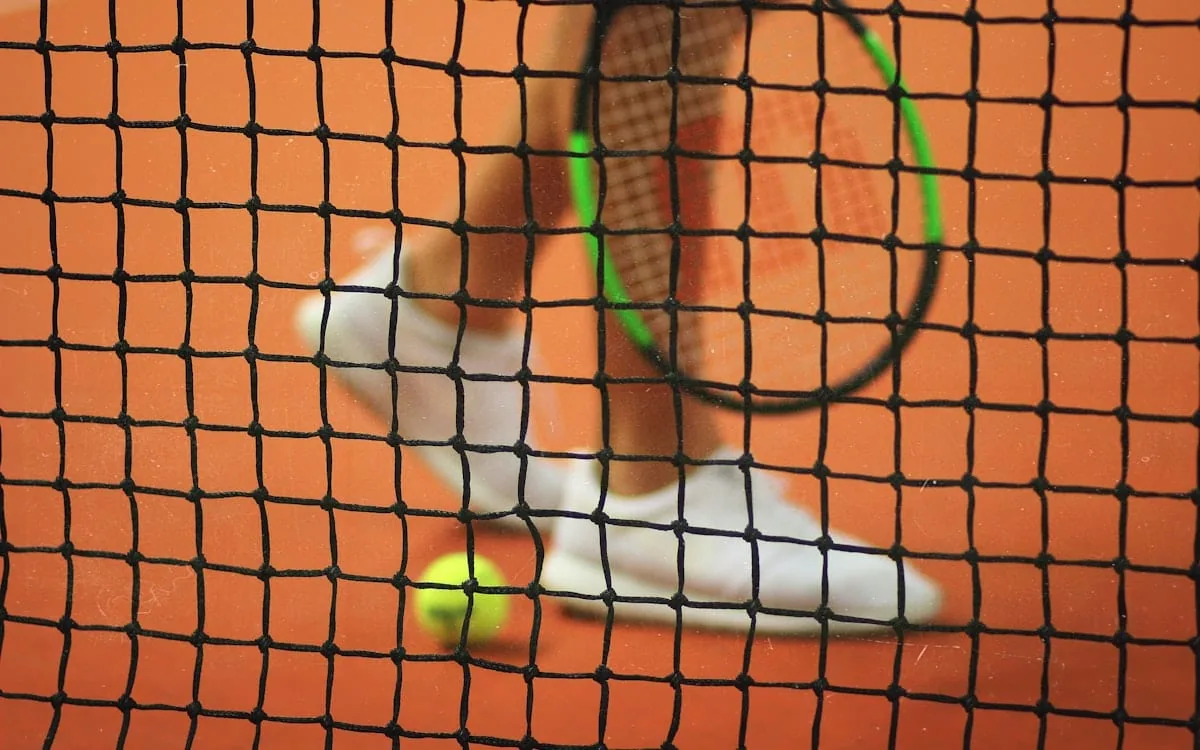
Photo: a ball on clay seen through the net, from our picture library.