Somewhere this morning there is a tennis ball sitting in a small cardboard box on a shelf, bought for three pounds, and somewhere else there is a silver cup in a climate-controlled room that changed hands for 357,546 dollars. Both of those are tennis collections. Nobody ever tells you that the same hobby stretches that far, which is probably why so few fans ever start one.
October is the month it tends to occur to people. The season is in its last act: the men finish in Beijing and Tokyo this week, Shanghai starts on Tuesday, Wuhan follows, and then the sport disappears indoors for six weeks of European arenas before going quiet entirely. You spend more evenings at home. You start noticing the blank wall behind the television. And at some point you think, idly, that it would be quite nice to own something from all this.
So here is the honest version: what exists, what it costs, what is a trap, and how to look after it once you have it.
Tennis arrived late to its own memorabilia market
If you have ever glanced at what baseball cards or football shirts do at auction and assumed tennis works the same way, it does not, and the reason is structural.
Baseball has been printing cards since the nineteenth century and has had an organised collectors market for roughly seventy years. Football clubs have been selling replica kit since the 1970s. Tennis has no clubs, no squads and no season-long shirt. It has individuals who travel, who change sponsors, and whose equipment goes back in the bag at the end of the week. For most of its history there was simply no apparatus for turning any of that into objects a fan could own.
The card market tells the story cleanly. There was a company called NetPro that produced tennis sets in the 1990s, stopped, and came back in 2003 after a gap of almost a decade. Then there was a long near-silence. It was not until 2021, when Topps and Fanatics decided tennis was worth their attention and signed up something in the region of three hundred players, that the sport had a proper, continuous card programme for the first time.
That lateness is the good news. A market that only properly woke up five years ago is a market where the entry level is still genuinely cheap, where plenty of serious material is still sitting in attics unrecognised, and where you are not competing with eighty years of accumulated expertise. You have missed nothing important. Almost nobody has.
The tier that costs less than lunch
Start at the bottom, because the bottom of tennis collecting is unusually good.
Grand Slam tournaments produce an enormous volume of physical material every year and sell a surprising amount of it. Wimbledon gets through something close to 55,000 balls across the fortnight. Balls that are no longer fit for play do not get thrown away: they go into little presentation boxes and are sold on site for charity, at around three pounds a ball, or four for a can of three. That is a ball that was struck in a professional match, at a Grand Slam, in a year you can name, for less than the price of a coffee and a pastry.
The towels are the other famous one. The All England Club has them made in enormous quantity, in the region of 99,500 a year in various sizes, and the great majority are sold to the public rather than used on court. A player-style towel runs to around forty dollars. There is now even a bathrobe made from recycled towels of previous years, which is either charming or slightly odd depending on your temperament.
Caps, bottles, tote bags and the rest sit in the same bracket. None of it will ever be worth money. That is not the point. The point is that it is real, it is dated, and it came from the place. A shelf of ten balls from ten different years is a more interesting object than almost anything you could buy for the same total outlay, and if you want it to look like a collection rather than clutter, a simple acrylic display cube per ball does more work than you would expect.
Paper is the part everyone overlooks
Here is the tier that serious collectors quietly rate and casual ones ignore completely.
Every tournament prints things. The official programme. The daily order of play. The draw sheet. Accreditation passes. Ticket stubs, back when tickets were physical. Press notes. Almost all of it gets binned on the day, which is exactly why a complete, clean example of any of it from a famous afternoon is scarce in a way that a mass-produced towel never will be.
The order of play is the sleeper. It is a single sheet of paper, usually free, that lists exactly who was playing where and when on a specific day. If that day happens to be the one where a nineteen-year-old won a match nobody expected, you are holding the only document that proves the ordinary morning before it. Fans who were there have them. Fans who were not can usually buy them for very little.
Programmes from finals, especially finals that turned out to matter, hold value better than most things at the cheap end. So do signed menus, scorecards and anything with a venue stamp. The trick with all of it is that paper is fragile in ways metal and wood are not: it yellows, it foxes, it absorbs whatever is in the air. Keeping sheets in acid-free archival sleeves is the difference between an artefact and a stained piece of rubbish in fifteen years, and anything that goes on a wall wants a UV-filtering frame rather than ordinary glass, because sunlight eats ink faster than anyone believes until it has happened to them.
Cards, and the year tennis suddenly got expensive
Then there is the middle tier, which is where the numbers stop being gentle.
Modern tennis cards behave like any other card market: a base card of a famous player costs a few pounds, and the money lives entirely in autographs, numbered parallels, grading and scarcity. A 2025 Topps Chrome Alcaraz gold autograph numbered to fifty has sold for a few hundred dollars. A graded gold refractor autograph from the year before went for a little over 1,700. Those are real prices for real objects that a normal person could decide to buy.
And then there is the top of the market, which went somewhere nobody expected. A one-of-one Carlos Alcaraz autographed rookie card from the 2022 NetPro Golden Slam set sold for 237,907 dollars. The sale it displaced was also an Alcaraz: a one-of-one 2024 Topps Royalty card with a piece of racket knob embedded in it, which made 222,000. The highest figure in the sport belongs to Serena Williams, whose 2003 NetPro rookie patch autograph, graded PSA 8 with a perfect autograph grade and carrying swatches of match-worn clothing, sold for 266,400 dollars in 2022 and set the record for the most expensive trading card of any sportswoman.
What those three sales have in common is that they are all effectively unique objects dressed up as cards. The lesson for anyone starting out is not to chase that end of it. It is to understand that condition is nearly everything in cards, that an ungraded card and the same card in a sealed grading slab are different products at different prices, and that the cheapest insurance you will ever buy is a packet of penny sleeves and toploaders before anything goes in a drawer.
Rackets: the price of a very good car
Above cards sit the objects that were actually on court.
The record for a tennis racket at auction belongs to the Babolat that Carlos Alcaraz used to win the 2023 Wimbledon final, which sold for 173,000 dollars. The racket it overtook was the one Rafael Nadal used at Roland Garros in 2017, sold for 157,300 in June 2025. Earlier, Nadal had a racket from the 2007 Roland Garros final go for 118,206, and Andy Murray had one from his 2013 Wimbledon title make around 73,000. The Billie Jean King racket from the Battle of the Sexes reached 125,000, which, given what that afternoon did to the sport and to a fair bit of the world beyond it, reads like a bargain.
The outlier among racket sales is not really a sale at all but a clearing-out. In 2021 Roger Federer put his career through Christie's: a live sale in London covering his Grand Slam years, then an online sale of three hundred lots covering everything else across twenty-one seasons. The estimate for the whole thing was about a million dollars. It made more than 4.7 million, every single lot sold, and the proceeds went to his foundation. A set of three rackets from the 2019 Wimbledon final made 224,898 dollars against an estimate of around ten to fourteen thousand. His Roland Garros 2009 champion outfit and racket, and his 2007 Wimbledon equivalent, each cleared 150,000 pounds.
What that auction proved was not that Federer is beloved, which everyone knew, but that there was an enormous unmet appetite for genuine, documented, player-used tennis equipment and almost no supply of it. Five years on, that is still roughly the situation.
The trophy that was never supposed to be for sale
The most startling tennis sale of the last year was not a racket at all.
In April this year, the trophy Boris Becker won at the 1989 US Open, beating Ivan Lendl in the final for the fourth of his six Grand Slam titles, sold for 357,546 dollars. It was made by Tiffany and Co. It had been on loan to the International Tennis Hall of Fame in Newport, Rhode Island, where thousands of visitors had seen it sitting behind glass with his name on it. It became the most expensive tennis championship trophy ever sold at auction, largely because it is about the only one that has ever been sold at all.
The reason it was available is not a happy one. Becker was declared bankrupt in 2017, and the sale sits at the end of a long and public financial unravelling. We wrote about that sale when it happened, in the story of Becker selling his 1989 US Open trophy, and the detail that stayed with most readers was that the cup fetched considerably more than he had earned for winning the tournament in the first place.
For a collector, the Becker trophy is useful mainly as a boundary marker. Grand Slam winners do not sell their trophies. Governing bodies do not release them. The only route to one runs through somebody having a very bad decade. If you ever see a championship trophy offered casually, the overwhelming likelihood is that it is a replica, a runner-up plate, or a fake, and we have written separately about what tennis trophies actually are and who keeps them.
How not to get burned
The unglamorous section, and the one worth reading twice.
Signatures are where most money gets wasted. An autograph with no documented chain of custody is worth, functionally, nothing, however convincing it looks, because you can never prove it to the next person. There are two routes that work. The first is to get it yourself: at a qualifying week, a practice session, an open day, where you watched the pen touch the paper. The second is to buy only material certified by a recognised authenticator, with the certification number intact and checkable. Anything else, including the vague reassurance that it came from a reputable dealer, is a story rather than evidence.
Three more rules worth internalising. Match-used is not the same as player-issue; a racket made to a player specification that never saw a match is a different object from the one that did, and the gap in price should be enormous. Photo-matching, where a specific object is identified in a specific photograph by its own markings, is the strongest proof available and worth paying for. And limited editions sold by the thousand are merchandise, not scarcity, no matter how ornate the certificate in the box.
If you want the entry-level version of all this: buy cheap things with verifiable origins rather than expensive things with lovely stories. A three pound ball with an official tournament box is a more honest object than a signed photograph from an unknown source at fifty times the price.
Living with it, which is most of it
Owning is about ten per cent of collecting. The rest is storage, and tennis material is unusually vulnerable because so much of it is natural fibre, old varnish and printed paper.
Three things do the damage: light, damp and handling. Light fades painted racket throats and bleaches paper, which is why anything on display wants filtered glass and why direct sun through a window is the single worst place in any house. Damp warps wooden frames and foxes paper, so a cheap hygrometer and a few silica gel desiccant packs in a closed cabinet are a genuine intervention rather than fussiness. Handling transfers skin oils onto exactly the surfaces that matter, which is why people who look serious wear cotton inspection gloves and are not, in fact, being precious.
Displaying beats boxing, as long as it is done properly. Rackets look extraordinary on a wall and terrible in a cupboard, and a pair of wall-mount display brackets turns a shelf problem into a feature. Smaller pieces want a glass-fronted cabinet, which solves dust and handling in one purchase. If you are building a room around this, we went through the whole business of arranging one in our guide to the tennis room at home for the indoor season.
If you are only ever going to buy one thing
Buy the thing attached to a day you actually remember.
Not the most expensive item you can stretch to. Not the player everyone agrees is the greatest. The match you watched on a laptop in an airport, or stayed up for at four in the morning, or saw from the back row of a court with no roof. A ball from that fortnight. The order of play from that Tuesday. A programme with that name misspelled in the draw. It will cost very little and it will be the only object in the house that means precisely nothing to a valuer and a great deal to you.
For almost everyone, that is where this ends up anyway: not an investment portfolio but a small, specific, slightly eccentric archive of the hours you gave to the sport. The money at the top of the market is a curiosity. The three pound ball is the actual hobby. If you want the reading to go with it, our list of the best tennis books ever written is a reasonable second shelf.
Shanghai begins on Tuesday. Somebody will do something in the second week that you will still be describing to people in five years. Whoever is in the building that day will walk out with a creased sheet of paper in their pocket listing the order of play, and in a decade it will be the rarest thing either of you owns.
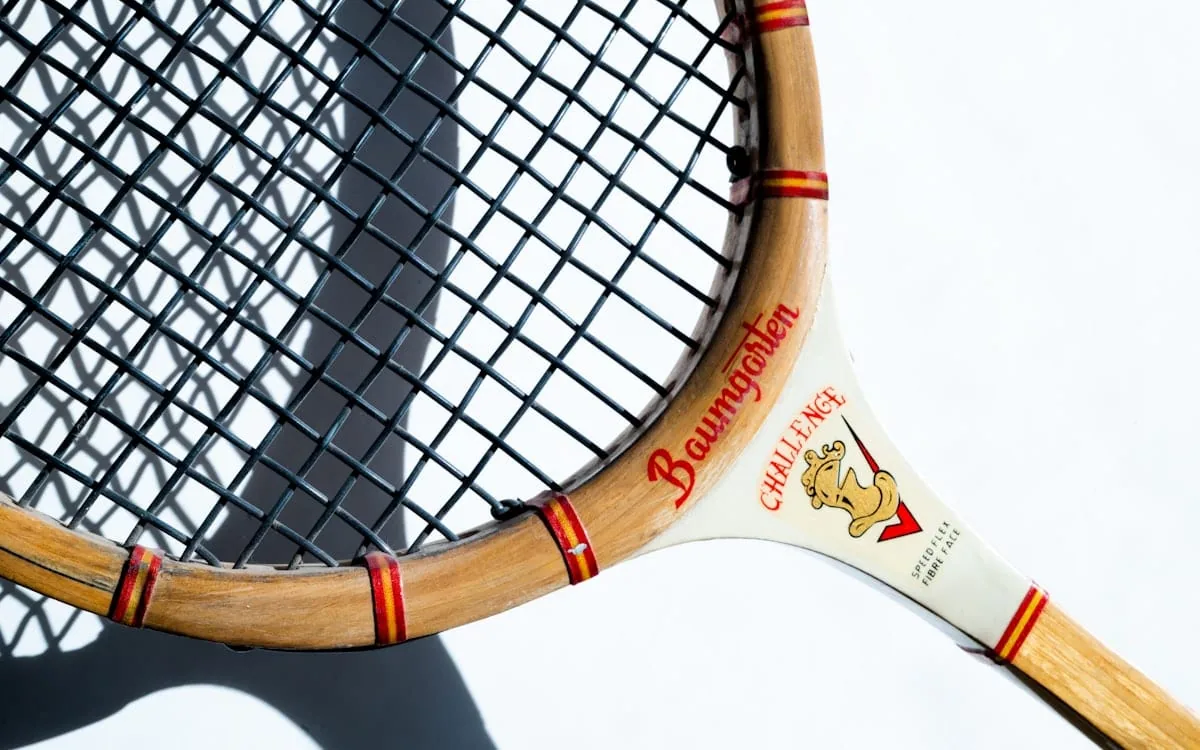
Photo: a vintage wooden racket on a plain background, from our picture library.
🎾 Gear from this story
BabolatBabolat Pure AeroCarlos Alcaraz's racket of choiceView on Amazon →As an Amazon Associate, SUPER.TENNIS earns from qualifying purchases.