Sometime in the next ten days you are going to watch a tennis match in your own home at an hour that makes very little sense, and the room you watch it in will be exactly as you left it in June: the same lamp in the wrong place, the same cushion you have been meaning to replace, the sound coming out of a television that was designed by people who assumed nobody would ever want to hear a ball being struck.
This is the part of the year when that stops being a small thing. From this weekend until the last Sunday in November, tennis is almost entirely a living-room sport. There are no queues, no ground passes, no seven-hour day sessions in the sun. There is you, a screen, and a tour that has gone quietly around the world without you.
So this is a piece about the room. Not about rackets you will play with, because you probably do not play, and that is completely fine. About the objects: what to put on the wall, what to put on the shelf, what to sit under at one in the morning when a match in Shanghai turns into the best two hours of your week.
The ten weeks when tennis comes to you
Start with why the room suddenly matters.
This weekend, on 18, 19 and 20 September, the Davis Cup Qualifiers take over: fourteen nations, seven ties, home crowds who have taken a Friday off work. The following weekend, from 25 to 27 September, the Laver Cup lands at the O2 in London on its black court, with Yannick Noah on the Europe bench and Andre Agassi on the World one. Then the tour goes east. Chengdu starts on 22 September, Beijing and Tokyo follow at the end of the month, and Shanghai runs through the first half of October. After that it is Europe indoors, Turin in November, and the Davis Cup Final 8 in Bologna to finish. Our guide to the autumn run-in lays out the whole run in order.
Here is what that does to your week. Shanghai and Beijing are eight hours ahead of universal time; Tokyo is nine. A one in the afternoon match in Shanghai goes on air at six in the morning in London and one in the morning in New York. An evening session there, starting at seven, is lunchtime in Britain and breakfast on the American east coast.
Which means that for a European fan, October tennis is something you have on while you make coffee and answer emails. For an American fan, it is something you either record or get up for. Either way it is domestic. It happens in your kitchen and your living room, in the dark or in the early light, with the volume low. Ten weeks of that is a lot of hours in one room, and almost none of us have ever spent ten minutes thinking about what that room is like.
The good news is that tennis is an unusually beautiful sport to decorate with. It has had a century of graphic design, its own colour scheme, its own art tradition, and equipment that ages into sculpture. You do not need much. You need a few right things.
Start with one old racket
If you buy one object this autumn, buy a wooden racket.
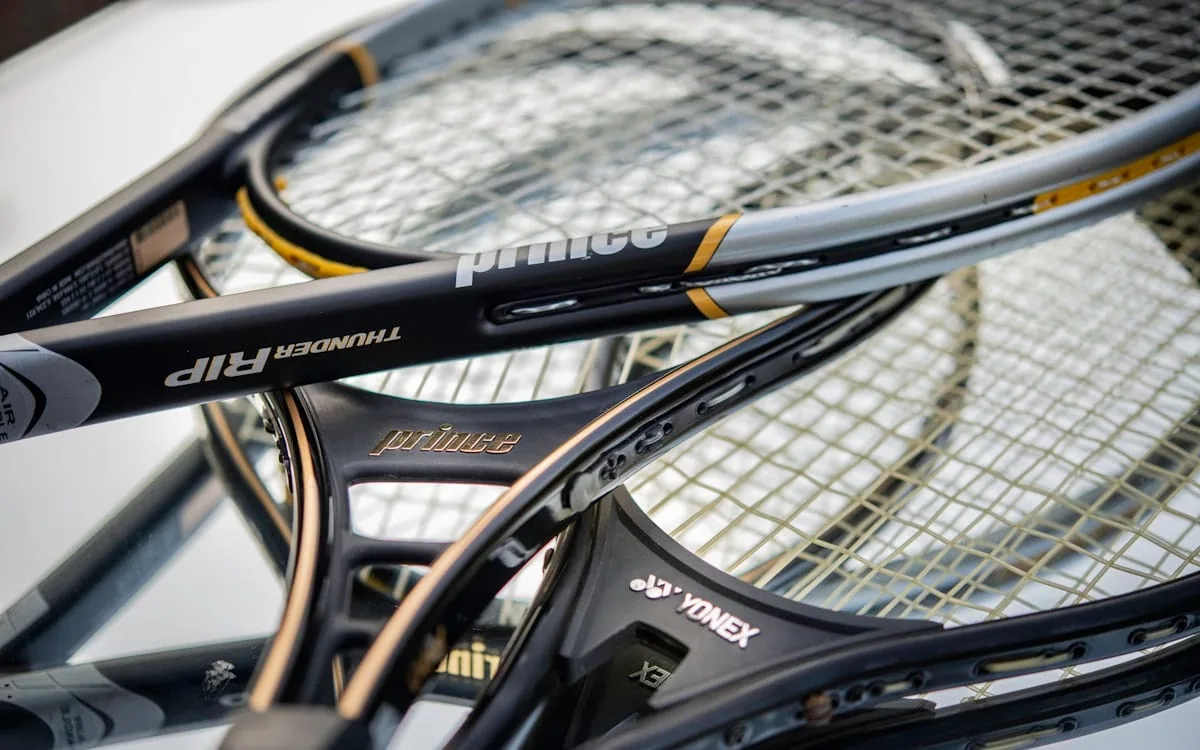
Not to hit with. A wooden frame from the 1960s or 1970s is a genuinely lovely thing to look at: laminated strips of ash and beech pressed into a curve, a throat shaped like a keyhole, a leather grip gone dark with somebody else's hands, a name on the shaft in gold lettering. They were made in the tens of millions and then abandoned all at once, which is why they are still cheap. Junk shops, car boot sales, the back of your uncle's garage. There are plenty of vintage wooden rackets for sale online too, if you have no patience for rummaging, and honestly the battered ones look better than the pristine ones.
They also carry a proper piece of history. Wood did not fade out gently. It fell off a cliff in about five years at the end of the 1970s, when graphite arrived and everybody discovered that a lighter, stiffer frame with a bigger head made the ball do things wood could not. The last man to win a major with a wooden frame was Yannick Noah, at Roland Garros in 1983, with a wide-bodied Le Coq Sportif that had been reinforced with graphite to hold the larger head together. Chris Evert is usually credited with the last women's major won with wood, at Wimbledon in 1981.
Look at that Noah date again, then look at the calendar. The last man to win a Grand Slam with a wooden racket will be sitting on the Europe bench at the O2 in nine days, captaining a team of players who were born a decade and more after he stopped playing. Hang a wooden frame on your wall and that is what is hanging there: the exact moment the sport changed shape.
Practical notes, because this is where people go wrong. One racket is a statement, three is a collection, six is a problem. Hang it with two small picture hooks under the head rather than a single nail through the strings, put it at eye level rather than up near the ceiling, and give it a clear patch of wall. A wooden racket in a cluttered gallery wall just looks like a car boot sale. On its own, on a plain wall, it looks like it was chosen.
The sport already makes its own art
Tennis has the best posters in sport, and hardly anyone puts them up.
Every year since 1980, the French federation has commissioned a different artist to make the official Roland Garros poster and given them near-total freedom with it. The first was by the Italian painter Valerio Adami, and the series since has run through Eduardo Arroyo, Joan Miro, Antoni Tapies and dozens more. This year the poster came from the French photographer JR, who built a collage that turns the clay of Philippe Chatrier into an eye. These are not sports prints with a scoreline on them. They are gallery posters that happen to be about a tennis tournament, and they look completely at home in a room where nobody plays tennis at all.
Wimbledon gives you the other half of the palette. The All England Club settled on its dark green and purple in 1909, apparently because the previous colours were a bit too close to the Royal Marines, and it has kept them so consistently since that in 2016 the club managed to trademark the combination outright. That is the rare sporting colour scheme that works as decorating advice: deep green and a bruised purple, against cream, in a room with wooden floors.
You can lean into that without buying anything branded. A dark green wall in an alcove. A purple throw on a grey sofa. One large framed poster instead of five small ones, because the single biggest improvement most walls can make is fewer, larger objects. Buy decent poster frames rather than expensive art: a good frame with a wide mount makes a cheap print look deliberate, and a bad frame makes an expensive one look like a pub.
One more piece of free design history for the shelf. Tennis balls were white for the first century of the sport. The switch to optic yellow was approved by the International Tennis Federation in 1972, largely because colour television had arrived and white balls disappeared against pale courts and chalk lines. Wimbledon, being Wimbledon, held out with white until 1986. That yellow, which now reads instantly as tennis to everyone alive, is a television invention less than fifty years old. It is also, conveniently, the only accent colour your room needs.
A shelf that is not just a shelf
Tennis writing is much better than it has any right to be, largely because the sport is so lonely and so long that it turns players into odd, interesting people who eventually explain themselves in print. A short shelf of the good stuff is worth more than a long shelf of the rest, and our list of the best tennis books ever written is the place to start if you want the canon.
For the room specifically, though, think about the big photography books. Tennis photography has an advantage most sports photography does not: one person, in strong light, against a flat plane of colour, doing something violent with perfect posture. A tennis photography book left out on a low table does the same work as a picture on the wall, at a quarter of the commitment, and it gives people something to pick up while you are getting the drinks.
Stack them flat rather than upright, two or three at most, and put something on top: a ball, a small bowl, a coaster. An upright row of spines is a library. A flat stack with an object on it is a room somebody lives in.
The sofa is equipment
Here is the part nobody sells you, because there is no brand attached to it: the single biggest upgrade to autumn tennis watching is being comfortable at the right temperature with the right amount of light.
Evening tennis indoors is a low, warm, dim sort of thing. The arena on screen is dark with a lit court in the middle of it, and if your own room is flooded with overhead white light you are fighting the picture the whole time. Kill the big light. One lamp behind you, one across the room, warm dimmable bulbs in both, and the screen stops feeling like a window and starts feeling like a stage.
Then the blanket. Genuinely. October and November tennis is watched by people who are slightly too cold and too stubborn to put the heating on, often at an hour when the house has gone cold anyway, and a heavy wool throw over your knees turns a three-hour match from an endurance test into the best part of the day. Get one that is big enough to share and dark enough to survive being sat on. The tennis room is not a museum. It is a place where you fall asleep in the fourth set.
Watching at three in the morning without waking the house
Now the specific problem of the next six weeks: the good matches are on at ridiculous hours, and you live with other people.
Headphones solve almost all of it. A pair of over-ear wireless headphones does something unexpected to tennis, which is that it puts you much closer to the sound of the sport than any speaker will. The strings, the shoe squeak, the grunt cut off mid-breath, the half second of silence before a crowd decides a ball was in. Commentary at a whisper, ball strike at full volume, nobody upstairs any the wiser. It is the closest thing to a courtside seat that exists in a house.
The second problem is knowing when anything is actually on. Tournament schedules are published in local time, which for the next six weeks means a time zone you do not live in, and there is a particular misery in setting an alarm for a match that finished two hours earlier. A small dual time zone clock on the shelf, set to Shanghai or Tokyo, sounds like an affectation until the first time it saves you. It is also a quietly pleasing object to own during a swing that lasts until the end of October.
Third, the coffee question. If you are getting up at one in the morning on the American east coast to watch a quarterfinal in Beijing, do not make a full pot and do not make it strong. You want something warm to hold, not a chemical decision you will regret at nine. An insulated french press made at half strength, or tea, keeps its heat through a long third set without committing you to being awake until dawn. And if the match is dreadful, go back to bed. The highlights will be there.
On the nights when there is nothing on at all, which do happen even now, this is the season for the back catalogue. Our round-up of the best tennis films and documentaries exists precisely for a wet Tuesday in November with no live tennis in any time zone.
One glass, not a cupboard of them
The last object, and the one most likely to get out of hand: the drink.
You do not need tennis-branded glassware. Nobody needs a tumbler with a racket etched on it. What is worth having is one set of tall highball glasses, because almost every good tennis drink is a tall drink over a lot of ice, and because a proper glass is the cheapest way to make an ordinary Tuesday night feel like an occasion.
If you want the full ceremony, the Honey Deuce is the obvious one, and it is easy enough to make at home that the US Open sells hundreds of thousands of them a fortnight at a price that should embarrass everybody. The frozen melon balls are not optional, incidentally. They are the whole trick: they look like tennis balls in the glass and they keep the drink cold without watering it down.
What not to buy
A short list, offered in the spirit of saving you money.
Do not buy anything with a motivational slogan and a racket on it. Do not buy a framed replica shirt unless you genuinely loved the player who wore it, because a framed shirt is a commitment for a decade. Do not buy the ball-shaped version of an object that already exists in a normal shape: the ball-shaped lamp, the ball-shaped cushion, the ball-shaped storage box. Do not buy a net for your wall.
And do not do the whole room at once. A tennis room assembled in one weekend from one website looks like a themed bar. The good ones happen slowly: a racket found in a junk shop in March, a poster from a tournament you actually went to, a book somebody gave you, a glass that survived a party. One object a year is plenty.
The room keeps the season
There is a thing that happens if you let a room collect tennis slowly, and it takes a couple of years to show up.
The objects stop being decoration and start being a record. The racket on the wall is the one you bought the summer you started watching properly. The poster is the year you were actually there, in the rain, on a ground pass. The blanket is the one that was over you when a match you had never expected to care about went to a fifth set at two in the morning and you found yourself standing up in your own living room with your hands on your head.
That is what this autumn is for. Ten weeks of tennis played eight time zones away, largely ignored by everybody who only watches the Slams, arriving in your house at odd hours in low light. The season will end in Bologna in November, the lights will go off, and the sport will disappear for five weeks. The room will still be there in January when the first balls are struck in Melbourne, holding everything that happened in it.
Photo: a stack of well used rackets, the frames and strings of a sport that ages into decoration.


