At a little after five on Sunday morning, in a country most tennis fans could not find quickly on a map, there will be people sitting in the dark with the television on. Asuncion is twelve hours behind Tokyo. The quarterfinal that matters to them starts in the late afternoon in Japan, which means it starts before dawn in Paraguay, which means somebody somewhere has set an alarm for a tennis match for the first time in roughly twenty years.
The player they are getting up for is called Adolfo Daniel Vallejo. Everyone shortens it to Dani. He is 22, he came through qualifying, he is not seeded, he was not on anybody's list of names to watch this week, and on Saturday he became the first Paraguayan ever to reach the last eight of an ATP 500 event. He did it by beating Matteo Berrettini, a man who has played in a Wimbledon final.
If you have never had a reason to care about Paraguayan tennis before, this is a good week to start, because the story behind that one result is much better than the result itself.
Two matches nobody had marked on the schedule
Start with what actually happened in Tokyo, because the details are what make it.
Vallejo did not get a free pass into the main draw. He played qualifying, won his way through, and landed in the first round against Rafael Jodar, the young Spaniard who has been one of the loudest stories of the autumn, fresh off the run that made his name in Japan. On paper it was the Spaniard's match. Vallejo won it 6-1, 6-3, and Jodar did not hit a single ace in the entire thing. That is not a scoreline you get by hanging on. That is a scoreline you get by taking somebody's serve apart and refusing to give anything back.
Then came Berrettini in the second round. They had never played each other. Berrettini served, as Berrettini does, and for an hour it looked like the obvious thing was going to happen: the Italian had four set points in the opening set, three of them in a row inside the tiebreak, and could not convert one of them. Vallejo took the breaker 8-6. And then, in the way that sometimes happens when a big man loses a set he was sure he had, the match fell over completely. The second set went 6-1 to the Paraguayan. One hour and 46 minutes, and a qualifier ranked in the mid-fifties was in a quarterfinal.
The live rankings had him projected up into the low fifties by the time he walked off. That is a detail only a certain kind of fan enjoys, but it is the mechanism by which lives change in this sport: one good week, and the numbers that decide whether you fly economy to Challengers in Brazil or get into Grand Slam main draws automatically shift under your feet.
It is worth spelling out what that shift buys, because it is not vanity. A ranking in the low fifties means direct acceptance into the main draw of every Grand Slam without playing a qualifying event first. It means arriving at a major on the Saturday instead of the Tuesday before, rested, with three fewer matches in your legs. It means being seeded at Challengers rather than drawing the tournament favourite in the first round, and it means tournaments start covering your flights and your hotel rather than you covering theirs. For a player from a country with no direct flights anywhere, that last part is not a small administrative detail. It is the difference between a season that pays for itself and a season his family pays for.
He plays Jiri Lehecka next, the Czech ranked 23 in the world, who is the heaviest hitter left in a draw that has gone strange. Carlos Alcaraz, the defending champion, is still in it. So is Valentin Vacherot. Almost nobody else who was seeded survived the week. That is the thing about a draw coming apart: somebody has to walk through the gap, and this week it was the man from Asuncion.
The boy who kept having to leave
Vallejo was born in Asuncion on 28 April 2004, the youngest of three boys. His father Gustavo and his two older brothers were the first people to decide, out loud, that the small one might actually be able to do this for a living, which in Paraguay is a slightly eccentric thing to decide.
At 14 he left for the IMG Academy in Florida on a one-year scholarship. That is young to move continents for a sport, and it is the age at which most families in most countries quietly conclude that the whole thing has gone far enough. His did not. By 2021 he had won the Orange Bowl, the junior tournament in Florida that has been producing future professionals since the 1940s. On 15 August 2022 he became the world number one junior, and a scholarship to the Rafa Nadal Academy in Mallorca followed.
Hold that date for a second: 2022. Because thirty years earlier, in 1992, another Paraguayan was the world number one junior. Her name was Rossana de los Rios, she won the junior title at Roland Garros that year, and she went on to a professional career that ran from 1989 all the way to 2010, peaking at number 51 in the world and a fourth round in Paris in 2000. Two junior world number ones in the history of a country of fewer than seven million people, three decades apart. For a nation with no tennis tradition to speak of, that is a strange and rather lovely statistic.
Why being a Paraguayan tennis player is partly a logistics problem
Vallejo has been blunt about the specific, boring obstacles, and they are worth repeating because they explain why so few players come out of places like this.
The airport in Asuncion is small. There are no direct flights to the places a young professional needs to be. Getting to the United States means two or three connections, which means a day and a half of travel, which means money and fatigue before a single ball is struck. Multiply that by a season of 25 tournaments and you have a structural disadvantage that no amount of talent quite erases.
Then there is the part that is harder to fix. The mentality at home, as he has described it, is simply not to go pro. Nobody tells you it is impossible. They just do not tell you it is possible, which produces the same result. Football owns the country. Tennis is a club sport for people who can afford a club. The idea that a kid from Asuncion might end up ranked inside the top sixty in the world is not a thing anyone has had recent evidence for.
Compare that to the countries that have built tennis on purpose. Italy spent two decades and a great deal of federation money constructing the system that now produces top-ten players in both draws. Kazakhstan went further still, recruiting and funding a tennis nation into existence inside a decade. Paraguay has done neither. Vallejo is not the output of a programme. He is one family, one stubborn kid, a scholarship, and a lot of connecting flights.
Pecci, Delgado, and the long quiet
Here is the history he is walking into, and it is shorter than you would think but far better than you would expect.
In 1979, a tall, elegant Paraguayan called Victor Pecci arrived at Roland Garros and simply would not go away. He beat Guillermo Vilas in the quarterfinals. He beat Jimmy Connors in the semifinals. In the final he ran into Bjorn Borg at the absolute height of his powers and lost 6-3, 6-1, 6-7, 6-4, taking a set off the greatest clay-court player the game had seen. The following March he was ranked number nine in the world. It remains the only Grand Slam singles final any Paraguayan has reached.
Then, nineteen years later, Ramon Delgado. Second round, Roland Garros, 1998, against the world number one. Delgado beat Pete Sampras 7-6, 6-3, 6-4. Sampras later wrote that the defeat was the moment he understood he was never going to win the French Open. Delgado got as high as 52 in the world in April 1999. His last win in a Grand Slam main draw came at the 2003 US Open.
And then nothing. For two decades, Paraguay was a country that had once had tennis players. No one from there was inside the top 100 after 2005. A generation of Paraguayan children grew up without ever seeing one of their own in a main draw on television. Vallejo is only the third Paraguayan man in the history of the ATP rankings to get into the top 100 at all, and the first since the year he turned one.
Paris in May, and a round that had waited 23 years
The first crack in the quiet came this May, and it came in the least satisfying way imaginable, which somehow made it more memorable.
Vallejo made his Grand Slam main-draw debut at Roland Garros. He drew Cameron Norrie, a former Wimbledon semifinalist, exactly the kind of grinder who eats nervous debutants for lunch. Vallejo won the first set in a tiebreak, 7-6, and had gone 2-0 up in the second when Norrie retired.
It is not the way anyone dreams of it. There is no final forehand, no collapse on the clay, no handshake at the net with the crowd standing. But the record books do not have a column for how it ended, and what it says is this: for the first time since Ramon Delgado at the 2003 US Open, 23 years earlier, a Paraguayan had won a round at a Grand Slam. He lost in the second round, but by then the point had been made. He had also reached the final qualifying round in Melbourne in January and played the first round at Wimbledon in the summer. One season, three majors, a country back on the board.
If that trajectory sounds familiar, it should. South America has been quietly reloading for a few years now, most visibly through Joao Fonseca and the Brazilian revival, and the continent has a habit of producing players who are made on clay and then turn out to be much more dangerous than that on everything else.
The weekend in Lima that still hurts
Two and a half weeks before Tokyo, Vallejo was in a very different kind of pressure.
Paraguay travelled to the Jockey Club in Lima on 18 and 19 September for a Davis Cup World Group I tie against Peru, with a place in next year's Qualifiers at stake. Peru had the better team on paper and the crowd in the building. By the fourth rubber, Paraguay were 2-1 down and it was on Vallejo to keep the tie alive against Ignacio Buse, ranked 35 in the world and more than twenty places above him.
He won it 7-5, 5-7, 7-6. Three sets, a deciding tiebreak, a hostile room, a whole country level at 2-2 because of him.
And then Paraguay lost the fifth rubber. Juan Pablo Varillas beat Hernando Escurra 6-2, 6-4, and Peru went through 3-2. Vallejo had done everything a team can ask of a number one and it had not been enough, which is the particular cruelty of Davis Cup for players from small nations. Argentina can lose a singles match and shrug. Paraguay cannot. When your country has one top-100 player, every tie comes down to whether he can win two matches and whether somebody else can win one.
He made his Davis Cup debut in 2019, by the way. He was 15 years old. His record for Paraguay now stands at five wins and three losses, which for a player who has barely had a professional career yet tells you how long he has been carrying this.
A clay player teaching himself to live on hard courts
The tennis itself is South American to its bones. Right-handed, two-handed backhand, heavy topspin forehand, outstanding movement, the kind of player who is happy to stay in a rally for eighteen shots because he is confident the other man will crack first. Everything good that has happened to him in his career happened on clay. Five Challenger titles so far, most of them on red dirt: Guayaquil and Curitiba in 2025, Concepcion earlier this year where he beat Alejandro Tabilo 6-2, 1-6, 6-1, plus another final in Brasilia. In 2024 he became the youngest Paraguayan ever to win a Challenger.
Which is exactly what makes this week strange. Tokyo is a fast indoor-feeling hard court at the end of a long season, and it is precisely the surface where clay-raised players are supposed to run out of answers. The Berrettini serve should have been unplayable on it. Instead the Paraguayan returned well enough to drag the first set into a tiebreak, and then calm enough to win the three points that mattered most in it.
By his own telling, he has been working on the forehand specifically, on getting more racquet-head speed through the ball, which is the single adjustment that turns a solid clay-court game into something that can hurt people on hard courts too. He has spoken about wanting to keep breaking records for his country, which is the sort of line that sounds like press-conference filler until you notice that he has broken one roughly every six months for two years.
What Sunday actually is
Lehecka is a difficult draw. He hits the ball harder than anyone Vallejo has faced this week, he is twenty-plus places higher in the rankings, and he has the kind of flat power that does not care what surface you grew up on. If Vallejo loses, he still leaves Tokyo with the best week of his life, a ranking in the low fifties, and a result nobody from his country has ever had.
But that is not really what Sunday morning in Asuncion is about.
There is a thing that happens in countries with no sporting tradition in a particular sport, and it happens exactly once per generation. A kid who should not have been able to do this does it anyway, on television, in a tournament the whole world is watching, and in the week afterwards the municipal courts fill up with children who had never previously considered that the game was for them. Pecci did it in 1979, and in a country that size a Roland Garros final does not stay a sports result for long; it becomes a shared memory that people date other things by. Delgado did it in 1998. Then the signal went dead for two decades.
Vallejo did not come through a system. He came through three flights, a scholarship, a father who did not laugh, and a set of mornings on a court in Asuncion that nobody was filming. The system is what might come next, if a federation somewhere is paying attention.
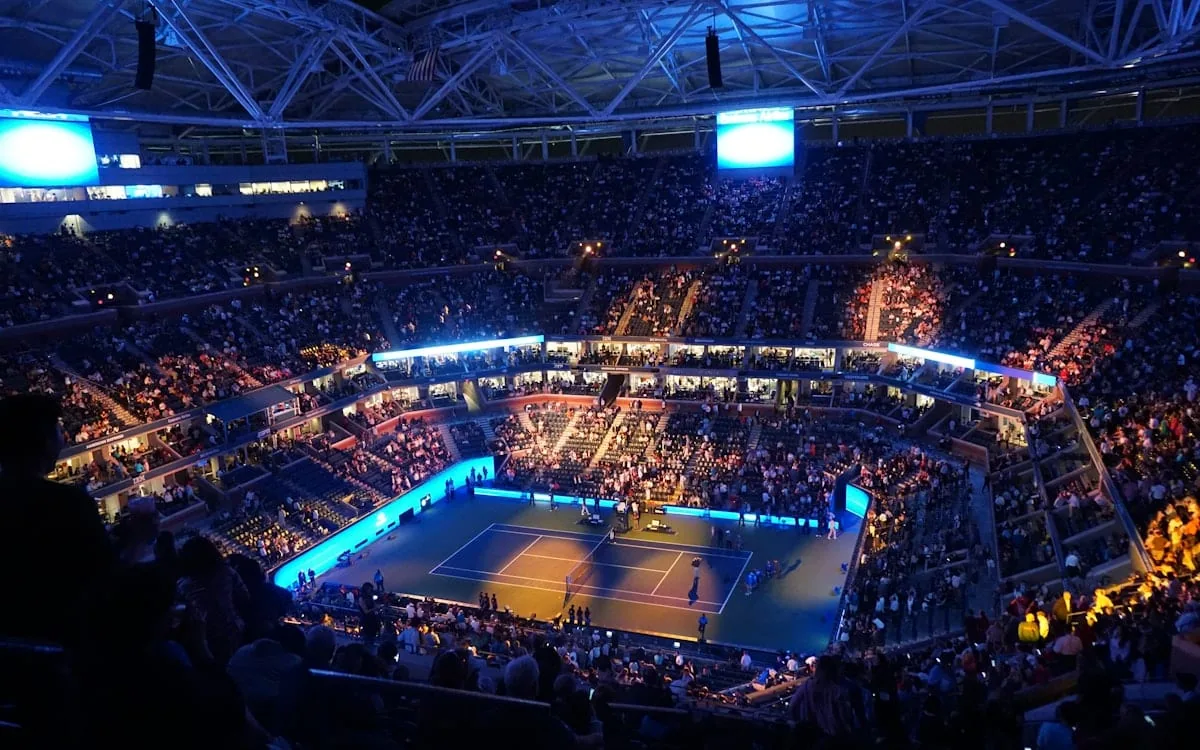
Twelve hours ahead, in a half-empty stadium in Tokyo, none of that will be visible. There will be a 22-year-old in the corner with a towel over his head, and a scoreboard, and a Czech on the other side who intends to end this. In Asuncion it will still be dark.
Photo: public hard courts, from our picture library.
🎾 Gear from this story
WilsonWilson Pro Staff 85Pete Sampras's racket of choiceView on Amazon →As an Amazon Associate, SUPER.TENNIS earns from qualifying purchases.