Three weeks from now, on a Wednesday night in Riyadh, six of the best tennis players alive will walk into an arena to play matches that count for absolutely nothing, and you will almost certainly watch at least one of them.
Right now the sport is somewhere else entirely. The men are in Tokyo and Beijing until Tuesday, the women in Beijing until 11 October, and if you follow tennis from a sofa in Europe or the Americas you are currently either setting alarms or giving up and reading the scores over breakfast. Then Shanghai takes over for a fortnight. And then, on 21 October, the season stops for three nights and does something that has no equivalent anywhere else in the sport.
The Six Kings Slam is not a tournament. It has no ranking points, no qualifying, no history, no governing body and no record book that will remember it. It is an exhibition. It is also, by some distance, the richest three nights of tennis ever played, and the fact that it exists at all tells you more about where the sport is heading than anything that happens in Shanghai.
Here is what it is, who is going, what they are paid, and why the whole thing is worth twenty minutes of your attention even if you decide you disapprove of it.
Three nights, six men, one knockout bracket
The format is almost insultingly simple, which is part of the appeal.
Six players. The two highest ranked get a bye straight to the semi-finals. The other four play quarter-finals on the opening night. Semi-finals the next night, a rest day, then the final. That is the whole event: five matches across three sessions, no doubles, no early rounds, nobody you have never heard of.
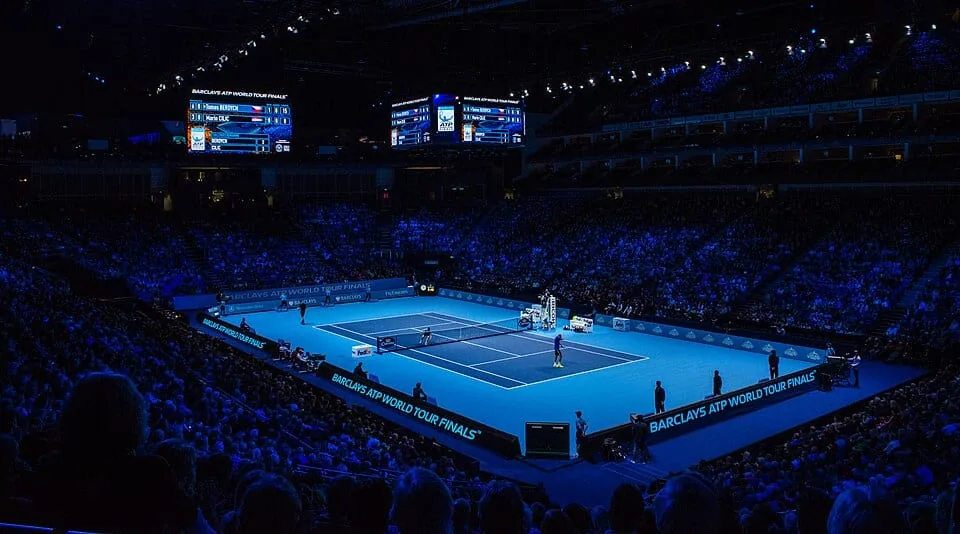
This year it runs on 21, 22 and 24 October at the ANB Arena in Riyadh, with 23 October as a rest day, as part of the Riyadh Season entertainment programme that also books boxing, concerts and football. The field is Jannik Sinner, who has won both previous editions, Carlos Alcaraz, Novak Djokovic, Alexander Zverev, Taylor Fritz and Alex de Minaur, the only debutant in the six.
Compare that with a normal week on tour, where the top seeds arrive on different days, half of them lose to somebody ranked 60th before you have worked out the schedule, and the final is on a Sunday when you are doing something else. The Six Kings Slam has removed every part of tennis that is unpredictable, inconvenient or slow. What is left is the bit people actually tune in for: the famous ones, playing each other, on consecutive nights, in prime time.
Whether that is a good thing or an alarming thing is the interesting question, and we will get there.
The money, laid out plainly
This is the part that makes people sit up, so let us be precise about it.
Every player who turns up is paid a guaranteed appearance fee of 1.5 million dollars. Not for winning. For arriving, warming up and playing one match. The champion collects a further 4.5 million on top, which takes the winner to 6 million dollars for a maximum of three matches over four days. The total pot in recent editions has sat at 13.5 million dollars.
Now put that next to the real thing. The 2026 US Open paid its singles champions 5.5 million dollars each, the largest single payday in the history of the sport, out of a total player compensation pool of 108 million dollars, the first time any Grand Slam has gone past nine figures. To earn that 5.5 million you have to win seven matches in a fortnight in New York heat, against anyone the draw gives you, with a nation watching.
To earn 6 million in Riyadh you have to win three.
When Jannik Sinner won the first edition in 2024, his cheque was the biggest in tennis history, bigger than the 4,740,300 dollars Novak Djokovic collected for going unbeaten at the 2022 ATP Finals, and it came from an event that does not appear in his record. Nothing about that match will ever show up in a career statistic. The money was real.
Jessica Pegula, talking about it on a podcast with Madison Keys, put it about as plainly as a player can: the prize money is insane. Both of them were open about the fact that any player would take that call. It is difficult to argue with. A show-up fee of 1.5 million dollars is more than the overwhelming majority of professional tennis players earn in a career, and far more than most of the top hundred earn in a season once their costs are paid. We went through where tennis prize money actually goes earlier this year, and the short answer is that between tax, coaching, physio and travel, a headline number loses most of its weight before it reaches a bank account. An appearance fee does not. It is clean money.
The Netflix of it all
The second thing that makes this event unusual is where you will find it.
The inaugural edition in 2024 went out on DAZN, a subscription sports platform that plenty of tennis fans do not have. Since 2025 the Six Kings Slam has streamed live and exclusively on Netflix, worldwide, at no extra cost to anyone who already pays for the service. The 2026 edition does the same.
If you have spent years working out which obscure channel has the rights to a given tournament in your country, that sentence is quietly radical. No sports package. No regional blackout. No separate app. The same place you watch everything else, with more than twenty cameras, wirecams, drones, robotic rigs and augmented reality graphics layered on top, produced like an entertainment show rather than a sports broadcast.
It has been a remarkable year for tennis on that platform. In May, Netflix released Rafa, a four-part documentary series on Rafael Nadal directed by Zach Heinzerling, following the last and most painful chapter of his career, with Roger Federer and Djokovic both appearing. In June came Chris and Martina: The Final Set, a feature documentary on Chris Evert and Martina Navratilova, their rivalry and the friendship that outlived it and then carried both of them through cancer treatment. Now the live event in October, with the same six faces the streaming service has spent two years building shows around.
Netflix got into live tennis in the first place with an Alcaraz against Nadal exhibition in Las Vegas in 2024. Two years later it has a documentary slate, a live event and the biggest names in the sport under contract for three nights a year. That is not a side project any more. That is a tennis channel with no tour attached to it.
Who is in the building, and who is nowhere near it
Six men. No women. Not one.
That is not an oversight, it is the design: the event is six male players, hence the name. But the absence has become more conspicuous this year, because of what happened to the other Riyadh tennis event.
The WTA Finals, the women's season-ending championship, was played in Riyadh in 2024 and 2025 on a three-year deal with the Saudi Tennis Federation. The deal paid better than anything in the history of that event and attracted loud, sustained objections from Evert, Navratilova and John McEnroe among others. In July this year the WTA asked to move the 2026 edition elsewhere, the Saudi federation agreed, and the contract ended a year early, with reporting at the time pointing to the escalating conflict in the region. The 2026 WTA Finals will now be played at Indian Wells from 8 to 15 November, and from 2027 the event has a long-term home in Charlotte, which we wrote about when the announcement landed.
So the women's championship has left and the men's exhibition is going ahead, in the same city, three weeks earlier, for more money per player than the women's event paid its champion. Whatever you think about any of it, that is the shape of the autumn.
The men who are going were not selected by a ranking cut-off either, which is its own small departure from how tennis normally works. There is no qualification route into the Six Kings Slam. You cannot play your way in during the summer. You are invited, by the people paying, because you are famous enough to sell three nights of television, and the invitation is worth more than most titles on the calendar.
That makes Alex de Minaur the quietly interesting name in this year's six. The Australian is the only debutant in the field, the only one of the six who has never reached a Grand Slam final, and he has spent his entire career being described as the hardest worker and the fastest man in the sport rather than its biggest draw. He has now been judged box office. For a player who has made a career out of being underestimated, being handed an appearance fee of 1.5 million dollars because somebody thinks people will tune in to watch him is a strange and rather lovely form of promotion.
Three weeks, four cities, one set of legs
Now look at it from inside a player's diary, because this is where the Six Kings Slam gets genuinely difficult to defend.
Shanghai finishes on 18 October. Riyadh starts on 21 October. The Paris Masters, the last big event of the regular season, runs from 31 October to 8 November at Paris La Defense Arena. The ATP Finals follow in Turin from 15 to 22 November, and for a dozen or so players the Davis Cup final eight in Bologna comes after that.
For most of this decade, the players have told anyone who would listen that the calendar is too long and too punishing. They have said it in press conferences, in player council meetings and in a legal filing. And then, in the gap between a Masters 1000 and the last Masters 1000, six of them will fly to Saudi Arabia for an event that does not count, because it pays better per match than anything that does.
That is not hypocrisy, exactly. It is what happens when a sport leaves that much money lying on the table outside its own structures. The tours cannot pay an appearance fee. An exhibition can pay nothing but appearance fees. If you want to understand why the autumn of the tennis season has become so strange, the schedule is the place to start, and our guide to what actually happens after the US Open walks through the whole run-in.
The risk is obvious and everyone involved knows it. One awkward landing in a meaningless semi-final three weeks before Turin and the conversation changes very fast.
What the tennis is actually like
The assumption, if you have never sat through one of these, is that an exhibition means hit-and-giggle tennis: trick shots, tracksuit tops, a glorified practice session with microphones on.
The Six Kings Slam has not really been that. The first final, in 2024, went to three sets, Sinner beating Alcaraz 6-7, 6-3, 6-3 after losing the opening tiebreak. Last year Sinner won it 6-2, 6-4, dropped serve not once, and won more than eight points in ten behind both his first and second serve. That is not an exhibition scoreline. That is a player who does not know how to turn it off.
And some of it has been unexpectedly moving. The 2024 edition included a third-place match between Djokovic and Nadal, won by Djokovic 6-2, 7-6, played about a month before Nadal retired for good. It was an exhibition, in a country neither of them comes from, for a trophy nobody will ever look up. It was also two men in their late thirties playing each other for what turned out to be close to the last time. Tennis does not always get to choose where its endings happen.
What the format cannot manufacture is jeopardy. Nothing is lost by losing. No ranking moves, no season is rescued, nobody goes home in tears. For some fans that is precisely what makes it watchable, a chance to see Alcaraz against Djokovic with the tension taken out. For others it drains the whole thing of the one ingredient that makes sport different from entertainment. Both reactions are correct, and you will know which one you have about forty minutes in.
How to watch it from your sofa
The practical details, which for once are kind to the people watching rather than the people playing.
Riyadh is three hours ahead of UTC. An evening session there is late afternoon in Britain and Ireland, early evening in western Europe, and the middle of the working day on the east coast of the United States. After a month of Asian swing matches landing at three in the morning, which we talked you through in our guide to watching the Asian swing without wrecking your week, October in Riyadh is the easiest tennis of the autumn to catch live if you live in Europe. Quarter-finals on 21 October, semi-finals on 22 October, the final on 24 October, all on Netflix with your existing subscription.
And if you want to make a night of it, the viewing is better than the schedule suggests. Five matches in three nights means no dead rubbers, no waiting out a rain delay on an outside court, and no four-hour first-rounder between players you cannot pick out of a line-up. It is tennis arranged entirely around the convenience of the person watching, which the sport has historically been very bad at.
The uncomfortable part, briefly
It would be dishonest to write about this event at length and skip the obvious.
Saudi Arabia has spent heavily on sport across the past decade, and the standard criticism is that major events buy international goodwill that the country's human rights record would not otherwise earn. Tennis players have been asked about it repeatedly and most give some version of the same answer: they are not politicians, they go where the sport is played, and the money is life-changing. Evert and Navratilova, who lived through tennis being used as a political instrument from the other side, have argued the opposite in print.
You do not need me to tell you which to believe. What is worth noticing is that the argument is no longer about whether this is happening. It is happening, it is on the biggest streaming platform in the world, the sport's top six men signed up for it, and the governing bodies have no mechanism to stop an exhibition. The only thing left to decide is how you feel while you watch.
Three nights in October
The strange truth about the Six Kings Slam is that it has become, in two editions, one of the few occasions all year when the best men in the sport are guaranteed to play each other. The draw at a Grand Slam can keep Sinner and Alcaraz apart for a fortnight and then separate them in a semi-final. An eight-man bracket cannot hide anybody. If you want to see the top of men's tennis collide, this odd, enormously expensive non-tournament gives you a better chance than most real ones.
So on 21 October the lights will go up in a building in Riyadh, and six men who cannot gain a single point or lose a single place will play anyway, for an audience sitting in a hundred countries with the same app open. Nothing about it will count. Quite a lot about it will tell you what tennis is becoming.
Photo: floodlights above a court at night, from our picture library.
🎾 Gear from this story
HeadHead Speed ProNovak Djokovic's racket of choiceView on Amazon →As an Amazon Associate, SUPER.TENNIS earns from qualifying purchases.