Some time today, in an arena in Shenzhen, four women will walk out to play a tennis match for a country that barely had tennis when they were born.
Kazakhstan face Spain in the quarter-finals of the Billie Jean King Cup Finals, the women's World Cup of tennis. Eight nations, straight knockout, each tie settled in a single day: two singles rubbers, then a doubles if the singles are split. Win and you are in the semi-finals later this week. Lose and you fly home having played one match at the end of a season that has already eaten eleven months of your year.
Spain have won this competition five times. Their last title came in 1998, which means a 28-year wait for a sixth, long enough that most of the current squad were not alive for the last one. Kazakhstan have never reached a final. Until last year they had never reached these Finals at all.
And they are doing it without the best player they have ever had.
The player who is not there
Ten days ago, Elena Rybakina beat Aryna Sabalenka 6-4, 5-7, 6-2 in the US Open final. It was her third major, after Wimbledon in 2022 and the Australian Open in January, and it carried her to the top of the world rankings: the 30th woman to get there since the computer started counting, and the first player from Kazakhstan, of either sex, to manage it.
On 18 September, four days before this tie, she withdrew from the Finals with an injury. So the captain Yuriy Schukin arrives in Shenzhen with Yulia Putintseva, Anna Danilina, Zhibek Kulambayeva and Sonja Zhiyenbayeva, and with the awkward job of explaining that the world No. 1 will not be hitting a ball this week.
It is a blow, obviously. It is also, if you squint, quite a useful way to look at what Kazakhstan actually is in tennis now, because it takes the shiniest object off the table and leaves you with the rest of the project. And the rest of the project is the interesting part.
Fifty-five courts
Rewind to 2007. The Kazakhstan Tennis Federation was in a state that people in the sport still describe, without much softening, as close to bankruptcy. The country had around 55 courts, almost all of them in Almaty. There were roughly 500 registered players in total, spread across Almaty, Astana, Karaganda and Shymkent: a national playing population you could comfortably fit inside one busy club in Barcelona or Miami.
What happened next is the part that gets skipped when people argue about passports. The government pulled together a group of businessmen and sports executives, and the billionaire Bulat Utemuratov took over as president of the federation. He is still there. And a decision was taken that came in two halves, which have been pulling in opposite directions in the public imagination ever since.
Half one: buy time. Recruit players who already existed, mostly from Russia, who had talent and no money behind them, and give them funding, bases, coaching and a flag.
Half two: build. Put courts in places that had none, and start teaching children.
Half one produced results almost immediately, because that is what it was designed to do. Half two takes about twenty years, which is roughly where we are now.
The shopping list
The recruitment worked like this. A player somewhere in the Russian system is talented, ranked outside the top 150, and burning through money they do not have. Tennis at that level is a business that costs six figures a year in coaching, travel and physios, and pays back a fraction of it. The Kazakh federation makes an offer: we will fund you, we will give you training bases and a team, and you play under our flag.
Yulia Putintseva went first among the current group, in May 2012, aged 17. She was born in Moscow in January 1995, learned the game at the Spartak club there, and by the time she switched she was already living in France and training at the Mouratoglou academy, where she still trains today. She has since reached a career-high of world No. 20, in January 2025, won three WTA titles and reached three Grand Slam quarter-finals.
Alexander Bublik, who plays on the men's side, switched in 2016. He reached No. 10 in the world in January of this year, which is the highest ranking any Kazakh man has held.
Rybakina came in 2018, at 19, ranked somewhere around 175 in the world. She was flown out to meet Utemuratov. She has said since that the Russian federation had given her no financial support and that her parents could not pay for a professional career; Kazakhstan offered funding, facilities and a structure, and she said yes. Four years later she won Wimbledon, the first major title any Kazakh player had won, and when she landed back home she held up her Kazakh passport at the press conference, which tells you she already knew what the next question was going to be.
Anna Danilina, the doubles specialist in the squad, took a different road entirely: she was also born in Russia, but spent four years playing college tennis in Florida, where she was a four-time All-American, before turning professional. In 2023 she won the US Open mixed doubles title with Harri Heliovaara, beating the top seeds Jessica Pegula and Austin Krajicek 6-3, 6-4. She is a four-time Grand Slam doubles finalist, and the first Kazakh player to win a mixed major.
Four players, four different stories, and one thing in common: none of them were produced by Kazakh tennis. They were adopted by it.
The argument you have probably heard
You do not have to look hard to find people who think this is cheating.
The former world No. 1 Yevgeny Kafelnikov took a public dig at Kazakhstan for buying players. Rybakina, asked about it, pushed back on the framing rather than the facts: the jump from juniors to the professional tour is brutal, she said, and you need a good team around you to survive it. Late last year the Russian federation president Shamil Tarpischev claimed she was really still a Russian citizen with what he called a sporting citizenship elsewhere; the Kazakh federation replied, in unusually blunt language for a governing body, that she is a citizen of Kazakhstan with a Kazakh passport, that there is no such thing as sporting citizenship in the country, and that she has represented Kazakhstan in every international event since 2018.
It is worth being honest about both sides of this.
The uncomfortable bit: a wealthy federation went looking for talent it had not developed, and the fastest route to a flag on a scoreboard was a chequebook. Nobody pretends otherwise.
The bit the critics tend to skip: the players it recruited were, almost without exception, being failed by the systems they came from. A 19-year-old ranked 175 in a country with a queue of higher-ranked players ahead of her was not on a path to Wimbledon. She was on a path to quitting in her early twenties with debts, which is what happens to most players at that ranking, in every country, every year. When a federation says no to a player and another one says yes, the argument about loyalty is a little easier to make from the outside than from inside the player's bank account.
And team tennis has always been like this. Nations in the Davis Cup and this competition have been built on migrants, exiles, dual passports and players who grew up somewhere other than the country on their shirt for a hundred years. If you want to see what a purely home-grown tennis nation looks like when it works, the way Italy assembled its current generation is the better comparison, and even that took two decades of deliberate investment.
What else the money bought
Here is the part that changes the shape of the argument, and it is the part that has taken almost twenty years to become visible.
By the federation's own accounting, roughly 200 million dollars has gone into tennis in Kazakhstan since 2007. Some of that paid for recruits. Most of it went into concrete and coaching.
The number of players has gone from around 500 to roughly 45,000. There are now 39 tennis centres and clubs, and training is available in every region of the country rather than in one city. The federation runs programmes with more than 145 kindergartens, which is the unglamorous end of the sport where habits are actually formed. The number of ITF-certified coaches in the country has nearly doubled in five years, to more than 400. Children's training fees at many clubs sit at a level that ordinary families can absorb rather than agonise over, which in tennis is close to a radical act.
Kazakhstan also started hosting. There is an ATP event in Almaty, there are professional women's events, and in August the clay courts of Gorky Tennis Park in Almaty staged the Roland Garros Junior Series qualifying event for West and Central Asia, with a full slate of Kazakh teenagers playing on home soil for a place in Paris.
That is the difference between renting a tennis nation and building one. The recruits gave the country results in the 2020s. The courts are meant to give it players in the 2030s.
The woman who was there before any of it
Before Rybakina, before Putintseva, before the money, there was Zarina Diyas.
She was born in Almaty in October 1993, when the country was two years old as an independent state and had almost nothing in the way of tennis infrastructure. She ground through the ITF circuit for years, broke out in 2014, reached the fourth round at Wimbledon that summer and again in 2015, won a WTA title in Tokyo and peaked at world No. 31 in January 2015.
She retired in April this year, and the description that followed her out of the sport was consistent: Kazakhstan's first home-grown star. Not a recruit. Not a transfer. A girl from Almaty who got to the top 31 in the world at a time when her country had fewer courts than a mid-sized European town.
Every project like this needs its proof that the thing is possible, and for a decade Diyas was it. That she retired the same year a Kazakh player reached No. 1 by a very different route is a coincidence, but it is a useful one, because it frames the question the next ten years will answer: can the country produce another Diyas, only better supported?
The teenagers who will settle it
The early evidence says maybe.
There are currently three Kazakh boys inside the ITF junior top 100. The best of them, Amir Omarkhanov, has been as high as No. 4 in the world junior rankings, has already reached a semi-final at a professional event in Astana and has played qualifying at a Masters 1000 in Madrid and at the ATP event in Almaty. Zangar Nurlanuly, 16, won three junior titles last year and climbed to No. 32.
Junior rankings are a notoriously unreliable crystal ball. Plenty of junior world No. 4s never crack the top 200 as adults, and a couple of teenagers do not make a tennis nation. But they are the first cohort to have come all the way through a system that did not exist when Rybakina was learning the game in Moscow, and what they do in the next five years is the actual verdict on the 200 million dollars.
For this week, though, the team in Shenzhen is still the old model: recruited, imported, naturalised, and short of its best player.
What to actually watch today
Putintseva is the heart of it. She has won 27 Billie Jean King Cup matches across a team-leading 33 ties, which is a level of service to a national team that nobody gives to a flag of convenience. She is also one of the most combustible competitors in the women's game, a player who argues, gestures, mutters and then produces a backhand down the line from a position she had no business reaching. In a format where one singles rubber can flip a tie, her willingness to make a match ugly is a genuine asset.
Danilina is the other reliable piece. If this goes to a deciding doubles, Kazakhstan have a major champion on their side of the net, which is not nothing against a Spanish team who are deep but do not have a doubles player of that pedigree.
Kulambayeva is the one to look for if you care about the longer story. She was born in Almaty in March 2000, has been as high as No. 102 in the world in doubles, and is in this squad on merit rather than on a passport. Sonja Zhiyenbayeva, born in Almaty in 2006 to a Kazakh mother and a German father and a Kazakh citizen since 2024, is the youngest in the group and the next generation in miniature.
Spain will be favourites, and reasonably so. Jessica Bouzas Maneiro, Cristina Bucsa, Sara Sorribes Tormo, Marina Bassols Ribera and Kaitlin Quevedo give them four or five plausible selections and no obvious weak rubber, and Sorribes Tormo in particular is the kind of relentless, ball-returning problem that makes opponents play twenty shots more than they want to. Kazakhstan without Rybakina are betting on Putintseva producing one of her days and the doubles going their way.
Last year, on their first appearance at these Finals, they lost the quarter-final to the United States by the narrowest available margin: Putintseva beaten in the first singles, Rybakina levelling it by beating Pegula, and the doubles going to Pegula and Taylor Townsend. One rubber from a semi-final, with a full-strength team. Today they are trying to go one better with a weaker hand.
If you want the wider context of how this competition works and where it sits in a season that never stops, our guide to team tennis and the Davis Cup format covers the machinery, and the story of the host nation this week explains why the Shenzhen crowd has a particular reason to care. If you want to understand the player who is not playing, Rybakina's strange, quiet route to No. 1 is the place to start.
The scoreboard and the courts
There is a version of this story where the point is a trophy, and Kazakhstan either reach their first final this week or they do not, and the whole 19-year project gets graded on a single afternoon in a Chinese arena.
That version is wrong, and the Rybakina withdrawal accidentally proves it. A team that lives or dies on one recruited superstar is a team with a very short shelf life. A country with 45,000 players, 39 centres, 400 coaches and three boys in the junior top 100 is something else: slower, less glamorous, much harder to dismiss.
So watch the tie today for what it is. Putintseva snarling at her own team box between points. Danilina, a long way from a college campus in Florida, playing for a flag she chose. A first semi-final on the line for a nation that, within the professional lifetime of the women playing, had 55 courts and 500 players.
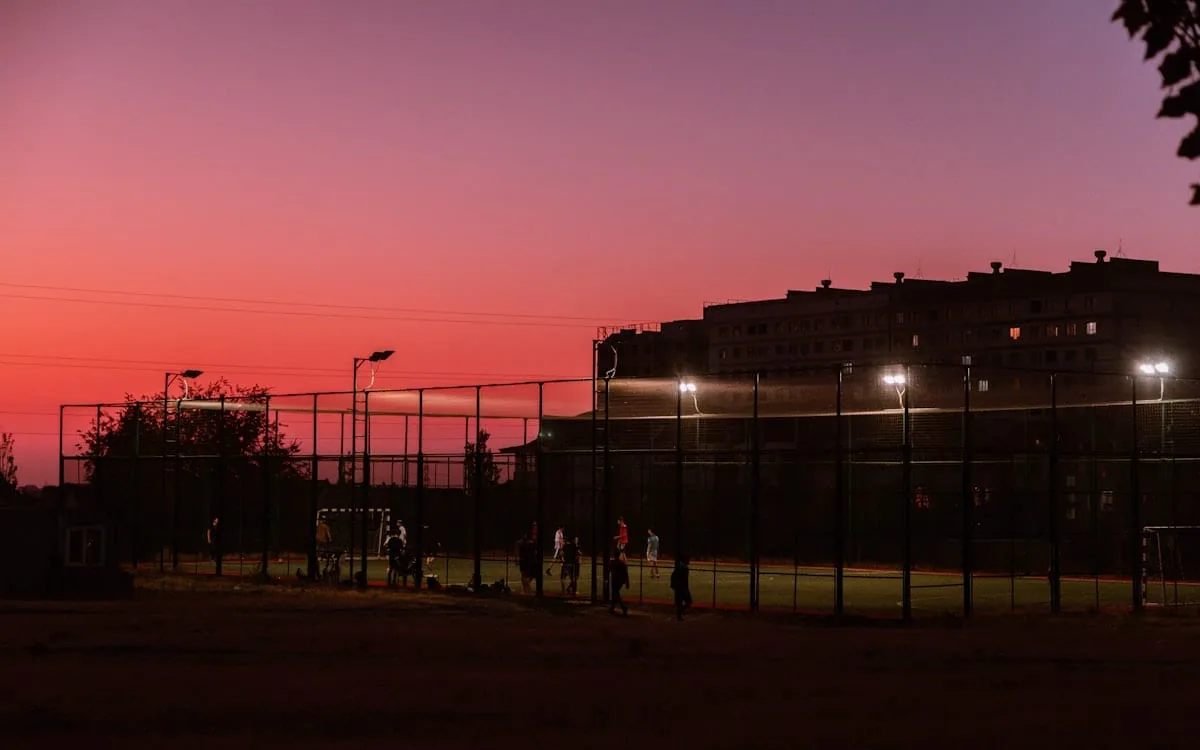
And then think about the floodlights going on over a public court in Almaty on an ordinary Tuesday evening, and the kids queuing to get on it. That is the part of this story nobody can buy, and it is the part that will decide whether anyone is still telling it in 2040.
Photo: floodlit public courts at dusk, from our picture library.
🎾 Gear from this story
HeadHead Speed MPElena Rybakina's racket of choiceView on Amazon →As an Amazon Associate, SUPER.TENNIS earns from qualifying purchases.