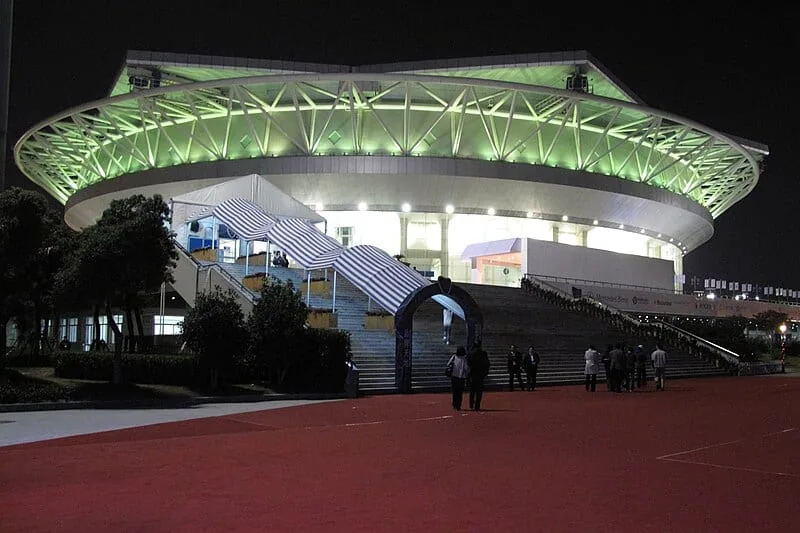
On Thursday evening in Shenzhen, a 23-year-old woman who spent the last days of August playing tennis in front of a few hundred people on an outside court in New York will walk into an arena holding thousands, almost all of whom came to watch her specifically. Nobody in that building will need the story explained. In China, Zheng Qinwen is not a tennis player who is having a good week. She is the one who won the Olympics, then disappeared, and has spent the whole of 2026 finding her way back.
The Billie Jean King Cup Finals start in Shenzhen on Tuesday and run to the following Sunday. Eight countries, one trophy, a week of team tennis at the far end of a long season. If you only watch the Grand Slams, this is the event you have been scrolling past for years without ever quite working out what it is. This year is worth stopping for, and not only because the host nation has a genuine story walking out first.
What is actually happening this week
The Billie Jean King Cup is the women's World Cup of tennis. Countries, not individuals. Captains on the bench instead of coaches in a box. Team kit, national flags, and the strange sight of players who spend fifty weeks a year trying to beat each other sitting in a row on plastic chairs shouting for a compatriot.
The Finals week runs from 22 to 27 September at the Shenzhen Bay Sports Centre. Eight nations qualified: Belgium, the Czech Republic, Great Britain, Italy, Kazakhstan, Spain, Ukraine, and China, who are in as hosts. It is a straight knockout from there. Quarter-finals, semi-finals, final, done inside six days.
The format changed this year, and the change is worth knowing because it shapes how each tie feels. A tie is best of three rubbers, but they are no longer crammed into one long day. The two singles matches are played on the first day, and the doubles, if it is still needed, is played on the second. It brings the women's competition into line with the Davis Cup, and it means a country can go to bed one-all, knowing that everything comes down to a doubles match the following afternoon. If you have ever watched the men's version and wondered why the doubles specialists suddenly become the most important people in the building, you already understand what that does to a week. Our guide to the Davis Cup explains the same architecture from the men's side.
The draw was not kind to the hosts. China play Italy, who have won the last two editions, on Thursday. Czechia, who have won this thing eleven times, open the week against Great Britain on Tuesday. Kazakhstan play Spain. Ukraine play Belgium.
The gold medal, and then nothing
To understand why a home crowd in Shenzhen has been waiting for this, you have to go back to the summer of 2024, and to a clay court in Paris that had been laid over the top of Roland Garros for two weeks in August.
Zheng Qinwen won the Olympic singles title there. Not a bronze, not a doubles medal shared with a partner. The gold, in singles, the first Chinese player to do it. She beat the world number one on the way and then cried on the podium while the anthem played, and in the weeks that followed she became something bigger than a tennis result at home. Chinese tennis had produced one true global superstar before her, Li Na, who won Roland Garros in 2011 and the Australian Open in 2014 and then retired into a kind of national affection that no ranking could measure. For a decade afterwards, every promising Chinese teenager had been introduced as the next one. Zheng was the first who actually looked like it.
Then her elbow went.
The injury built through 2025 until it stopped being manageable, and in the summer of that year she had surgery on it. The recovery took longer than anyone had planned for. She was supposed to play the Billie Jean King Cup Finals in 2025 and could not, pulling out with the operation barely two months behind her. She has not played this competition since April 2024, which is to say she has not played it since before she was an Olympic champion.
She came back to the tour in February of this year, and the results were bleak in the way that comebacks usually are and almost nobody talks about. A first-round loss at Roland Garros. A first-round loss at Wimbledon. By June the ranking she had spent five years building had fallen out of the top hundred entirely, and the protected entry that shields returning players had begun to run out. The gold medal was two years old. The record books did not care.
The six matches in New York
Which is how an Olympic champion came to be playing qualifying at the US Open at the end of August.
This is the part that fans of other sports find hardest to believe about tennis. There is no seeding by reputation and no wildcard by right. When entries closed, Zheng was ranked 127 in the world and the main draw cut off at 118. Nine places. So she went to Flushing Meadows a week early, along with the journeywomen and the teenagers and the grinders, and played three matches on the small courts with no cameras on them to earn a place in the draw. It was only the second time in her career she had qualified at a major. The first was the Australian Open in 2022, when she was nineteen and nobody knew her name.
She came through, beating Elena Pridankina 6-4, 3-6, 6-0 in the final round, and then the fortnight turned into the strangest run of the tournament.
The third round is the one people will remember. She played Madison Keys, the 22nd seed, and lost the first set 6-1, and then found herself in the deciding set trailing 5-0. Not 5-2. Five games to love, with Keys serving for the match at 5-1 and holding a match point. Zheng saved it. Then she won the next game, and the one after, and the one after that, until she had taken seven games in a row and the match 1-6, 7-6(3), 7-5. It was the second consecutive match in which she had come back from 5-0 down in a set and won seven straight games, which is the sort of statistic that makes you check the source twice.
Four days later she played Iga Swiatek in the fourth round, a player she had lost to more often than anyone else on tour, in their ninth meeting. She trailed 5-0 after twenty minutes. She saved three set points. She won 7-5, 6-3.
The run ended in the quarter-finals against Elena Rybakina, who beat her 3-6, 6-1, 6-4 and left New York as the new world number one. Rybakina is in Shenzhen this week too, leading Kazakhstan against Spain, and if you want to understand why she has become so difficult to stop, we wrote about the quietest superstar in women's tennis earlier this summer.
But Zheng went home from that loss having won six matches in a fortnight from the qualifying draw, having beaten a top-25 player from a match point down and a top-ten player from 5-0 down, and by the middle of September her ranking had climbed back to 52. In seven months she had gone from unranked-in-all-but-name to inside the top sixty. That is the woman walking out in Shenzhen on Thursday.
Why the team week hits differently
Here is what nobody who has only watched individual tennis quite expects about a team tie.
For fifty weeks a year, a tennis player loses alone. The handshake, the bag, the tunnel, the empty locker room. Even the ones with big teams around them are fundamentally in a solo sport, and the loneliness of it is one of the things that quietly wears people down.
Then for one week in September, all of that inverts. There is a captain on a chair beside the court who is allowed to talk to you at every changeover. There are four teammates in matching kit ten feet away, standing up every time you win a point. There is a country in the stands rather than a crowd. Players describe it, over and over, as the most nervous they ever get and the most fun they ever have, which sounds like a contradiction until you have watched someone serve at 4-5 in a deciding set with their whole team holding their breath behind them.
It also changes what you see from the stands, or from the sofa. Team ties are the one week of the year when tennis sounds like football. Crowds sing. They sing during rallies sometimes, which purists hate and everybody else enjoys enormously. Flags get draped over the front row and stay there for six days. Coaches who spend the rest of the season pretending to be calm in a players box end up crouching by the net post at a changeover, talking fast, while a camera sits two feet from their face. Nothing about it is dignified and all of it is watchable, and it is the reason people who do not follow the week-to-week tour often find this the easiest tennis of the whole year to fall into.
For Zheng specifically, this week is the first time since the Olympic final that she has played in front of a home crowd with something national on the line. Shenzhen is not her city, she comes from Hubei province, far inland. It will not matter at all.
China have never won this
The hosts are not favourites and it would be dishonest to pretend otherwise.
China have been entering this competition since 1981 and their best ever run was reaching the World Group semi-finals in 2008. That is the ceiling. No final, no title, in forty-five years of trying. Li Na still holds the national team records nearly a decade after retiring, with 35 wins overall and 27 in singles, which tells you something about how thin the layer beneath her always was.
The squad this week is Zheng Qinwen, Zhang Shuai, Wang Xiyu, Guo Hanyu and Jiang Xinyu, with two genuine doubles specialists in that list, which matters enormously under the new format where the doubles is played fresh on its own day rather than at the end of a long one.
And the captain is the detail that makes the whole thing rhyme. China are led by Zheng Jie, who was a very good player and who in 2008 did something that looks remarkably familiar this month. Ranked 133 in the world, she beat the world number one at Wimbledon and went all the way to the semi-finals, becoming the first Chinese player ever to reach the last four at a major, and dragged her ranking from 133 to 40 in a fortnight. She had already won the Australian Open and Wimbledon doubles titles in 2006 with Yan Zi.
So the woman on the bench, telling Zheng Qinwen what to do at the changeovers, is the woman who turned up at a Grand Slam ranked outside the top 130 and beat the best player in the world. The same year China made their only semi-final in this competition. She has, you would imagine, some relevant advice.
The Italy problem
Italy have won the last two editions of this competition, including a 2-0 win over the United States in last year's final, and they arrive in Shenzhen with a team built around Jasmine Paolini and Sara Errani, who are Olympic doubles champions and among the most watchable partnerships in the sport.
That combination is exactly the wrong shape of opponent for a host nation under this format. Italy can lose a singles rubber and still walk into the doubles with genuine gold-medal quality on court. It is the same depth that has made Italian tennis the most consistently successful programme in the world across both tours, a thing we unpicked in how Italy built a tennis empire.
Elsewhere, the Czechs bring Linda Noskova, who spent this summer learning what life is like as a Wimbledon champion, and they face a British team in the opening tie on Tuesday. Kazakhstan have Rybakina. Ukraine, whose players have carried a great deal more than tennis results for four years now, face Belgium.
How to watch it from a long way away
Shenzhen sits eight hours ahead of Greenwich, which means the timings are strange but not impossible. A day session in China starts before dawn in Britain. An evening session lands roughly at British lunchtime and North American breakfast, which makes it the rare bit of Asian-swing tennis you can watch at a civilised hour with a cup of coffee rather than setting an alarm for three in the morning.
Coverage varies by country, and the smart move is to check where team tennis lands in your territory before Tuesday rather than during it, because the rights tend not to sit with the same broadcaster who showed you the US Open. This is also the opening act of the autumn, the last stretch of the year that we mapped out in what happens to tennis after the US Open.
The bit that is actually worth your Thursday
There is a version of this week in which China lose to Italy in two straight rubbers on Thursday evening and the home crowd goes quiet and the tournament rolls on towards a Czech or Kazakh or Italian trophy on Sunday. It is, honestly, the most likely version.
But the thing about watching Zheng Qinwen in September 2026 is that likelihood stopped being a useful guide about three weeks ago. Down 5-0 in a deciding set with a match point against her, the likely outcome was a handshake. Down 5-0 to Swiatek, the likely outcome was a routine loss to a player who had beaten her most of the times they had met. She is a long way from the ranking she had two summers ago and a long way from her best tennis, and in the middle of all that she has developed the specific and unteachable habit of refusing to accept the score in front of her.
Put that on a court in her own country, with her own flag over the net post and a former Wimbledon semi-finalist telling her what to do between games, and the odds stop being the interesting part. Thursday evening in Shenzhen, an arena that has waited two years gets to make some noise, and a player who spent August qualifying gets to find out what she sounds like to fifteen thousand people who never once stopped calling her the Olympic champion.
Photo: a tennis arena in China lit up at night, the kind of building this week fills.
🎾 Gear from this story
HeadHead Speed ProQinwen Zheng's racket of choiceView on Amazon →As an Amazon Associate, SUPER.TENNIS earns from qualifying purchases.


