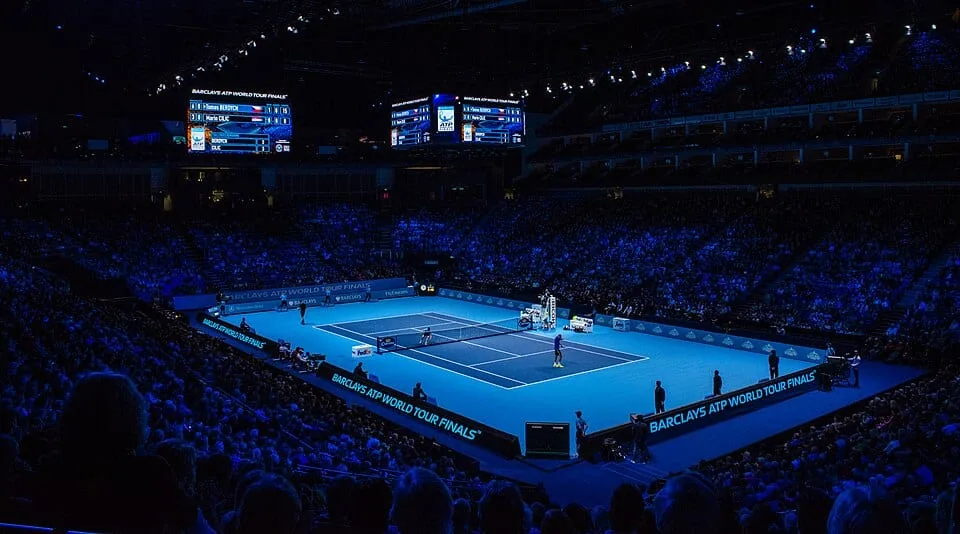
On Monday evening, in a grey concrete hall on the eastern edge of Basel, the house lights will go down and roughly twelve thousand people will make the kind of noise that only happens indoors. It is always louder than the size of the room suggests. The roof takes everything the crowd gives and hands it straight back.
This is the Swiss Indoors, and it has been happening every autumn since 1970, which makes it older than almost everyone who will play in it this week.
For about fifteen years it was also the single most emotionally loaded week on the men's calendar, because one man from this city kept coming back to win it, and the building kept behaving as though it could not quite believe its luck. Then the tournament lost two consecutive editions to a pandemic. And in the gap, quietly, in a different country, that man's career ended.
Basel never got to say goodbye to Roger Federer. Not properly. Not in the hall where he started.
Seven autumns later, the tournament sells its tickets anyway, the lights still go down, and this week there is a genuinely strange and rather good draw in there. It is worth understanding how a tennis tournament survives losing the thing it was most famous for — and what it turns into afterwards.
A tent in Muttenz
The beginning is almost comically small.
In 1970, a young Basel man called Roger Brennwald put on a tennis tournament in an air-supported tent hall in Muttenz, a suburb on the way out of town. It ran under a sponsor's name that sounds like a brand of swimwear, which it more or less was. There was no ATP ranking system worth the phrase. There was no television money. There was a tent, some chairs, and a local organiser with ideas well above his station.
Brennwald has run it ever since. He is in his late seventies now, still the president, still the person whose name comes up whenever anyone in Swiss tennis discusses what happens to the tournament when he eventually stops. That is more than fifty years of one person deciding which players get invited to one city in late October. There is no equivalent in tennis. There is barely an equivalent in any sport.
In 1975 the tournament moved into the newly built St. Jakobshalle, out by the football stadium, and it has been there ever since. The hall was gutted and rebuilt in the late 2010s and reopened on 22 October 2018 — the opening day of that year's tournament, which tells you something about who the building was being rebuilt for. Capacity went up from around nine thousand to roughly twelve thousand. The lighting got better. The concourses stopped feeling like a municipal swimming pool.
What did not change is the thing that makes indoor tennis in October feel different from everything else: outside it is cold and dark by six, and inside there is a perfectly lit blue rectangle and a sound system and a few thousand people who have come straight from work. The whole autumn indoor stretch has this quality, but Basel has the most concentrated version of it, because the hall is compact and the crowd is local and the city genuinely cares.
The ball boy
Here is the part everybody knows, and it is still remarkable every time you look at it directly.
In the mid-nineties, a skinny kid from the Basel suburbs worked the tournament as a ball boy. He stood against the back wall in a polo shirt that did not fit him, rolled balls to grown men, and went home. There is photographic evidence. He looks about eleven and faintly annoyed.
He came back as a player in 2000, aged nineteen, ranked in the thirties, and reached the final. He lost it to Thomas Enqvist in five sets.
He came back in 2001 and reached the final again. He lost that one to Tim Henman in straight sets, 6-3, 6-4, 6-2, in front of the people he grew up with.
Then he did not reach the final in 2002 or 2003, and did not play the tournament at all in 2004 or 2005, by which point he was the best player in the world and his hometown event had become the one line on his record that looked wrong.
He finally won it in 2006, beating Fernando Gonzalez in the final. He was twenty-five, and by then he had already won five major titles, which is a slightly absurd order of events. Imagine winning Wimbledon three times before you manage to win the thing fifteen minutes from your parents' house.
After that he hardly stopped. Ten Basel titles in all, the last in 2019. Three more finals lost, to Juan Martin del Potro and to Novak Djokovic, both of whom discovered what it is like to beat a local in that building and then have to accept a trophy in the silence afterwards.
Ten titles in a tournament where he had once handed people towels. There is no better version of that story anywhere in sport, and Basel got to host all of it.
The two years that were taken
The 2020 edition was cancelled in the summer of that year. The organisers announced it in mid-July, and the ATP signed it off. Everyone understood. Indoor arenas full of twelve thousand shouting people were, at that specific moment in history, the worst idea anybody could have had.
The plan was to roll the fiftieth anniversary into 2021 instead and make it an enormous party. That edition was cancelled too.
So the tournament went from October 2019 straight to October 2022. And in between, in September 2022, Federer played his final professional match at the Laver Cup in London, in a doubles rubber, with the whole thing ending in tears on a bench in another country.
That is the quiet tragedy of this tournament, and almost nobody outside Switzerland thinks about it. Every great player gets a farewell edition somewhere. The home crowd gets to stand up, the tournament gets to put something on a wall, the player gets to cry into a microphone and thank a city by name. Basel was owed that more than any venue on earth, and the calendar simply took it away. By the time the hall was allowed to open its doors again, he was not a player any more.
They have done what they can since. There are banners. There is a court named after him. He turns up sometimes, in a suit, and the building loses its mind for four minutes. But there was never a last match, and there never will be.
What a hometown tournament is actually for
It would have been very easy for the Swiss Indoors to become a museum after that. A lot of events in that position do. They lean on the nostalgia, the attendance drifts down, and in about six years they are an ATP 250 in a half-empty hall.
Basel went the other way, mostly by being stubborn about one thing: the quality of the field.
It is an ATP 500 with prize money of a little over 2.58 million euros this year, which is serious money for a thirty-two-player draw, and it sits in the one week of the season where top-twenty players are desperate for points. The event is a week long, the courts are fast, the hall is full, and the players like it. Ask around and you get the same answers: good hotel, short drive, excellent crowd, slightly terrifying crowd if you are playing a Swiss.
And the tournament kept doing the thing it had always done, which is to hand its wildcards to local teenagers who have no business being in the draw and let them find out what a real arena feels like. That is, after all, how the whole Federer story started — not with a wildcard, but with a tournament that was physically present in a kid's childhood, close enough to touch.
You cannot manufacture another one of those. But you can keep the door open.
Last year, a teenager took the place apart
Which brings us to what happened twelve months ago, and why the 2025 edition is now the one people reach for when they want to explain why this tournament still matters.
An unseeded nineteen-year-old from Brazil called Joao Fonseca came through the draw, beat seeded players on his way including Jakub Mensik, who retired hurt with a foot problem, and then Denis Shapovalov, and arrived in the final against Alejandro Davidovich Fokina, who was having the best stretch of his career.
Fonseca won it 6-3, 6-4 in eighty-five minutes. It was his second ATP title and his first at 500 level. He became the youngest champion in Basel since Jim Courier in 1989, and the first Brazilian to win an ATP 500 event since Gustavo Kuerten in 2001.
The hall, which had spent the best part of two decades watching a local win, found that it rather enjoyed watching somebody else's local win instead. Fonseca played the whole week with a Brazilian flag contingent in the upper tier making a noise entirely disproportionate to its numbers.
He has withdrawn from this year's tournament. Defending champions do that sometimes in late October, when the body has run out of season. It is a shame, and it is also completely normal, and the draw has absorbed it without much difficulty.
This week, then
The main draw runs from Monday 26 October to Sunday 1 November at St. Jakobshalle, with the qualifying rounds played over this weekend.
The seeds, in order, are Ben Shelton, Arthur Fils, Rafael Jodar, Novak Djokovic, Taylor Fritz, Alejandro Davidovich Fokina, Jiri Lehecka and Casper Ruud.
Look at that list for a moment and notice how much of it would have read as a misprint three years ago.
Shelton at the top of an indoor 500 in Europe. Rafael Jodar, who was playing college tennis in Virginia not very long ago, seeded third. Davidovich Fokina back as a seed in the building where he lost last year's final, which is its own small story. And Djokovic seeded fourth, in Basel, on a wildcard. He has won this tournament before, and he did it by beating Federer in a final in this hall, which is one of the more thankless achievements available to a tennis player. He is now the one being handed an invitation by a tournament that once had to find a way to stop him.
Felix Auger-Aliassime withdrew alongside Fonseca; Quentin Halys and Nuno Borges came into the draw in their places.
The Swiss contingent is where the week gets emotional. Jerome Kym and Dominic Stricker are both in, both ranked a long way outside the top hundred, both of them given the kind of chance that only a hometown tournament hands out. Stricker in particular has spent two seasons trying to find the level that once took him into the second week of a major, and there is no crowd on earth more willing to carry him through a tight third set.
And then there is Stan Wawrinka, who is forty-one years old and who announced in January that this would be his last season.
He has had a strange, stubborn, admirable year. In February he climbed back into the top hundred, which made him the first player in his forties to manage it since Federer. He is now somewhere around 140 in the world, with a win-loss record that is not pretty. He reached the third round in Melbourne in January and lost to Fritz. He went out in the first round in Paris and at Wimbledon.
None of which has anything to do with why the hall will stand up for him. He has three major titles. He beat Djokovic in a Roland Garros final and Nadal in an Australian Open final, playing a backhand that nobody has ever hit harder. He is the other great Swiss player of that era, the one who spent twenty years being described in relation to somebody else, and who kept winning the matches that the somebody else did not.
This is almost certainly the last time he will play this tournament. Basel has had one farewell taken from it already. It will not waste this one.
The other hall, in Vienna
One practical thing worth knowing if you are planning your week: there are two ATP 500 events running simultaneously, and they are both indoors, and they are both excellent.
Vienna hosts the Erste Bank Open at the Wiener Stadthalle across exactly the same dates, with Alexander Zverev at the top of its entry list and Carlos Alcaraz coming in on a wildcard. So the top of the men's game has essentially split itself in half across two Central European cities for seven days.
Players choose between them for all the unromantic reasons: appearance fees, travel, who the tournament director called first, how the surface suits them, whether they want a draw with a clear path or a draw that will test something. Agents spend September on this. By the time you see a name in a bracket, it has usually been argued over for weeks.
This is the chaotic, slightly ridiculous charm of the late indoor season. Two halls, two crowds, two sets of ranking points, and a group of players all doing arithmetic in their heads about the race to the ATP Finals in Turin, which is close enough now that a quarterfinal in the wrong city can cost somebody a seat.
If you want the louder building, take Basel. If you want the bigger names at the top of the draw, take Vienna. If you have a laptop and no obligations on Thursday afternoon, take both.
The hall at half past eleven
The thing worth watching for this week has very little to do with who lifts the trophy.
Late in the evening, after the second match on centre court, when the crowd has filed out into the Basel cold and the cleaners are working along the rows, the lights in St. Jakobshalle stay on for a while. Somebody is always still on court. A player who lost, hitting serves alone. A junior who got a practice slot because the schedule overran. Somebody's coach feeding balls from a basket.
That is the part of this tournament that the pandemic could not cancel and that Federer's retirement did not take away. A building in a mid-sized Swiss city, open late, with a court in it, and a kid somewhere in the stands watching and thinking that it does not look impossible.
It worked once, spectacularly. The whole point of keeping the doors open is that nobody gets to know in advance whether it will work again.
🎾 Gear from this story
WilsonWilson Pro Staff RF97Roger Federer's racket of choiceView on Amazon →As an Amazon Associate, SUPER.TENNIS earns from qualifying purchases.