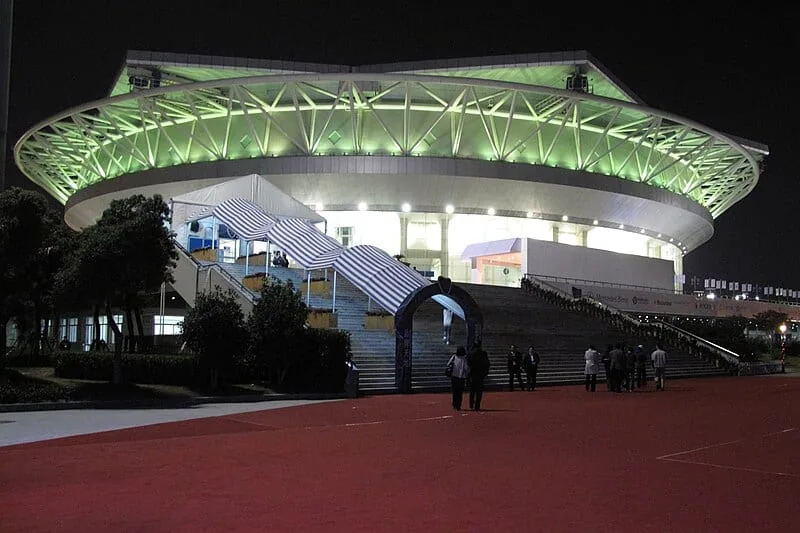
Somewhere inside the Ariake Coliseum this week, a twenty-year-old from Madrid will walk out as the fourth seed at a tournament Carlos Alcaraz is defending, and a good number of people in the stands will quietly look him up on their phones. Eighteen months ago he was playing college tennis in Virginia.
His name is Rafael Jodar. This time last year he was ranked outside the world's top 650 and he was a university student with a locker in a college gym. On Monday's ranking list he was world No. 14, with 2,659 points, and this week he is seeded fourth at the Japan Open in Tokyo. That is not a rise. That is a lift shaft.
If you follow tennis loosely, the way most of us follow it, you may have heard the name in passing during the spring and filed it under things to check later. This is the later. Because the thing about Jodar is not only how fast he has climbed. It is the strange, slightly stubborn route he took to get here, which almost nobody from Spain has taken, and which the rest of the sport is now watching very carefully.
The year that does not look real on paper
Start with the numbers, because they are the part that still makes people blink.
He began the 2026 season ranked outside the top 100. By 10 August he had a career high of world No. 11. In between he won his first ATP title, reached a semi-final in Barcelona, and made the quarter-finals of a Masters 1000 in Madrid, another in Rome, and one at Roland Garros. His match record for the year stands at 36 wins and 14 losses.
For a player in his first full professional season, at twenty years old, that is not a good year. It is the kind of year that gets a player talked about in the same breath as names they have no business being near yet, which is its own sort of pressure, and we will come back to what that pressure did to him in August.
He turned twenty on 17 September, thirteen days ago, somewhere between a Challenger-hardened summer and a debut in front of a full arena in London. It has been that kind of twelve months.
Spanish prospects do not go to college. He went to college.
Here is the part that makes him unusual, and it needs a little explaining if you have never followed American university sport.
In Spain, the path for a gifted teenager is well worn and well funded. You join an academy, you play the junior circuit, you start entering low-level professional tournaments at sixteen or seventeen, and you grind. You lose to hardened thirty-year-olds in half-empty clubs in Tunisia and Portugal for two years and you either come through it or you do not. That is how Rafael Nadal came, roughly how Carlos Alcaraz came, and how almost every Spanish player you can name came.
American college tennis is a different sport in almost every respect. It is played by teams. A dual match puts all six singles courts on at once, with doubles played first for a single team point, and the whole thing decided by which university gets to four points before the other one does. There are coaches shouting from courtside, which is not allowed on tour. There are crowds of students who have come to make noise on purpose. There are no ranking points at all. For a young player with professional ambitions it has traditionally been seen as the consolation route, the thing you do if the tour did not want you.
Jodar won the US Open boys' singles title in 2024. The tour very much wanted him. And in January 2025 he enrolled at the University of Virginia instead.
What happened next was not a gap year. He went 19-3 in singles in his first college season. He was named ACC Freshman of the Year and the national rookie of the year by the ITA, the body that runs American college tennis, and he finished as an All-American and the highest-ranked player in his conference. He also, crucially, spent five months playing matches that counted for other people rather than for himself, in front of crowds who were extremely happy to tell him what they thought of his second serve.
He still works with Brian Rasmussen, an assistant coach from that Virginia programme, alongside his father, who is also called Rafael and who has coached him since the beginning. That continuity matters more than it sounds. Most players who climb this fast change something significant on the way up. He mostly did not.
The autumn he stopped being a student
The transition, when it came, happened in about eight weeks and mostly in small American towns.
In October 2025 he reached the semi-finals of the Challenger in Tiburon, California. Then he won the Challenger in Lincoln, Nebraska. Then he won another one in Charlottesville, on the doorstep of his own university, which took him to No. 166 in the world. Three Challenger titles in a single season is a serious haul for a player of any age. He collected them while still technically an undergraduate.
By the end of November he had qualified for the Next Gen ATP Finals in Jeddah, the tour's end-of-season event for the best players aged twenty and under. On 30 December he announced he was giving up his remaining college eligibility and turning professional. The whole arc, from enrolling to leaving, took less than a calendar year.
It is worth sitting with what that decision looked like from the inside. He had a scholarship, a team, a coach he trusted and a campus he liked, and he walked away from all of it in the last days of December to go and lose first-round matches in foreign countries for a living. Everyone in that situation says the same brave things to the press. Very few of them have a spring like the one he then had.
Marrakech, Barcelona, and the night in Madrid
The 2026 season opened with a scatter of firsts: tour-level wins at the Australian Open, then in Dallas, Delray Beach, Acapulco and Miami. Ordinary-looking results that, stacked up, meant a player ranked outside the top 100 was suddenly beating people ranked inside it on three different continents.
Then came Marrakech in April. The Grand Prix Hassan II is one of the friendlier weeks on the calendar, a clay-court ATP 250 in the Moroccan spring, and Jodar went through the draw and won it, beating the Argentine Marco Trungelliti 6-3, 6-2 in the final. First tour title, at nineteen, in his fourth month as a professional.
He took the form to Barcelona and beat Cameron Norrie 6-3, 6-2 on the way to the semi-finals, becoming the fifth Spanish teenager in the Open Era to get that far at his own country's biggest clay event outside Madrid. And then he went to Madrid, his home city, on a wild card, ranked No. 42 in the world.
That week he became only the third Spaniard, after Nadal and Alcaraz, to win a main-draw match in Madrid before turning twenty. He kept winning, and he arrived in his first Masters 1000 quarter-final against Jannik Sinner, who was and is the world No. 1.
Sinner won it 6-2, 7-6(0). Read that scoreline for a second. The teenager lost the first set in forty minutes and then took the world No. 1 to a tie-break in the second, and lost the tie-break without winning a point in it. It was simultaneously a hiding and a statement, which is roughly what the best young players produce against the very best players for about a year before the results flip. Afterwards Sinner walked to the on-court camera and wrote two words on the lens: what a player. We wrote about that whole strange, upset-strewn fortnight in our Madrid recap, and even then it was becoming obvious that the Jodar story was the one with legs.
Paris, five sets, and a very Spanish handover
Roland Garros was his first. It is a horrible tournament to have as your first, because the clay is slow, the matches are best of five, and nineteen-year-olds who are having a lovely spring tend to run out of legs somewhere in the second week.
He reached the third round and met the American Alex Michelsen, and won in five sets to reach the fourth round of a Grand Slam for the first time. In that round he drew Pablo Carreno Busta, a former top-ten Spaniard and a man who has spent a decade making younger players feel physically ill on clay. Jodar beat him too. A generational handover played out over three or four hours on a side court, watched by a few thousand people who understood exactly what they were seeing.
The quarter-final was against Alexander Zverev, the second seed, who would go on to win the title. Zverev won 7-6(3), 6-1, 6-3, and the score tells you the shape of it: one set of genuine, nervy, high-level tennis, and then the experience gap opening like a trapdoor. Jodar became the first player from the Virginia programme to reach a men's singles quarter-final at a Grand Slam. Our full recap of that fortnight in Paris has the rest of a tournament that produced two first-time champions.
Then the bill arrived
This is the part that usually gets skipped in pieces like this, and it should not be, because it is the most human thing in the story.
He had never played a grass season. He made his debut on the surface at Queen's Club in June, having never hit a competitive ball on grass in his life, and then played Wimbledon a fortnight later. He went to North America for the hard-court summer, reached a career-high ranking of No. 11 on 10 August, and in Cincinnati produced two of the best wins of his year: he beat Alejandro Tabilo for the loss of three games, and he saved a match point to beat Denis Shapovalov.
Then he went to New York for the US Open, the place where his career had turned two years earlier when he won the junior title, and he lost in the first round to Bu Yunchaokete 6-2, 6-1, 6-1.
Not a close one. A thumping, on the court where he had lifted a trophy as a seventeen-year-old, in the first Grand Slam main draw he had ever played at Flushing Meadows.
You can read that as a collapse if you like. It is more useful to read it as arithmetic. He had played fifty matches in a season that started in Australia in January, on four surfaces, in a dozen time zones, with a ranking climbing so fast that the expectation attached to him changed roughly every three weeks. His body had never done a year like that. Neither had his head. Young players do not decline gently when they run out; they fall off a cliff in a single afternoon, and then the tour moves on to the next city without them.
London, a blue blazer, and a reset
Yannick Noah, the captain of Team Europe, had named Jodar in his Laver Cup squad back in July, when the Roland Garros run was fresh and the summer had not yet happened. By the time the event arrived at the O2 in London from 25 to 27 September, the pick looked braver than it had in the summer.
Jodar played Alexander Bublik, one of the most awkward and unpredictable opponents in the sport, in front of a full arena and a bench containing most of the best players in Europe. He won 6-2, 6-3 in an hour and twenty-four minutes, won eighty-one per cent of the points behind his first serve, and took four of his nine break points. Team Europe went on to win the whole thing 13-5.
A hit-and-giggle exhibition, some people will tell you. Perhaps. But it is also three days of a twenty-year-old sitting on a bench beside players he grew up watching, being coached by a Grand Slam champion, in a team environment that looks a great deal more like a college dual match than anything else on the professional calendar. Of all the players in that arena, he was probably the one best equipped to enjoy it. He had spent a season playing for a team already.
What Tokyo is actually for
Which brings us to Ariake, and to this week.
The Japan Open, the 52nd edition, runs from 30 September to 6 October, and it is the oldest tour-level tournament in Asia. Alcaraz is the defending champion and opens against Michelsen, the same American Jodar beat in five sets in Paris. Frances Tiafoe is the second seed, and he has the unenviable job of playing Kei Nishikori in the first round of the last tournament of his career, which we wrote about in our piece on Nishikori's farewell in Tokyo. The building will be emotional all week, and almost none of that emotion will be aimed at the fourth seed.
Jodar opens against Adolfo Daniel Vallejo of Paraguay. It is, on paper, a routine first-round match for a seeded player. What makes it interesting is what sits behind it: for the next two months, everything he plays is new ground. He has no results to defend from last October and November because last October and November he was winning Challengers in Lincoln and Charlottesville, on the other side of the world from the tour he now belongs to.
That is an unusual position to be in at this stage of a season. Most players spend the autumn anxiously protecting points. He gets to spend it accumulating them, on hard courts, in a part of the calendar where the draws are strong and the crowds are enormous. Tokyo, then Shanghai, then the indoor stretch in Europe. If the body holds, this is the most productive eight weeks of his life. If it does not, it will be because a twenty-year-old asked a first professional season to last eleven months, which is a very normal way for this to go.
What to watch for, if you have never seen him play
He is six foot three, which is tall enough to serve properly and still young enough that the body is catching up to the frame. The forehand is the shot: heavy, flat, hit early, and used to take time away from people rather than to build a point slowly. On clay that made him awkward. On a quick hard court it makes him dangerous.
The less obvious thing is what he does between points. Players who come through the college system tend to have a different relationship with noise. They have played matches where a hundred students were screaming at them by name, where a teammate two courts away needed them to hold serve, where the coach was allowed to talk to them and did. Very little on a professional court frightens them. You can see it in the way he handles a hostile crowd or a bad call, and you could see it against Sinner in Madrid, when a nineteen-year-old down a set in front of his home city did not shrink by a single inch.
If you want the full record, the titles and the head-to-heads as they accumulate, his player page keeps score. What the numbers will not show you is the route.
Because the route is the genuinely new thing here. For twenty years the message to every gifted teenager has been that the American university system is where good juniors go to become good coaches. Jodar took a scholarship, spent a season playing for a team in front of a few hundred people, left with a national rookie of the year award, and turned up in the world's top fifteen eighteen months later. Somewhere in Spain right now there is a fifteen-year-old and a set of parents having a conversation they would not have had two years ago.
On Wednesday his name goes up on a board in Tokyo with a small number four beside it, and most of the arena will be there for somebody else entirely. He has had that before, in matches where the crowd could be counted in rows. The only real difference is the direction of the counting: more than six hundred ranking places in a year, one title, four quarter-finals, fifty matches, twenty years old, and a season with five weeks still left in it. Those five weeks start now.
Photo: an empty hard court in afternoon sun, from our picture library.
🎾 Gear from this story
HeadHead Speed MPJannik Sinner's racket of choiceView on Amazon →As an Amazon Associate, SUPER.TENNIS earns from qualifying purchases.