On Monday evening in Basel they gave Stan Wawrinka a golden ball, played him video messages from four of the best players of his lifetime, and made him stand in the middle of a tennis court for an hour while a full house refused to stop clapping. He cried. Of course he cried. He has spent twenty-three years being the least theatrical man in professional tennis, and the sport waited until the very end to put him somewhere he could not hit his way out of.
That was the warm part. Tuesday evening is the real thing.
That is when Wawrinka walks out at the St. Jakobshalle to play Jiri Lehecka in the first round of the Swiss Indoors, and when he loses — against the eighth seed, at 41, ranked outside the top 100, it is the overwhelming likelihood — his career is finished. Not winding down. Finished. He announced it last December in a post that called 2026 one last push, and he has spent the whole season walking slowly towards this particular hall in this particular city, which was the only place the story could sensibly have ended.
If you have followed tennis loosely for the past fifteen years, you know the name, you know the backhand, and possibly not much else. That is the odd thing about Wawrinka. He won three Grand Slam titles. That is more than Andy Roddick, more than Marat Safin, more than almost anyone alive who is not one of the four men who owned the sport for twenty years. And he still reads to most people as a cult favourite rather than a great. This week is a good moment to correct that, because what he actually did was stranger and harder than the highlight reel lets on.
A kid with a wildcard, losing in straight sets
Start in this same building, twenty-three years ago.
In 2003 the Swiss Indoors handed a main-draw wildcard to an 18-year-old from Lausanne who had won the junior title at Roland Garros that summer. He walked out against Tomas Zib, a solid and unglamorous Czech tour pro, and lost both sets in tiebreaks without ever really arriving. He said afterwards that he had been tense from the first ball and never shook it off. He came back in 2004 on another wildcard and lost in the first round again, this time to Tommy Robredo.
Then he kept coming back, and kept losing early. Across two decades, Wawrinka lost in the first round in Basel nine times. Nine. At his country's biggest tournament, in front of people who shared his passport, the overwhelming pattern of his career here was one match and a quiet exit.
Twice it went differently. In 2006, aged 21, he beat Agustin Calleri, Tim Henman and David Nalbandian in consecutive rounds before Fernando Gonzalez stopped him in the semi-finals. In 2011 he made the last four again and ran into Roger Federer, who went on to win the thing, as Federer tended to do here. Wawrinka never reached a Basel final. This week is his eighteenth or nineteenth main draw in the city depending on which record-keeper you believe, and his relationship with the tournament has never been the easy romance a farewell implies. One Swiss paper summed it up perfectly this week: it was not always a love story.
Which is exactly why Monday night mattered. Basel was not thanking him for what he did in Basel. It was thanking him for everything he did everywhere else, and doing it in the only room that had watched the whole arc from the beginning.
Growing up next door to the greatest
For the first decade of his career, Wawrinka was the second-best tennis player in a country of nine million people, and the gap was not close. Federer was already winning Wimbledon when Wawrinka was still losing first rounds at home. Every Swiss newspaper photograph had one of them in focus and the other slightly behind.
He has never pretended otherwise, and he never sulked about it either, which is more unusual than it sounds. In 2008 the two of them won Olympic doubles gold together in Beijing, four matches of Wawrinka hitting enormous forehands and Federer finishing points, and the photographs of that week show a 23-year-old who cannot quite believe his luck. In 2014 they finally won Switzerland the Davis Cup, beating France in a football stadium in Lille in front of a record crowd of more than 27,000, with Wawrinka winning the opening rubber and Federer closing it out. A country that had produced the most decorated male player in history had never won the team event until the second-best player grew into someone who could carry his end of it.
Living beside Federer did two things to him. It kept him invisible for ten years. And it gave him, every single week, an unarguable demonstration of what the top of the sport actually required, which is a kind of education that no coach can sell you.
Twelve-ten in the fifth
Nothing about Wawrinka suggested a late bloom. He turned 27 with a career that looked finished in outline: a top-20 player, a nice backhand, a nice man, a quarter-final here and there.
Then came the 2013 Australian Open and a fourth-round match against Novak Djokovic, who was the best player in the world and the defending champion and had beaten Wawrinka every time they had ever played. It lasted five hours and two minutes. Wawrinka lost 12-10 in the fifth set. He sat in his chair afterwards with a towel over his head, having played the best tennis of his life and lost anyway.
It is the most important match he ever played. Everyone who was close to him says the same thing: he walked out of that stadium convinced for the first time that the level was not out of reach. He hired Magnus Norman, the Swede who had been to a Roland Garros final himself and who turned out to be the right voice at exactly the right moment. He got fitter, meaner, more patient. Somewhere in there people started calling him Stanimal, which is a silly nickname that became an accurate one.
And he had, on his left forearm, a line from Samuel Beckett that he had tattooed there long before any of this happened: ever tried, ever failed, no matter, try again, fail again, fail better. Players collect ink that means nothing by the following season. That one has aged into something close to a career summary, and it still sits near the top of any list of tattoos in tennis that actually mean something.
Twelve months after the 12-10 defeat, he came back to Melbourne and beat Djokovic in the quarter-finals, 9-7 in the fifth.
Three finals, three world number ones
What happened next is the part that still does not compute.
At the 2014 Australian Open, after surviving Djokovic, Wawrinka beat Rafael Nadal in the final 6-3, 6-2, 3-6, 6-3. Nadal hurt his back during the warm-up and played most of it in visible pain, which has given the result an asterisk in some tellings. Watch the first two sets again. Wawrinka was hitting through a healthy Nadal before anything went wrong. Three months later he beat Federer in the Monte Carlo final for a Masters 1000 title, and that spring he reached world number 3, which remains his career high.
At Roland Garros in 2015 he arrived as an afterthought, played a quarter-final against Federer, a semi-final against Jo-Wilfried Tsonga, and then a final against Djokovic, who had beaten Nadal in the quarters and was heavy favourite to complete his career slam. Wawrinka won it in four sets, hitting one of the most absurd backhands anyone has produced in a major final, wearing a pair of red and pink chequered shorts that the internet has never entirely forgiven him for.
At the US Open in 2016 he came from a set down to beat Djokovic again, 6-7, 6-4, 7-5, 6-3, with a third set that turned on a single long service game and a closing stretch in which Djokovic, physically spent, had nothing left to throw at him.
Three Grand Slam finals. Three wins. In every one of them the man on the other side of the net was the world number one. No one else in the modern era has a record like that, and it says something exact about him: for most of his career he was the fourth or fifth best player in a given week, and roughly twice a year he became unplayable.
The knee
Then it stopped, abruptly and painfully.
He reached one more major final at Roland Garros in 2017 and lost it badly to Nadal, who was by then doing something close to his best work on clay. Weeks later he lost in the first round at Wimbledon and that was his season done. He had two operations on his left knee that August. He has said he could not walk properly for months, and that the hardest part was the ordinary, dull fear that the body would not come back.
It came back, but not all the way. He fell out of the top 250. He spent 2018 playing matches he would once have won in his sleep and losing them. The ranking crept back towards the top 20 and then slid again. There was one glorious throwback night at the 2019 US Open, when he was two sets up on Djokovic in the fourth round and Djokovic retired, and there were years of early-round exits, and there were injuries that cost him whole chunks of calendar.
Through all of it he kept entering tournaments. He played qualifying. He played challengers in small halls in front of a few hundred people, as a three-time major champion in his late thirties, because the alternative was stopping and he was not ready to stop. There is no decent sporting word for what that is. Stubbornness is too small and dignity is too grand.
One last push
The 2026 farewell season has been a tour of places that meant something, and the results have mostly been what a 41-year-old ranked outside the top 100 can expect.
At Roland Garros, where he had the best fortnight of his life in 2015, he played his last French Open and lost in the first round in four sets to a lucky loser, Jesper de Jong, who went on to have the kind of week that changes a career. In July he said goodbye to Gstaad, the Alpine clay event where he played his first professional matches as a teenager, losing in three sets to Jaime Faria and then standing through a ceremony where they handed him a pair of skis with The Man written along them and played him video tributes from Stefanos Tsitsipas and Casper Ruud.
And last week, in Lyon, he produced one more of them. In the first round he beat the young Spaniard Martin Landaluce 6-3, 6-7, 7-6, saving a fifth match point in the deciding tiebreak, which at 41 and with that knee is faintly ridiculous. In the second round he ran into the top seed, Flavio Cobolli, who is 17 years younger and fighting for a place at the season finale in Turin, and the gap showed.
Then he drove home to Switzerland for the last week of his working life.
The golden ball
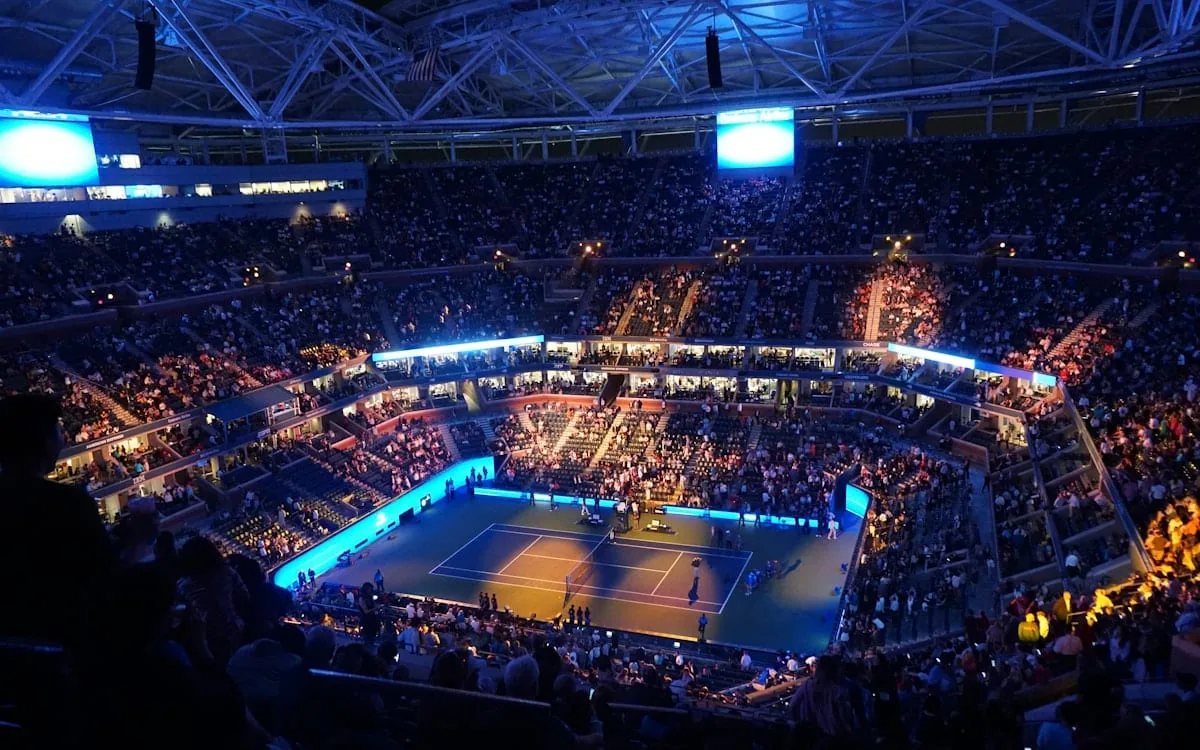
Monday night in Basel started at six, ran well over its hour, and by the end nobody in the building was pretending to be neutral.
Roger Brennwald, the tournament president who has run this event since 1970 and who gave Wawrinka that first wildcard in 2003, called him the Sylvester Stallone of tennis, which is both ridiculous and, if you have ever watched Wawrinka physically wear an opponent down over four sets, completely fair. He handed over a golden ball. The Swiss singer Bastian Baker performed. Federer and Andy Murray sent video messages, as did John McEnroe and Gael Monfils, and so did Djokovic, who then watched the whole thing live from the tournament president's box alongside Martina Hingis and the cross-country skier Dario Cologna, having come to Basel partly because he was asked to be there for it.
Wawrinka, holding the microphone, said the thing that explains him better than any statistic. He had always given the best of himself, he said, but he had never dreamed of winning Grand Slams.
That is not modesty. It is the literal truth, and it is why he is worth a paragraph of your attention even if you have never hit a tennis ball in your life. He was not a prodigy marked out at twelve. He was a very good player who became, through a specific decision taken at 27 in the aftermath of a defeat, a great one for about three years. Most careers do not have that in them. Most people do not have that in them.
The Swiss Indoors knows a thing or two about endings it did not get to hold properly. The hall never managed to say a proper goodbye to Federer, who retired in London in the years after the tournament lost two editions to a pandemic. This time, they got to do it in the room.
What happens on Tuesday night
Lehecka is the eighth seed, 24 years old, hits a very heavy ball and has every reason to want a straightforward win in his first match of an indoor 500. They have never played each other, which is a strange fact in itself: Wawrinka has been on tour so long that his career barely overlaps with the one that will end it.
The sensible expectation is a loss in two sets, a long ovation, and a man walking off with a bag over his shoulder. The less sensible expectation is the one every Swiss person in that building will be carrying up the stairs: that the backhand turns up one more time, the hall gets loud enough to be useful, and the whole thing goes three sets and well past eleven o'clock.
You should watch it either way, and if you have a streaming subscription and an evening free, you should watch it live rather than catch the clips. The clips will give you the ovation. They will not give you the ninety seconds before the first point, when a 41-year-old stands at the baseline in the city where he first played a professional match and bounces the ball, and the room understands that there is no next tournament.
After Basel there is one more date: 19 December, at Palexpo in Geneva, an exhibition called One Last Backhand, where he will play a singles match against Monfils and then a doubles with Federer on his side of the net against Monfils and Murray. It will be a party rather than a contest. The actual competitive record closes this week.
He will finish with three major titles, sixteen tour titles, an Olympic gold medal, a Davis Cup, a career-high ranking of 3, and a line from a Beckett novella on his arm that he chose before he had won anything at all. Fail again. Fail better. He lost nine first-round matches in this building. He is going out in it anyway, on his own terms, at the only hour of the only evening that was ever going to do.
🎾 Gear from this story
WilsonWilson Pro StaffStan Wawrinka's racket of choiceView on Amazon →As an Amazon Associate, SUPER.TENNIS earns from qualifying purchases.