Stan Wawrinka had already gone home. The bags were back in Switzerland, the US Open wild card list had been published without his name anywhere on it, and the last summer of a twenty-year career had quietly rearranged itself around an absence. He had said what he needed to say about it, which was not much and was somehow the saddest version of it. "I was just sad not to be able to say goodbye to New York and to the US Open."
Then, late on a Wednesday, his phone rang.
Patrick Kypson, the young American who had been given that final wild card, had withdrawn injured. The tournament wanted to know whether Wawrinka fancied one more trip to Flushing Meadows. He was, by his own account, already back in Switzerland when the call came. He said yes. He got on a plane. And on Monday, ten years after he stood on Arthur Ashe Stadium with the trophy and a shirt soaked through, the 41-year-old walks out for the last Grand Slam match of his life.
If you only watch tennis a few weeks a year, this is one of the weeks. And this is one of the stories.
The wild card that almost never came
Wild cards are the small print of tennis, and they are usually boring. A tournament gets a handful of free main-draw places to hand out, and it hands them to promising local teenagers, to a returning star, to whoever the sponsors and the national federation and the story of the week point towards.
The US Open gave its last one to a player ranked around No. 115, which is a perfectly defensible thing to do. Wawrinka is No. 125 and 41 years old. He has won a small number of matches this season and lost a lot more. On paper, there is no argument.
Except the US Open is not paper. Wawrinka won it. He beat the best player in the world in the final to do it. And he had already announced that 2026 would be his last year, which meant the list, when it came out without him, was not a ranking decision so much as a closed door on a farewell.
Tennis fans, who are not always right but are frequently loud, said so. Then Kypson pulled out, the door opened again, and a man who thought he had played his final major found himself repacking. There is something very tennis about that: no ceremony, no announcement from on high, just an injury to someone else and a late phone call and a seat on a flight.
Ten years ago, on the biggest court in the sport
In September 2016, Wawrinka arrived at the US Open as a player everyone respected and nobody picked. He was 31. He had already won two majors that nobody had picked him for either.
He came through a semi-final against Kei Nishikori by 4-6, 7-5, 6-4, 6-2, the kind of scoreline that tells you he lost the first set, worked out the problem, and then simply kept hitting harder than the other man could absorb. And in the final he met Novak Djokovic, the defending champion, the world No. 1, the most complete returner the sport has produced.
Wawrinka lost the first set in a tie-break, 7-1. Then he won the next three: 6-4, 7-5, 6-3.
Look at that sequence for a second, because it is the whole man. He does not start well. He gets outplayed for stretches. And then somewhere around the middle of the second set, the ball starts leaving his racquet at a speed that changes the negotiation entirely, and the greatest defensive player in history runs out of ways to say no.
That was his third major final. He has never lost one. Australian Open 2014, Roland Garros 2015, US Open 2016: three finals, three wins, and in each of them the man across the net was the world No. 1. If you want a single fact to keep about Stan Wawrinka, keep that one.
The backhand you can pick out with your eyes shut
Here is why people who have never held a racquet love watching him.
The one-handed backhand is going out of the world. It is harder to learn, harder to defend with, and worse against the shoulder-high bounce that modern strings and modern courts produce. There are perhaps a handful of men left on tour who hit one at the top level, and Wawrinka hits the biggest of them all.
It does not look efficient. It looks like a decision. He turns his back on you, coils, drops the racquet head somewhere near his ankle, and then unwinds with his whole body committed to a shot that either lands on the line or lands in the third row. There is no half-speed version. There is no safety setting. Fans in the stands can hear the difference between his backhand and everyone else's, a flat crack rather than the modern brushed hum.
That is the thing to watch for if you are new to this. You do not need to follow the score. Wait for a rally where he gets pushed wide to his left, and watch what he does with a ball he has no business attacking. That shot won him three majors and cost him a hundred other matches, and he never once thought about changing it.
A farm in Vaud, and a club five minutes up the road
He did not come out of an academy. His parents, Wolfram and Isabelle, farmed in Saint-Barthelemy in the canton of Vaud, and Stan and his brother grew up doing farm work. When he was eight, his parents told the boys to pick a sport. There was a tennis club about five minutes away. That was the whole selection process for a career that produced three major titles, an Olympic gold in doubles with Roger Federer in Beijing in 2008, and a Davis Cup for Switzerland in 2014.
On his left forearm there is a tattoo, a line from Samuel Beckett: Ever tried. Ever failed. No matter. Try again. Fail again. Fail better.
It became a poster quote, and a bit of a joke, and then it became something else. Because the interesting thing about that sentence is what it does not say. It does not say you will win. It does not promise anything. It is a set of instructions for continuing when the evidence is not on your side, which is what a tennis career mostly is, and which is exactly what he has been doing this year, going out to face players half his age in front of crowds who came to say goodbye.
The night in Melbourne that turned him into a champion
You do not become Stan the Man by winning. You become him by losing correctly, once, in front of everyone.
The 2013 Australian Open, fourth round, against Djokovic. Wawrinka went ahead 6-1, 5-2. He was two games from beating the world No. 1 and did not do it. Instead they played on for five hours and three minutes, and in the fifth set the games kept going: six all, eight all, ten all, until at twenty past one in the morning Djokovic finally took it 12-10 with a curling backhand pass that missed Wawrinka's outstretched racquet by about an inch.
He lost. He also stopped being a player who could not do this. That season he made his first Roland Garros quarter-final, his first US Open semi-final, and qualified for the season finale for the first time. Twelve months later he beat Djokovic in a quarter-final in Melbourne and Rafael Nadal in the final, and he was a Grand Slam champion at 28, an age at which most players are being described as established.
The other half of that turn was a coach. He began working with the Swede Magnus Norman in 2013, a former world No. 2 who had lost a Roland Garros final himself and who spent his time with Wawrinka doing something quite unfashionable: not rebuilding the technique, but persuading the man holding the racquet that he belonged in the last week of majors. It is a useful thing to know if you are a fan rather than a player. At that level almost nobody wins more matches by learning a new shot. They win them by finally believing the shots they already have will hold up when it is 4-4 in the fourth and the crowd has stopped breathing.
Then, in 2015 in Paris, in a pair of red checked shorts that the internet has never fully recovered from, he beat Djokovic again in a final. Then New York in 2016. Career-high ranking of No. 3. Sixteen tour titles. Fifty consecutive majors played, an iron-man run that only ended when his left knee needed two operations in 2017 and took the better part of two years of his life with it.
The long goodbye: Melbourne, Paris, London
He announced it last December, in the plainest possible language. "Every book needs an ending. It is time to write the final chapter of my career as a professional tennis player. 2026 will be my last year on tour." Then he added two words that have been on every banner in every crowd since: one last push.
Melbourne came first, and Melbourne was glorious. On a wild card, in his twentieth appearance there, he beat the French qualifier Arthur Gea 4-6, 6-3, 3-6, 7-5, 7-6(3) to become the oldest man into the third round at Melbourne Park since Ken Rosewall. He lost the next one to Taylor Fritz, and then stood on court with a microphone and a beer, thanked the crowd for twenty years, and admitted he was sad to leave.
Paris was shorter and no less emotional: a first-round exit to the Dutchman Jesper de Jong, who was in the draw only because he had lost in qualifying and got rescued by a withdrawal, and who went on to have the run of his life. Wawrinka waved at the Paris crowd for the twenty-first and final time. He was not the only French Open regular saying goodbye this year, either, with Gael Monfils taking his own farewell lap in front of the same crowd.
And then Wimbledon, where he ran into Matteo Berrettini on day one and lost four sets that all went to tie-breaks. All four. In the second one he held six set points and did not take any of them, and the breaker crawled to 18-16 before Berrettini finally got out of it. It lasted well over four hours. He cried at the end of it, and so did quite a lot of people watching.
Grandstand, and the Italian who has done this to him before
Which brings us to Monday, and the small joke the draw has played.
Wawrinka plays Matteo Berrettini again, in the first round, at the same stage of the same season, eight weeks after the Wimbledon match. It is the only meeting they have ever had, and now it is two. Berrettini is 30, a former Wimbledon finalist himself, and a man whose own career has been chewed up by injuries badly enough that he knows exactly what it is to be handed a wild card and be grateful for it.
"It is a rematch, of course," Wawrinka said in New York. "Wimbledon was a tough battle, was a great match. I think we both played well. More than four hours, four tie-breaks, so it was really special."
That is worth sitting with for a moment, because it is not a one-sided piece of sentiment. Berrettini reached a Wimbledon final in 2021 and then spent years being taken apart by his own body, one abdominal or hand or foot problem after another, dropping out of the rankings and climbing back and dropping out again. He knows precisely what it costs to walk on court not knowing how many more times you get to do it. Whatever happens on Monday, these two are not strangers to the same weather.
They are scheduled on the Grandstand, not on the stadium where he won the title. That is either a shame or exactly right, depending on your taste. The Grandstand is the court where the noise sits right on top of the players, where a crowd of a few thousand can sound like a football match, and where the atmosphere does not need a night session and a celebrity row to get going. If the last act of a beloved player is going to be played anywhere, a packed outside stadium in Queens is not the worst theatre in the world.
And if he wins, the reward is absurd. The winner of this match goes into the second round to play the fourth seed, Novak Djokovic, assuming Djokovic gets past Mariano Navone. The man Wawrinka beat in two Grand Slam finals. The man who broke his heart in Melbourne in 2013 and made his career by doing it. In a draw that nobody can call with any confidence, that is the storyline sitting one win away.
What he is actually leaving behind
There is a version of tennis history that only remembers the men at the very top of it, and Wawrinka does not fit into it neatly. He never held the No. 1 ranking. He never won Wimbledon. He was the second-best Swiss player of his own era, and he spent a decade being introduced as the other one.
But look at what he did with that. In an age when three or four men divided the majors between them for twenty years, Wawrinka took three away from them, and he took every single one by beating the world No. 1 in a final. He did not sneak them. He did not catch anyone on a bad week. He walked into the biggest matches of his life against the best players in the world and hit through them.
Add the Olympic gold in doubles, the Davis Cup, sixteen titles, fifty straight majors, two knee operations and two foot operations and a return from all of it. Add the fact that at 40 he became the first player in his forties to be ranked inside the top 100 since Federer. And add the thing you cannot count, which is that in twenty years on tour nobody seems to have a bad word about him.
He plans to finish at home, in Basel, in October, on the indoor court where he watched Swiss tennis as a kid. That is the real ending. What happens in New York this week is the last chapter of the major-championship part of the story, which for a player of his kind is the part that mattered most.
If you want a way into this sport, and you do not play it and are not going to, start here. Watch a 41-year-old with a bad knee and a wild card he almost did not get, in a stadium full of people who understand exactly what they are looking at, hitting the most beautiful shot in tennis until somebody stops him. He has been telling us for twenty years how he wanted to be judged, and it is inked on his arm: not by whether he won, but by how he kept going. Monday is one more go. If you are anywhere near a screen at Flushing Meadows time, give it an hour of your life. You can watch the rest of the fortnight around it, and you can read our guide to the tournament itself while you wait for the first ball.
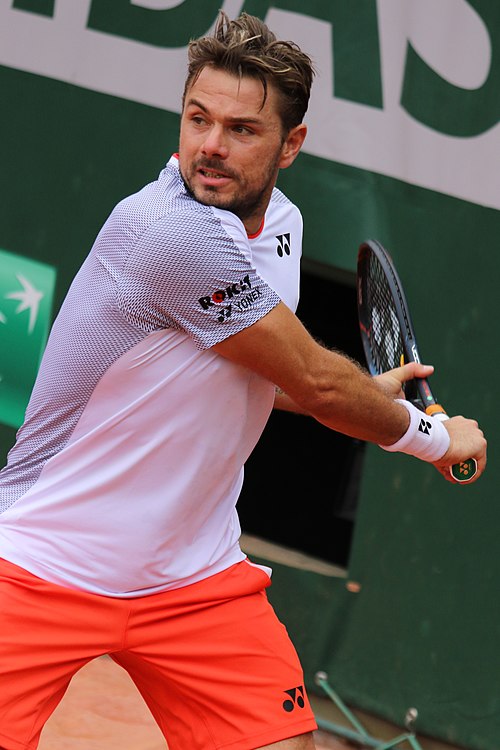
Photo: Stan Wawrinka at Roland Garros 2019 by si.robi, CC BY-SA 2.0, via Wikimedia Commons.
🎾 Gear from this story
WilsonWilson Pro StaffStan Wawrinka's racket of choiceView on Amazon →As an Amazon Associate, SUPER.TENNIS earns from qualifying purchases.