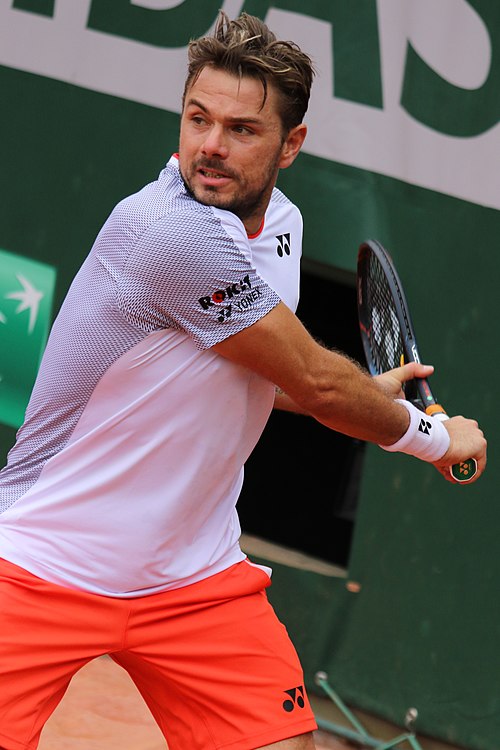
The biggest moment of Alexander Zverev's career happened while he was not on a tennis court.
On Monday afternoon in Shanghai, Carlos Alcaraz lost 7-5, 7-6(4) to Zizou Bergs, an unseeded Belgian having the day of his life. It was a lovely, scrappy, genuinely shocking match, and if you watched it you probably watched it as exactly that: an upset, a highlight, a thing to send to a friend. But the moment the last ball landed, a piece of arithmetic that had been quietly accumulating since January resolved itself somewhere off camera. Alcaraz could no longer catch Zverev in the rankings. Neither could anybody else. For the first time since the men's game started keeping this particular list in 1973, a German is going to finish a season as the world No. 1.
Zverev was not playing. He had won his third-round match the day before, beating Quentin Halys 6-4, 6-7, 6-3 for his sixtieth win of the season, and then he had done what players do on an off day, which is mostly eat and sleep and stare at a phone. He found out the way the rest of us found out. He called it a dream come true, which is the kind of thing people say, except that in his case there is a decade of evidence that it is literally true.
If that does not land as hard as it should, it is because almost nobody explains what year-end No. 1 actually is. It gets mentioned in passing, somewhere between the trophy ceremonies, as though it were a statistic rather than a thing you spend a career chasing. It is not a statistic. It is the shortest and most selective honour roll in the sport, and this week it has a German name on it for the first time, which is strange for reasons we should get to.
What you actually win
Nothing. That is the first thing to understand. There is no match, no final, no fortnight. You do not beat anyone for it. There is a trophy handed over in Turin in November and a nice photograph, but the thing itself is a row in a spreadsheet: whoever is top of the official rankings on the final Monday of the season, which this year falls on 23 November.
That makes it the only honour in tennis you cannot win on a hot streak. Grand Slams are seven matches. A Masters 1000 is five or six. Win enough of them in a lucky fortnight and you can take home something that will be on your gravestone. Year-end No. 1 is twelve months, and the rankings hold a rolling year of results, so a February first-round loss is still sitting there in November, quietly costing you. You cannot cram for it. You cannot peak for it. You have to be the best player in the world for an entire calendar year while also staying healthy enough to keep turning up, which is the part that eliminates most people.
It is also not the same thing as the race to the season finale, though the two get muddled constantly. The eight men who qualify for Turin do so through a separate table that resets every January, and we have written about those eight chairs and the scramble for them already. Year-end No. 1 runs on the ordinary rolling ranking, the one you see next to the names on your television. Different list, different maths, same twelve months of evidence.
And it is not the same as being No. 1, either, which is the detail that makes Zverev's version of this so odd. More on that shortly.
Twenty names in fifty-three years
Here is how exclusive this is. Since computer rankings arrived in 1973, roughly thirty men have reached world No. 1 at some point, even if only for a week. Twenty have finished a year there. Zverev is the twentieth.
The roll call is basically a history of the sport told in single names. Ilie Nastase was first, in 1973. Jimmy Connors then took five years in a row, 1974 through 1978, which still looks absurd written down. Bjorn Borg had 1979 and 1980. John McEnroe had four straight from 1981. Ivan Lendl took 1985, 1986 and 1987, lost 1988 to Mats Wilander, and then took 1989 back, because Lendl was not a man who let things go.
Pete Sampras holds the run that nobody has touched: six consecutive years, 1993 to 1998. Then the list opens up for a moment, the way the sport did at the turn of the century, with Andre Agassi, Gustavo Kuerten, Lleyton Hewitt and Andy Roddick each getting a turn, before Roger Federer closed the door again for four years from 2004.
After that it is mostly two surnames and a handful of interruptions. Rafael Nadal finished on top five times. Novak Djokovic did it eight, which is the record and will probably stay the record. Andy Murray broke through in 2016. Carlos Alcaraz did it as a 19-year-old in 2022 and again last year. Jannik Sinner had 2024. The modern era has been generous with trophies and miserly with this.
Twenty names in fifty-three seasons. For comparison, more than sixty different men have won a Grand Slam singles title in the same period. Winning a major is hard. Being the best player in the world for a year is a different category of hard.
The country that kept not being on it
Now the strange part. Germany is not a minor tennis nation. It is the country of Boris Becker, who won Wimbledon at seventeen and then won it twice more, who won the Australian Open twice and the US Open once and the season finale twice. It is the country of Michael Stich, a Wimbledon champion. Of Tommy Haas, who got to No. 2 and stayed relevant into his late thirties. It has produced champions continuously for forty years.
And until Monday, no German man had ever finished a season at No. 1.
Becker is the sharpest version of the story. He is the only German man who had ever reached No. 1 at all, and he held it for twelve weeks. Twelve. He got there on 28 January 1991 after winning the Australian Open, had three weeks, lost it, came back on 8 July that year after another Wimbledon final, and had nine more. Then it was gone. He was No. 1 in the middle of 1991 and he was not No. 1 at the end of 1991. For thirty-five years that was the whole German chapter of this story: a few months in the summer of one season, and then nothing at all.
Stich peaked at No. 2. Haas peaked at No. 2. Zverev himself had been No. 2 for long stretches without ever getting the week that mattered. It became one of those quiet national absences that nobody really talks about because there is nothing to say about it. The names were all there. The top line never was.
Except that Germany has had a year-end No. 1 for decades
Her name is Steffi Graf, and she finished a season as world No. 1 eight times.
This is the detail that reframes the whole thing. While the German men were piling up majors and never quite holding the summit through December, Graf was doing the opposite with a completeness that is almost comic: 1987, 1988, 1989, 1990, and then 1993, 1994, 1995, 1996. Eight years at the top of the women's game, and 377 weeks at No. 1 in total, which remains the record for anybody of any gender. Angelique Kerber did it too, in 2016, after a season with two majors in it.
So the correct version of Monday's news is not that Germany finally got a year-end No. 1. Germany has had one since 1987. What happened on Monday is that a German man finally joined the German women on a list they have been comfortable on for nearly forty years. Somebody should tell him. He will enjoy that.
There is even a neat rhyme in it. When Kerber reached No. 1 for the first time in September 2016, she was the oldest player ever to get there for the first time. Zverev, as it happens, is about to set the men's version of the same record.
Three finals he lost first
You cannot tell this properly without the losing, because the losing is most of it.
Zverev was born in Hamburg in April 1997 to two professional players. His father, Alexander Sr, played Davis Cup for the Soviet Union through the 1980s and moved the family to Germany in 1991. His mother Irina played too, and coached. His older brother Mischa, a decade ahead of him, got to No. 25 in the world and once knocked the world No. 1 out of the Australian Open. Alexander was the one everyone expected to go furthest, and for a long time the expectation was the problem.
He reached a Grand Slam final in 2020 at the US Open, led Dominic Thiem by two sets, and lost in five. He reached another at Roland Garros in 2024 and lost to Alcaraz in five. He reached a third at the 2025 Australian Open and lost to Sinner in straight sets. In between there was Olympic gold in Tokyo, two titles at the season finale, a pile of Masters trophies, a broken ankle in a semi-final at Roland Garros that took a year out of him, and an ever-growing label he could not shake off: best player never to win a major.
Then this year happened. On 7 June he beat Flavio Cobolli 6-1, 4-6, 6-4, 6-7(5), 6-1 in the Roland Garros final, four and a bit hours of nervous, error-strewn, utterly compelling tennis, and the label fell off at last. He was the first German man to win in Paris since Henner Henkel in 1937, and the first German man to win any major since Becker at the 1996 Australian Open. In July he reached the Wimbledon final and lost it to Sinner, 6-7(7), 7-6(2), 6-3, 6-4. In September he won the US Open, beating Ben Shelton 6-3, 7-6(2), 5-7, 6-2 in a final that extended the American men's long wait by another year.
Three major finals lost across six years, then two won in a single summer. He is only the fourth man in the Open era to win his first two majors in the same season. The thing everyone said he would never do, he did twice before the leaves turned.
He has not actually been No. 1 yet
Here is the part that will make a pub argument at some point this winter. Zverev has clinched year-end No. 1 without ever having spent a single week as world No. 1.
That is possible because the year-end ranking is decided by the points you accumulate across the season, and Sinner, who is still the man at the top of the live list, has not played since July and cannot defend anything. Zverev cannot mathematically overtake him on the weekly ranking until 2 November at the earliest. The year-end list is dated 23 November. So for the next three weeks the official world No. 1 is a man whose season is over, and the man who has already won the year is ranked below him.
Tennis rankings do this sometimes. They are a rolling twelve-month ledger, not a live scoreboard, and the lag between what is true and what is published can get genuinely funny. It will sort itself out in early November, and on 23 November the row in the spreadsheet will read Zverev, and that is the one that goes in the history books.
One more number, because it is a good one. On that Monday he will be 29 years and 217 days old, which makes him the oldest man ever to become year-end No. 1 for the first time. Three days older than Agassi was in 1999. Twenty days older than Murray in 2016. He got there late, by the standards of a sport that had him pencilled in for it at twenty.
The asterisk, and why it is wrong
Somebody is going to say it, so let us deal with it. Sinner, the world No. 1, announced on 6 October that his season was finished, a knee that had been bothering him since the summer requiring a proper course of treatment rather than another patched-up return. He had not played since winning Wimbledon in July. He ends the year 44-3 with six titles, which is a staggering record for a season that stopped in the middle, and he will not defend his title at the finale in Turin. Alcaraz, meanwhile, has had the kind of year where he keeps almost being irresistible and then losing to Zizou Bergs.
So, the argument goes, Zverev got it because the other two broke.
Two things. First, he won two Grand Slams and reached a third final. You do not back into that. Second, availability is not luck, or at least it is not only luck. The whole design of this honour is that it rewards the player who was there for all of it. Twelve months, thirty-odd weeks of travel, and the hardest skill on tour is not a second serve, it is getting your body to the first Monday of November still functioning. Zverev has played sixty-plus matches this year. That is the achievement, not an accident that happened around it.
The men on this list are not simply the twenty best players since 1973. They are the twenty who were, for one entire year, both the best and the most present. It is a slightly different sport from the one that hands out trophies on Sundays, and it is why the current shape of the top ten tells you more about the next five years than any single final will.
What is left of the season
Quite a lot, as it happens. Shanghai is still running until 18 October, and Zverev is still in the draw, with a fourth-round match against Alexander Bublik on Tuesday. The number next to his name is settled, but the tennis is not.
After that comes a short indoor run, then the Paris Masters at the start of November, which is the last chance for anyone still scrapping for a seat at the finale, and then Turin in the middle of the month, where the eight who qualified will play and where Zverev will be handed something shiny for a year of work that finished weeks earlier.
Watch him in the meantime, because this is the rarest version of a player you will see: one who has already won the biggest thing available to him and still has six weeks of matches to play. Some players go flat in that situation. Zverev, on the evidence of a career spent chasing a thing that kept moving away from him, might be about to play some of the most relaxed tennis of his life.
Somewhere in Hamburg there is a kid who has just watched a man with a Russian surname and a German passport put his country on a list it had been locked out of since 1973. In 1991, when Becker had his twelve weeks, the Zverevs were arriving in Germany with two suitcases and a small son. Thirty-five years is a long time to leave a space on a list. It is a much shorter time than it takes to fill one.
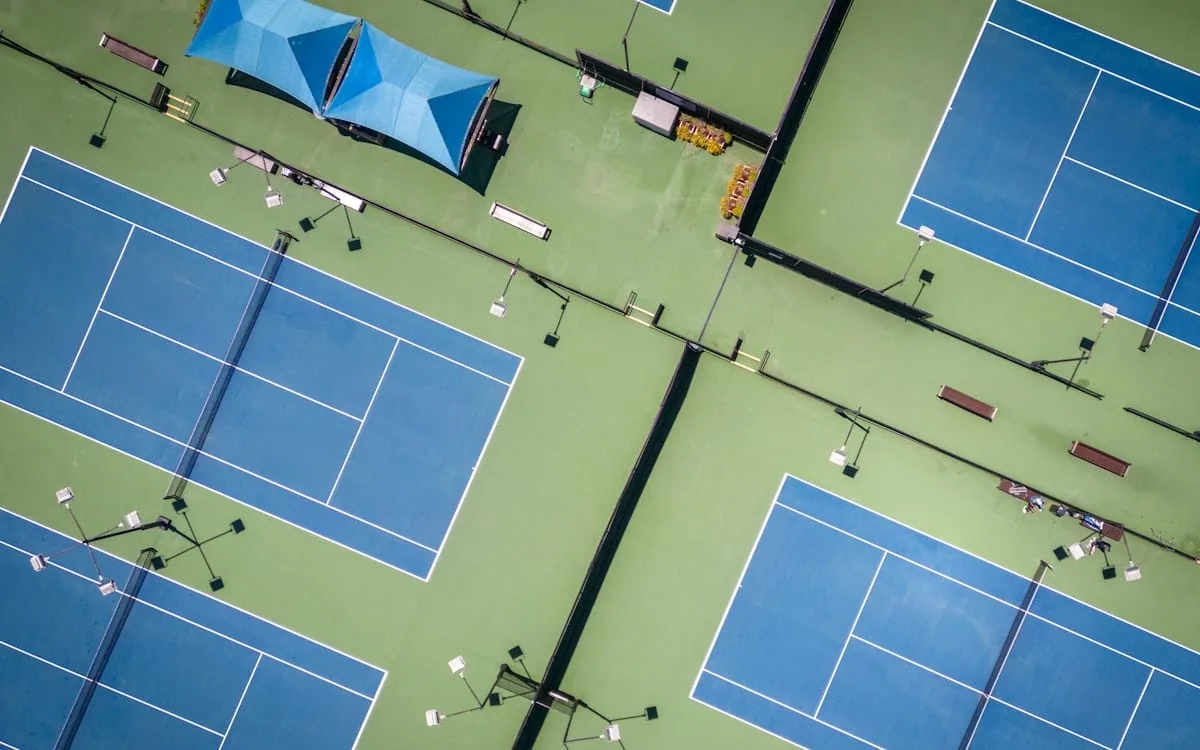
Photo: an overhead view of a club full of hard courts, the ordinary surface on which a twelve-month season is quietly decided.
🎾 Gear from this story
HeadHead Extreme TourAlexander Zverev's racket of choiceView on Amazon →As an Amazon Associate, SUPER.TENNIS earns from qualifying purchases.