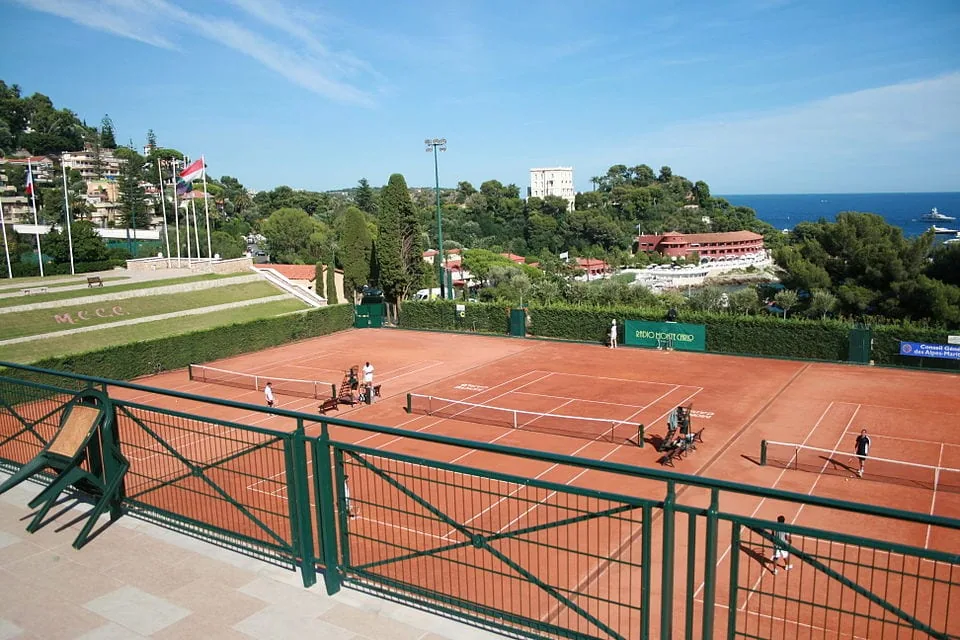
There is a grass bank on a hillside above the Mediterranean with four letters cut into it: M.C.C.C. Below the bank sit the terraced red clay courts of the Monte-Carlo Country Club, the sea filling in the whole right-hand side of the view like a painted backdrop somebody forgot to take away. Every April the world's best players come here for a week and the cameras fall in love with the place all over again.
For fifty weeks of the year it is just a tennis club. And for about fifteen years, one of the small boys hitting on those courts was a kid from the village up the road who was not especially famous, not especially tall in the story anybody was telling, and not on anybody's list of future champions.
This week that kid is the top seed at an ATP tournament in Chengdu, in the south-west of China, roughly nine thousand kilometres from that grass bank. His name is Valentin Vacherot, he is 27 years old, and the sentence "Vacherot is the number one seed" would have been received as a joke by almost everyone in tennis eleven months ago.
The week that broke the rankings
To understand why this week matters, you have to go back to October last year, to a fortnight in Shanghai that people who follow tennis closely still talk about in the slightly dazed tone usually reserved for lottery winners and weather events.
Vacherot arrived at the Shanghai Masters ranked 204th in the world. He was not in the main draw. He was not even properly in the qualifying draw: he got in as an alternate, the tennis equivalent of turning up at the airport hoping somebody misses their flight.
Then he won. Not one match, not a decent run, not a nice story for the local paper. He won the whole thing.
On the way he beat players he had no business beating, and in the semi-final he beat Novak Djokovic 6-3, 6-4, a match in which Djokovic twice called for treatment on his lower back and in which Vacherot, to his enormous credit, did not once let the occasion talk him out of what he was doing. That result alone made him the lowest-ranked man to reach a Masters 1000 final since the series began in 1990.
The final was stranger still. Waiting for him was Arthur Rinderknech, the Frenchman who had knocked out Daniil Medvedev in the other half. Rinderknech is Vacherot's first cousin. Two members of the same family, from the same corner of the Cote d'Azur, playing each other for one of the nine biggest titles outside the Grand Slams, having arrived at the tournament with a combined ranking that would not have got either of them a seeding at a mid-sized 250.
Vacherot won it 4-6, 6-3, 6-3. He became the first Monegasque player in history to win an ATP singles title, the first unseeded champion in Shanghai, and the lowest-ranked Masters 1000 champion of the modern era. Then he cried, and his cousin cried, and their families in the stands cried, and a good portion of the neutral audience watching at home did too.
What it was actually worth
Here is the detail that tells you most about the life he had been living up to that point. Before Shanghai, Vacherot had earned 594,077 dollars in career prize money. That is the total. Eight years of professional tennis, hotels, flights, stringing, physios, Challenger events in cities most fans could not place on a map, and just under six hundred thousand dollars to show for it.
The cheque for winning Shanghai was 1,124,380 dollars.
In one fortnight he earned nearly twice what the rest of his career had produced. If you have ever wondered what the gap between the top thirty and the rest of professional tennis really looks like, that is it, stated in one line, with no interpretation needed.
Back home, the reaction was the sort of thing that only happens in a country small enough to fit inside a large airport. The Monte-Carlo Country Club threw open its doors and gave him a hero's welcome. The president of the Monegasque tennis federation had made the trip out to Shanghai for it. In a nation of roughly 38,000 residents squeezed into two square kilometres of rock, one man had just won a Masters 1000 and the entire place behaved accordingly.
The long, unglamorous route
The temptation with a story like this is to file it under fairytale and move on. That would be unfair to the fifteen years that made it possible.
Vacherot was born on 16 November 1998 in Roquebrune-Cap-Martin, a French commune that curls around the eastern edge of Monaco and which, as it happens, is where the Monte-Carlo Country Club physically sits. The most Monegasque venue in world sport is technically in France. This is the kind of detail the Riviera specialises in.
From the age of nine until he was fifteen he trained with Bernard Balleret. Bernard's son Benjamin was a Monegasque professional himself, and is now Valentin's coach. He is also, in one of the neater knots in this family tree, Valentin's half-brother. A boy learning the game from the father, then spending his professional life being coached by the son. The whole operation has been kept inside two families and one club.
Then, instead of grinding out his late teens on the Futures circuit like most European hopefuls, Vacherot went to America and played college tennis at Texas A&M. College is still treated in some quarters as the route you take when the tour route has not worked out. It bought him four years of matches, physical development and an education, and he came out the other side ready to start a professional career at an age when many of his contemporaries were already halfway through theirs and running out of money.
He then spent years in the part of the sport nobody televises. Challengers in Pune and Nonthaburi. Qualifying draws. Ranking numbers in the 150s and 200s that go up and down according to results on courts with no line judges and no crowd to speak of. He was, by any reasonable measure, a good player having a normal career. Nothing about it suggested Shanghai.
The year after
The hard part of an improbable win is not the win. It is the twelve months afterwards, when everybody who watched it wants to know whether you were a fluke, and when the ranking points you earned sit on your record like a debt that comes due at exactly the same time next year.
Vacherot did not collapse. He went the other way.
In April he came home to Monte-Carlo, to those clay courts under the bank with the letters on it, and produced the run of his life in front of the only crowd that has ever watched him grow up. He beat Juan Manuel Cerundolo and Hubert Hurkacz in three-setters, dismantled the fourth seed Lorenzo Musetti in straight sets, and then in the quarter-final saved thirteen break points to get past the fifth seed Alex de Minaur 6-4, 3-6, 6-3. He became the first Monegasque player of the Open era to reach the quarter-finals of his home Masters 1000, and then the first to reach the semi-finals.
There he ran into Carlos Alcaraz, who was world number one at the time and who beat him. It was, in hindsight, one of the last things Alcaraz did at full tilt before the wrist injury that took him out of Roland Garros and most of his season closed over him.
Two and a half weeks later, on 4 May, Vacherot reached a career-high ranking of 16 in the world. No Monegasque had ever been inside the top 20.
The rest of the year has been solid rather than spectacular, which after Shanghai counts as a triumph of its own. A run to the third round at the US Open as the 22nd seed. A doubles final at Indian Wells alongside Rinderknech, the two cousins back on the same side of the net where they presumably prefer to be. And a ranking that has drifted between the middle teens and the low twenties without ever falling back towards the wilderness he came from.
Rinderknech, for what it is worth, got dragged upwards by the same fortnight. He reached his own career-high of 24 in the world on exactly the same day his cousin reached 16, which is either a lovely coincidence or evidence that two players who grew up hitting against each other tend to improve on the same schedule. He still has not won a tour title. The family has one, and it lives in Monaco.
Monaco, the smallest country in the draw
While all that was happening, something even less likely was going on in the Davis Cup.
Monaco is not a tennis nation in the sense that Spain or Australia are tennis nations. It is a principality with one serious club, a population smaller than a decent English market town, and a Davis Cup history consisting almost entirely of the lower divisions. Its first appearance in the competition was in 1929.
In February this year, Monaco travelled to Astana to play Kazakhstan in a World Group I play-off, which on paper was a formality for the hosts. It was not. Vacherot beat Alexander Bublik 7-6(4), 7-6(7), closing it out with an ace on his fifth match point, and Monaco took an unassailable 3-1 lead. Promotion.
Then, last weekend, while most of the tennis world was looking at the ties that decide who goes to the Davis Cup Final 8 in Bologna, Monaco quietly beat Finland 3-1. Vacherot won both his singles rubbers. The reward is a place in the first round of the 2027 Davis Cup Qualifiers: the first time Monaco has been at that level of the competition since 1929, ninety-seven years ago.
"To be in the best world group," Vacherot said afterwards, "it is frankly incredible for one of the world's smallest countries."
There is an irony here that anyone who follows the sport's finances will have spotted already. Monaco is full of tennis players. It has been a tax residence of choice for the top of the game for decades; Novak Djokovic has lived there for years, and a fair slice of the locker room keeps an address within a short walk of the Casino. What Monaco has never had is a Monegasque. Vacherot is the first person actually from the place to matter in the sport, and he did it while representing a federation that could hold its entire registered playing base in the Country Club's car park.
Why Chengdu, and why now
Which brings us, finally, to this week and to a hard court in China.
The Chengdu Open is an ATP 250, the smallest category of event on the men's tour, with a 28-player draw. It began on Wednesday and runs to Sunday. Vacherot is the number one seed, which earns him a bye into the second round, where he will meet either a qualifier or the American Aleksandar Kovacevic. Alejandro Davidovich Fokina is seeded second; the third seed, Alejandro Tabilo, is the defending champion.
None of that would normally be worth your Thursday evening. The 250s are the tour's working week: small arenas, modest crowds, players you half recognise, and a champion who collects a trophy on Sunday in front of a few thousand people before flying somewhere else on Monday morning. Here is why this one is different.
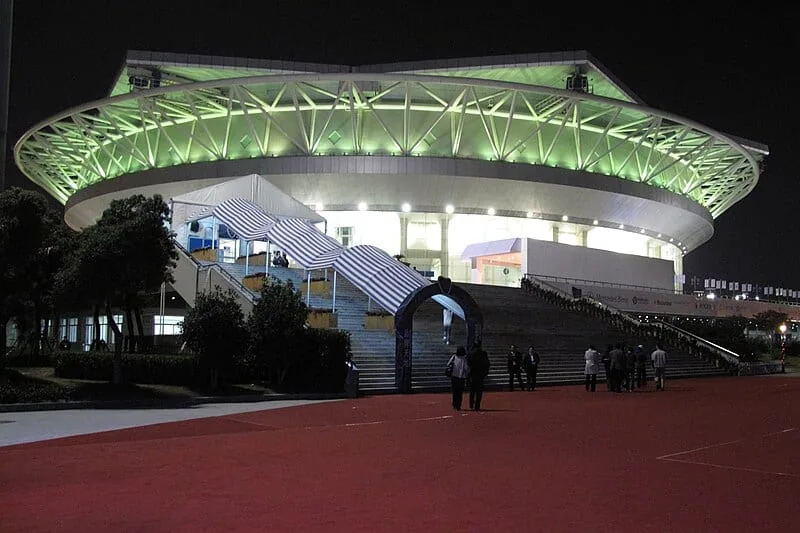
In roughly a fortnight, the tour arrives in Shanghai, at the Qizhong Forest Sports City Arena, and Valentin Vacherot walks back into the building where his life changed. Masters 1000 titles are worth 1,000 ranking points, and those points fall off his ranking the moment the tournament starts again. Unless he goes very deep in Shanghai a second time, his ranking is going to drop, possibly a long way, through absolutely no fault of his own. That is simply how the rolling twelve-month ranking system works, and it is the least sentimental thing in professional sport.
So the weeks before Shanghai are not filler for him. They are the chance to put points on the board that are not borrowed from last year. A good week in Chengdu is 250 points of insulation. A title is a small buffer against the cliff edge waiting in October.
This is the bit of the calendar that casual viewers tend to skip, and understandably so: the matches are on at breakfast time in Europe and the middle of the night in the Americas, the stadiums look half empty on television, and the tournaments have names that do not ring any bells. But the autumn stretch after the US Open is where a surprising amount of the season gets decided, and it is where players like Vacherot either consolidate a breakthrough or quietly slide back down.
What to watch for
If you tune in to a Vacherot match this week having never seen him play, do not expect a highlight machine. He is not one of the physical freaks who has been marketed at you since he was sixteen. He is a late-blooming, well-drilled, extremely composed tennis player who does the right things repeatedly and who, when the moment gets enormous, gets calmer rather than louder. That is what beat Djokovic. That is what saved thirteen break points against de Minaur. That is what closed out Bublik on a fifth match point in front of a hostile Kazakh crowd.
What makes him worth caring about, though, is the shape of the story rather than the shots. Most of what we watch in tennis is the product of a system: a national federation, an academy, a sponsor, a talent pipeline that identified a child at eight and never let go. Vacherot is the product of a family, a single club on a French hillside with a Monegasque flag over it, and a college degree from Texas.
He also carries something almost no other player does, which is a whole country's tennis history on his own record. When he plays a Davis Cup rubber, Monaco wins or loses. When he reached the top 20, Monaco reached the top 20. There is a version of that which sounds like pressure, and he has been asked about it plenty. He tends to answer the way he answered when somebody asked him to choose between the biggest prizes in the sport and the tournament at the bottom of his road.
"I would rather win Monte-Carlo," he said, "than a Grand Slam."
Almost no professional athlete would say that out loud, and fewer still would mean it. He does. Ten years of watching the world's best players walk past your childhood club every April will do that to a person.
He will not win Monte-Carlo next April. The odds are firmly against it, in the way they were firmly against every other thing on this page. But somewhere on that hillside this winter, in the cold months when the clay gets rolled and re-rolled and the tourists have gone, there will be a handful of Monegasque kids hitting balls on court six with the sea behind them, and for the first time ever they will know the name of somebody who did it from there.
Photo: the clay courts of the Monte-Carlo Country Club above the Mediterranean, from our picture library.
🎾 Gear from this story
HeadHead Speed ProNovak Djokovic's racket of choiceView on Amazon →As an Amazon Associate, SUPER.TENNIS earns from qualifying purchases.