There is a Thursday coming in early December when you will reach for the remote out of habit and find there is nothing on. No Shanghai, no Turin, no Bologna, not even a small indoor event in a half-empty hall in a city you had to look up. The tour will have packed itself away, and it will not come back until the courts in Australia start making that hard, bright noise again in January.
That gap is about six weeks long, and most tennis fans treat it like a power cut: something to be endured, refreshed out of, filled with clips of points you have already seen. Which is a shame, because it is the only stretch of the year when the sport sits still long enough to be read about properly.
The year is already thinning out
This season started emptying earlier than usual. On 6 October the world number one posted a video saying he was done for 2026. Jannik Sinner has not played a match since he beat Alexander Zverev in the Wimbledon final in July; his knee has been inflamed for months, he withdrew from Cincinnati, then from the US Open, and finally his medical team told him what he probably already knew. A course of treatment now, and time to be properly fit before he starts building towards 2027. It costs him Shanghai, Vienna, Paris, the ATP Finals in Turin and the Davis Cup week in Bologna. He said he has to think about the long career, not the next eight weeks, which is the most adult sentence anyone has said about tennis all year.
What is left of the season is genuinely good. Shanghai is running this week at the Qi Zhong centre with Zverev as top seed and Novak Djokovic still chasing a fifth title there. The Wuhan Open starts on Monday, the last WTA 1000 of the year, back at the Optics Valley centre; the women have their own unfinished argument at the top of the rankings, where Elena Rybakina is holding the number one spot she took at the US Open, ending a run of ninety-nine consecutive weeks for Aryna Sabalenka. Then the indoor European weeks, then the ATP Finals in Turin from 15 to 22 November at the Inalpi Arena, then the Davis Cup Final 8 in Bologna from 24 to 29 November. And then the lights go off.
Six or seven weeks of nothing. If you are the kind of person who watches tennis rather than plays it, that is a long time to go without the thing you like.
Highlights will not get you through that. Highlights are the ending without the waiting, and waiting is most of what tennis actually is. Books give you back the part the edit cuts out.
So here are ten, arranged roughly by how much tennis you need to already know. None of them require you to have ever hit a ball properly in your life. Several of them are better if you have not.
Start with the one that changed what a sports book could be
Open came out in 2009 and more or less ruined the genre for everyone who came after. Andre Agassi wrote it with J.R. Moehringer, a Pulitzer winner who understood that an athlete talking about process is boring and an athlete talking about fear is not.
The famous part is the first page, where Agassi says plainly that he hates tennis and has hated it for as long as he can remember, and plays it anyway because it is the only thing he was ever allowed to be. Everything after that is a man explaining, in order, exactly how a childhood gets spent. The ball machine his father built and nicknamed the dragon. The academy in Florida that functioned, in his telling, as something closer to a holding facility. The wigs. The marriage that ended. The back that eventually required injections just to let him walk out to serve.
It works for people who do not play because Agassi barely writes about technique. He writes about the inside of a day. If you have only ever seen him as a bald man in loud shorts on a nostalgia reel, the book will rearrange him entirely, and his record will read differently afterwards.
One afternoon, taken apart stroke by stroke
Levels of the Game is from 1969 and is about a single match: Arthur Ashe against Clark Graebner, a semi-final at Forest Hills in 1968, the first year professionals were allowed into the Grand Slam events.
John McPhee does something nobody had quite done before. He moves point by point through the match, and every time the ball is in the air he steps sideways into who these two men are: Ashe, Black, from segregated Richmond, playing a loose improvisational game that his opponent reads as recklessness; Graebner, white, from a comfortable Ohio family, hitting the ball the way he was raised to, hard and straight and correct. The tennis and the biography keep swapping places until you cannot separate them, which is the point.
It is about one hundred and fifty pages. You can read it in an evening, and it will permanently change how you watch a baseline rally, because you will start wondering what each shot selection says about the person making it.
Pair it with Days of Grace, the memoir Ashe wrote with Arnold Rampersad, published in June 1993, four months after he died. It opens with his announcement in 1992 that he had contracted HIV from a transfusion during heart surgery, and ends with a letter to his daughter, who was six. It is not a tennis book in any useful sense. It is just the best thing a tennis player has ever written.
The writer who loved watching more than anyone
String Theory collects five essays David Foster Wallace wrote about tennis, gathered by the Library of America in 2016. He had been a seriously good junior in central Illinois, good enough to know exactly how far short of professional he was, and that gap is what the whole book runs on.
The one everyone quotes is the Federer essay, in which Wallace tries to explain why watching that particular player felt like a physical event rather than a sporting one. The better one, honestly, is the piece about Michael Joyce, a player ranked around the edge of the top hundred, in which Wallace follows a man who is one of the best few dozen tennis players on the planet and whose life is nevertheless mostly airports. There is also an essay about Tracy Austin that is really an essay about why sports autobiographies are usually terrible, which is funny to find in a collection like this.
He writes long sentences and uses footnotes like a man who cannot stop talking. If that sounds exhausting, start with the Joyce piece and see how you feel after twenty pages.
When it was a completely different sport
A Handful of Summers is Gordon Forbes remembering the amateur circuit of the 1950s and 1960s, when he was a South African player good enough to be in the draws and not good enough to win them. Peter Ustinov wrote the foreword, which tells you roughly what register the book is in.
Nobody was paid. Everyone travelled by boat and train. Players shared rooms, borrowed money, and spent a great deal of time being mildly disgraceful in hotels across Europe. Forbes writes it all down as comedy, and then every so often lets a sentence land that reminds you these were young men crossing continents in an era when crossing continents was difficult, chasing something that would not have supported them for a week.
For a modern viewer it is the most useful kind of history: it shows you what the sport has gained, and quietly what it has lost.
The woman who built the business you watch
All In is Billie Jean King's 2021 memoir, written with Johnette Howard and Maryanne Vollers, and it is the one book on this list that explains why professional women's tennis exists at all in its present shape.
The parts people know are here: the Riggs match, the prize money fights, the nine players who signed a one-dollar contract and started their own tour because the alternative was accepting a fraction of what the men were paid. The parts people do not know are better. King writes with real exactness about being outed in 1981, losing every endorsement she had within a day, and about the eating disorder she lived with through the years when she was winning everything.
Every time you watch a WTA 1000 draw like the one starting in Wuhan on Monday, with its own prize fund and its own ranking and its own television deal, you are looking at the result of arguments this woman had in the early 1970s and mostly won.
If you are still not over him
The Master is Christopher Clarey's Federer biography, published in August 2021 while the end was clearly coming. Clarey covered him for decades and had access to him, to his coaches, to his rivals, and to the people who watched him as a teenager break rackets and lose his temper, which is the version of Federer almost nobody saw.
It is a reporter's book rather than a love letter, and it is better for it. The chapters on the long apprenticeship, the years when he was talented and frustrating and not yet anything, are the ones that will surprise you if your mental image of him starts around 2004. Clarey is good on the mechanics nobody films: the scheduling decisions, the coaching changes made quietly in December, the way a player in his thirties rebuilds a shot because the alternative is retiring.
There is also a useful corrective in it for anyone who has spent the last few years being told that the current top of the game is somehow lesser. Federer spent most of his early twenties losing to people whose names are now trivia answers. Greatness looked patchy at the time too.
A whole season, written like poetry
The Circuit follows the 2017 men's season, and it was written by Rowan Ricardo Phillips, who is a poet, and it won the PEN/ESPN prize for literary sports writing in 2019.
That year was the one where Federer and Nadal both came back from injury and divided the Grand Slams between them when everyone had written them off. Phillips travels through it in real time without knowing how it ends, which gives the book an uncertainty that most sports writing cannot fake. He also writes about crowds, airports, cities and the strange business of flying somewhere to watch strangers, better than almost anyone.
If you have ever sat up until four in the morning for a match in another time zone and then struggled to explain to a colleague why, this book is the explanation.
Where all of this came from
Love Game is Elizabeth Wilson tracing the sport from Victorian lawns to the present, and it is the one to read if you have ever wondered why tennis has so many odd manners attached to it.
Wilson is interested in class, in clothing, in who was allowed to play and who was allowed to watch, and in the long awkward negotiation between tennis as a garden party and tennis as a professional sport. A lot of what still looks strange about the game makes sense once you see the social machinery underneath it, from the hush before a serve to the all-white rule that Wimbledon has never let go of.
The match people are still arguing about
Strokes of Genius is L. Jon Wertheim on the 2008 Wimbledon final, published the following year, and it borrows McPhee's method: one match, taken apart, with everything else fitted around it.
Four hours and forty-eight minutes of playing time, two rain delays, and a finish in light so bad the players could barely see the ball. Wertheim uses it to explain racket technology, string tension, the economics of a player's team, and the particular psychology of two men who liked each other and were trying to end each other's year.
If you enjoy that, the rivalry literature goes back further. The 1980 Wimbledon final has its own small library, and the Borg and McEnroe story is the one most often retold, usually badly, by people who think temperament is a personality rather than a strategy.
How to actually get through ten books
You will not. Nobody does. Pick two.
If you came to tennis recently and are still slightly embarrassed about not following everything, start with Open and then Levels of the Game. They are both short, both about people rather than systems, and neither assumes you know what a slice backhand is for. If the vocabulary is still the bit that trips you up, the scoring itself takes about five minutes to sort out properly and then you never have to think about it again.
If you have been watching for twenty years and feel like the sport has become a stream of identical hard courts, read A Handful of Summers and then Love Game, in that order. The first will make you laugh and the second will explain why the first is funny.
If you are angry about something in the current game, read All In. Whatever it is, King has already had the argument, usually in a committee room, usually against someone who told her the figures simply did not allow for it.
And if what you actually miss is a specific player rather than tennis as a whole, read the book about that player and do not apologise for it. That is a perfectly good reason to read anything.
A practical note, because the off-season is also when people overspend out of boredom. Four of these are old enough to be easy to find secondhand, and Forbes in particular turns up in charity shops in tennis-playing countries far more often than it should. Several work well as audiobooks on a dark walk, though not String Theory, where the footnotes do not survive being read aloud. And if you are going to buy only one of them new, make it the Phillips. Small presses and working writers need the sale more than the estate of anyone else on this list.
In January
The thing nobody tells you about reading tennis in the off-season is what it does to you when the season comes back.
You will be watching a first-round match in Australia in January, two players you have barely heard of, one of them ranked in the eighties, both of them sweating through a second set that nobody is paying attention to. And you will find yourself thinking about Michael Joyce in the airport, or about Forbes on a boat with no money, or about Graebner hitting the correct shot because he was raised to hit the correct shot. The match will not have changed. You will have.
Six weeks of silence is coming. You may as well arrive at the other end of it with something in your hands.
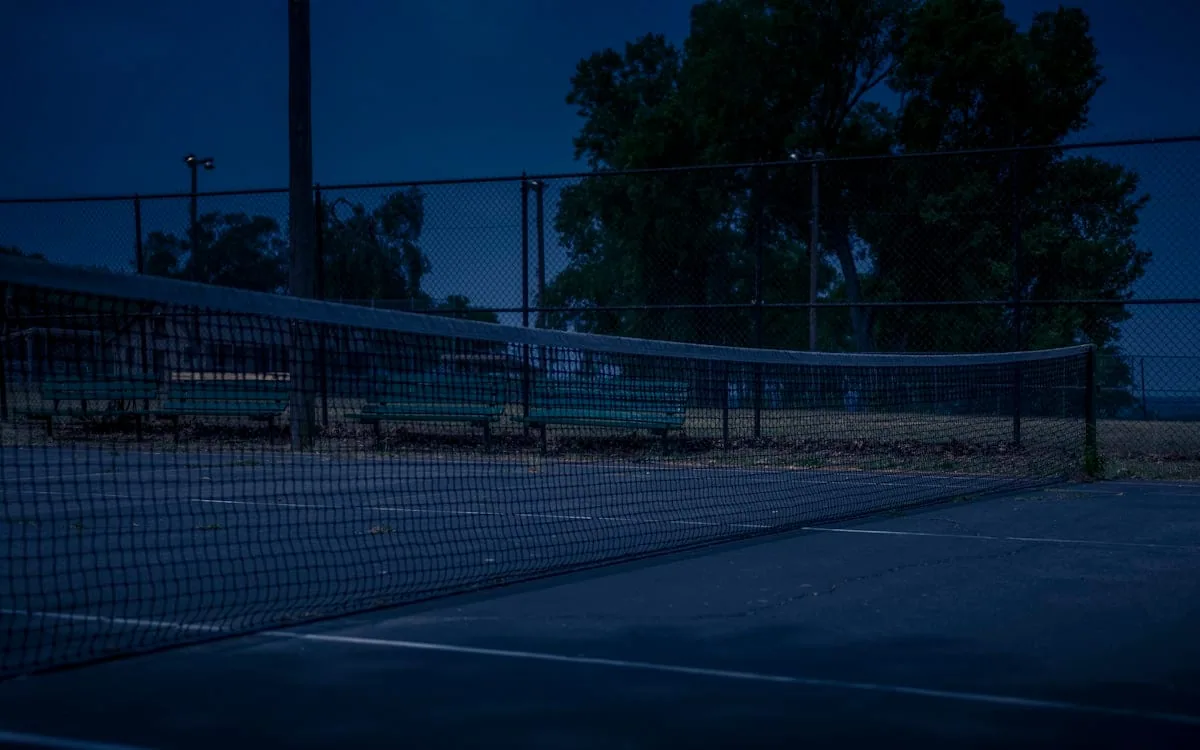
Photo: an empty public court at dusk, the net still up and nobody left to use it.
🎾 Gear from this story
WilsonWilson Pro Staff RF97Roger Federer's racket of choiceView on Amazon →As an Amazon Associate, SUPER.TENNIS earns from qualifying purchases.