Somewhere in the first ten minutes of the US Open main draw today, a teenager in a navy Ralph Lauren polo will jog to the base of the net on Arthur Ashe Stadium, fold herself into a crouch, and then do the hardest part of the job: nothing at all. No fidgeting. No scratching an itch. No looking up at the 23,000 people above her. Just stillness, for as long as the rally lasts, while two of the best players alive hit a ball at each other roughly eight feet over her head.
You have watched hundreds of hours of tennis and you have probably never once watched her. That is the point. The ball crew is the only group at a Grand Slam whose entire performance is measured by how completely you fail to notice them. And yet they are on court more than anyone. Players come and go in two hours. Umpires rotate. The ball crew is there from the first ball of the qualifying weekend to the last point of the men's final, in the heat, in the rain delays, in the 1am finishes that only New York produces.
This year there are 315 of them. They were chosen from thousands. Here is what it takes.
What the job actually is
At a Grand Slam, six people work a court at a time. Two crouch at the net, one at each post, and four stand at the back corners behind the baselines, one in each pocket of space between the singles sideline and the doubles alley. They swap positions on a rotation so nobody spends the whole match doing the sprinting or the whole match doing the standing, and each shift runs about an hour before a fresh set of six comes on.
The net pair have the glamorous half and the terrifying half of the job. They are the ones who dart across the court between points to collect a dead ball, and they are the ones who have to read the game well enough to know when it is safe to move. Get that wrong at a Slam and you are in the frame of a highlight reel for the rest of your life. The back four are the supply line. They feed balls to the server, hold the spares, and cover the corners.
Then there is the choreography around it. The 90-second changeover, when they run the umbrellas out on a hot afternoon and hold them steady over a seated player who is not looking at them. The towel, handed over and taken back, over and over, for three or four hours. The bin of used balls swapped for fresh ones every nine games. The moment a player's cap comes off and someone has to sprint it back.
And the roll. When a ball has to go from one end of the court to the other, it does not get thrown across the middle of a live playing surface. It gets rolled, flat and fast and dead straight, right along the ground at the back of the court, usually about 40 feet, ideally without a single wobble. It looks like the easiest thing in the world when it is done well, which is exactly why it is one of the things they test you on before they let you anywhere near a match.
Twenty minutes that decide your summer
The route in is not a secret and it is not an invitation. Anyone who is at least 14 and legally allowed to work in the United States can apply, which is why the application list for a New York summer runs into the thousands. Most applicants come from the tri-state area, which gives the crew its particular flavour: Queens teenagers, teachers on their holidays, retirees from Long Island, a lot of people who grew up hearing planes come down over the courts.
Applicants who get through the paperwork are invited to an in-person tryout in the middle of June, on the courts at the Billie Jean King National Tennis Center. Around 650 people made it that far this year. Each of them got 20 to 30 minutes on court to prove they could do the job.
They run line drills, back and forth between the sidelines, scooping up balls at speed, because agility is the single biggest thing the assessors are looking for. They catch and they bounce, to show hand-eye coordination that holds up under nerves. They roll, and the roll is judged on whether it stays flat and straight. And they throw, because a ball person has to be able to send a ball the length of a tennis court on the fly, which is a great deal further than it looks on television. Cathie Delaney, the assistant director of ballpersons, has told rooms full of hopefuls exactly that: you will have to throw the length of the court.
Of the 650 who tried, 315 came out the other end onto this year's crew. It is not quite as brutal as it sounds, because a good number of the people on court over the next fortnight are returning veterans who have done this for five, ten, twenty years and know the rhythms better than some of the players. But for a first-timer it is genuinely competitive, and plenty of very fit, very keen people go home from a Sunday in June having been beaten by a ball that would not roll straight.
Fourteen to eighty-two
The single loveliest thing about the US Open ball crew is a policy that barely gets mentioned: there is no upper age limit. Every other stereotype about this job dissolves the moment you know that.
The youngest members are 14, which is what you expect. The rest is what you do not. Bob Kass, a semi-retired real estate executive from Port Washington, tried out in 2021 at the age of 67 and did not make it. He went away, worked on it, came back, and made the crew at 69, sharing a court rotation with kids who were 55 years younger than him. He said the point was to show that his demographic still had plenty to offer. Spectators recognised him, called out to him, wanted photographs with him.
He is not even the record. That belongs to Manny Hershkowitz, who worked on court at Flushing Meadows in September 1999 at the age of 82, and is listed by Guinness World Records as the oldest ball person at a major championship. Eighty-two. Crouching at the net. In New York, in September.
That mix is the crew's actual identity, and it is visible from the stands if you look for it. On the same court you will see a ninth-grader who was doing algebra homework in May and a man in his sixties who has taken two weeks off work, both wearing the same polo, both moving on the same whistle.
The only Slam that pays
Here is the part that surprises people: this is a job. The US Open is the only Grand Slam that pays its ball crew, at a rate reported this summer at around 19 dollars an hour, with a meal allowance on top. The shifts are long and stack up over the best part of three weeks once qualifying and Fan Week are counted, so it is a real summer wage rather than a token.
Then there is the uniform, which has quietly become one of the most coveted pieces of kit in tennis. Ralph Lauren dresses the crew every year in a specific ball crew collection, they wear it head to toe, and they generally get to keep it. There are people who apply for this job largely because they want to be the person in the room who owns one.
None of which is really why anyone does it. What you are actually buying with those hours is a vantage point money cannot get you. There is no ticket at Flushing Meadows, at any price, that puts you eight feet from a Novak Djokovic service motion at 9pm under the lights on a night session at Arthur Ashe. The crew gets that for a fortnight, and they get paid for it.
How the other three majors do it
Every Slam solves the same problem differently, and the differences say a lot about each tournament.
Wimbledon runs the most famously rigorous programme in the sport. Its ball boys and girls, universally called BBGs, are not open applicants at all. They are nominated by around 30 schools in the boroughs near the All England Club, mostly Merton, Sutton, Kingston and Wandsworth, plus a handful in Surrey, and the schools put forward pupils in Year 9 and 10 in the autumn. Selection days follow at Raynes Park in the depths of January, testing fitness, coordination, ball skills, concentration and the ability to stand absolutely still. Those who survive train for around five months before the Championships even start. Roughly 280 BBGs make it each year out of about 1,500 candidates, a group that typically splits into around 170 new recruits and 110 returning from previous years. It is a school scheme run to the standards of an elite sports academy, and it has been supplied by local schools since 1969.
The Australian Open takes the opposite approach and casts its net across an entire continent. Around 400 ballkids work the tournament each January, chosen from well over 3,000 applicants, with trials run state by state through the spring and summer and a mandatory block of on-court training sessions before an official induction day. Tennis Australia also runs an international strand: a group of ballkids from the China Open, for example, has travelled to Melbourne to work the Australian Open, which is about as good a school trip as exists.
Roland Garros, meanwhile, has its own recruitment across France, and the Australian Open has been known to send its best performers there as a reward. Four tournaments, four philosophies, one job.
The last humans on court
There is a reason to pay more attention to the ball crew in 2026 than there was ten years ago, and it is not sentimental. They are almost the only people left.
The US Open has not used line judges since 2021, when it became the second major to go fully electronic and put Hawk-Eye Live on every competition court. Where there used to be a semicircle of officials in coordinated kit, each with a job and a voice and the occasional catastrophic misjudgement, there is now a camera array and a recorded call. Seventeen courts, a couple of hundred cameras, no humans. Wimbledon followed in 2025. The old drama of a player wheeling around to glare at a line judge is simply gone from the sport.
What that leaves on a US Open court is the two players, the chair umpire, and six people in Ralph Lauren. That is the entire human population of the most-watched tennis stadium on earth. The ball crew are not decoration around the edges of a professional match any more. They are, along with the umpire, the last of the working staff you can actually see.
The towel problem
The job has also had its own reckoning, and it is worth knowing about because it changed how some players behave.
For years the towel ritual sat awkwardly with a lot of viewers: a multimillionaire athlete clicking fingers or gesturing impatiently at a 15-year-old to produce a sweat-soaked towel, several times a game. It came to a head when Fernando Verdasco was widely criticised after video circulated of him snapping at a ball boy who had not moved fast enough. Roger Federer used a press conference to tell his fellow professionals, in plain terms, to respect ball kids.
The ATP experimented with a fix. At the Next Gen Finals in Milan, towel racks were installed in the corners of the court so players had to fetch their own towels rather than have a teenager sprint one over. Reaction split predictably. Andrey Rublev was in favour. Stefanos Tsitsipas, who won the event, hated it, complaining that he was always running for the towel and always thinking about it while he played. The racks never made it to the Slams, so the towel is still handed over at Flushing Meadows this fortnight. But the conversation lingered, and the way most players handle that exchange now, with a nod or a thank you, is noticeably different from ten years ago.
The ball boy who came back with the trophy
If you want the ultimate argument for taking this job seriously, it is a Swiss one.
In 1992 and 1993, a skinny local kid rode his bike ten minutes from home to the Swiss Indoors in Basel and worked as a ball boy. In the 1993 final he collected balls for Michael Stich and Stefan Edberg; Stich won it in four sets, and afterwards handed the 12-year-old his ball boy's medal. The kid was Roger Federer. He would go on to win that tournament ten times as a player, and he has said the medal is still among his prized possessions, that he loved being a ball boy there because it let him watch the best players in the world up close and see how they handled the pressure.
That is not a fairytale about becoming a champion. It is a fairly precise description of what the job gives you: proximity. You learn what the ball actually sounds like off a professional racket, how much a player sweats in the third set, what the silence before a second serve feels like from inside it. It is the best tennis education available anywhere, and at Flushing Meadows it comes with an hourly rate.
What to watch for, starting tonight
The next fortnight is the best chance you will get all year to see this properly, so here is how to actually watch it.
On changeovers, when the broadcast is showing you a player with a towel over their head, look at the bottom of the frame. That is where the umbrella is being held. Watch how long an arm stays perfectly still. On a hot afternoon at Flushing Meadows, with the court surface radiating heat back up at everyone standing on it, that is a genuinely punishing thing to do for two weeks.
At the end of a rally, watch the net pair rather than the ball. You will see them read the point a fraction before it finishes, and the good ones are already rising out of the crouch as the last shot is struck.
Watch a roll. Really watch one. If it stays flat and arrives dead in the other player's hand, that person passed a June audition to be able to do that.
And if you are ever at the site in person, go and stand at an outside court during the first week rather than staying in the big stadiums. That is where you can hear the crew working, where the sightlines are close enough that you can see a 14-year-old getting instructions from a supervisor between games. If you have never done the free week at Flushing Meadows before the main draw, it is the same crew, the same drills, no queue and no ticket. For everything else about the fortnight, from the schedule to the surface, our US Open tournament guide has it, and the story of the man whose name is on the big stadium is worth ten minutes too, because Arthur Ashe had opinions about who tennis was for that the ball crew quietly proves right every year.
Because that is what those 315 people are, in the end. A Queens ninth-grader, a retired executive who failed the audition once and came back, a schoolteacher, a college athlete, all dressed identically and all of them a few feet from the best players on the planet. The tournament sells itself on stars, and the stars deserve it. But the fortnight runs on people who trained for a job you are supposed to look straight through, and who will spend the next two weeks being very good at being invisible.
Look at the edges of the picture tonight. There is a whole cast down there.
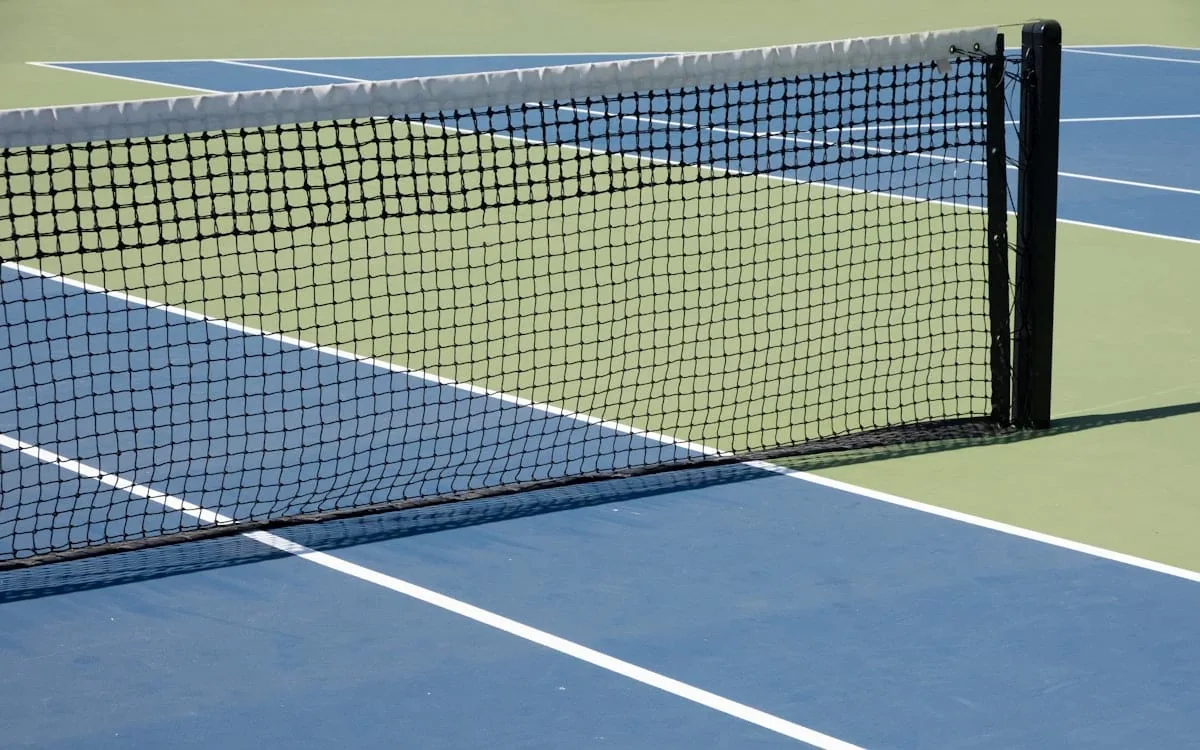
Photo: a tennis net against a blue hard court, via Unsplash.
🎾 Gear from this story
WilsonWilson Pro Staff RF97Roger Federer's racket of choiceView on Amazon →As an Amazon Associate, SUPER.TENNIS earns from qualifying purchases.