There is a second tournament happening at the US Open this week, and most people watching the tennis on television will never see a point of it.
It starts today. While the quarter-finals fill Arthur Ashe Stadium and the cameras follow the names you already know, the wheelchair championships begin on the courts out beyond the crowds, and they run all the way to Saturday. Doubles gets going first, on Tuesday. Singles starts on Wednesday. The doubles finals are on Friday, the singles finals on Saturday, and by the time the last ball is struck at Flushing Meadows two men may have done something that has not been done in this sport very often at all.
If you have never watched a wheelchair match, this is the week to fix that, and not out of duty. The tennis is genuinely brilliant. It is also, right now, sitting on two of the best storylines anywhere in the game.
One rule, and only one
What surprises people most is how little is different.
Same court. Same net, at the same height. Same balls, same lines, same scoring, same tiebreaks, same coin toss. A set is still six games, a match is still best of three. When you tune in mid-rally you are watching tennis, full stop.
The single change is the bounce. In wheelchair tennis the ball is allowed to bounce twice before it is returned, and the second bounce is permitted to land outside the court. That is it. That is the whole rulebook difference.
And once you know it, you start to see what it actually does to the sport, because it is not a concession. It is the thing that makes the geometry work. A player who is chasing a ball across the court has to arrive, set the chair, and hit, and the second bounce is what buys them the fraction of a second to do all three. Watch a few games and you will notice that the best players almost never use it. Taking the ball on the first bounce is the aggressive option, the way stepping inside the baseline is in the running game, and the moment somebody is forced into that second bounce you can see the point tilting. It is a live scoreboard of who is in control, and it is right there in front of you.
The chair is the equipment
The other thing worth knowing before you watch is that the chair is not a wheelchair in the sense you are picturing. It is built for one job.
The wheels lean inward at the top, a camber that looks strange for about four minutes and then looks obvious, because it makes the chair pivot on a coin and stops it tipping through a turn. There is usually a small castor at the back to catch the chair when a player leans into a serve. Players are strapped in at the legs and hips, because the chair has to move as one piece with the body rather than under it. None of this is comfortable furniture. It is closer to a racing bike than to anything you would find in a hospital corridor.
Which leads to the part that takes the longest to appreciate: everything a player does with their hands, they are also doing with their hands. There is no running. There is pushing, and the push has to end before the swing begins, and then it has to start again immediately after the follow-through. The rhythm of the whole sport is push, brake, hit, push. Once you hear it, matches sound completely different, and the players who are best at it are the ones who seem to arrive early to balls that should have beaten them.
It changes what a good shot even is. On foot, an opponent stranded in the corner is in trouble but recoverable; a couple of hard strides and they are back. In a chair, recovery costs pushes, and pushes cost time you cannot borrow back later in the rally. So the winning play is often not the outright winner at all. It is the ball hit somewhere slightly awkward, one metre from where the other player wants to be, forcing a turn and a reset and then another turn. Points are built rather than blasted. When a rally does end abruptly, it is usually because three shots earlier somebody quietly won the argument about position.
Tokito Oda is twenty years old and holds everything
The story of the men's draw is a Japanese player who is not yet old enough to have a long career behind him and already has one.
Tokito Oda turned twenty in May. Last September, on these same courts, he beat Gustavo Fernandez to win the US Open for the first time, and that title completed a career Golden Slam: all four majors plus Paralympic gold, gathered up before his twentieth birthday. Most players spend a career failing to assemble that set. He did it as a teenager.
Then he kept going. He won the Australian Open in January, beating Martin de la Puente 3-6, 6-2, 6-2 to hold all four majors at once. He won Roland Garros in June, beating Alfie Hewett 6-3, 6-3. He won Wimbledon in July, beating Hewett again, 6-1, 6-1, for a third title there and a tenth major singles title in total.
So do the arithmetic on what he is walking into this week. Australian Open, Roland Garros, Wimbledon, all won this calendar year. One tournament left. If Oda wins in New York on Saturday he completes a calendar-year Grand Slam, and he does it having also held the previous US Open, which would mean five consecutive majors. That is the level of thing you tell people you saw.
He is worth watching for the tennis alone, incidentally, not just the ledger. He plays with his chest almost over the front wheels, absurdly low and forward, and he hits a backhand that most players in the draw cannot get near. He is also visibly, unmistakably enjoying himself, which after eighteen months of being the man everyone is trying to beat is not nothing.
The man on the other side of it
Alfie Hewett has been in both of those finals this year, and that framing is unfair to him, so let us do it properly.
The 28-year-old from Norfolk has won the US Open singles title four times, in 2018, 2019, 2022 and 2023. He lost the 2021 final to Shingo Kunieda, which in that era was not a criticism of anybody. For most of a decade he has been either the best player in the world or the man half a step behind whoever was, and he is now running into a twenty-year-old at the peak of a run. Sport does that to people. It does not diminish them.
And then there is the doubles, which is where the British story becomes something close to absurd. Hewett and Gordon Reid have been playing together for years, and in June at Roland Garros they won a record-extending seventh straight title in Paris, their twenty-fourth Grand Slam title as a partnership. Reid, in the same match, collected the thirtieth major title of his own career. A month later they added another Wimbledon, their seventh there.
Doubles in wheelchair tennis is the format nobody warns you about, because the court fills up. Four chairs in a space designed for two people on foot, angles that should not exist, players covering for each other in ways that are obvious only after they have worked. If you have half an hour on Friday, this is the thing to spend it on. Hewett and Reid have made an entire second career out of turning up.
The quiet streak nobody is talking about
While everyone counts Oda, Niels Vink has been doing exactly the same thing in the quad division and getting a fraction of the attention.
The quad draw is for players whose impairment affects three or more limbs, which for many of them means the racket is taped or strapped to the hand, and the serve is built around the grip they can hold rather than the one they would choose. It is a mixed division: men and women compete in the same draw. It also produces some of the most inventive tennis at the whole tournament, because when a stroke is unavailable, players build a different one.
Vink, from the Netherlands, won the Australian Open in January by beating his countryman Sam Schroder 6-3, 7-6(5), which completed his own career Golden Slam alongside the Paralympic gold he won in Paris in 2024. He won Roland Garros in June over Ahmet Kaplan, 6-3, 6-4. He defended Wimbledon in July past Schroder, a fifth consecutive major singles title and a tenth overall. He arrives in New York in precisely the same position as Oda: three majors this year, one to go, a calendar Grand Slam sitting there.
Two calendar Grand Slams, in one week, at one tournament. It seems worth somebody mentioning.
The draw that actually opened up
The women, meanwhile, have spent 2026 doing the opposite of what everybody expected, which is the best possible reason to watch.
For years the answer was Diede de Groot and there was no follow-up question. The Dutch player won six US Open titles in a row from 2018 to 2023 and put together records that read like typing errors. Then came injury, and surgery, and the strange experience of being the greatest player in your sport while losing matches you used to win without thinking.
This year has been a proper argument. In January, Li Xiaohui of China beat de Groot 6-1, 6-2 in the Australian Open final for the first major title of her life. In June, de Groot answered in Paris, beating Ksenia Chasteau 6-1, 6-0 for a sixth French Open title, her twenty-fourth major singles title, and her first in nearly two years. It also made her the first player ever to win all four majors at least six times each, which is a sentence you have to read twice.
Then in July, at Wimbledon, Yui Kamiji beat her 6-0, 6-0. That is not a misprint. The Japanese player, who has been in the top of this sport for a decade, took her first Wimbledon title without dropping a game in the final, sealed a career Golden Slam of her own, and collected a twelfth major.
Three Slams this year, three different champions. And Kamiji is the defending champion in New York, having beaten Li 0-6, 6-1, 6-3 in last year's final here, a scoreline that tells you everything about how that match went and how it turned. Whatever happens in this draw is not written yet, which is exactly the appeal of any underdog run, the way an unheralded lucky loser can take over a Grand Slam when the door opens for a week.
The summer they tried to cancel it
None of this was inevitable, and it is worth remembering how recently it nearly went the other way.
In June 2020, planning a pandemic US Open with a shrunken footprint, the USTA announced there would be no wheelchair event that year. No juniors, no mixed doubles, no wheelchair. The Australian Dylan Alcott called it disgusting discrimination in public and did not soften it. Britain's Andy Lapthorne said the same. Andy Murray backed them. Within about a week the decision had been reversed and the wheelchair competition was restored to its usual slot in the calendar, played that September.
That is five years ago, not fifty. The reason the draws are here this week, and the reason they are bigger than they were, is that players spent a decade being loud about it and refusing to be the part of the schedule that gets cut first when the tournament needs space.
You can see the shift in the money, too. Wheelchair prize money at this year's US Open is a record 2,309,200 dollars, up more than forty per cent on last year. That is a rounding error against what the singles champions on Ashe will take home, and if you want the full breakdown of how a Grand Slam divides its cheque, the shape of it is instructive. But the trajectory is the point. Ten years ago these numbers were not in that conversation at all. There are junior wheelchair events at this tournament now, which means the pipeline exists, which means the players coming up will not have to argue for a spot on the schedule the way Alcott and Lapthorne did.
How to watch it, if you are new
Two practical things, and neither requires you to become an expert.
The first: watch the chair, not the ball, for one whole game. It feels wrong and it works. You will start to see the positioning battle underneath the rally, the way one player is repeatedly turning square and pushing forward while the other is being spun and dragged behind their own baseline. It is the same fight over court position that decides every match on the main show courts at Flushing Meadows, just made visible.
The second: go early in the day and get close. These matches are played on the smaller courts, where you can stand a few metres from the action rather than watching from a stand two hundred feet up. You can hear the wheels. You can hear players talking to themselves, and to each other, in a way the microphones in the big stadium never quite catch. It is the same reason the outside courts are the best-kept secret of the first week of any Slam, and it comes with all the ordinary joys of a day at this tournament, oversized cocktail included.
Saturday
By Saturday afternoon this will have resolved one way or another. Oda will have a calendar Grand Slam or a loss he did not expect. Vink will have the same, in a division most people cannot name. Hewett will have another title, another final, or another year of being asked about somebody else. One of Kamiji, de Groot, Li or someone nobody has picked will be holding a trophy in the New York heat.
The tennis will have been superb either way, played by people who are among the best in the world at a game the rest of us cannot play, on a court a few steps from where you are standing. That is a very short walk for the amount you get back. Take it this week, while there are two Grand Slams sitting on the table and hardly anyone at the fence.
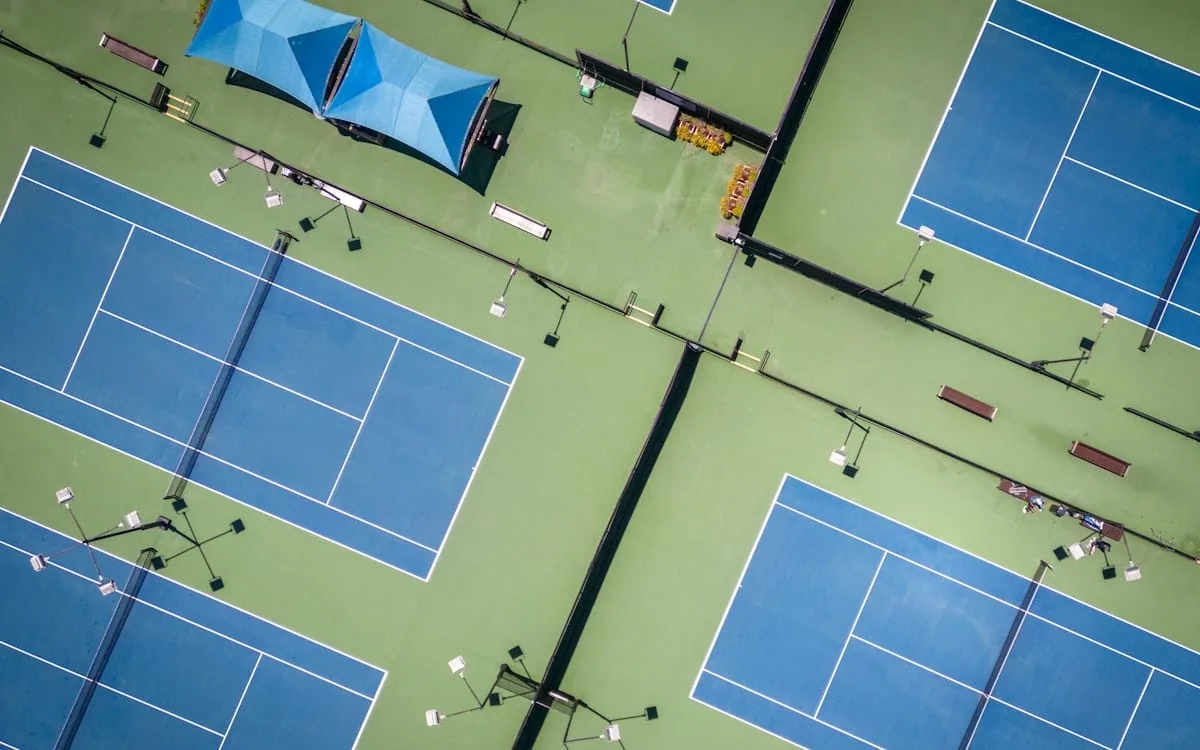
Photo: an aerial view of outdoor hard courts with matches in progress, via Unsplash.