By Sunday afternoon, while most of the tennis world has already mentally boarded a flight to New York, forty-eight men will walk out onto hard courts on a university campus in North Carolina and start a tournament almost nobody has circled.
This is the Winston-Salem Open, and it occupies the least glamorous slot in professional tennis: the seven days immediately before the US Open. The main draw begins on Sunday 23 August at the Wake Forest Tennis Complex, with two matches scheduled for the afternoon and two more under lights. The singles final is on Saturday 29 August at four in the afternoon. The very next morning, the US Open main draw starts in Queens, and everything that happened in North Carolina gets quietly filed under preparation.
What is worth knowing, though - and it is the reason I want you to give this week ten minutes of your attention - is that the word preparation does a lot of lying there. For a certain kind of player - and there are far more of them than there are Alcarazes and Sabalenkas - Winston-Salem is not a warm-up. It is the tournament. It is a genuine chance at a trophy, a fortnight of ranking points, and in several famous cases a career turning over from potential into fact.
The worst week on the calendar, and the men who take it anyway
Think about what you are being asked to do as a player in the last full week of August.
You have just come out of a month of North American hard courts. Toronto or Montreal, then Cincinnati, both of them brutal, both of them humid, both of them played in the sort of heat that turns a three-set match into an endurance event. If you had a good run, you are tired. If you had a bad one, you are tired and doubting yourself. And in eight days, the last Grand Slam of the season begins, the one with the biggest stadium, the loudest crowd and the longest fortnight in tennis.
The conventional wisdom says rest. Fly to New York early, practise on the actual courts, get your body flat and your sleep right, and arrive at Flushing Meadows with something left in the tank.
The players who enter Winston-Salem have decided the conventional wisdom is wrong for them. Their argument is simple and it is very human: you cannot practise match rhythm. You can hit a thousand balls with a coach feeding cross-court and still walk out for a first round in New York feeling like you have forgotten how to compete. What these players want is not more tennis. It is more matches - matches with a scoreboard, a chair umpire and consequences.
If you lost early in Cincinnati, you have been hitting for a week with nothing on the line. Going to New York with that as your preparation is a frightening prospect. So you drive four hundred miles south instead, and you try to win three matches in a place with a small crowd, cheap tickets and a court you can walk right up to.
That is the deal Winston-Salem offers, and it is why the entry list is always deeper than it has any right to be.
What it actually is
Let me give you the plain facts, because the tournament is easy to describe and surprisingly hard to find on television.
The Winston-Salem Open is an ATP 250, the entry level of the men's tour above Challengers. It is played on outdoor hard courts at the Wake Forest Tennis Complex on the Wake Forest University campus in Winston-Salem, North Carolina. Total prize money this year is over 775,000 dollars.
The singles draw holds 48 players, four of whom come through qualifying. Qualifying is played across Saturday 22 and Sunday 23 August. The main draw runs from Sunday through Friday, and the final is on the last Saturday of the month. The draw itself was made on Friday evening at half past five, local time, which means that as you read this the brackets have just been written.
2026 is the fifteenth edition. The tournament arrived in Winston-Salem in 2011 and has been played every year since with one exception - the 2020 edition never happened, lost with so much else to the pandemic, which is why the fifteenth anniversary falls in a year you might have counted as the sixteenth.
The way it came to exist is a small piece of tennis politics worth knowing. The slot was created by folding two struggling events into one. Pilot Pen Tennis in New Haven, Connecticut - which had itself moved from Long Island, where the tournament had been played since 1981 - was combined with the Romanian Open in Bucharest, and the resulting licence was handed to Winston-Salem. Two tournaments in two countries were rolled up and set down on a college campus in North Carolina, and a fortnight of tennis history was rebooted from scratch.
John Isner won the first one in 2011, seeded fourth, in a town that had never hosted a tour event before. Fifteen years later, the tournament has outlived plenty of flashier ideas.
The most winnable big draw in tennis
Here is the part that makes Winston-Salem strange in the best way.
A 48-player draw is unusual. Most 250s hold 28 or 32 players. Wimbledon and the US Open hold 128. A 48 draw means the top sixteen seeds get a first-round bye, so a seeded player needs four wins for the title rather than five, and it means there is room for a small army of players who would not normally be within touching distance of a tour-level main draw.
Do the arithmetic from the other end and you see why this week matters so much to so many people. Forty-eight players start. Only one leaves with a trophy, but a first-round win at an ATP 250 is worth real ranking points and real money to a man ranked in the nineties who has spent the summer flying between continents on his own budget. If you have never looked closely at what a tour player actually banks after tax, coaching, flights and physio, our piece on how tennis prize money really works is a sobering read. Winning two matches in Winston-Salem can be the difference between a profitable August and one you would rather not discuss with your accountant.
Then there is the qualifying draw, which is where I would spend my Saturday if I lived anywhere near North Carolina. Four players make it through. The rest go home, or hang around as alternates in case somebody withdraws with a strained shoulder on Sunday morning. This is not a hypothetical route to something wonderful. At Roland Garros this year a Dutchman named Jesper de Jong lost in the last round of qualifying, got into the draw when Arthur Fils pulled out, and then beat Stan Wawrinka and Karen Khachanov to reach the fourth round of a Grand Slam - the lucky loser run that made the whole tournament stop and look. Every qualifying draw contains someone waiting for a phone call like that.
Where careers have actually started
This is the argument that ought to win you over, because it is not sentiment. It is a list.
In 2016, a 25-year-old Spaniard named Pablo Carreno Busta arrived in Winston-Salem without a tour title to his name. He beat his compatriot Roberto Bautista Agut in the final, 6-7, 7-6, 6-4, two tie-breaks and three hours of grinding, and won his first ATP trophy. He would go on to reach two Grand Slam semi-finals and win an Olympic bronze medal.
In 2018, a lanky Russian who had spent most of the season being described as promising and erratic beat Steve Johnson 6-4, 6-4 to take the title. That was Daniil Medvedev, in the summer that his career slid into gear. Within two years he was contesting Grand Slam finals; within three he had won the US Open.
In 2019, Hubert Hurkacz beat Benoit Paire 6-3, 3-6, 6-3 for the first ATP title of his life. He has since reached a Wimbledon semi-final and spent years in the world top ten.
In 2023 Sebastian Baez won it. In 2024 Lorenzo Sonego took the title without dropping much of anything, beating the young American Alex Michelsen 6-0, 6-3 in a final that lasted barely an hour. Last year Marton Fucsovics beat Botic van de Zandschulp 6-3, 7-6 for the trophy.
Look at that list again. A maiden title for a future Olympic medallist. A first big statement from a future US Open champion. A first title for a future world number six. Winston-Salem does not just fill a week. It keeps catching players at the exact moment they turn into who they are going to be, which is a genuinely rare thing for a tournament that most fans could not place on a map.
Who is in the field this year
The entry list published in late July had thirteen players from inside the world top fifty and four former champions of the event, which for an ATP 250 in the shadow of a Grand Slam is a serious field.
Luciano Darderi leads it. The Italian was ranked 23 when the list came out, having spent 2026 turning himself from a clay-court specialist into a player who can hurt people on any surface. Behind him: Arthur Rinderknech of France, Alejandro Tabilo of Chile, and Ignacio Buse, the young Peruvian who has been one of the quiet stories of the season.
Then there is Arthur Fery, which is a name that would have meant almost nothing to you a year ago and now belongs to a Wimbledon semi-finalist. The Briton went from a wildcard nobody expected anything from to one of the defining runs of the grass season, and he arrives in North Carolina ranked around 37 with a completely different life to the one he had last summer.
Denis Shapovalov is in the draw too, a former world number ten still hunting the consistency to match his hands. So is Adrian Mannarino, at an age when most players have already opened a coaching academy, who won this title in 2022. Carreno Busta comes back nine years after his breakthrough here. Sonego defends nothing but arrives as the 2024 champion. Baez completes the quartet of former winners.
That is what makes the field worth your time. It is not a collection of names you half recognise from a draw sheet. It is a group of players in wildly different places on the same curve - one on the way up, one on the way back, one hanging on, one who has already had his moment and would rather like another.
The two Americans, and the college pipeline
Only two American players earned direct acceptance into this year's main draw, which for a tournament on American soil is a striking number, and both of them are worth watching for the same reason.
Ethan Quinn makes his Winston-Salem debut having climbed to a career-high ranking of 46 during a breakout season. Jenson Brooksby also plays here for the first time, ranked 77, still working his way back to the level he had before injuries and a long absence took years out of his twenties. He won his first tour title in 2025 at the US Men's Clay Court Championships, which for a player who had spent that long in the wilderness was one of the more moving afternoons of last season.
Quinn came out of American college tennis, which is no longer the consolation route it was once treated as. Fery played at Stanford. That path - four years of team tennis, a degree, then a professional career started at 22 instead of 18 - has stopped being a fallback and started being a strategy, and we wrote about exactly that shift after this summer's Montreal final and the college route behind it.
Wild cards were still being finalised when the entry list went out, and by tradition Winston-Salem hands at least one to a young American who has never played a tour main draw before. That match, whenever it lands, will be somebody's first. Those are always the ones worth finding.
What it is like to be there
If you have only ever watched tennis from a sofa or from row 40 of a stadium, an ATP 250 is a different sport.
The Wake Forest Tennis Complex is a college facility, not an arena. The main court seats a few thousand. The outside courts have a couple of rows of bleachers and a fence, and you can stand at that fence and be six feet from a top-hundred player hitting a forehand. You can hear the coaching. You can hear a player muttering at himself between points, which is the single most humanising sound in professional sport. Tickets cost a fraction of a US Open grounds pass and you can watch tennis from eleven in the morning until eleven at night.
Late August in North Carolina is hot and thick and the evening sessions are the good ones, when the lights come on over the courts and the temperature finally drops into something survivable. Locals bring folding chairs. Students wander through. It feels less like a major sporting event than a very well organised town fair that happens to have the world top fifty in it.
That is the thing sport keeps forgetting to tell you: the smaller the tournament, the closer you get. You will never be six feet from Carlos Alcaraz. You can be six feet from a man ranked 60 in the world, and he is playing tennis you could not comprehend at close range.
What to watch for this week
Cincinnati has a couple of matches left to play out this weekend and the last big names of the American summer will be crowned there. New York opens its gates on Sunday for Fan Week, and by next weekend the qualifying rounds and the practice-court gossip will have swallowed all the oxygen in tennis.
In the middle of that, on a campus in North Carolina, forty-eight players will be chasing the last trophy before the Slam. Watch for the qualifiers - four of them, playing on Saturday and Sunday for a place in a main draw that could change their season. Watch Quinn, who has the best twelve months of his life behind him and no idea yet how good he might become. Watch Fery, arriving somewhere small with expectations he has never carried before. Watch Mannarino, still going, still infuriating opponents with a game that should not work at this level and somehow does.
And if you find the stream and you are not sure why you are watching a second-round match between two players you have never heard of on a Tuesday afternoon in August, keep this in mind: Daniil Medvedev played one of those exact matches on that exact court eight years ago, and nobody was watching that either.
The trophy gets lifted on Saturday at four. By Sunday lunchtime the winner will be on a plane to New York with the rest of them, and the difference is that he will get on it having won something.
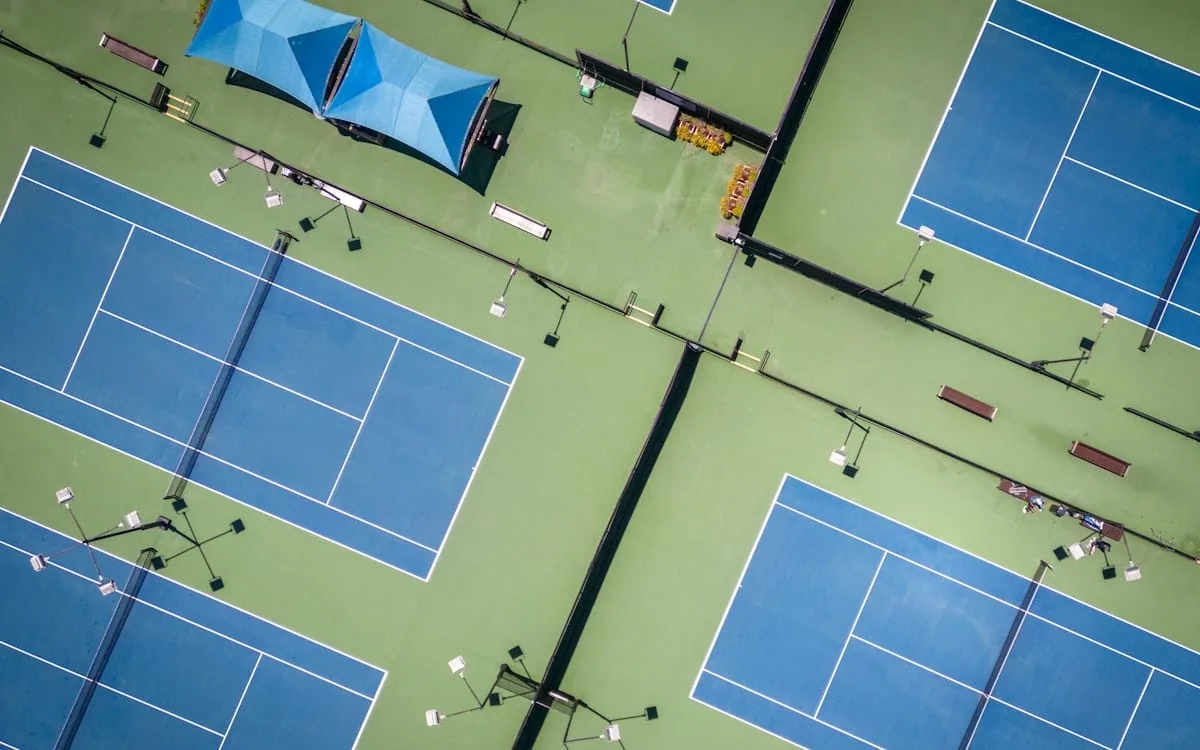
Photo: blue hard courts from above, via Unsplash.
🎾 Gear from this story
TecnifibreTecnifibre T-Fight 305Daniil Medvedev's racket of choiceView on Amazon →As an Amazon Associate, SUPER.TENNIS earns from qualifying purchases.