Tram 4 runs south out of Porta Nuova station into the fog, and for the first ten minutes you will wonder whether you have got on the wrong one.
This is not the part of Turin that ends up on postcards. The arcades thin out. The buildings get lower and browner. You pass a stretch of road that could be almost any mid-sized European city on a damp Tuesday, and then, quite suddenly, there is a great pale drum of a building on your left with floodlights on the roof and a queue of people in coats shuffling towards it, and every single one of them is holding a phone with the same screenshot on it.
You are in the right place. The tennis season ends here.
What is actually happening this week
The Nitto ATP Finals run from 15 to 22 November at the Inalpi Arena, which is the sixth time Turin has hosted the men's season-ending championship since it arrived from London in 2021. Eight singles players, eight doubles teams, two groups of four, round robin into semifinals into one Sunday final, and then the season simply stops and everybody goes home until January.
The draw ceremony is on Thursday 12 November, which splits the eight into the John McEnroe group and the Ivan Lendl group. Until that happens, nobody knows who plays whom, which is a strange and quite pleasant limbo for a tournament starting in days.
The eight are Alexander Zverev, Carlos Alcaraz, Ben Shelton, Daniil Medvedev, Flavio Cobolli, Arthur Fils, Frances Tiafoe and Rafael Jodar. Zverev goes in as top seed and the year-end world number one. Alcaraz arrives having won the Paris Masters on 8 November, beating Shelton in the final for his fifth title of the year, which is not a bad way to get on a plane to Italy. Alex de Minaur and Taylor Fritz are the reserves, which means they travel, they practise, they stay ready, and they very probably do not play.
Four of the eight have never done this before: Tiafoe, Cobolli, Fils and Jodar. That is half the field walking into the biggest indoor arena in Italy for the first time with the whole year resting on it. Jodar took the last place by 64 points over de Minaur, which is the kind of margin that keeps a person awake, and we wrote about how he got there from outside the top 150 when the field was confirmed.
If you want the mechanics of the thing, the groups, the points, the countback rules that decide who goes through when everyone finishes 2-1, our full guide to how the ATP Finals works lays it out properly. This piece is about the other half of it. The week itself. The city it happens in.
The building is an Olympic ice rink with a tennis court dropped into it
The Inalpi Arena was not built for tennis and does not really look like it was. It went up in 2005, designed by Arata Isozaki and Pier Paolo Maggiora, to host the ice hockey at the 2006 Winter Olympics, and it spent the years afterwards as the venue Turin wheeled out for arena tours and basketball. It has had three names in twenty years: Palasport Olimpico at the start, Pala Alpitour from 2014, and Inalpi Arena since a naming deal announced in January 2024. Locals still call it the Pala, in the way that people always keep using the name a building had when they were younger.
For most events it holds somewhere north of fifteen thousand. For tennis it does not, because a tennis court needs a long clean rectangle of floor and a run-back behind each baseline, so the configuration shrinks to around twelve thousand seats arranged tight around a single court.
That number matters more than it sounds. Twelve thousand people in a sealed room is a completely different experience from twelve thousand people in an open stadium. Outdoors, sound escapes upward and sideways and dissipates into the evening. Indoors it does not. It bounces off the roof and comes back down on the court, so a long rally in Turin builds a noise that an outdoor tournament simply cannot produce. When the crowd gets going in the second set of a night session, the arena does something closer to what a football ground does.
It works. The 2025 edition drew 229,879 spectators across the week, a record for the event and about nine per cent up on the year before. For a sport that spends a lot of the calendar worrying about half-full stadiums in the afternoon, that is a genuinely healthy number, and it is the main reason the ATP and the Italian federation extended the deal: Turin now has the Finals through 2027, with the event staying in Italy through 2030 and the host city after 2027 still to be settled. There has been talk of moving it elsewhere in the country. Nothing is decided.
If the whole idea of tennis under a roof in November still feels slightly wrong to you, we made the case for why the indoor swing is the most underrated part of the season earlier this autumn. Short version: the ball moves faster, the conditions never change, and the players cannot blame the weather.
Getting there, and why tram 4 is the answer
The arena sits at Corso Sebastopoli 123, in Santa Rita, a residential district in the south of the city next to the Stadio Olimpico. It is not in the centre and it is not near anything you would otherwise visit, which catches people out.
Tram 4 is the one you want. It runs from Porta Nuova, the main station in the middle of town, more or less straight down to the arena in about twenty minutes. If you have come in on a Frecciarossa from Milan or Rome you will probably arrive at Porta Susa instead, and tram 10 connects that side of the city to the same area.
The metro is the trap. Turin has exactly one metro line, and it does not stop at the arena. Carducci-Molinette is the nearest station and it is still a bus ride or a determined twenty-minute walk away in the cold. Plenty of first-timers work out the metro, feel clever about it, and then spend the last section of the journey regretting their shoes.
In recent years ticket holders have been able to travel free on match days on the relevant tram lines, which is a civilised touch, but check the current terms when you buy rather than assuming. Driving is not worth it. Park at the hotel, take the tram, and spend the saved energy on the walk back to the stop afterwards with eleven thousand other people.
The shape of a day
There are two sessions a day and you should understand what you are buying. Each session is one doubles match and one singles match, which means a day ticket and a night ticket get you broadly the same amount of tennis. The day session starts late morning; the night session starts in the evening and can run very late if the singles goes three sets, which in a group of eight players who are all top-ten good, it frequently does.
Tickets are not cheap. At the time of writing the official site has day-session seats for the opening Sunday ranging from roughly 255 euros up to about 392 euros for parterre, the seats down at floor level. Night sessions on resale sites have been going for rather less, around 145 to 150 euros, although resale prices move daily and are their own adventure.
If that is beyond what you want to spend on one afternoon of tennis, there are two cheaper ways into the week that most people never look at. Practice-session tickets go for something like 15 to 45 euros, and they get you into the building to watch eight of the best players in the world hit for an hour with nobody keeping score, which if you have never done it is an oddly intimate thing. And Fan Village access runs around 15 to 30 euros, which buys you the surrounding circus rather than the arena.
The practice courts are the insider pick. You stand close enough to hear the ball. There is no scoreboard to look at, so you watch the actual tennis instead, and you start to notice the things that the broadcast never shows you: how long a player spends on one shot, who talks to their coach and who refuses to, how much of this job is repetition.
Between sessions, the city does the rest
This is what makes Turin a better tennis trip than its reputation suggests. You have a morning and most of an afternoon free every day, in a city that almost nobody visits.
Turin spent centuries as a royal capital and it looks like one. It is laid out in long straight lines with miles of arcades along the main streets, which in November is not an architectural detail, it is shelter. You can cross a good portion of the centre in the rain without getting wet.
The Mole Antonelliana is the thing you can see from everywhere, a tall improbable spire that was started as a synagogue in 1863 and ended up as the National Cinema Museum. The museum is genuinely good, built up through the inside of the building so you spiral around film history, and there is a panoramic lift that runs up to the top for a view over the rooftops to the Alps, which on a clear day is the single best twenty euros in the city.
The Egyptian Museum is the other one, and it is not a provincial curiosity. It is one of the most important collections of Egyptian material anywhere outside Cairo, and people routinely give it half an hour and end up giving it three.
Then there is the eating, which is the real argument for Turin. This is the home of the bicerin, a layered drink of espresso, drinking chocolate and cream served in a small glass, and you can have one at Caffe Al Bicerin, which has been serving them since 1763. It is not a coffee. It is a small warm event. Turin also has a serious claim on vermouth, it invented gianduiotto, the little gold-wrapped hazelnut chocolate, and it takes aperitivo more seriously than almost anywhere in Italy, which in practice means that a drink in the early evening comes with enough food attached that you may quietly cancel dinner.
For a market morning, Porta Palazzo is one of the largest open-air markets in Europe and it is a proper working one, not a tourist set. Go early. Much of it packs up around two in the afternoon on weekdays, with Saturday the full day. In the evening, San Salvario is where the city goes out.
Nothing on that list requires a tennis ticket. All of it fits in the hours between sessions.
It will be cold, and the light will go early
Turin in November is not a warm city and you should pack accordingly. Daytime highs sit somewhere around ten to thirteen degrees, nights drop to three to five, and the Po valley produces real fog, especially in the mornings. You get around nine or ten hours of daylight and only about four hours of actual sunshine a day on average.
So the rhythm of the week is this: you wake up to a grey city you cannot see across, you spend a cold bright afternoon walking under the arcades, the light goes at about half past four, and then you get on a tram in the dark towards a building full of light and noise. There is something about that sequence that makes the tennis feel more like an occasion than it does in the Australian summer. You have earned the warmth by the time you sit down.
And on the clear days, which do happen, you come up out of a side street and there are the Alps sitting at the end of the road, white and absurdly close, looking like someone has propped up a painting at the end of the boulevard.
The hole where the champion should be
There is one thing this week is missing, and everyone in Turin knows it.
Jannik Sinner is not playing. The two-time defending champion, who won this title in 2024 and 2025 in front of his own crowd, ended his season in the autumn with inflammation in his knee and has not competed since he won Wimbledon in July. Speaking in Milan on 10 November, he said he hopes to be back for the Australian Open in 2027 and that he will not rush it. His absence is also, indirectly, why Jodar is here at all: the points Sinner did not defend left the eighth place open.
It is impossible to overstate what Sinner meant to this event in this city. An Italian winning the season-ending championship in Italy, twice, is the sort of thing that converts a sports event into a civic occasion. Ticket demand for 2026 wobbled when his withdrawal was confirmed, and that is not a criticism of anybody. It is just what happens when the local hero misses the home tournament.
But a sports town is only really a sports town once it turns up for a week that it has no personal stake in. Turin still has Cobolli, who made it here off the back of a run through Lyon, Vienna and Paris, and the Italian crowd will adopt him completely within about four games. It has Alcaraz in the form of his life. It has four debutants who will remember this week for the rest of their careers whatever happens. And it has an arena that has sold itself out on atmosphere for five years running.
The week does not need a national champion to be worth getting on a tram for. It would just be nicer with one.
If you are watching from the sofa instead
Most of us are, and that is fine. The whole point of the indoor season is that it comes to you at a reasonable hour in the northern hemisphere, in good light, with no rain delays and no three-hour gaps where somebody mops a court. If you want to make a proper evening of the last fortnight of the year, we put together a plan for watching the whole November run from home, tournament by tournament.
You can even do the Turin part of it properly. Make something with hazelnuts in it. Find a vermouth. Put the lamps on low so the room looks like the arena. It is ridiculous and it absolutely works.
One Sunday, and then nothing
What makes this week strange, and what you can feel in the building, is that there is no next week. No draw to look ahead to, no points to defend on Monday, no flight to the next city. Someone lifts a trophy on the evening of 22 November and then the professional tennis season, the whole enormous eleven-month machine of it, simply switches off.
Turin gets to be the place where that happens. For seven days a slightly overlooked industrial city in the north of Italy is the centre of the sport, and then the lights go off in Santa Rita and the trams go back to carrying people home from work.
If you have ever thought about going to a tennis tournament and been put off by the heat, the queues and the two-week commitment of a Grand Slam, this is the one. Eight players, one court, seven days, a tram ride, and a city that will feed you extremely well in between. Book it for next year. Bring a coat.
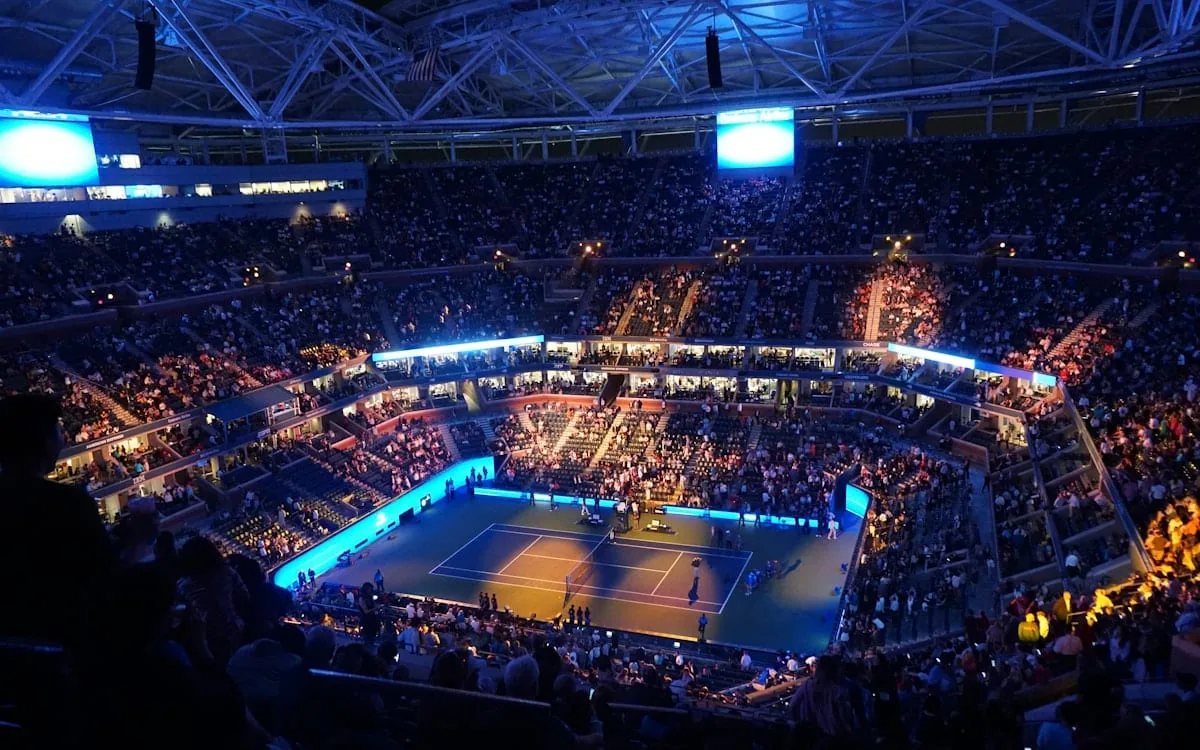
Photo: a packed indoor arena at night with the court lit under floodlights, from our picture library.
🎾 Gear from this story
BabolatBabolat Pure AeroCarlos Alcaraz's racket of choiceView on Amazon →As an Amazon Associate, SUPER.TENNIS earns from qualifying purchases.