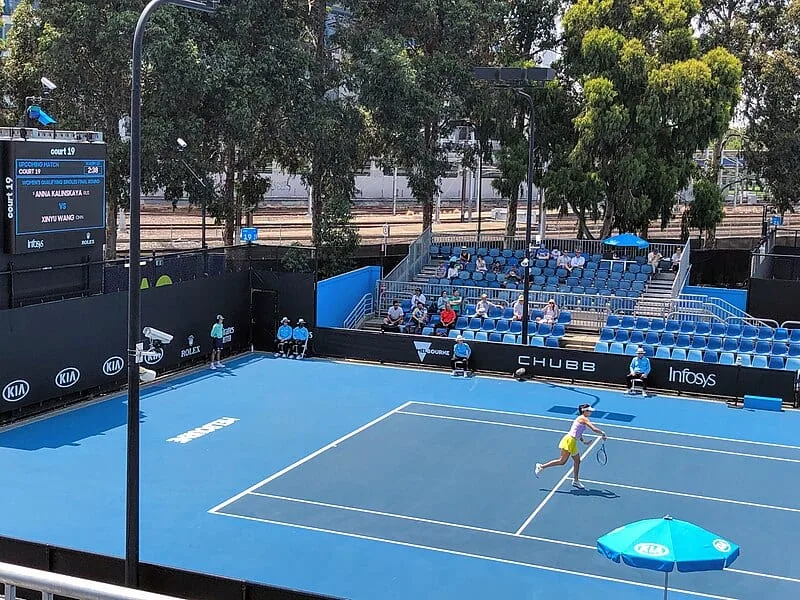
Alexander Zverev saved four match points in his opening match in Vienna this week, against a wild card most of the crowd could not have picked out of a line-up, and if he had lost any one of them the world rankings would look different on Monday morning.
He did not lose them. He came through 7-5, 3-6, 7-6(11), which is the kind of scoreline that tells you almost everything: two hours and change of a man ranked at the very top of the game being dragged somewhere he did not want to go, in a building in the middle of a European city, in the last week of October, in front of people who had come straight from work.
That building is the Wiener Stadthalle. The tournament is the Erste Bank Open. It has been going since 1974, it is one of the best rooms in tennis, and if you have never deliberately sought it out, this is the week to fix that.
A concert hall that becomes a tennis stadium
What makes Vienna sound the way it does is architectural rather than sporting.
The Stadthalle was not built for tennis. It was built between 1953 and 1958 to a design by the Austrian architect Roland Rainer, and its main room, Hall D, opened on 21 June 1958. It is a general-purpose arena, the sort of place that hosts concerts and ice shows and exhibitions, and in its standard configuration it holds somewhere around 10,700 seats, with room for roughly sixteen thousand people when it is laid out for music.
For one week a year, a tennis court goes down in the middle of it.
This matters more than it sounds. A purpose-built tennis stadium is designed around sightlines to a rectangle of court, which tends to mean a bowl that opens upward and outward, with a lot of air above the players. Sound goes up and escapes. A multi-purpose hall is designed around a stage, which means a lower, tighter, more enclosed room with a roof that holds noise in rather than letting it out.
So Vienna is loud. Not loud in the way a full Arthur Ashe is loud, where twenty-three thousand people make a wash of sound that arrives like weather. Loud in a closer, more personal way, where you can hear individual voices, where a single shout after a missed first serve carries, where the applause has edges to it. Players talk about the atmosphere here constantly and it is not just politeness. The room is doing something.
Add the fact that it is dark outside by late afternoon in Vienna at the end of October, and that everybody arrives indoors out of the cold, and you get an event with the texture of a night out rather than a day at the sport. That is a genuinely different thing from a summer tournament, and it is most of why the indoor swing has the devoted following it has. If you want more on how the calendar turns at this point in the year, we have written about what happens to the season after the US Open.
What the roof does to the tennis
If you mostly watch the Grand Slams, indoor tennis can take a few games to tune into, because the sport genuinely behaves differently under a roof.
There is no wind, no sun to serve into, no shifting shade across the baseline, and no humidity swinging from one session to the next. Every variable that makes outdoor tennis slightly unpredictable has been removed. What is left is a pure test: the conditions on Thursday night are identical to the conditions on Sunday afternoon, and the only thing that changes is the two people on court.
The practical effect is that the ball travels faster and sits lower. Cold, dry, still air offers less resistance, and indoor hard courts are generally laid a little quicker than their outdoor equivalents. Serves get rewarded. Flat hitters get rewarded. Players who grind from six feet behind the baseline and win by attrition find that the rallies they need simply are not available, because the point is over before they have built it.
This is why the indoor season produces results that look strange next to the summer. Big servers go deep. Players who have had an anonymous year suddenly win four matches. And the very best players, the ones whose game does not depend on any particular set of conditions, tend to be even harder to beat than usual, because there is nothing left in the environment to trip them up.
Watch for how early the returner stands. Indoors, that tells you most of what you need to know about how a match is going.
Fifty-two years, and a lot of letterheads
The tournament dates to 1974. Its first singles champion was Vitas Gerulaitis, which already tells you how long ago that was: Gerulaitis was a player of the wooden-racket era, all hair and front-foot aggression, and he won here before most of this year's draw had parents old enough to vote.
In the five decades since, the event has changed its name more times than anyone can be bothered to count. Tournaments outside the Grand Slams live and die on sponsorship, and a title sponsor is a tenancy, not a marriage. What is now the Erste Bank Open took that name in 2011, when the Austrian bank put its name above the door, and the fact that the arrangement has lasted fifteen years is quietly remarkable in a sport where backers come and go every few seasons.
The record for most singles titles belongs to Brian Gottfried, the American, with four. That is a name that means very little to anyone who started watching after about 1990, and that is rather the point of a tournament this old. It accumulates. The honours board in Vienna runs from players your grandparents argued about to players who were not born when the euro was introduced, and the list is continuous the whole way down.
More recently the roll reads like a who-is-who of the current era. Zverev won it in 2021. Daniil Medvedev took the 2022 title, beating Denis Shapovalov 4-6, 6-3, 6-2. Jannik Sinner won in 2023, edging Medvedev 7-6(7), 4-6, 6-3 in a final that went about as long as a final can. Jack Draper won in 2024, beating Karen Khachanov 6-4, 7-5. And Sinner came back and won it again in 2025, beating Zverev 3-6, 6-3, 7-5.
Four different champions in five years, three of them now permanent fixtures at the top of the game. For an event that is not a Masters 1000 and never has been, that is a serious strike rate.
The Austrians
Every tournament outside the big four wants a home champion, and most of them wait a very long time.
Vienna has had three. Horst Skoff won in 1988. Jurgen Melzer won back-to-back in 2009 and 2010, which remains the only time an Austrian has defended the title. And then Dominic Thiem won it in 2019, at the absolute peak of a career that would produce a US Open title the following year.
Three home winners in fifty-two editions. Put like that it sounds thin, and it is, but it is also roughly par. Home players are usually not the best players, and a 500-level event draws a field good enough that sentiment does not get you far. What those three nights bought, though, was a kind of permanent credit. Austrian tennis is a small operation by the standards of Spain or Italy or the United States, and it has produced exactly enough to keep a national audience genuinely invested. The current generation is carrying that on: we wrote earlier this year about Lilli Tagger and the one-handed backhand that got Austria talking again.
The goodbye that Vienna actually got
If you want to understand what this tournament means to the people who go, the story is October 2024.
Thiem had announced he was finishing. His body had never properly recovered from a wrist injury sustained in 2021, and the last few seasons had been a slow, public, rather painful unwinding of a player who had once pushed Rafael Nadal and Novak Djokovic to the limit on their best surfaces. He chose Vienna for the end, which was the only place it could have been.
On Sunday 20 October the tournament staged a farewell exhibition: Thiem against Zverev, a rematch of the 2020 US Open final, the match Thiem had won. More than five thousand people came in for it. Boris Becker was there. Tommy Haas was there. Thiem won the exhibition set 6-3, which is exactly what should happen at an occasion like that and does not always.
Two days later he played his actual last professional match, on the same court, and lost to Luciano Darderi 7-6(6), 6-2. No fairytale. A tight first set he could not quite close, and then the thing simply ended, the way careers usually do rather than the way we would script them. The hall gave him a standing ovation, the fans had prepared a choreography, and the racket he used is now in a display case in the building.
That is a very Vienna sequence of events: the party first, held properly and with everybody present, and then the real thing two days later, unsentimental and slightly cruel. Farewells rarely go to plan. We have been following several of them this autumn, including Gael Monfils and his last six weeks on tour.
Why Vienna and Basel are always elbowing each other
Here is the oddity of this week that nobody ever quite fixes: there are two ATP 500 tournaments running at the same time, in two European cities, four hundred miles apart.
Vienna and the Swiss Indoors in Basel both run from 26 October to 1 November. Both are indoor hard courts. Both are 500s, which is the level directly below a Masters 1000. Both have a long history, a loyal city and a serious budget. And both are chasing the same thirty or so players who are fit, in form, and have not already gone home.
The result is an annual split. The top of the game divides itself between the two, each tournament ends up with a genuinely strong half-field rather than one event having everybody, and both of them spend the autumn quietly competing for commitments. From a fan's point of view this is actually rather good: two strong indoor tournaments in one week gives you tennis on television from late morning until late at night, in overlapping European time zones, for seven straight days.
From a scheduling point of view it is a historical accident that has calcified. The calendar has very little give in it at this point in the season. Paris follows immediately. The Tour Finals in Turin follow that. Nobody is going to volunteer to move, because the week you have is the week you own.
What is actually at stake in Vienna right now
This year the week arrived with an unusually sharp edge to it.
Sinner, the defending champion and the man who has won two of the last three titles here, withdrew before the event with a knee injury. That takes the obvious favourite out and, more importantly, it loosens his grip on the top of the rankings.
Zverev came in as the top seed with a very specific piece of arithmetic in front of him: reach the quarter-finals in Vienna and he is guaranteed to become world number one on 2 November, for the first time in his career. Not at some point if results fall right over the next month. Guaranteed, on that date, by winning two matches.
Which is what made that opening match against wild card Martin Landaluce such strange viewing. Four match points. A man two wins from the top of the sport, in a hall where he has already won a title, being asked by a player with nothing whatsoever to lose whether he actually wanted it. He survived, in a third-set tiebreak that went to 13-11. Two wins from the thing he has been chasing since he was a teenager, and he spent an hour and a half of it a single point from going home.
Carlos Alcaraz is in the other half, seeded second and playing on a wild card, having entered late. He beat Khachanov 6-4, 7-6(5) in his opener, a match he afterwards admitted he was not entirely sure how he had won. Alcaraz has never won Vienna. For a player who has collected almost everything else, an indoor 500 in a packed European hall in late autumn is an oddly conspicuous gap.
So: the defending champion absent, the top seed two wins from the summit and already nearly out, and the most watchable player in the game in the opposite half, indoors, in a room that amplifies everything. That is a good week.
If you are watching from somewhere else
A few practical things, because this is a tournament that rewards a bit of planning.
Vienna is on Central European Time. Day sessions start late morning, the night session runs into the late evening, and the whole thing is built around people finishing work and coming in. If you are in the UK you are an hour behind, which makes the evening matches comfortable viewing. If you are on the east coast of the United States, the night session is your afternoon, which is unusually civilised compared with the Asian swing most of this month.
The final is on Sunday 1 November. Then everybody gets on a plane to Paris, where the last Masters 1000 of the season begins, and the arithmetic for the eight places in Turin gets finalised in a hurry.
And if the week leaves you wanting to actually go to one of these, Vienna belongs on a very short list of cities where you can build a trip around a tournament without the tennis having to carry the whole thing. It is a tram ride from the Stadthalle to most of the things people come to Vienna for anyway. We put together a guide to the best cities for watching live tennis if you want to think about next autumn.
The engraving
There is a detail in the Thiem story that has stayed with me since I read about it, and it is the display case.
A tournament kept the racket. Not a museum, not a sponsor, not a private collector who paid for it at auction. The building where he played his last match put the thing he played it with behind glass, in the corridor, where people walk past it on their way to their seats carrying a beer.
That is what a tournament is, after fifty-two years. It is not the prize money or the ranking points or the broadcast deal, all of which change. It is a room in a city that has been paying attention for long enough to know what is worth keeping. Somebody will win here on Sunday and get their name added to a list that starts with Gerulaitis and runs through Gottfried and Skoff and Melzer and Thiem and Zverev and Medvedev and Sinner and Draper, and in forty years somebody will read that name and have no idea who it was.
The list will still be there. That is the deal Vienna has been quietly making with its tennis players since 1974, and it is a better one than most.
Photo: a hard court surface and service line in close detail, from our picture library.
🎾 Gear from this story
HeadHead Extreme TourAlexander Zverev's racket of choiceView on Amazon →As an Amazon Associate, SUPER.TENNIS earns from qualifying purchases.