Five matches, ten sets, and not one of them lost. That is how a nineteen-year-old closed the 2026 women's season on Sunday in the California desert, and if you only switch the tennis on when something big is happening, you picked a very good week to look away and a very bad one.
Mirra Andreeva won the WTA Finals at the first time of asking. She beat Elina Svitolina 7-5, 6-3 in the final at Indian Wells, in an hour and 48 minutes, having already beaten Svitolina once that week, and Aryna Sabalenka, and Diana Shnaider, and Jessica Pegula. The eight best players of the year went to the desert. One of them went home having never been two sets from the exit, never even one set down.
She is nineteen. She has a Grand Slam title from five months ago. And she spent the middle of the week being discussed on an open microphone by an opponent she then beat in a semi-final. There is a great deal going on here, and almost none of it asks you to understand a backhand to enjoy.
What the week actually looked like
The year-end championships are not a normal tournament. There is no draw to survive, no qualifying, no 128 players grinding through a fortnight. Eight women, two groups of four, everybody plays everybody in their group, top two go through. If you want the full mechanics of countback and who-beat-whom, we laid the format out in the round robin explainer — it is the same shape the men are using in Turin this week.
What it means in practice is that there is nowhere to hide. You cannot have a scratchy opening match and then find your game against a qualifier. Every opponent is a top-eight player, and by the time you reach the semi-finals you have already played three of them.
Group one had Coco Gauff, Jessica Pegula, Linda Noskova and Marta Kostyuk, who was only there because Elena Rybakina fell ill and withdrew before a ball was hit. Group two had Sabalenka, Andreeva, Svitolina and Karolina Muchova, who also got ill and pulled out before her last match, which is how Shnaider ended up playing a dead rubber against the best player in the building. It was that sort of week in the desert: dry air, cold nights, a lot of coughing in the player lounge.
Andreeva's three group matches read like a misprint. Svitolina, 6-4, 6-0. Sabalenka, 6-4, 6-0. Shnaider, 6-2, 6-1. The Sabalenka match is the one to go and find, because it did not start the way it finished. Andreeva was 1-4 down in the first set to a woman who has spent most of three years at or near the summit of the rankings, and then won 20 of the next 23 points. Twenty of twenty-three. Against Sabalenka. By the end of it the group was decided and most of the building had worked out what it was watching.
The semi-final, on Saturday 14 November, was Pegula. Andreeva won it 6-3, 6-4. Then the final on Sunday against Svitolina, who had taken Noskova apart 6-2, 6-1 in the other semi and who arrived in the title match with a story of her own.
The numbers from that semi-final explain the week better than any adjective can. Andreeva won roughly three-quarters of the points behind her first serve. Pegula, who has built an entire career on returning well enough to drag opponents into long, uncomfortable rallies, made headway in only about a fifth of the games she received. There was no drama in it and barely a wobble. The match that had been billed all week as the one with needle in it turned out to be the most straightforward afternoon of the tournament.
Add it up: ten sets played, ten sets won. The last player to win this event on debut was Ashleigh Barty in 2019. The last champion younger than Andreeva was Maria Sharapova, in 2004, three years before Andreeva was born. Statisticians spent Sunday night putting her name alongside Chris Evert and Serena Williams on the very short list of players who took the year-end title at the first attempt without losing a set.
The microphone
The thing you will have seen clipped and reposted, if you saw anything from the desert at all, had nothing to do with the tennis.
Earlier in the week, Pegula was on a practice court. The WTA had microphones on those courts so that fans could listen in on a livestream. Nobody had made that clear to the players. Pegula, talking the way players talk among themselves when they assume nobody is listening, said Andreeva was a bit of a diva and needed to be humbled, and added that she had lost some respect for Conchita Martinez, Andreeva's coach, over the way she handles her player.
It was everywhere within the hour. The WTA apologised, taking what it called full responsibility for failing to tell players and their teams that the practice microphones were live. Pegula, by several accounts, went to Andreeva and Martinez directly rather than leaving it to a press conference.
Here is the part worth sitting with, because the clips cut it out. In the same conversation, Pegula was unusually generous about the tennis: she rated Andreeva's movement, her physical qualities and her court intelligence extremely highly, and reached for a comparison with Coco Gauff to describe what she was looking at. Her reservation was about temperament, not talent. Stripped of the sharp words, it was a professional assessment, and a flattering one.
Andreeva, asked about it, did not escalate. She defended her coach in the plainest terms available — that work is simply what Conchita does, all day, every day, and that this is how you would define her. Martinez, the 1994 Wimbledon champion and a former world No. 2 herself, has coached Andreeva since April 2024, through the entire climb from promising teenager to this.
And then the draw did what draws sometimes do, and put the two of them in the same semi-final 48 hours later. Andreeva won in straight sets. She said nothing pointed afterwards. She did not need to; a scoreboard is a more efficient reply than any press conference, and she appeared to know it.
The girl who went second
Andreeva is nineteen, born in 2007, and she is the second tennis player in her family rather than the first. Her mother enrolled her older sister Erika in the sport before Mirra started, and Mirra followed her into it at six years old, at a club in Krasnoyarsk — a Siberian city a very long way from anywhere anyone would call a tennis capital. Erika plays professionally too. If you have ever had an older sibling do something first and then spent your childhood chasing them down a corridor, you already understand the engine in this story.
She lives and trains in Cannes now, which is where a great deal of the French coaching world has set up, and which goes some way to explaining the flavour of her tennis: patient, heavy off the ground, happy to build a point over nine shots rather than end it in two.
What makes her worth an evening of your time is not the forehand, although the forehand is excellent. It is that she plays with her entire face. You always know exactly what she thinks about a point. When something goes wrong you know about it. When she pulls off something absurd — and she does, several times a match, usually on the run — she turns to her box and the delight is completely unguarded. There is no professional mask yet. Watching her is closer to watching a brilliant junior who wandered into the main draw by accident and then decided to stay.
That openness is presumably also what sits behind the diva line. Players who show everything get read as difficult. Players who show nothing get called ice-cold and are admired for it. It is not a fair trade, and nineteen-year-olds rarely get much credit for being nineteen.
The season behind the trophy
A year-end title can look as though it arrived out of nowhere. This one did not.
In January she won Adelaide, beating Victoria Mboko 6-3, 6-1. In April she won Linz, coming back from a set down against Anastasia Potapova to win 1-6, 6-4, 6-3. She lost the Madrid final to Marta Kostyuk — the Ukrainian having one of those seasons that carried her into the top 10 and kept her there, and that eventually got her into this field when Rybakina withdrew.
Then, in June, Roland Garros. Andreeva won the French Open at eighteen, beating the Polish qualifier Maja Chwalinska 6-3, 6-2 in a final that nobody had on their card in May. She dropped one set in seven matches on the way. She became the youngest women's champion in Paris since Monica Seles in 1992. Chwalinska, ranked outside the top 100 when that fortnight began, had an extraordinary autumn of her own afterwards, which we wrote about when she and Sonay Kartal produced the unlikeliest WTA 1000 final of the year in Wuhan.
So: Adelaide, Linz, Roland Garros, and now the WTA Finals. Four titles in a season, seven in a career that is barely three years old at tour level, and a major and a year-end championship among them before her twentieth birthday.
She arrived in the desert ranked No. 3, a career best she had only reached in October. The live rankings had her moving past Sabalenka during the week, which means she goes into the off-season at a new career high. Above her, unmoved by any of it, sits Rybakina, who sealed the year-end No. 1 ranking in Tokyo weeks before the Finals began and then had to watch this one from a sickbed. Two different achievements, two completely different shapes of season, both settled inside a fortnight.
The other side of the net
It would be unfair to write about Sunday without Svitolina, because hers was the better story right up until the last hour of it.
She is 32. She is a mother. She had not played this event since 2019, and getting back to it required a return from pregnancy, a long rebuild of her ranking and a season of results that most people had quietly stopped expecting. We wrote about that return when the field was announced, in the piece on her coming back after seven years, and it is worth remembering that she arrived in California saying she did not expect to reach the final.
She was beaten 6-4, 6-0 by Andreeva in the group and found a way back through the week anyway, then dismantled Noskova in the semi. In the final she went with her for eleven games. At 5-5 in the first set the match was genuinely open. Then Andreeva took the last two games of it, and in the second set, after trailing 2-1, won five of the final six games. That is how these things tend to end against her: not with a collapse, just with a gradual, unanswerable tightening of the screw.
The trophy ceremony produced its own small fuss. Andreeva, winner's microphone in hand, congratulated Svitolina and her team for the week, said out loud how hard it is to lose a final, and made a point of what it takes to come back and do this as a mother. The cameras found Svitolina on her bench, nodding. Svitolina, speaking afterwards, thanked the crowd, her team and Ukraine, talked about her daughter, and did not mention Andreeva — which parts of the internet decided was a snub, and which was more plausibly a consequence of the format, since the runner-up was being interviewed on court rather than giving a speech, and was never asked a question about her opponent.
If you watched it live you probably thought nothing of it. If you watched it on a phone eight hours later under a caption telling you to be outraged, you probably did. That gap is modern sport in one paragraph, and it is worth knowing which side of it you are standing on.
The desert, the money, the move
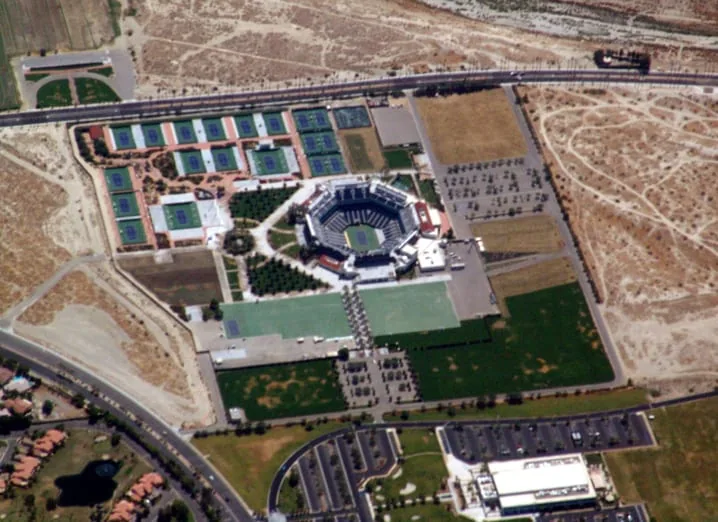
This was the first year the WTA Finals had been held at Indian Wells. The event has been a travelling circus for a decade — Singapore, Shenzhen, Guadalajara, Fort Worth, Cancun, Riyadh — and moving it to the Tennis Garden in the Coachella Valley gave it something it had been missing: a stadium that already belongs to tennis, a crowd that already knows the sport, and a site that looks genuinely extraordinary from the air, a grid of blue courts dropped into bare desert with mountains standing over three sides of it.
The total purse was 10 million dollars, down by roughly a third on the previous edition in Riyadh. That is its own quiet story and one that will keep running into next season, because prize money at this event has become a proxy for a larger argument about where the women's tour should play its biggest week. Nobody at the trophy ceremony mentioned it. They rarely do.
What the venue gave the tennis was late-afternoon light, cold evenings and a crowd close enough to the court that you could pick out individual voices on the broadcast. For a tournament that has spent ten years looking for a home, this looked a lot like one.
What you actually saw
If you are the sort of tennis watcher this site is written for — someone who loves the sport and has no intention of ever playing it — here is the short version of what happened in California.
A teenager who had never played the year-end championships turned up, beat the world No. 2, a resurgent 32-year-old mother on her comeback, and the most consistent American of the past five years, and did not lose a single set doing it. She was publicly criticised mid-tournament by one of those opponents, said almost nothing about it, and then beat her. She finished the year with four titles, a French Open, and a new career high ranking.
She also spent most of the week looking like somebody having the time of her life, which, given everything else that was going on around her, is the detail that will stay with me longest.
The 2027 season starts in Australia in about seven weeks, and Andreeva will most likely begin it in Adelaide, where this whole run began in January — except that she will walk in this time as the player who finished the previous year unbeaten at the one event where every opponent is excellent. That is a very different weight to carry into a first-round match on a hot Tuesday. Whether a nineteen-year-old who hides nothing can carry it lightly is the most interesting question the women's tour has to answer in 2027.
🎾 Gear from this story
BabolatBabolat Pure DriveMirra Andreeva's racket of choiceView on Amazon →As an Amazon Associate, SUPER.TENNIS earns from qualifying purchases.